PhonePe is going back to the market. Banking sources cited by IANS say the Walmart-controlled payments company is preparing to restart its IPO and is targeting a listing valuation of ₹1.2 lakh crore to ₹1.5 lakh crore, though the company has not commented. The easy read is a comeback story. In March 2026 the company paused the listing, after bankers had suggested cutting its valuation expectations to about $9 billion, a link PhonePe rejected. Eight months later, the window looks open again.
It is worth slowing down on that. PhonePe's value rests on one asset, its lead in UPI, and two rules decide what that lead is worth. One is a merchant fee that would finally let UPI volume earn money. The other is a cap that would stop the lead from growing. As of today, the fee has no start date and the cap is due in five weeks.
The rule with a date on it
In November 2020 NPCI, which runs UPI, proposed a 30 percent cap on the share of UPI transactions any single app could process. It has never been enforced. NPCI's January 2025 decision pushed the deadline to 31 December 2026, and it was the third extension.
PhonePe is far over the line. In September 2026 it processed 10.91 billion transactions, a 45.57 percent share of the 23.93 billion that went through NPCI-listed apps, according to MediaNama's reading of NPCI data. Google Pay held 32.23 percent, and Paytm, a distant third, handled 1.94 billion transactions, or 8.1 percent.
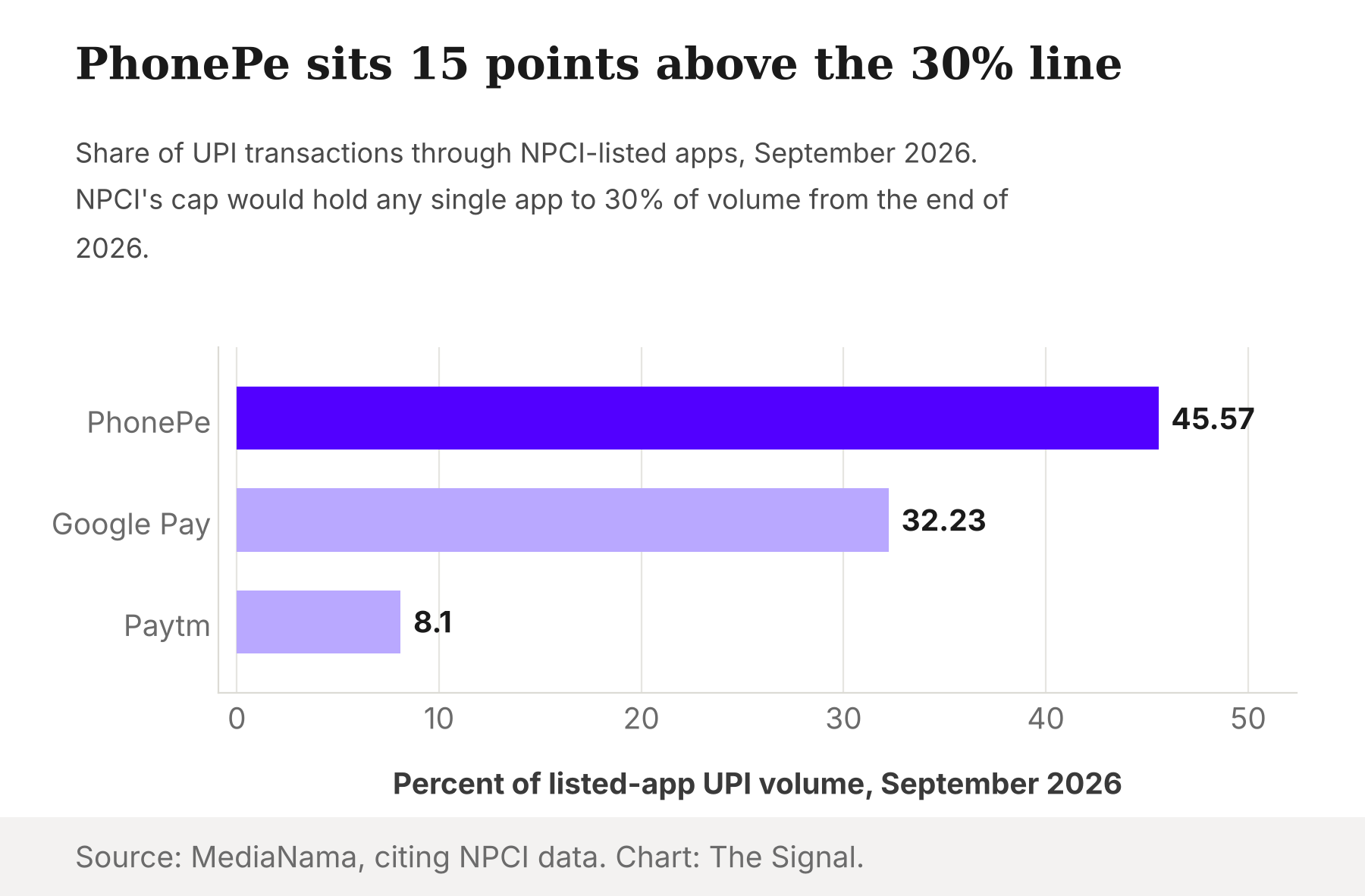
Put the two numbers together and the gap becomes concrete. At September's volume of 23.93 billion listed-app transactions, a 30 percent ceiling works out to about 7.18 billion. PhonePe was roughly 3.73 billion over it in a single month. That excess is nearly twice everything Paytm processed in the same month. Google Pay was over too, but only by about 0.53 billion.
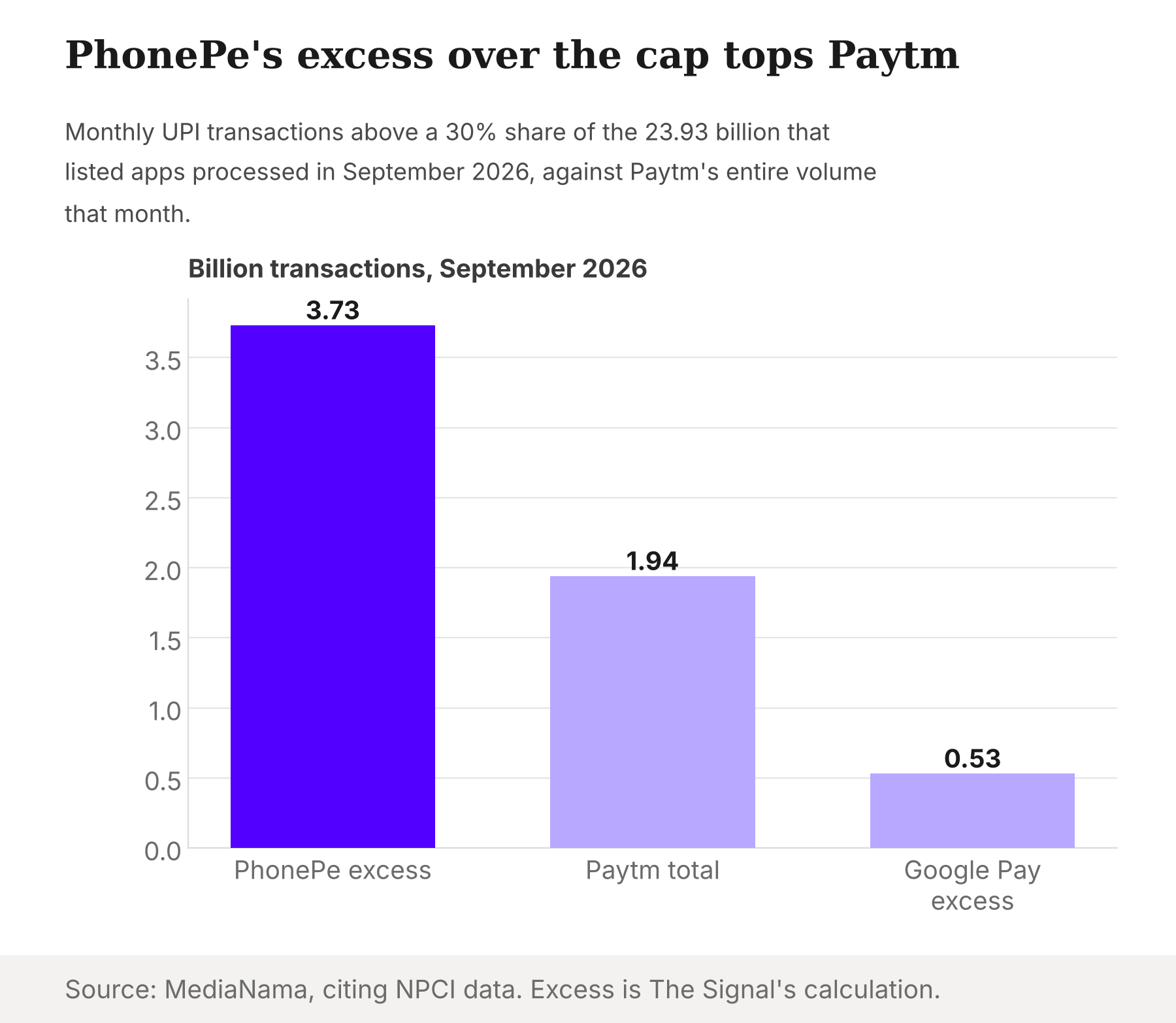
One caution on precision. The cap is measured as a rolling three-month share of all UPI volume, not one month of listed-app volume, so September is a guide to the size of the gap rather than a compliance verdict. PhonePe's own prospectus gives a similar figure: its UPI volume share was 46.85 percent as of September 30, 2025.
The company has already priced the risk in words
PhonePe's updated draft prospectus, filed with SEBI in January 2026, treats the cap as a risk factor. It says enforcement may only stop it from onboarding new users, leaving existing users alone. It also says there is no assurance further extensions will be granted, and that enforcement would likely hurt its efforts to win new customers.
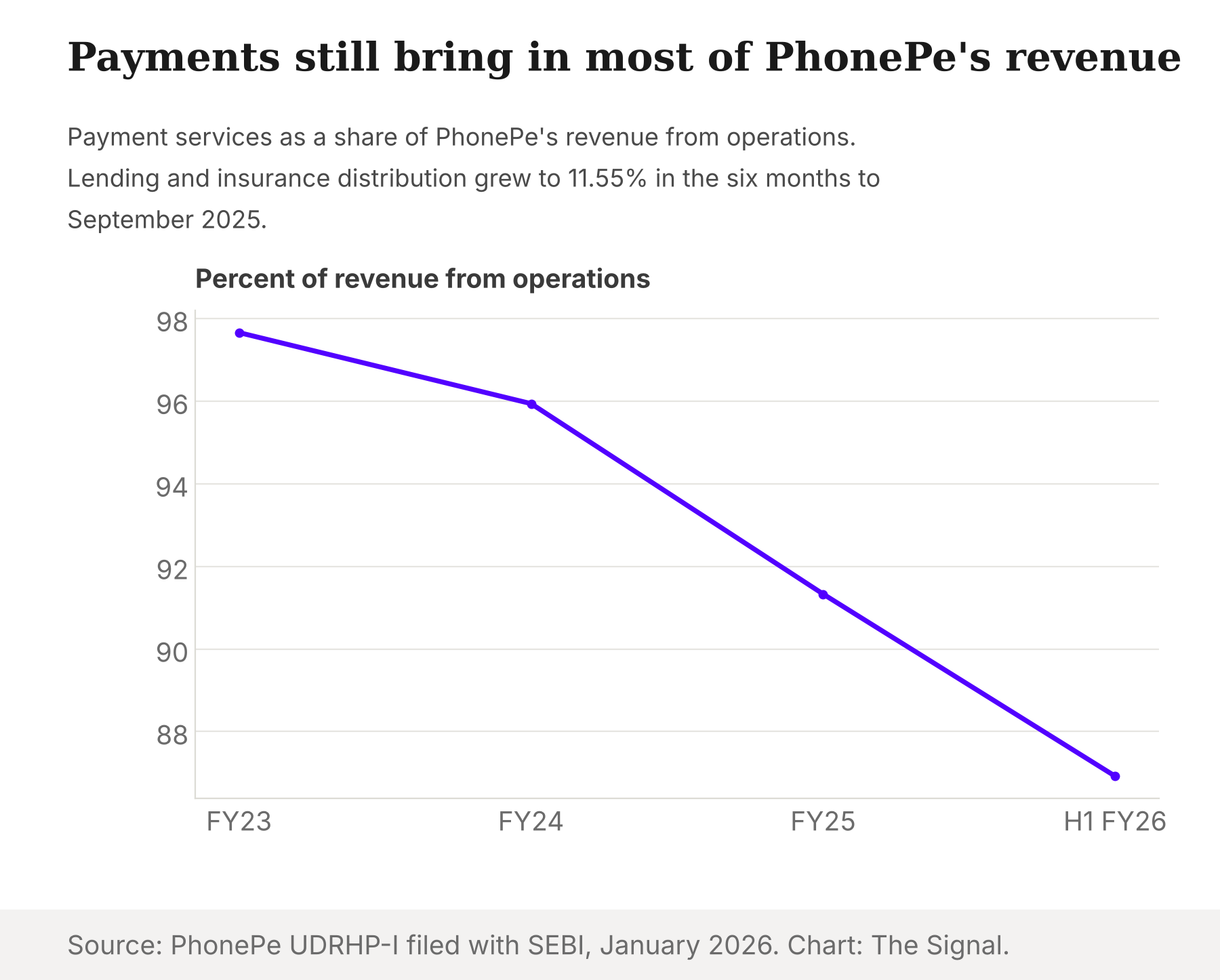
That matters because PhonePe is still, overwhelmingly, a payments business. Payment services made up 86.92 percent of its revenue from operations in the six months to September 2025, down from 97.66 percent in FY23. Lending and insurance distribution, the businesses meant to monetise all those users, rose to 11.55 percent from 6.76 percent a year earlier. A cap on onboarding is a cap on the funnel that feeds them.
The rule that would pay, and has no date
The second rule runs the other way. In September 2026 the Finance Ministry set out a 0.4 percent merchant discount rate on merchant UPI payments above ₹2,000, capped at ₹300 for payments of ₹75,000 and above. It was due from 15 October 2026. Payments of ₹2,000 or less, which the ministry says make up more than 95 percent of merchant UPI volume, stay free.
The ministry's case for the fee reads almost like a comment on PhonePe's position. It argues that under zero-MDR conditions, only well-capitalised tech conglomerates can afford to sustain long-term losses, and that a fee would let smaller apps compete. Read that way, the fee is another tool against concentration, with the market doing the work instead of a ceiling.
Then the fee slipped. On 13 October 2026 NPCI's steering committee said the charge would be implemented immediately after Diwali, on a date to be notified separately. As of 23 November 2026, the MDR still had no fresh start date, according to Elets BFSI.
What the valuation is pricing
The numbers PhonePe would list on are those of a fast-growing company that still loses money. Its operating revenue rose 11.5 percent to ₹7,920.5 crore in FY26, while its net loss widened 62 percent to ₹2,792 crore, according to Inc42's reading of its filings. A ₹1.2 lakh crore to ₹1.5 lakh crore valuation is about 15 to 19 times that FY26 revenue.
The valuation has also moved with the fee news, not the cap news. In September 2026, the week the fee framework was published, PhonePe was reported to be seeking a valuation of $10 billion. Its last private round, in 2023, was at a $12 billion pre-money valuation. The listing itself raises nothing for the company: it is entirely an offer for sale, with Walmart's unit, which holds 71.77 percent, selling down.
The two rules pull in opposite directions, and neither is settled.
| Rule | What it does to PhonePe | Status on 25 November 2026 |
|---|---|---|
| 0.4% MDR above ₹2,000 | Lets merchant volume earn a fee | Deferred on 13 October, no new date |
| 30% UPI volume cap | Limits onboarding of new users | Due 31 December 2026, deferred three times |
Sources: Department of Financial Services; The Federal; Elets BFSI; ThePrint; PhonePe UDRHP-I.
The honest objection
The strongest case for PhonePe is that the cap has never bitten and probably never will in its stated form. NPCI has deferred it three times. The prospectus says NPCI has levied no penalties since the circular. Even if enforced, the procedure protects existing users. On this view, the cap is a reporting line, and investors are right to ignore it.
That case is real, and it may well be right on timing. But it answers the wrong question. The deferrals show NPCI has chosen not to enforce the cap so far. They do not show it has given up the aim. The ministry's own fee rationale restates the concern about a market run by well-capitalised giants. An investor buying at 15 to 19 times revenue is paying for growth in lending and insurance, and that growth needs a widening funnel of new users. That funnel is exactly what the cap targets.
The Signal
PhonePe is asking public investors to price a business whose economics hinge on two regulatory switches. One switch, the fee, would turn its scale into revenue, and it has been pushed back with no date. The other, the cap, would turn its scale into a ceiling, and its date is 31 December 2026. Watch NPCI before New Year's Eve: a fourth deferral would make the IPO math easier, while a firm enforcement plan would force the prospectus risk factor into the price. Watch, too, which of the two rules gets a date first. A market lead is only an asset if the rules let you grow it and charge for it.
Reporting basis: September 2026 app-wise UPI volumes and shares are NPCI data as reported by MediaNama. The cap's history and its December 2026 deadline are per ThePrint's report of NPCI's decision, and PhonePe's own September 2025 market share, revenue mix, cap risk factor and penalty record are from its UDRHP-I filed with SEBI, which was read directly. The MDR framework and the ministry's rationale are from the Department of Financial Services FAQ, the deferral is per The Federal's report of NPCI's steering committee, and the absence of a new date is per Elets BFSI, citing an ETBFSI report. FY26 revenue, loss and the September valuation figure are per Inc42; the 2023 round and Walmart's stake are per Upstox, reporting the UDRHP; the March 2026 pause and the $9 billion banker suggestion rest on TechCrunch's single report; and the current ₹1.2 lakh crore to ₹1.5 lakh crore target rests on one IANS report citing unnamed banking sources. The 30 percent ceiling in transactions, PhonePe's and Google Pay's excess over it, the comparison with Paytm and the revenue multiple are The Signal's calculations from those figures.