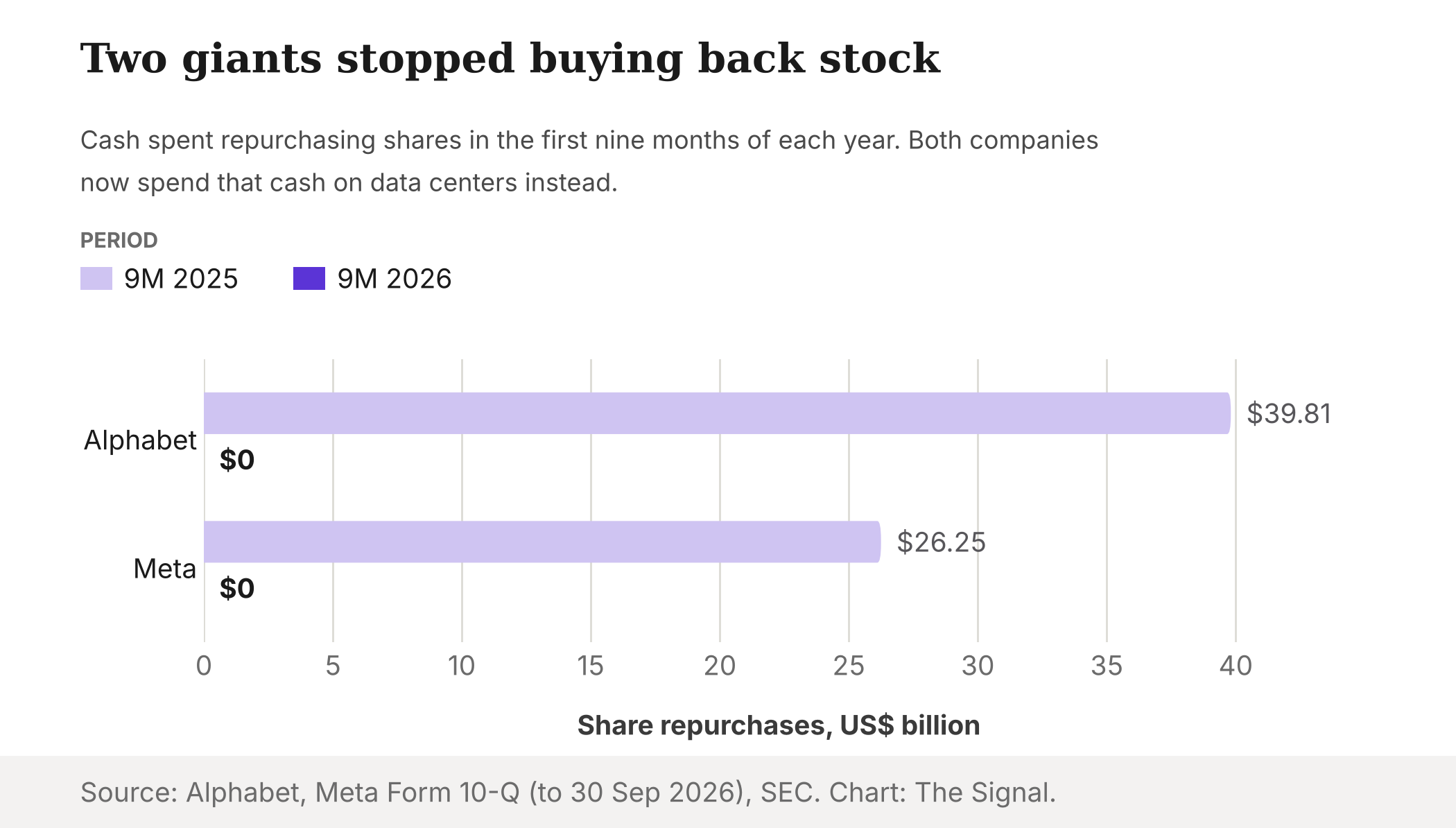
The standard picture of Big Tech is a cash machine that hands the surplus back to shareholders. For a decade that meant buybacks, tens of billions of dollars a year, quietly lifting earnings per share and the stock price. The latest quarterly filings suggest that machine has changed its job. Alphabet's 10-Q for the quarter ended 30 September 2026 shows repurchases of stock of $39.81 billion in the first nine months of 2025 and $0 in the same period of 2026.
It is worth slowing down on that. Alphabet did not stop buying back stock because it ran out of money. It stopped because the money has a more urgent use. Alphabet's operating cash flow for the nine months was $127.15 billion, while its purchases of property and equipment were $131.95 billion. Spending on data centers and chips exceeded what the business earned by about $4.8 billion, before a single dollar went to shareholders.
The gap is being filled with debt
The number that carries the story is borrowing. Alphabet raised $85.22 billion of net debt in the first nine months of 2026, against $38.0 billion a year earlier, and still paid $8.17 billion in dividends. A company that spends more than it earns and still pays a dividend has to fund the difference from somewhere, and the filing shows where.
Alphabet is not alone. Meta bought back no Class A stock in the first nine months of 2026, against $26.25 billion in 2025, while its capital spending rose from $48.3 billion to $83.1 billion on operating cash flow of $96.9 billion. Meta's cash flow still covered its capex, but only just: roughly $13.8 billion was left over. Meta also issued $24.9 billion of net long-term debt in 2026 and none in the same period of 2025, and paid $4.06 billion in dividends.
Amazon shows the extreme case. Its nine-month capital spending was $175.7 billion against operating cash flow of $113.8 billion, with $115.1 billion of long-term debt proceeds versus $0.7 billion a year earlier, and no repurchases of common stock. Amazon's capex nearly doubled from $92.3 billion in 2025, and its new borrowing is almost exactly the size of the shortfall and then some.
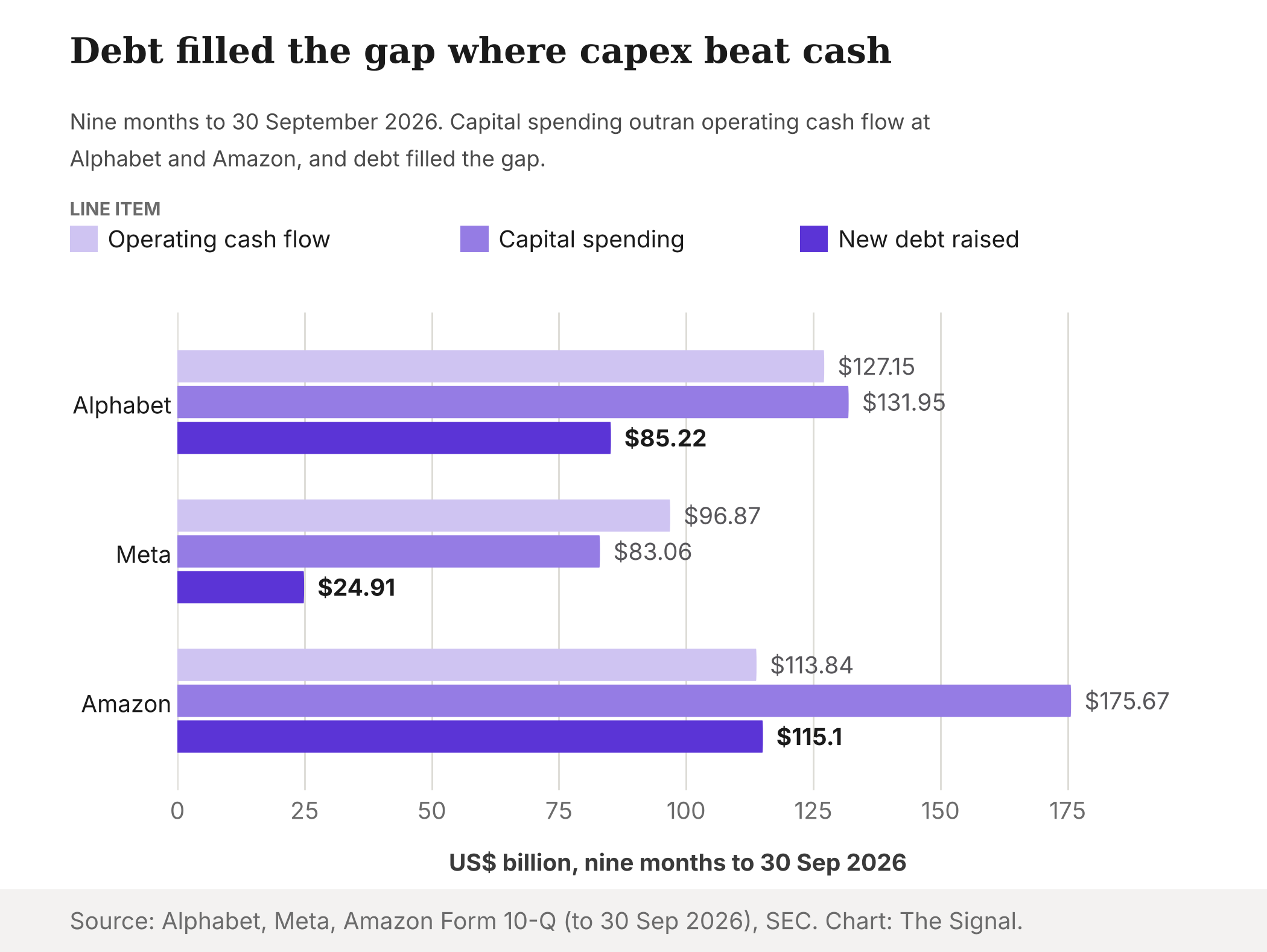
Add the three together and the scale is plain. Net debt of $85.22 billion at Alphabet, $24.91 billion at Meta and $115.1 billion at Amazon comes to about $225 billion in nine months. Two of them also removed roughly $66 billion of buybacks, the sum of [Alphabet's $39.81 billion]https://www.sec.gov/Archives/edgar/data/1652044/000165204426000084/goog-20260930.htm) and [Meta's $26.25 billion]https://www.sec.gov/Archives/edgar/data/1326801/000162828026066773/meta-20260930.htm) from the same period of 2025.
Microsoft is the counter-example, and it is narrowing
Not every giant has stopped. Microsoft's fiscal first quarter to 30 September 2026 included $4.38 billion of buybacks and $6.76 billion of dividends, from $58.0 billion of operating cash flow and $39.37 billion spent on property and equipment. That leaves $18.6 billion of free cash flow after capex, so shareholders took about 60 percent of it.
A year earlier the picture was looser. In the same quarter of 2025, Microsoft spent $19.39 billion on property and equipment out of $45.06 billion in operating cash flow, and paid out $5.65 billion in buybacks and $6.17 billion in dividends. Free cash flow then was $25.7 billion and shareholders took about 46 percent. Capex roughly doubled in a year, buybacks shrank, and the dividend, which a company is reluctant to cut, is now the larger payout. Microsoft is paying shareholders from a thinner cushion, and the direction is the same.
The honest objection
The strongest defense of the spending is that nothing here signals distress. Borrowing to build is ordinary corporate finance, and pausing buybacks is a choice. Meta's operating cash flow of $96.9 billion still covers its $83.1 billion of capex, and Microsoft's $58.0 billion covers its $39.37 billion.
That case is real. It answers a narrower question, though. The issue is not whether these companies can build, but who carries the cost while they do. A buyback paid from surplus leaves lenders alone. Alphabet's $85.22 billion of new debt has to be repaid from what the new capacity earns.
What it means from India
For an Indian reader, the link is indirect. Indian IT services firms and global capability centers serve customers like these, so the pace of cloud and AI building matters to them. That pace now rests partly on credit, which makes it more sensitive to borrowing conditions than a build-out paid from spare cash.
The Signal
Big Tech's story used to be a surplus returned. It is becoming a bet financed. Alphabet, Meta and Amazon bought back no stock in the first nine months of 2026 and borrowed about $225 billion between them, and Microsoft is returning cash from a shrinking margin. Watch two lines in the next filings: whether capex keeps outrunning operating cash flow, and whether the debt line keeps growing faster than the dividend line. A buyback is a promise that the cash has nowhere better to go. When it stops, someone has decided the cash has.
Reporting basis: every figure comes from each company's own Form 10-Q for the period ended 30 September 2026, filed with the US Securities and Exchange Commission (Alphabet, Meta, Amazon and, for its fiscal first quarter, Microsoft). Alphabet, Meta and Amazon are covered for the first nine months of the calendar year; Microsoft is a single quarter, so its figures are not summed with the others. These are four independent filings, each read directly. The shortfall between capex and operating cash flow, the Meta surplus, Microsoft's free cash flow and payout shares, the roughly $225 billion combined debt and the roughly $66 billion of prior-year buybacks are The Signal's calculations from those figures. A Reuters report on payout shares reaching a 15-year low prompted this piece, but it was not accessible for verification and no figure here relies on it.