
On 7 October 2026, the Reserve Bank of India raised its policy repo rate by 25 basis points to 5.50 percent, and the Monetary Policy Committee also changed its stance to calibrated tightening. The reading most people took from that is simple: a quarter-point hike, a modest tightening, short-term rates up by about that much.
The central bank's own weekly Treasury bill auctions tell a different story. At the 28 October auction, cut-off yields were 5.9337 percent on the 91-day bill, 6.5493 percent on the 182-day bill and 6.6900 percent on the 364-day bill. Seven weeks earlier, on 9 September, the same three bills cleared at 5.2089, 5.6174 and 5.9148 percent.
The move is three to four times the hike
The arithmetic is plain. Between the 9 September and 28 October auctions, the 91-day yield rose about 72 basis points, the 182-day about 93 and the 364-day about 78. Against a 25 basis point hike, that is roughly three to four times as much.
Cut-off yields at the RBI's weekly Treasury bill auctions, percent. Source: Reserve Bank of India auction results.
| Bill | 29 July | 9 September | 14 October | 28 October |
|---|---|---|---|---|
| 91-day | 5.3402 | 5.2089 | 5.7281 | 5.9337 |
| 182-day | 5.5977 | 5.6174 | 6.2896 | 6.5493 |
| 364-day | 5.7393 | 5.9148 | 6.4891 | 6.6900 |
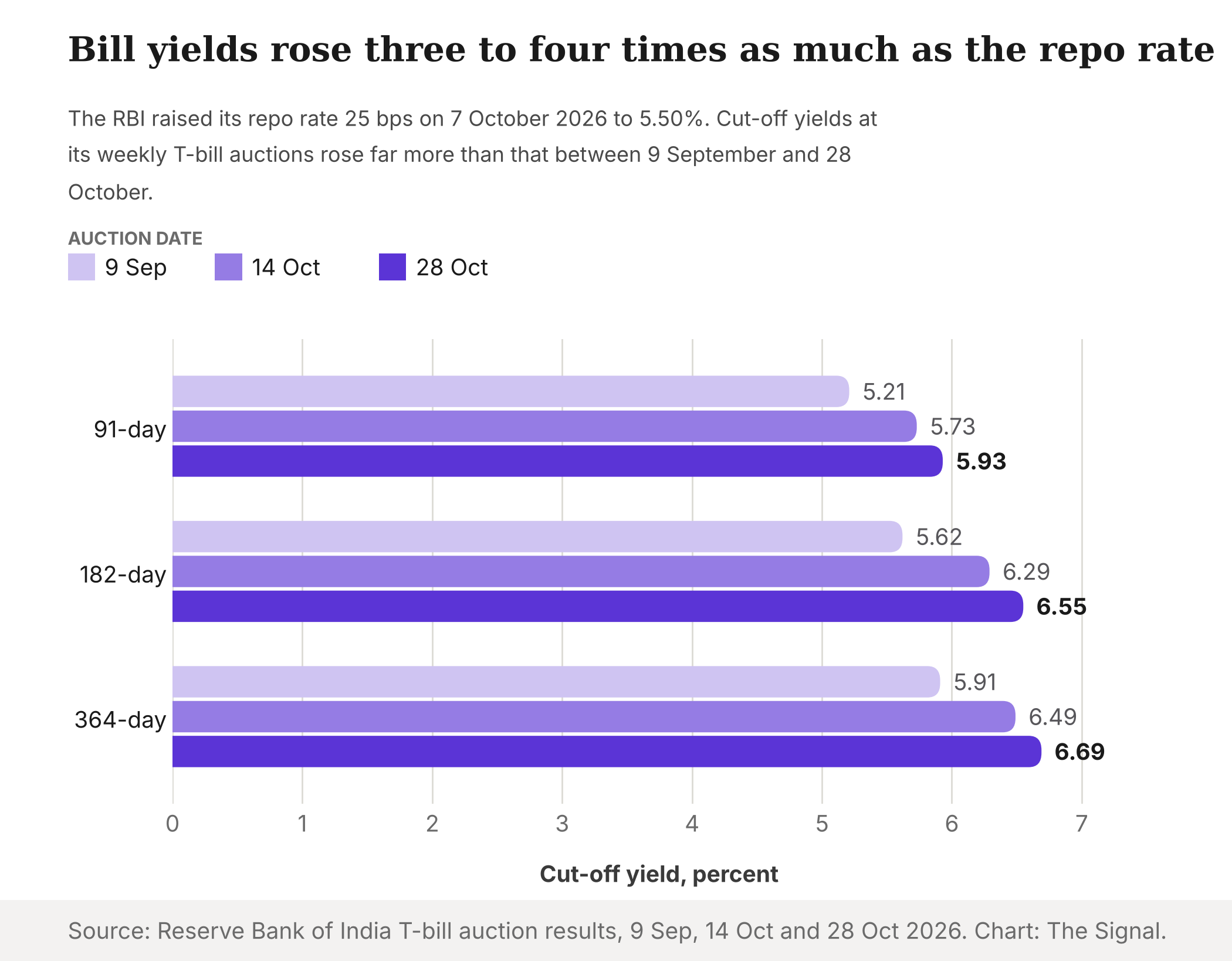
Before the hike, the 91-day bill was priced below the policy rate. The 91-day yield on 9 September was 5.2089 percent, under the 5.25 percent repo rate that the 25 basis point hike took to 5.50 percent. By 28 October it sat about 43 basis points above the new repo rate, and the 364-day bill sat about 119 basis points above it.
The week the RBI said no
The most revealing auction is the one in between. On 21 October, the RBI notified ₹8,000 crore, ₹8,000 crore and ₹7,000 crore across the three bills. It accepted nothing in any tenor, and no cut-off price was set. The release gives no reason.
It was not for lack of demand. Competitive bids that day totalled ₹15,366.600 crore for the 91-day bill, ₹18,925.500 crore for the 182-day and ₹11,352.500 crore for the 364-day. That is about ₹45,645 crore of bids against ₹23,000 crore on offer, roughly twice the amount. The bids were simply not at prices the RBI was willing to take.
A week later the bids came back at higher yields, and the RBI took them. The 28 October cut-offs were 5.9337, 6.5493 and 6.6900 percent, against 5.7281, 6.2896 and 6.4891 percent on 14 October. That is about 21, 26 and 20 basis points higher in two weeks, with the rejected auction in the middle.
The auction mechanics show how tight the squeeze was. On 28 October, the 182-day and 364-day bids were allotted only 52.7415 percent and 54.4444 percent of competitive bids at the cut-off, against 97.1013 percent for the 91-day bill. The longer bills drew far more bids at the cut-off than the RBI chose to fill.
What the hike alone does not explain
A 25 basis point hike moves the price of overnight money, but it does not by itself explain a 93 basis point move in the six-month bill. The RBI's own liquidity notices point to what moved the rest.
On 3 September, the RBI notified an overnight reverse repo auction of ₹6,00,000 crore, an offer to absorb cash from banks. On 19 October it notified a 7-day repo auction of ₹1,00,000 crore, an offer to lend cash to banks. By 26 October it was offering a 4-day repo of ₹1,50,000 crore. In seven weeks the central bank went from soaking up surplus cash to lending it.
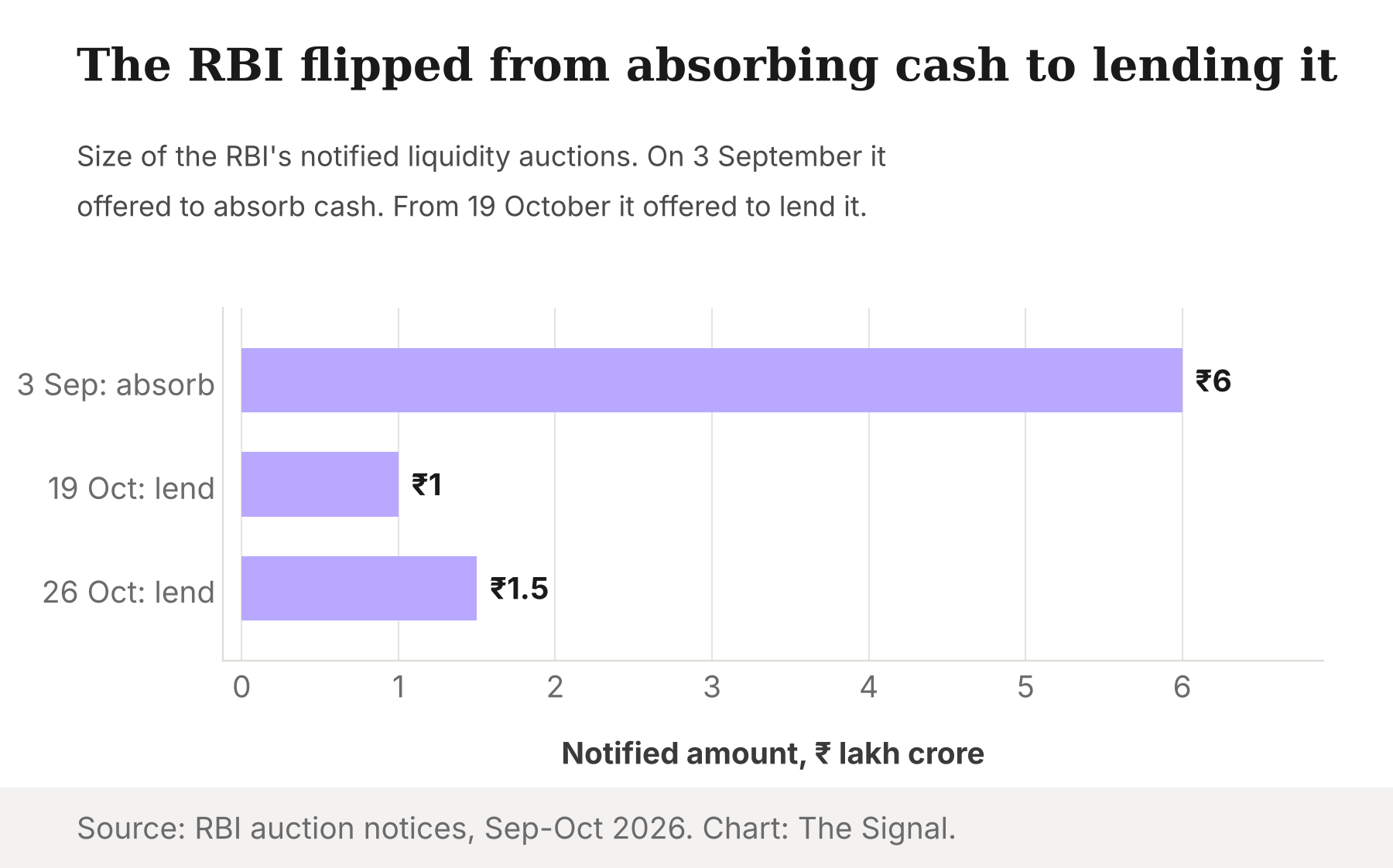
When cash is plentiful, a bill can trade below the policy rate, as the 91-day did in September. When banks are borrowing from the RBI each week, bills have to compete with that cost. The pass-through of the hike was therefore not 25 basis points. It was the hike plus the end of the surplus.
The honest objection
The strongest case against reading this as an unusual tightening is that bills were catching up, not overshooting. The 91-day yield was below the policy rate in September, so some of the rise just closes that gap. A bill is also not an overnight loan: the 364-day bill covers a year in which the MPC projects CPI inflation of 5.2 percent for 2026-27, with 6.0 percent in the third quarter, after CPI inflation rose to 4.8 percent in August from 4.5 percent in July. Investors holding a year of paper will ask for a premium over a 5.50 percent repo rate. The outside world is not helping either: the US Federal Reserve held its target range at 3-3/4 to 4 percent on 28 October, with two members preferring an increase.
All of that is fair, and it explains why bills sit above the repo rate. It does not explain the timing. The 21 October rejection shows the RBI was not a passive price taker as yields rose. It declined to clear at the prevailing bids once, and the market adjusted: the next auction cleared 20 to 26 basis points higher. The central bank was setting the level.
The Signal
The repo rate is the announcement. The bill auction is where the tightening is delivered. In seven weeks the 182-day yield rose about 93 basis points, the RBI turned from absorbing cash to lending it, and on one Wednesday it refused to sell a single bill. That sequence is how the central bank tightened beyond what the hike alone suggests.
What to watch is the next three Wednesday auctions. If cut-offs keep climbing while the RBI keeps offering repo money, the liquidity squeeze is doing more of the work than the policy rate. If the lending auctions fade and yields hold near the 6.5493 percent of 28 October, the market has found its new level. A 25 basis point hike turned out to be the smaller number.
Reporting basis: every auction figure, liquidity notice, the Monetary Policy Statement and the MPC minutes are the Reserve Bank of India's own releases, read directly on its website, so the piece rests on a single origin for its core facts and its inflation projection. The Fed decision is from the Federal Reserve Board's statement. The rise in yields between auctions, the spread to the repo rate, the total of rejected bids and the multiples against the hike are The Signal's calculations from those figures.