
The headline number is a good one. SEBI Chairman Tuhin Kanta Pandey said on 22 September 2026 that outstanding corporate bonds stand at about ₹61 lakh crore, up from about ₹20 lakh crore in FY2015-16, according to Business Today. That is a market roughly three times its size a decade ago. He added that more than ₹4.3 lakh crore had been raised through corporate bonds in FY2026-27 so far. Read the stock figure alone and the regulator's project of building a deep domestic debt market looks like it is working.
It is worth slowing down on that. A stock is the sum of earlier borrowing. It does not show what companies chose to do lately.
The flow tells a different story
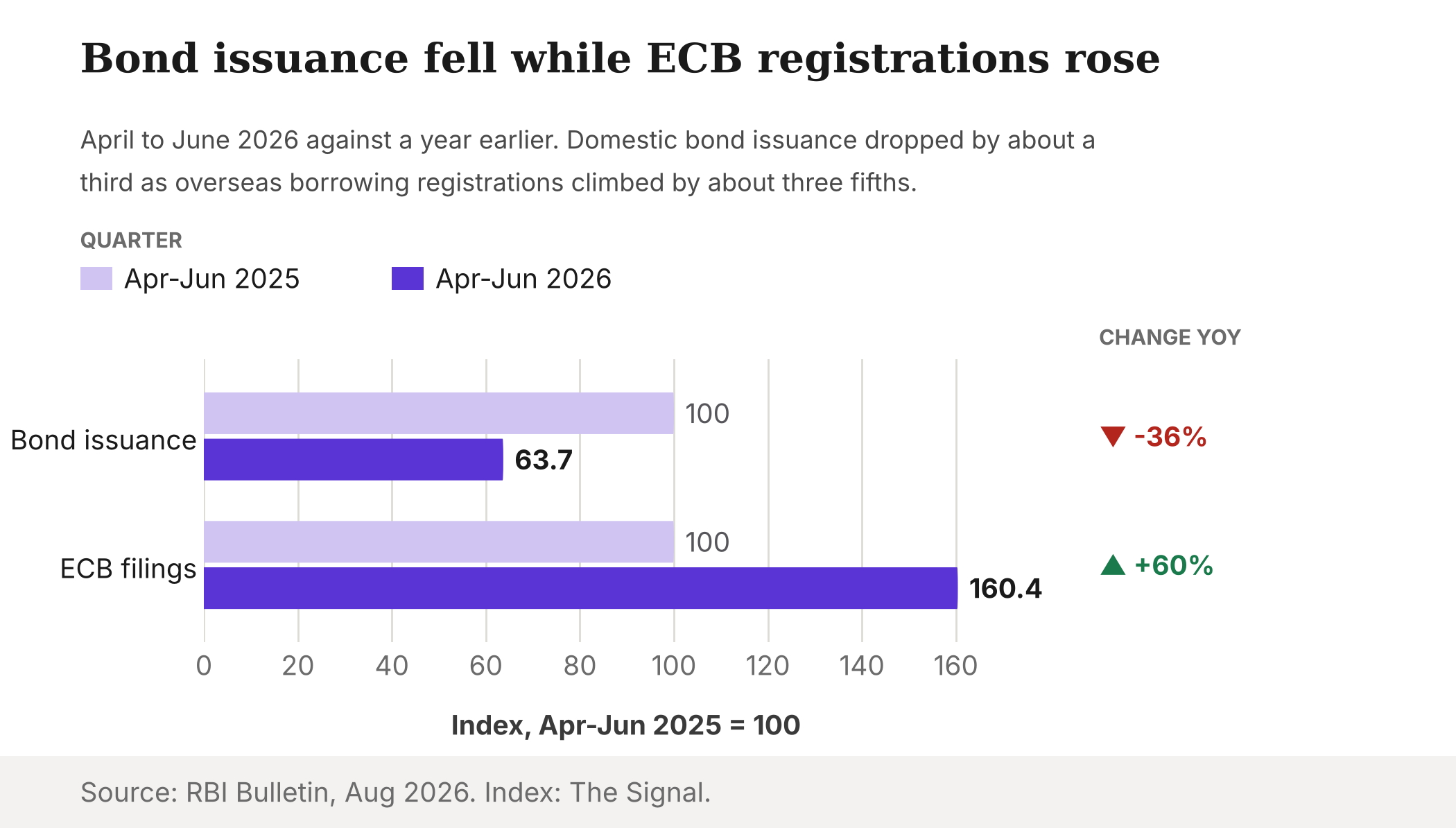
The Reserve Bank of India's August 2026 Bulletin has the flow. Corporate bond issuance stood at ₹1.88 lakh crore in April to June 2026, against ₹2.95 lakh crore a year earlier, the RBI reports. That is a fall of 36 percent.
Over the same quarter, the same bulletin says ECB registrations rose to US$14.6 billion from US$9.1 billion a year ago. ECBs are external commercial borrowings, loans that Indian companies raise from foreign lenders and register with the RBI. Registration is a filing, not a cash inflow, but the direction is plain: 14.6 against 9.1 is an increase of about 60 percent.
So in that one quarter, domestic bond issuance fell by about a third while overseas borrowing filings rose by about three fifths.
Banks took the slack
Companies that borrow less in bonds still need money. The same bulletin shows where some of it came from: non-food bank credit grew 19.1 percent year on year as of 31 July 2026. A bond market that tripled in a decade did not stop a bank-led credit surge in the first half of this fiscal year.
The October bulletin points the same way on the external side. The RBI says FDI, ECB and remittance flows strengthened in August. Two of the three routes around the domestic bond market, banks and foreign lenders, were busy at the same time as the third was quiet.
A big market that is still small
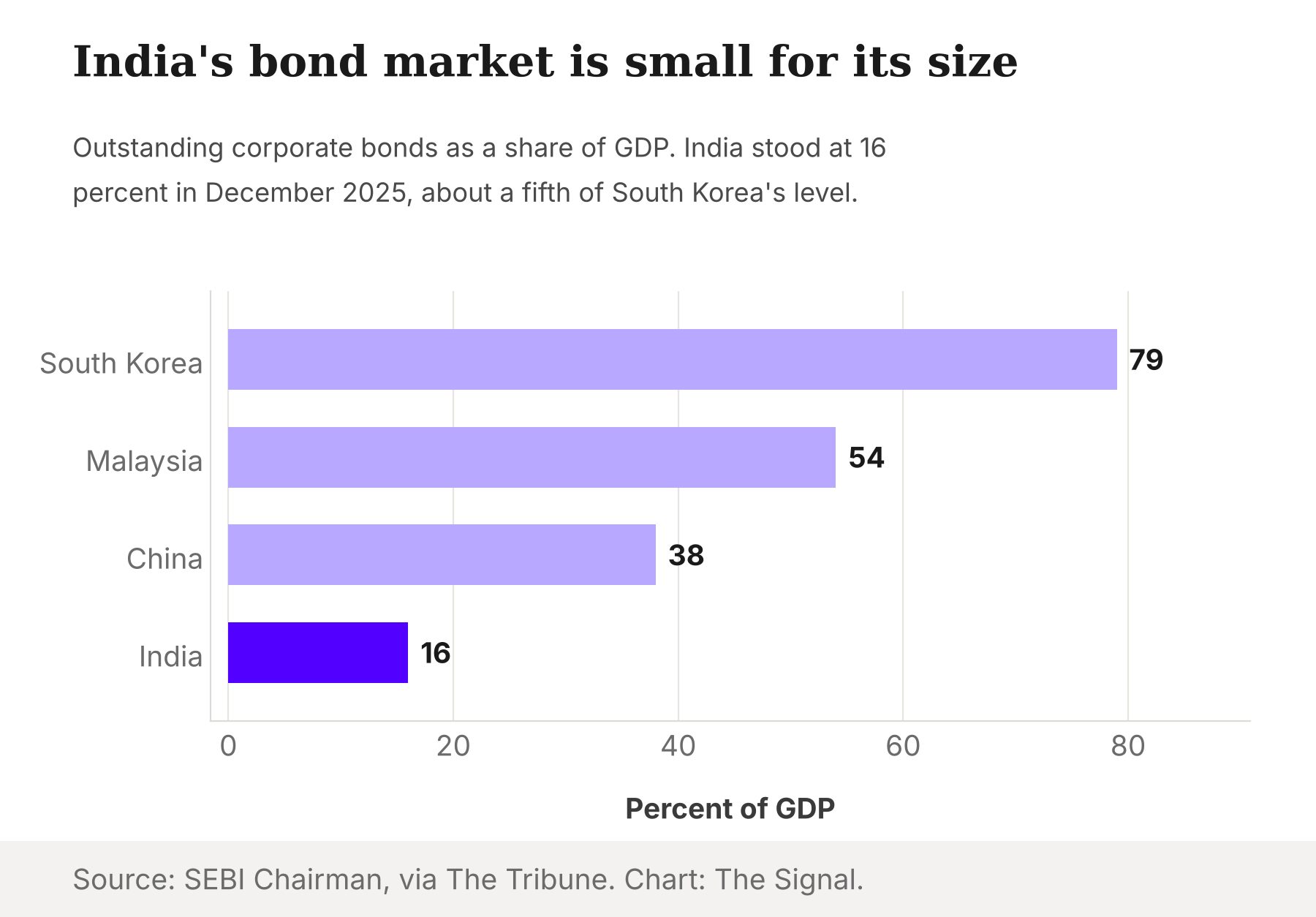
Part of the explanation is where the market started. In February 2026, Pandey said that outstanding corporate bonds were 16 percent of GDP in December 2025, against 79 percent in South Korea, 54 percent in Malaysia and 38 percent in China, as reported by The Tribune. In the same remarks, he put corporate bonds at 60 percent of bank credit to industry and services.
A market that small against the economy has room to grow. It also has little depth to fall back on when conditions shift. Companies that can borrow from a bank or a foreign lender on easy terms do not need the bond market to be good. They need it to be available.
The honest objection
The strongest case against reading too much into this is that one quarter is a short window, and bond issuance is lumpy. Large issuers come to market when conditions suit them, not on a calendar.
The numbers allow that reading. Pandey's figure of more than ₹4.3 lakh crore raised in FY2026-27 by 22 September, set against the RBI's ₹1.88 lakh crore for April to June, implies that at least ₹2.4 lakh crore was raised afterwards. That is more than the whole first quarter, in a shorter span. The quarterly gap may be partly a timing story.
Two cautions apply. The figures come from different sources and may not be measured identically, so that subtraction is a rough guide. And a later recovery would still leave the earlier pattern in place: ECBs and bank loans rose first.
The Signal
The ₹61 lakh crore figure measures what earlier borrowing left behind. It does not measure whether the market is winning today's borrowers. In April to June 2026, issuance fell 36 percent while ECB registrations rose 60 percent and bank credit grew 19.1 percent.
The test of the regulator's push is not the size of the stock. It is whether issuance recovers when banks and foreign lenders are not the easier option. Watch the next RBI Bulletin for the following quarter's issuance, and for whether ECB registrations stay above last year's pace. A bond market is built by the borrowers who choose it, not by the ones who inherit it.
Reporting basis: the RBI's quarterly bond issuance, ECB registration and bank credit figures are from its August 2026 Bulletin, and the August ECB flow comment is from the RBI's October 2026 Bulletin press release; both are RBI primary publications. The outstanding stock, the earlier comparison and the issuance to date are per Business Today, reporting SEBI Chairman Tuhin Kanta Pandey's speech of 22 September 2026, and rest on that single outlet. The GDP and bank-credit ratios are per The Tribune, reporting the same official's remarks of 4 February 2026, and also rest on that one outlet. Two RBI items and two press accounts of one SEBI official make three independent origins at most. The percentage changes, the growth multiple of the stock and the implied issuance after June are The Signal's calculations from those figures.