Jio Platforms listed on 28 October 2026 at ₹1,358 against an issue price of ₹1,119. That was a 21.36 percent premium at the open, and the shares ended the session at ₹1,419, giving the company a market value of ₹13,05,380 crore. Measured from the issue price, the close is a gain of about 27 percent. The same day, the Sensex finished at 73,246.03, down 0.48 percent, so Jio rose into a falling market.
The easy reading is that the jinx on giant issues is over. That reading is fair, but it tells a holder very little.
The jinx was real, and Jio escaped it
The size jinx had a basis. Hyundai Motor India raised ₹27,858.75 crore in October 2024 and closed its first day 7.16 percent below its issue price. In the same Outlook Money review, LIC closed its debut 7.77 percent down, and One97 Communications, the parent of Paytm, closed 27.4 percent down in November 2021. Three of the largest issues before Jio lost money for the people who got shares at the issue price on day one.
Jio's issue is larger than any of them. It was a fresh issue of up to 270,000,000 shares, with no offer for sale, and at ₹1,119 a share that works out to about ₹30,213 crore, above Hyundai's ₹27,858.75 crore. Against that backdrop, a first-day close 27 percent above issue is a strong result.
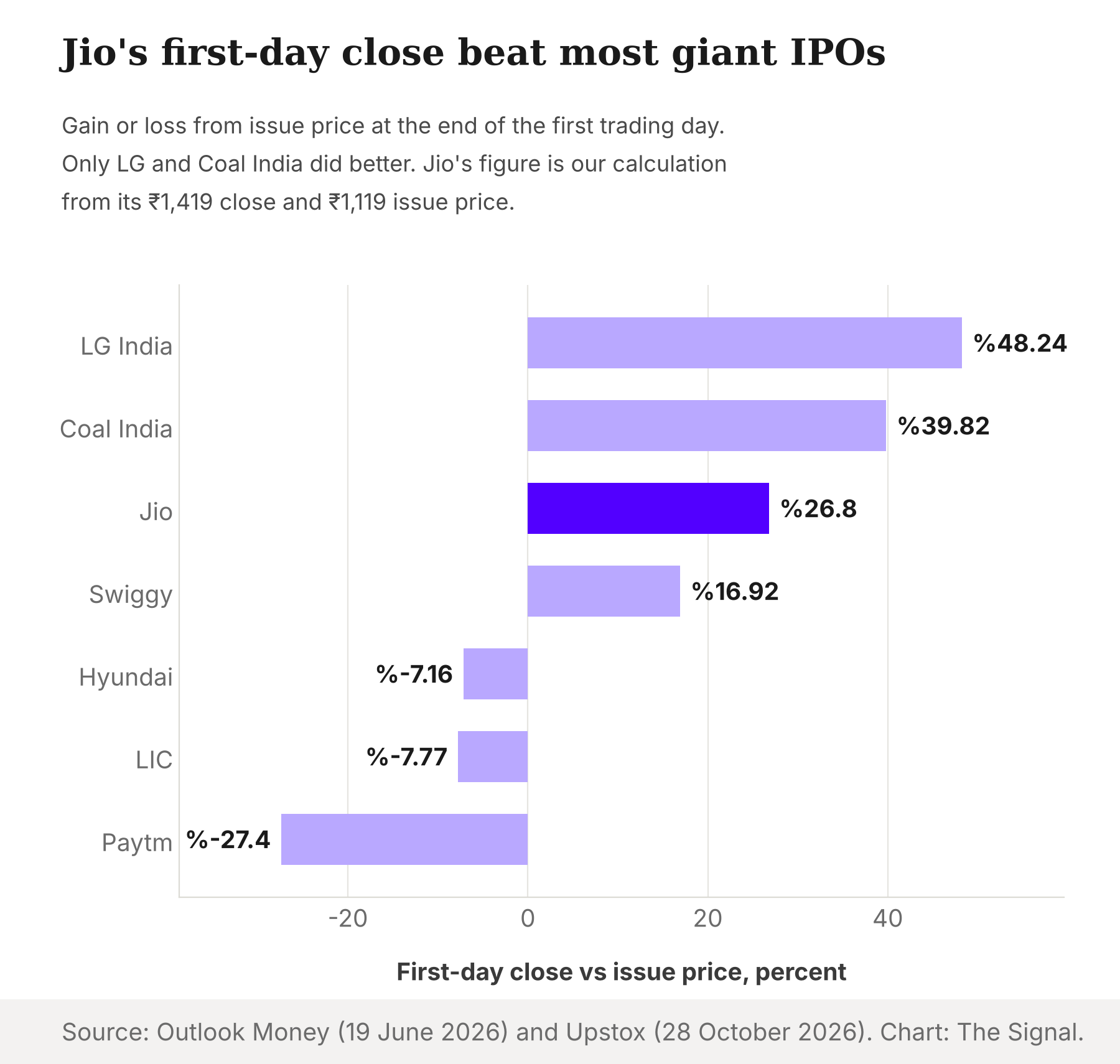
Of the issues in that table, only LG Electronics India, which surged 48.24 percent on listing day, and Coal India, which closed 39.82 percent above issue in October 2010, did better. The comparison mixes eras and sectors, and it uses closing prices throughout. Jio's 26.8 percent is our calculation from its ₹1,419 close and ₹1,119 issue price, so it is the like-for-like number. The 21.36 percent figure quoted in headlines is the opening premium.
Day one is a poor guide to what comes after
Now look at what happened to the same stocks later. Outlook Money's review, dated 19 June 2026, reports each issue's return against its issue price on that date.
| Issue | Day-one close vs issue price | Return vs issue price, 19 June 2026 |
|---|---|---|
| Coal India (2010) | +39.82% | about +83.67% |
| LG Electronics India (2025) | +48.24% | about +28.2% |
| Swiggy (2024) | +16.92% | about −35% |
| Hyundai Motor India (2024) | −7.16% | about +1% |
| LIC (2022) | −7.77% | about −6.68% |
| Paytm (2021) | −27.4% | about −49.15% |
Source: Outlook Money, 19 June 2026. Returns after day one are a snapshot on that date, not live prices.
Two rows carry the point. Swiggy gained 16.92 percent on its first day and was about 35 percent below its issue price by June 2026, while Hyundai lost 7.16 percent on its first day and was about 1 percent above issue. A buyer at the issue price who read day one as a verdict on the company was wrong in both directions.
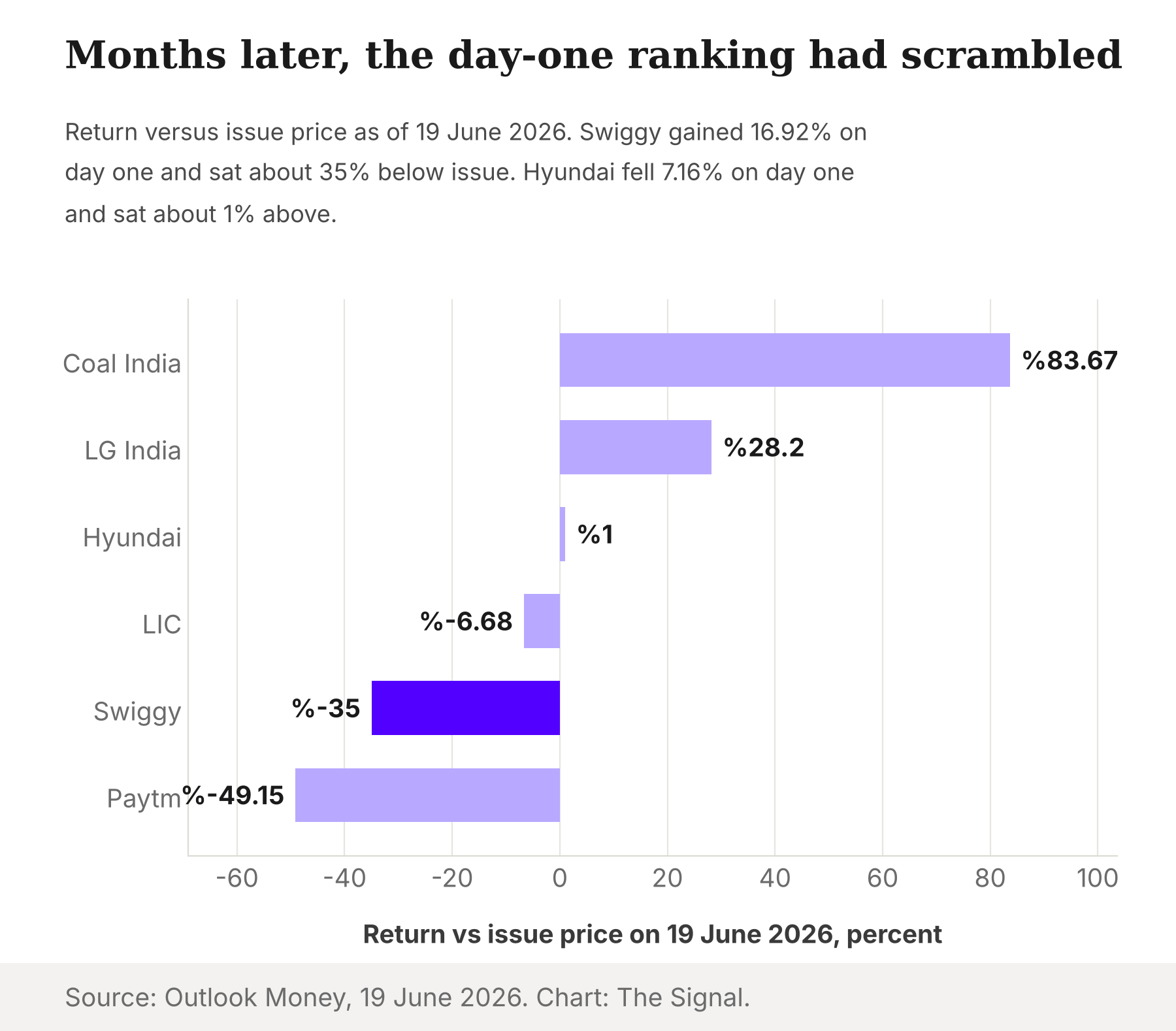
The ordering also shifted. LG led on day one and Coal India led by June. Swiggy ranked third by debut among these six and fifth by June. Six cases are not a statistical sample, and the pattern should be read as a caution, not a law. But the one thing the table does not show is day one reliably ranking the winners.
Why Jio's first day says less than it seems
A debut gain reflects demand for the shares on the day. It says little about the business that holders now own.
That business is unusual in one respect worth noticing. Jio's offer was entirely new shares, so no seller cashed out. The stated use of net proceeds is prepaying certain borrowings of its subsidiary RJIL, plus general corporate purposes. The draft prospectus put the company's total fund-based borrowings, including its subsidiaries, at ₹715,292 million as of 31 March 2026, or about ₹71,529 crore.
Set the numbers side by side. The roughly ₹30,213 crore raised (270,000,000 shares at the ₹1,119 issue price) equals about 42 percent of that ₹71,529 crore of debt, though only part of the proceeds is earmarked for repayment. And the debt itself is about 5.5 percent of the ₹13,05,380 crore market value at the close. On day one the market was not pricing the balance sheet. It was pricing growth, scarcity and the rarity of a Jio share. Those are the inputs that can reverse, as the Swiggy row shows.
The honest objection
The strongest case against this reading is that a gain is a gain. Anyone allotted shares holds a position worth about 27 percent more than they paid (the ₹1,419 close against a ₹1,119 issue price), and the winners in the table, Coal India and LG Electronics India, kept their gains. On that view Jio belongs with them, not with the cautionary rows.
That may prove right. But it is an argument about Jio's business, not about its debut. Swiggy also posted a day-one gain, and it did not hold. The debut gain does not distinguish the cases, which is the point.
A second caveat concerns timing. The six earlier returns are a 19 June 2026 snapshot, more than four months old, and several of those stocks will have moved since. The table shows how unrelated day one and later outcomes have been, not where those stocks trade today.
The Signal
Jio cleared the bar the largest Indian issues kept tripping over, and it did so with no seller on the other side of the offer. That is a real achievement. The next big issue, NSE India, listed at ₹1,800 on 24 September 2026, up just 0.84 percent from a ₹1,785 issue price, which shows how wide the range of debuts still is, even for flagship names. The share to watch is not the opening premium. It is Jio's price against ₹1,119 six months from now, when the first-day demand has been fully absorbed. Until then, the debut is a measure of appetite, and appetite is not the same as value.
Reporting basis: Jio's issue structure and use of proceeds are from the company's red herring prospectus filed with SEBI, and its March 2026 borrowings are from the draft prospectus filed with SEBI in June 2026; both were read directly. Jio's listing price, close and market value are as reported by Upstox's live listing coverage, which relays NSE data. The Sensex close is from a Kotak Securities market report. The returns for Hyundai, LIC, Paytm, Coal India, LG Electronics India and Swiggy rest on a single source, Outlook Money's 19 June 2026 review, and have not been checked against exchange data. NSE's listing figures are from The Week. The 26.8 percent first-day gain, the roughly ₹30,213 crore issue size, the 42 percent and 5.5 percent ratios, and the rank comparisons are The Signal's calculations from those figures.