The case for buying Indian stocks right now is easy to state. The market has fallen, so it is cheaper. MSCI's India index lost 14.72 percent in US dollar terms from January to the end of September 2026. In June, State Street Global Advisors noted, citing FactSet, that MSCI India traded near 20.8 times forward earnings in May, below its five-year average of 22.2 times. By the end of September, the index stood at 18.61 times forward earnings. Cheaper than its own recent past, and falling.
It is worth slowing down on that. Foreign investors do not choose India against India's history. They choose it against the other places their money could go.
The number that carries the story
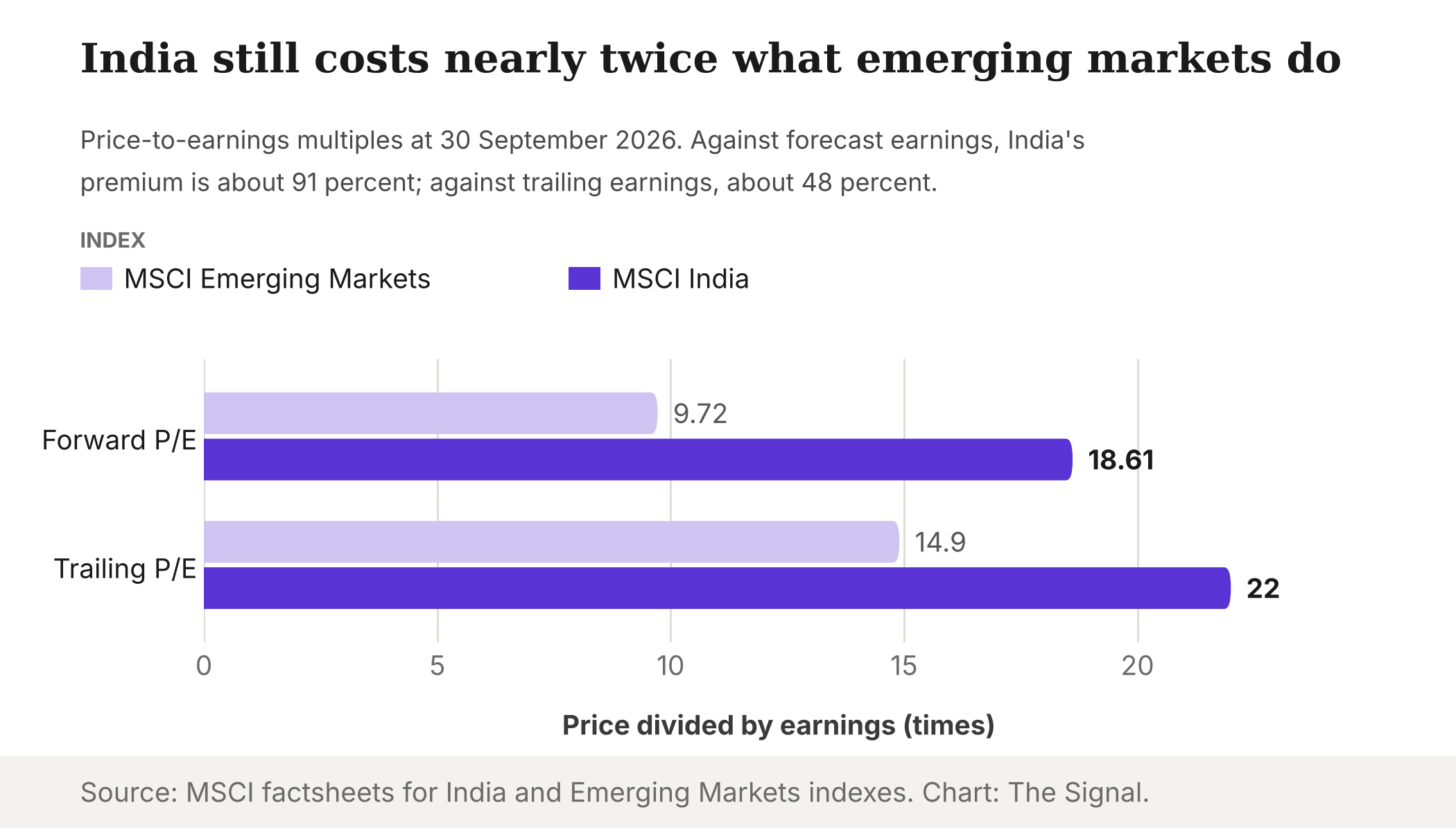
MSCI's Emerging Markets factsheet puts the whole emerging-market index at 9.72 times forward earnings and 14.90 times trailing earnings. India's figures, from its own factsheet, are 18.61 and 22.00. On forward earnings, India costs 91 percent more than the emerging-market average. On trailing earnings, 48 percent more.
That gap between the two measures is the interesting part. Both indexes look cheaper on forward earnings than on trailing, because analysts expect profits to grow. But the emerging-market multiple drops by a third, from 14.90 to 9.72, while India's drops by about a seventh, from 22.00 to 18.61. Taken at face value, forecasts embed roughly 53 percent earnings growth for the emerging-market index and 18 percent for India. These are The Signal's calculations from the two factsheets, and forward multiples are only as good as the forecasts behind them.
What explains the emerging-market jump? The same factsheet shows Information Technology at 43.78 percent of the emerging-market index, and India at 10.65 percent. The index is dominated by technology-heavy markets, and its forecasts are being pulled up by them. India, by contrast, is a market where consensus earnings estimates for 2026 and 2027 were being cut as of June, according to State Street.
The returns say the same thing
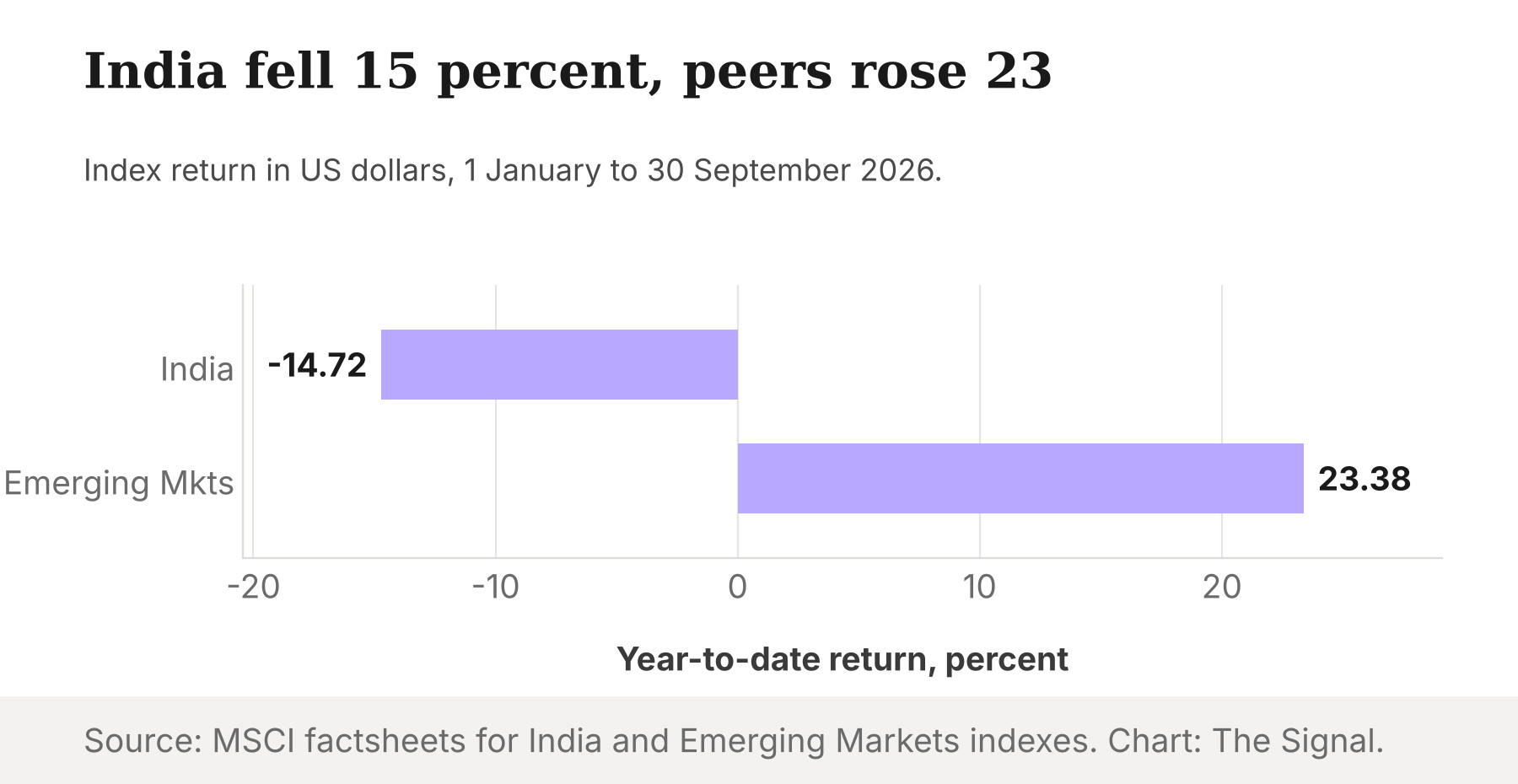
MSCI Emerging Markets rose 23.38 percent over the same nine months, against India's fall of 14.72 percent. That is a gap of 38 percentage points in a single year-to-date period, between an asset and the benchmark that its foreign owners compare it with.
A fund manager who owns India as part of an emerging-market allocation has two questions. Is India cheaper than it used to be? Yes. Is it cheap relative to the alternatives? On these numbers, no. The selling suggests the second question is winning. Foreign investors have pulled Rs 3.04 lakh crore out of Indian equities in 2026, according to NSDL data reported by the Free Press Journal. In October alone, they had sold a net Rs 44,166 crore by the time of an All India Radio report dated 11 October, citing depository data.
Who is buying
Domestic savers are the counterweight. Equity mutual funds took in a net Rs 38,306.55 crore in September 2026, according to AMFI's monthly report. Foreign selling in the first days of October, at Rs 44,166 crore, already exceeded that full month of domestic fund inflows by about 15 percent. The two figures cover different periods, so the comparison is a sense of scale, not a clean net flow.
The mismatch matters for what comes next. A market held up by domestic inflows can stay expensive against its peers for a long time, because the buyer is not benchmarking against emerging markets. But a market that is expensive against peers and losing foreign owners is also one where a slowdown in domestic inflows would leave no one else to pay the premium.
The honest objection
The strongest case against this reading is that India has always carried a premium. Investors pay more for a large, young, domestically driven economy, and a premium alone does not signal a mispricing. That is fair. This piece does not have a long history of the India premium over emerging markets, so it cannot say whether the 91 percent gap between 18.61 and 9.72 times forward earnings is wide by past standards. A second point is that the emerging-market forward multiple may be flattered by forecasts that have not yet been delivered, which would make the true gap smaller than it looks.
Both points could be right. Neither changes the narrower finding: the argument that India is cheap rests on its own history, and the people selling are using a different yardstick.
The Signal
India has become cheaper in absolute terms and has not become cheap in relative terms. At 18.61 times forward earnings against 9.72, the market still asks buyers to pay close to double what an emerging-market index costs, while the profits expected from it are being revised down rather than up.
Watch two things. First, whether the 2026 and 2027 earnings forecasts for India stop falling, because falling forecasts keep the multiple high even when prices fall. Second, whether monthly AMFI inflows hold near September's level while foreign selling continues. A market is cheap only against the thing the marginal buyer compares it with.
Reporting basis: index multiples, returns and weights are from MSCI's factsheets and index page for India and for Emerging Markets, as at 30 September 2026; MSCI is the origin for all of them, so they count as one origin. The five-year average multiple and the forecast revisions are per State Street Global Advisors, citing FactSet, in a note dated 15 June 2026, and rest on that single source. Domestic fund inflows are from AMFI's September 2026 monthly report. October foreign selling is per All India Radio, citing depository data, and the year-to-date total is per the Free Press Journal, citing NSDL; neither was checked against NSDL directly. The 91 and 48 percent premiums, the implied earnings-growth figures, the 38-point return gap and the 15 percent comparison of flows are The Signal's calculations from those figures.