Gold fell below $4,000 an ounce this week. Trading Economics data show spot gold at $3,993.96 on 23 October 2026, its lowest since mid-July, against a record of $5,608.35 in January. That is a fall of 29% from the peak. Rising oil prices have pushed up expectations that US interest rates stay higher for longer, and the metal has lost almost 4% in a week.
For a country where gold is the collateral behind a fast-growing loan book, the reflex is obvious. A 29% fall in the thing you lent against must mean trouble for the lenders. The RBI's June 2026 Financial Stability Report shows why the worry is fair: gold loans have grown at a compound annual rate of 42.4% since March 2024 and now make up 17.4% of NBFCs' retail portfolios. The same report warns that "a prolonged correction in gold prices could weaken collateral protection."
It is worth slowing down on that. A lender does not lose money on the fall from the peak. It loses money on the fall from the price at which each loan was written, and the RBI's rules test that ratio continuously.
The book was built from a lower base
The RBI measures the boom from March 2024. The World Gold Council wrote that month that gold "is trading close to US$2,200/oz." At $3,994, gold is still about 82% above that level.
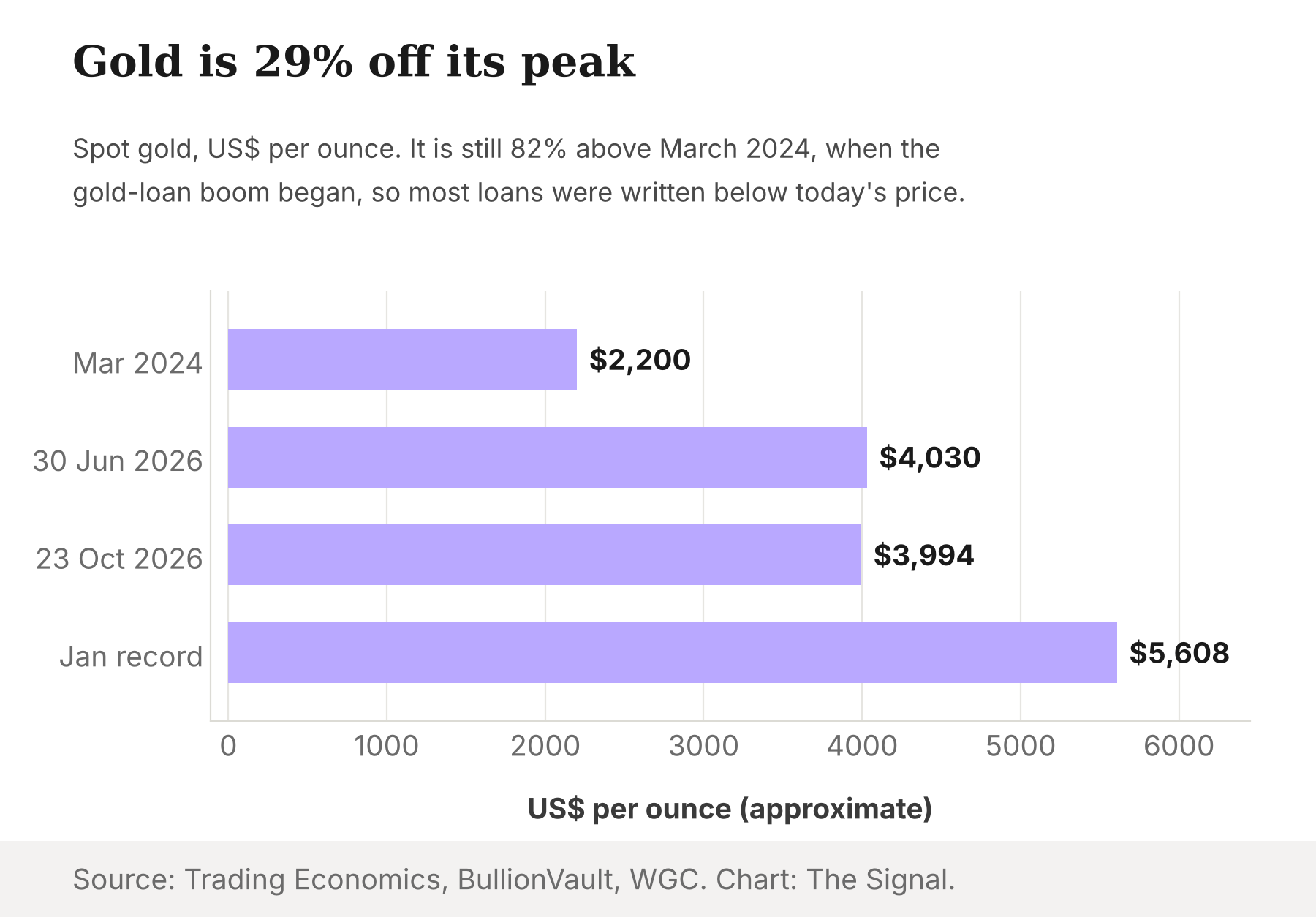
Growth at 42.4% a year means most of the book is recent. But recent does not mean written at the top. The January record was a spike, and by the end of June gold had already given most of it back. BullionVault reported that gold "set a 3pm London auction price beneath $4030" on 30 June 2026, down 6.5% from New Year's Eve. Today's price is about 0.9% below that end-June level.
That matters because of what Muthoot Finance disclosed on its 1 August earnings call. Asked for its loan-to-value (LTV) ratio as of June, including accrued interest, management answered 66.68%. LTV is the loan outstanding divided by the value of the gold pledged against it. One lender measured its cushion at a gold price within 1% of today's.
What the rules do to a falling price
The RBI's Lending Against Gold and Silver Collateral Directions cap LTV at 85% for loans up to ₹2.5 lakh, 80% up to ₹5 lakh and 75% above that. They also require that the ratio "shall be maintained on an ongoing basis throughout the tenor of the loan." Collateral is valued at the lower of the 30-day average closing price and the previous day's close, so in a falling market the lower number is the one that counts.
The cap is not a one-time test at disbursal. It moves with the price.
On the call, Muthoot's management said the new 85% ceiling has not changed behaviour much. A share of customers want it, but "not that everybody is taking 85%." Most still borrow around 75%, so the average sits well below the cap. That is consistent with the RBI's finding that "LTV ratios across banks and NBFCs have declined despite strong growth in gold loans."
Where the test actually starts
Take Muthoot's 66.68% as an average book and ask how far gold must fall from $3,994 to push it to each level. LTV rises in inverse proportion to the collateral price.
| Average LTV reached | Fall in gold needed | Implied gold price |
|---|---|---|
| 75% | 11.1% | about $3,550 |
| 85% | 21.6% | about $3,130 |
| 100% | 33.3% | about $2,660 |
Our calculation from Muthoot's reported LTV and the 23 October gold price. It assumes loan balances stay fixed and ignores top-ups and repayments.
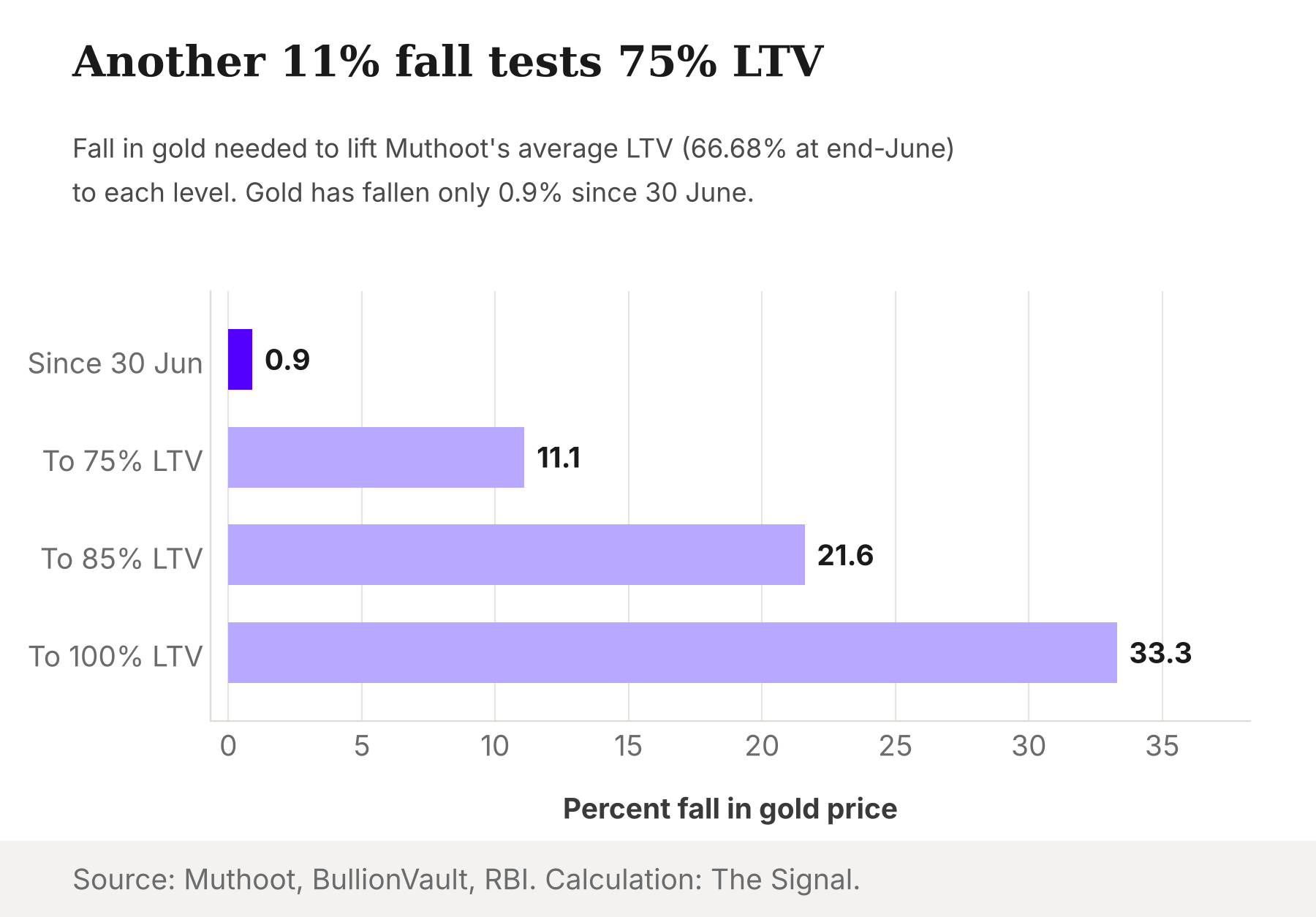
The first line to watch is 75%, about 11% below today. That is the lowest cap the RBI sets, so past it the average loan would breach the limit for large loans. That is a long way from a solvency problem, but it is where top-up demands and auctions would begin to multiply.
The honest objection
The strongest counter-argument is that an average hides a tail. Loans written near the January record at the 85% cap would already be underwater. Gold at $3,994 is 71% of its $5,608 peak, so an 85% loan written at the top now stands at roughly 119% of its collateral, and a 75% loan at about 105%. Any lender with a meaningful slice of such loans has a real problem, whatever the average says.
That case is real, and nothing public tells us how large that slice is. The answer is also less severe than it looks. Muthoot says most borrowers take around 75%, and only loans up to ₹2.5 lakh are eligible for 85%. The World Gold Council puts the January record lower, at US$5,405, which would make today's fall about 26% rather than 29%. Either way, the tail is a slice of recent loans, not the book.
A second objection is that the price is still falling. True, and the drivers are outside India's control: oil, US inflation data due on 29 October and a Federal Reserve meeting on 27 and 28 October. The runway above measures how far the fall can run before it reaches the lenders, not a forecast that it will stop.
The Signal
The headline fear is that gold's 29% crash will hit India's gold lenders. The crash has mostly already happened, and Muthoot's 66.68% was measured after it, when gold was within 1% of today's price, on a book that grew from a base near $2,200.
The risk is not the fall already behind us. It is a second fall of about 11%, to roughly $3,550, which would push an average book to the 75% line that the RBI's directions treat as the limit for large loans. Watch the next quarterly LTV disclosures, and watch whether lenders report more top-up calls or auctions. A cushion is only a fact until the price moves again.
Reporting basis: gold prices are from Trading Economics (the record and the 23 October level), BullionVault, reporting the London 3pm auction (30 June), and the World Gold Council (March 2024 and the alternative record). Loan growth and LTV trends are from the RBI's Financial Stability Report of June 2026, and the LTV caps and valuation rule are from the RBI's 2025 directions. The 66.68% LTV is Muthoot Finance's own figure from its earnings call and covers that company only, not banks or other NBFCs. The price comparisons, the 82% gap to March 2024, the 29% and 26% falls, the 0.9% change since 30 June, the LTV sensitivity table and the loans-at-the-peak estimates are The Signal's calculations from those figures.