On 15 October, SEBI rewrote the rules of the closing auction session, or CAS, the short auction that now sets the closing price of every stock with derivatives. The headline reading was a retreat. Traders had complained about the auction, and the regulator seemed to give ground.
That reading is half right. The auction survived. What changed is the job it does. SEBI's October circular says CAS "shall be implemented as a separate session of 10 minutes from 3:30 p.m. to 3:40 p.m.", where the January design specified "a separate session of 20 minutes from 3:15 pm to 3:35 pm". The auction is half as long and starts 15 minutes later.
It is worth slowing down on what else moved.
Settlement left the auction
Under the January framework, the expiry-day settlement price of an index contract was the index's closing price, built from the closing prices of its constituents. Those closing prices came out of the auction. So a few minutes of order matching decided what every expiring Nifty option paid.
The October circular cuts that link. On expiry day, SEBI now says, the index settlement price is based on "the volume-weighted average prices (VWAP) of the constituent securities during the last 30 minutes of the Continuous Trading Session". VWAP weights each trade by its size, so a thin print cannot move it much. Expiring index contracts also stop trading at 3:30 p.m., per the same circular, the minute the auction opens. The cash market still gets its auction. Derivatives no longer settle on it.
The changes take effect on 7 December 2026, except the order carry-forward rules, which start on 8 February 2027.
The number behind the change
The regulator's reasoning sits in its 12 September consultation paper. It compares expiry-day trading in benchmark index options across 26 expiries before CAS (February to July 2026) and 5 after it (3 August to 3 September 2026) on each exchange.
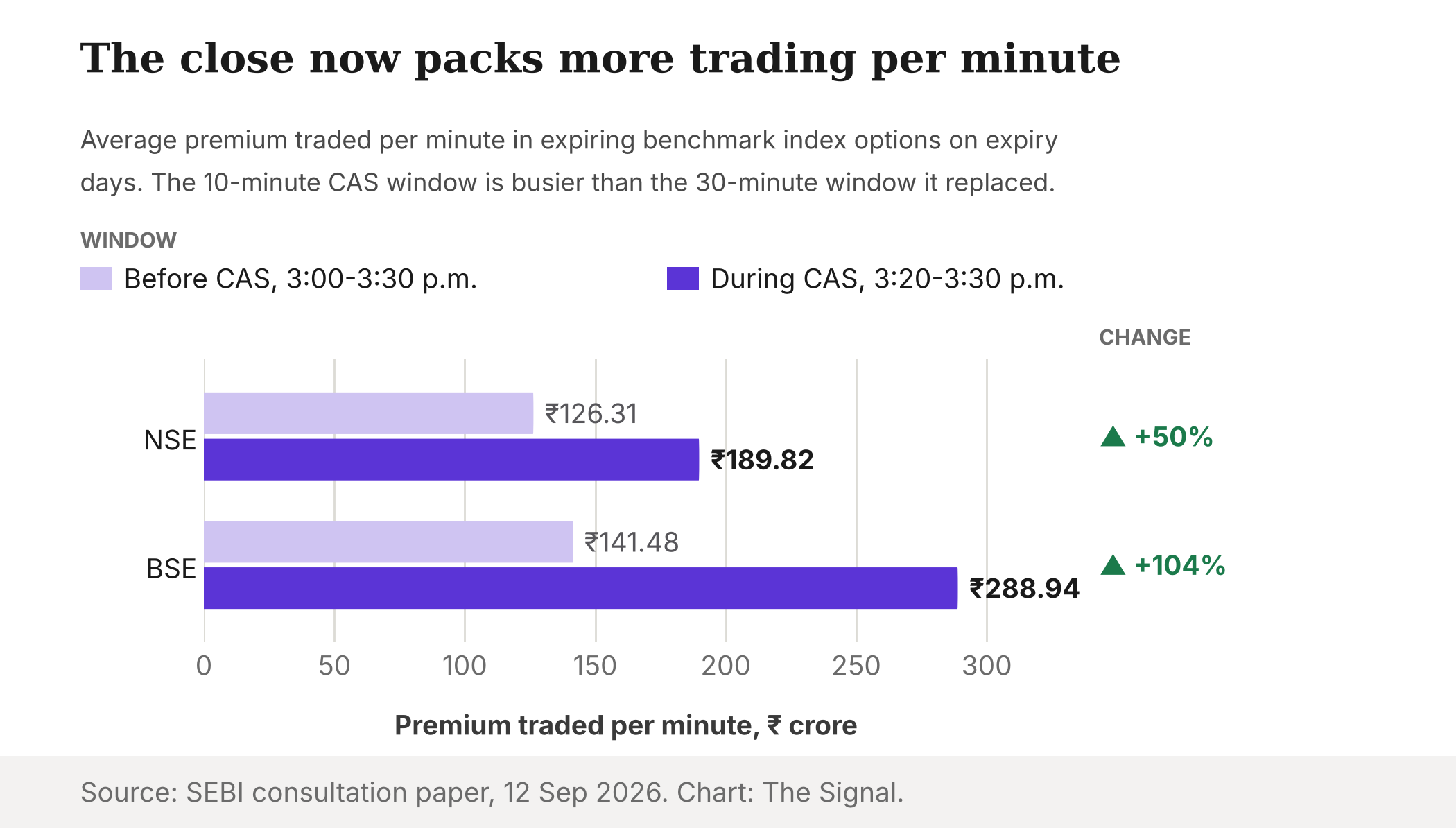
The finding is that option trading did not thin out as the settlement window shrank. On NSE, average premium traded per minute rose from ₹126.31 crore during 3:00 to 3:30 p.m. before CAS to ₹189.82 crore during 3:20 to 3:30 p.m. under CAS. On BSE it rose from ₹141.48 crore to ₹288.94 crore. That is a 50 percent increase on NSE and more than a doubling on BSE.
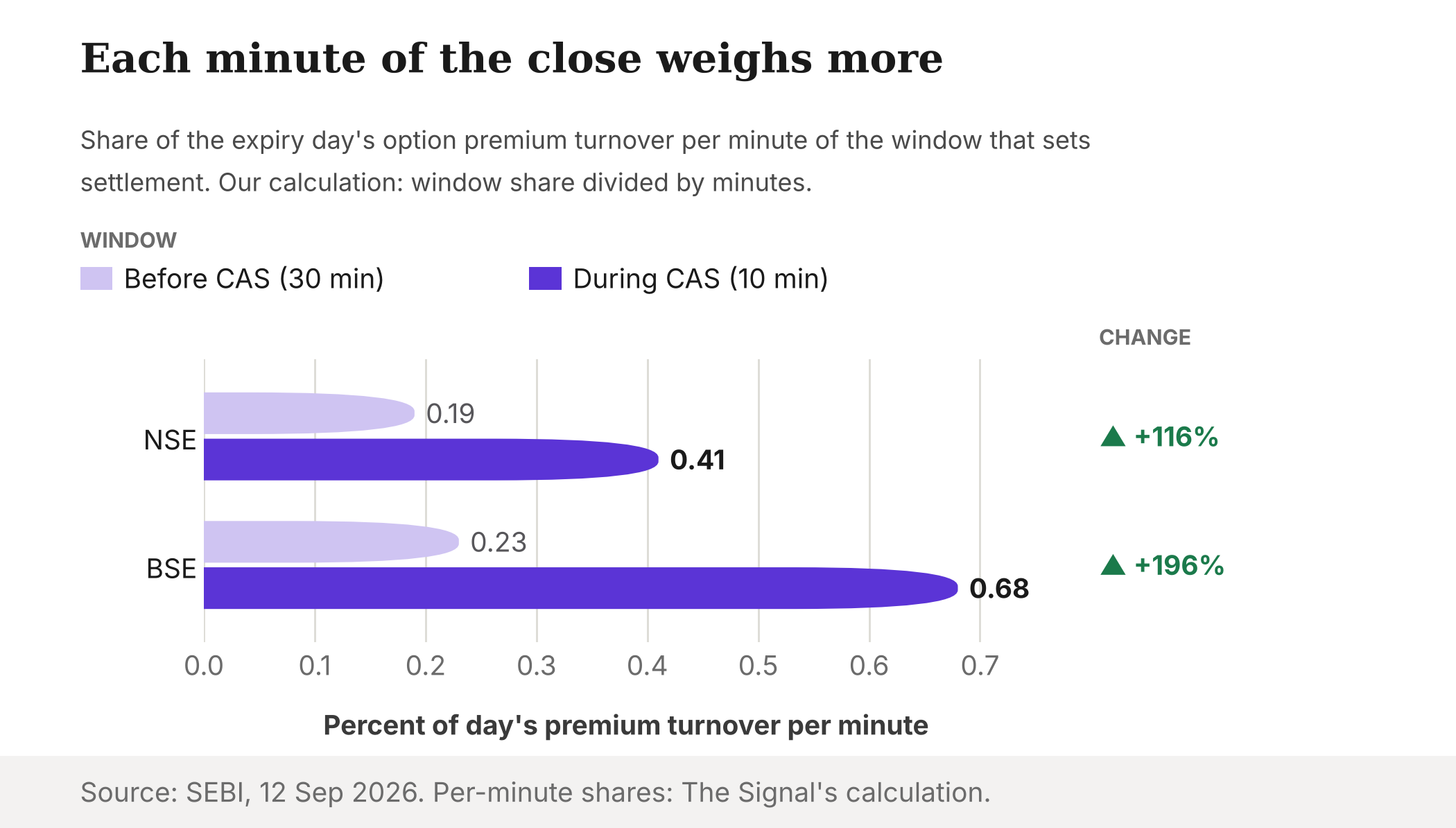
Look at the share of the day instead. SEBI's table puts the old 3:00 to 3:30 p.m. window at 5.72 percent of NSE and 6.75 percent of BSE premium turnover, and the 10-minute CAS window at 4.13 percent on NSE and 6.79 percent on BSE. On BSE, a window one third as long carried the same share of the day. Dividing by minutes, each minute of the settlement window now holds about 2.2 times as much of the day's NSE trading and about 3 times as much of BSE's. Those ratios are our calculation from SEBI's table.
There was also trading before the auction began. SEBI reports that the average premium traded during the five-minute transition from 3:15 to 3:20 p.m. was ₹791.50 crore on NSE and ₹668.38 crore on BSE, before order entry had even opened.
Why concentration matters
A settlement price is a single number that decides who pays whom. The shorter the window that sets it, the less trading it takes to move it, and the more reason there is to trade options against it. SEBI's own paper says the period relevant for determining settlement prices under CAS "is much shorter than the comparable pre-CAS period".
The data do not show manipulation, and SEBI does not claim any. They show a design in which a lot of option money rode on a short, thinly built price. Moving settlement back to the 30-minute VWAP spreads that exposure across three times as many minutes and across real trades.
The honest objection
The strongest case against this reading is that CAS was never meant to be a settlement tool. It was built to give closing prices a transparent discovery process, and a new auction takes time to attract participants. Early liquidity is not final liquidity. The 5 post-CAS expiries in SEBI's sample are a small base, and one volatile expiry could swing the averages.
That case is fair, and it explains why SEBI kept the auction for the cash market. It does not rescue the settlement link. Even if auction liquidity improves, a settlement price that depends on a 10-minute session will always be easier to lean on than one averaged over 30 minutes of continuous trading.
The Signal
SEBI's retreat was narrower than it looked. Its October circular protected the auction by taking away the one job that made the auction dangerous, which was deciding what expiring index options pay.
Watch two things after the 7 December start date. First, whether expiry-day premium keeps clustering in the last half hour, now that the settlement window is long again. Second, whether the auction's own trading grows once nothing in derivatives depends on it. A closing price is a number everyone sees. A settlement price is a number someone pays for.
Reporting basis: the January and October rules are from SEBI's own circulars of 16 January and 15 October 2026, read in full. The expiry-day premium figures, the five-minute transition totals and the 26-versus-5 expiry sample are from SEBI's consultation paper of 12 September 2026, which is the only source for them and which reports activity, not misconduct. Press accounts of the October circular disagree on the auction length, so this piece relies only on the circular text. All three sources are from SEBI, so the piece rests on a single origin. The per-minute share ratios are The Signal's calculations from those figures.