
The two biggest private lenders in India reported the same quarter on the same Saturday and produced very different results. ICICI Bank's profit after tax grew 20.1% year on year to Rs 148.43 billion in the September 2026 quarter. HDFC Bank's grew 4.7% to Rs 195.1 billion. The easy read is a verdict on management: one bank is compounding, the other is stalling.
It is worth slowing down on that. Two things sit inside those headline numbers, and they point in opposite directions. One flatters ICICI's growth. The other drags HDFC's. Once both are separated out, a real gap remains, but it is smaller and it comes with a cost.
HDFC Bank's number is a treasury story
Banks earn a trading profit on their bond books, and it swings with yields. HDFC Bank's presentation separates it. Profit after tax excluding treasury trading gains rose 12.6% year on year, against the 4.7% reported. So the core business grew nearly three times as fast as the headline suggests.
The rest of the picture is consistent with that. Other income, which includes fees and treasury gains, fell about 4% year on year. HDFC Bank's net interest margin was 3.16% on total assets, and its net interest income of Rs 34,619 crore came in below the analyst estimate of Rs 34,991.51 crore. HDFC Bank missed on its core lending income as well as on trading gains.
ICICI Bank's treasury was not the story
ICICI Bank had no such tailwind to lose. It booked a treasury loss of Rs 2.30 billion, against a Rs 2.20 billion gain a year earlier. That is a swing of Rs 4.5 billion in a bank whose pre-tax profit was close to Rs 200 billion, roughly 2%. Profit before tax excluding treasury grew 23.4%, which is higher than the reported figure, so treasury slightly held ICICI back rather than helping it. Core operating profit grew 21.8% to Rs 208.05 billion.
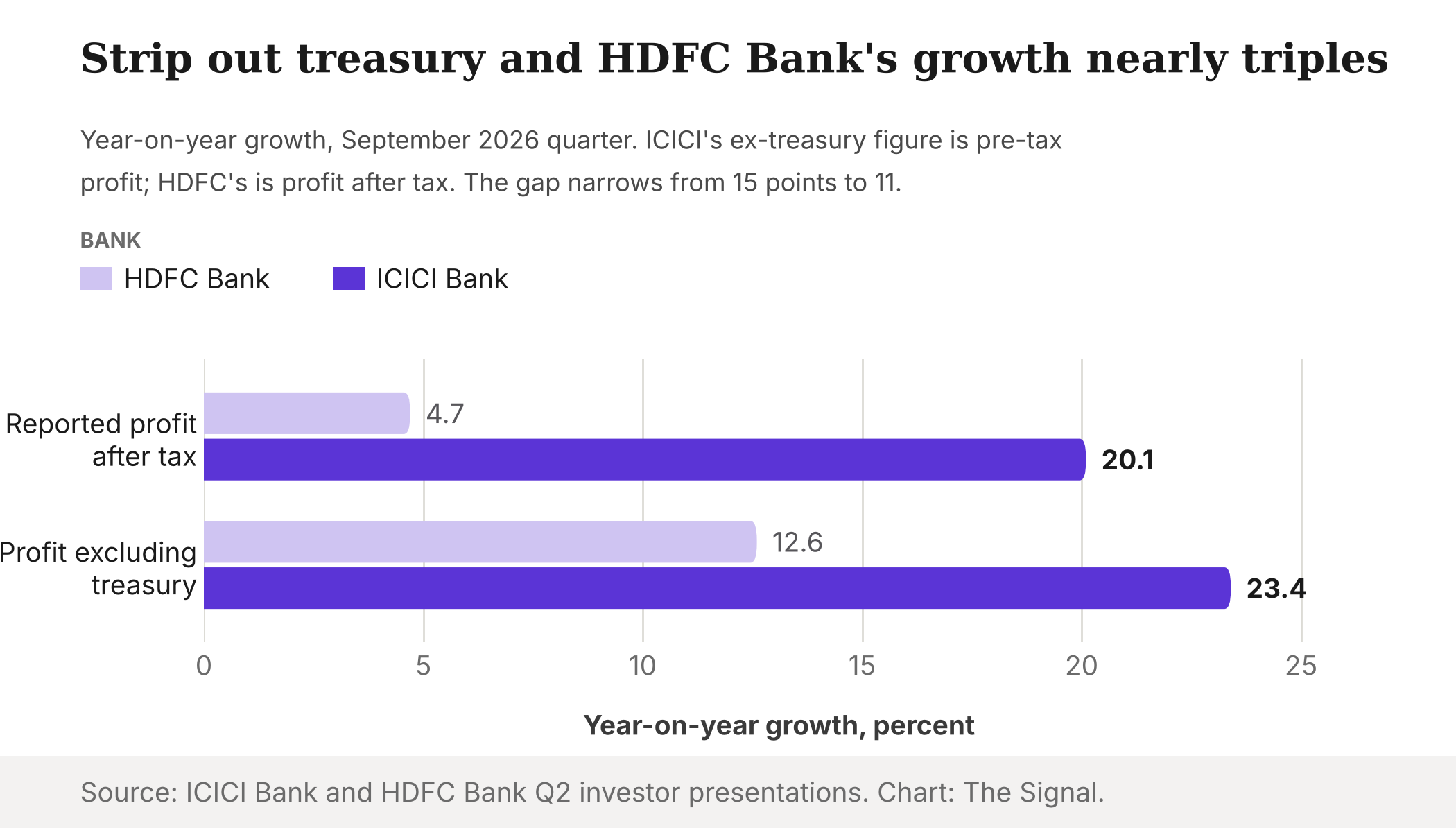
Set ICICI's 23.4% against HDFC's 12.6% and the gap falls from 15.4 points to 10.8. The two ex-treasury figures are not identical in kind, since ICICI's is before tax and HDFC's is after tax, so treat the 11 points as an approximation. The direction is not in doubt: about a third of the headline gap was a trading effect, not a franchise effect.
The dollar deposits underneath ICICI's growth
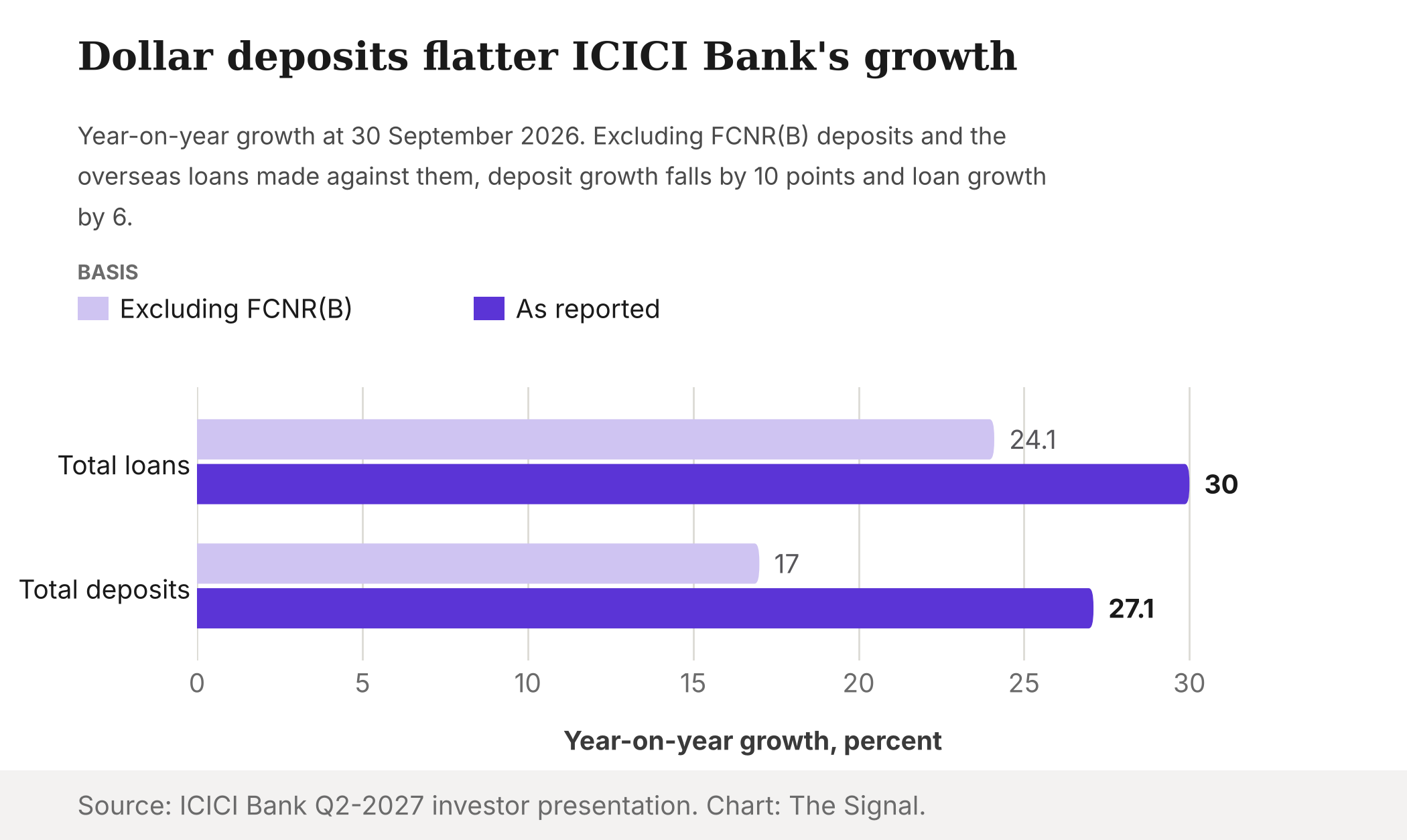
The second adjustment goes the other way. ICICI's balance sheet grew very fast in the quarter, and the bank itself breaks out FCNR(B) deposits and the loans made against them, a specific source of growth that the RBI created.
Total loans grew 30.0% year on year, but 24.1% once loans made by ICICI's international branches against FCNR(B) deposits are excluded. FCNR(B) deposits are foreign-currency term deposits from non-resident Indians. Deposits grew 27.1%, but 17.0% without them. Dollar-linked business therefore added about 10 points to deposit growth and about 6 points to loan growth.
The bank's overseas loan book rose from Rs 331.96 billion to Rs 1,429.54 billion in a year, and now makes up 7.8% of advances. That is 4.3 times the earlier size.
This is not an accident of ICICI's strategy alone. On 8 June 2026 the RBI opened a US Dollar-Rupee Forex Swap Facility for fresh FCNR(B) deposits of three to five years, with the circular saying the facility would remain open up to October 16, 2026. Banks sold the dollars they raised to the central bank. By the RBI's count, banks mobilised US$132,980 million of FCNR(B) deposits through 31 August 2026. The RBI built the window to pull dollars in, and ICICI used it heavily.
The price of the faster growth
The margin tells the other half. ICICI Bank's net interest margin was 4.18% in the September 2026 quarter, against 4.36% in the June quarter and 4.30% a year earlier. The margin fell 18 basis points in one quarter, in the same quarter that the overseas book swelled.
The margin and the overseas book moved in the same quarter, and the claim here is limited to that timing. But the logic is straightforward. A loan funded by a three-to-five-year dollar deposit, and made abroad, is a different product from a rupee home loan funded by a savings account. It is plausible that the mix pulled the average down, and the next quarter will show whether it did.
Even so, ICICI's margin is higher than HDFC Bank's. A margin of 4.18% on a larger and faster-growing base is not a weakness. The two margins are not quite comparable, because HDFC reports its figure on total assets and the definitions differ. The honest statement is that ICICI is growing faster while earning a margin that is moving the wrong way.
The honest objection
The strongest case against this reading is that growth is growth. Even without the dollar-linked loans, ICICI's core operating profit grew 21.8%, and loans still grew 24.1%. A bank that takes a government-designed funding window and turns it into earning assets is doing its job. On that view, discounting the FCNR(B) effect is nitpicking, and HDFC's ex-treasury 12.6% is simply the slower number.
That case is right on the facts and incomplete on the question. Nobody disputes that ICICI grew faster. The question is how much of the 15-point headline gap reflects a durable difference in the franchise. Treasury accounts for several points, and a temporary RBI window accounts for part of what remains in the balance sheet. Neither will repeat at the same scale. Analysts expected ICICI's profit at 143.65 billion rupees, and the bank beat it, so the result was strong. It was strong, though, in a quarter with unusual help.
The Signal
The reported gap of 15 points between ICICI and HDFC overstates the difference in how well the two franchises are run. Treasury explains why HDFC looks weak. A dollar-deposit window explains part of why ICICI looks strong. What is left is a real lead, in the range of ten points on profit growth, and a falling margin on the faster bank.
Two things decide whether that lead lasts. The first is what happens to ICICI's overseas book after the swap window. The RBI's repo rate is now 5.50% after the 7 October hike, so the next set of results will show how these loans and deposits behave when the incentive is gone. The second is whether HDFC's trading gains return. Watch ICICI's margin in the December quarter. A bank that grows 20% while its margin slips has bought growth, and the price shows up in the next filing.
Reporting basis: ICICI Bank's figures are per its Q2-2027 investor presentation, and HDFC Bank's are per its Q2 FY2027 earnings presentation. Each is a company filing, so each reflects what the bank reports about itself. The RBI facts are from the RBI's circular of 8 June 2026, its press release of 21 September 2026 and its Governor's statement of 7 October 2026. The analyst estimates are per Investing.com, citing a Bloomberg survey, and The Hans India, reporting agency copy. The dollar-linked growth effects, the 4.3 times overseas book multiple, the treasury swing as a share of profit and the narrowing of the gap between the banks are The Signal's calculations from those figures. HDFC Bank's ex-treasury profit is after tax and ICICI Bank's is before tax, so the two are not exactly comparable.