On 16 October 2026, the Jakarta Composite fell 614 points, or 10.6%, to 5,240, Business Today reports. That was its worst day since January 1998, and left the index down 39% for the year. The trigger was clear. Nikkei Asia reported that Indonesian stocks plunged more than 10% after MSCI signalled it was considering a downgrade of the MSCI Indonesia Index to standalone market status.
The easy reading is mechanical: an index provider threatens a country, tracker funds sell, prices collapse. It is worth slowing down on that, because MSCI's own figures point somewhere else.
What MSCI actually proposed
On 15 October 2026, MSCI announced a consultation on a proposal to reclassify the MSCI Indonesia Indexes from Emerging Market to Standalone Market status. MSCI says it will announce its final decision by the end of June 2027. It also says it expects to proceed with the reclassification unless the consultation identifies clear evidence of material improvements in market governance and functioning.
So this is a proposal with a long runway, not an exclusion that has taken effect. The market did not wait for the decision. It repriced on the signal.
The figure that carries the thesis
MSCI's consultation document reports that Indonesia's weight in the MSCI Emerging Markets Index has dropped from 1.16% to 0.43%. The float-adjusted market capitalisation of the Indonesian constituents fell from about $119.1 billion to about $53.4 billion, and the number of constituents fell from 18 to 9. The comparison runs from 31 December 2025 to 30 September 2026.
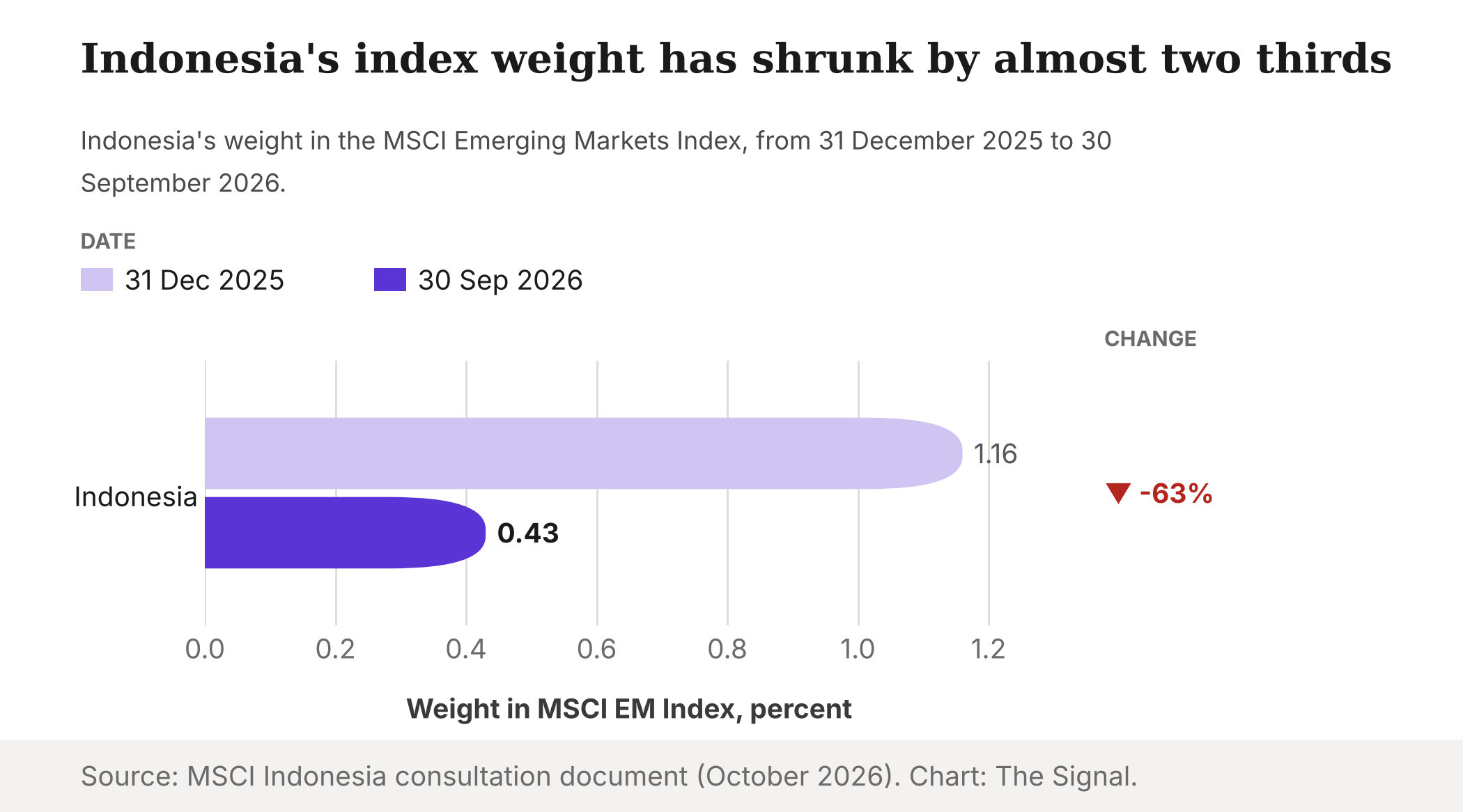
Set that against the whole benchmark. MSCI's factsheet as of 30 September 2026 shows the Emerging Markets Index at about $12.28 trillion of market capitalisation, with 1,165 constituents. Indonesia's $53.4 billion float-adjusted figure, set against $12.28 trillion, is the 0.43% in the headline.
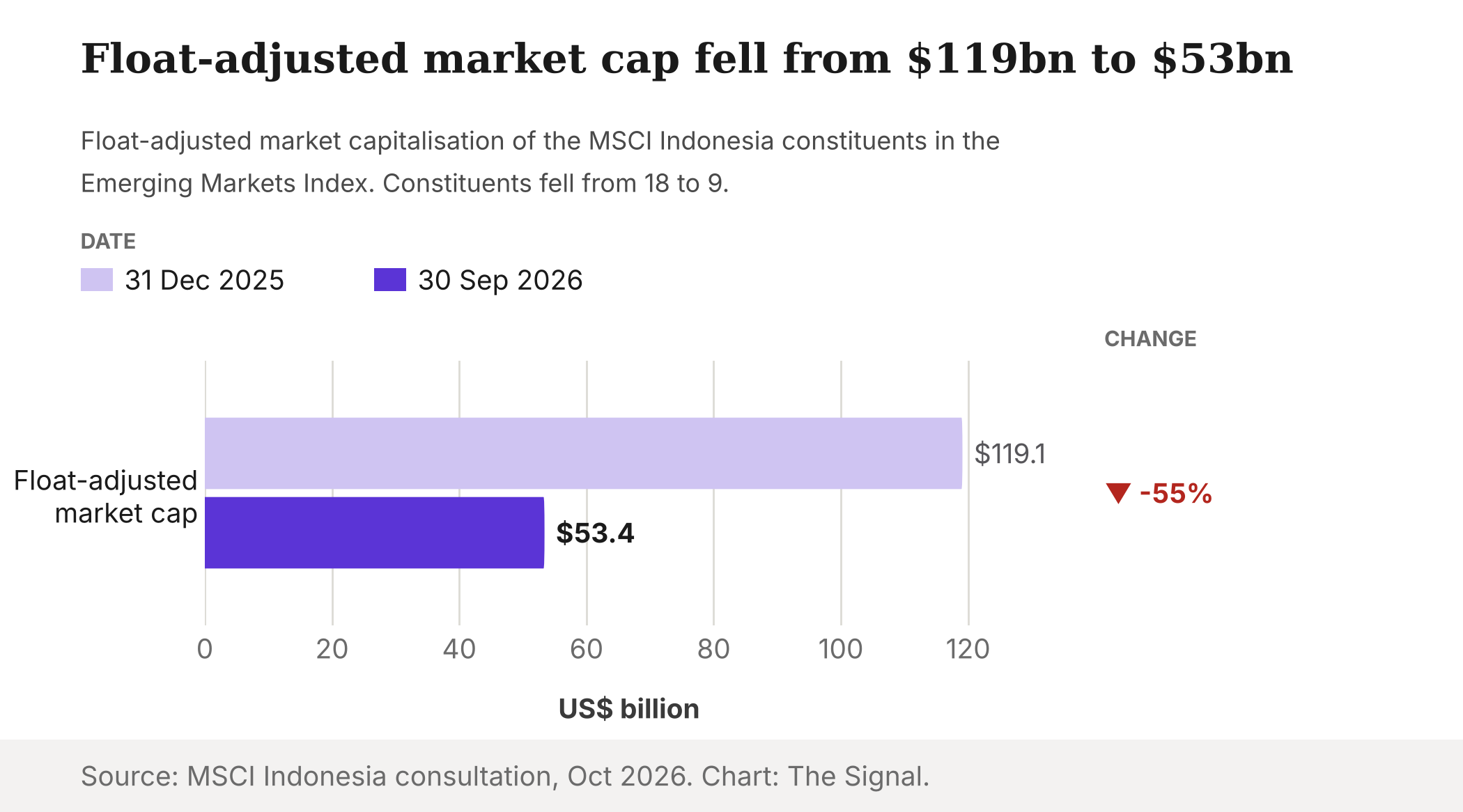
That shrinking came before the proposal. A market that is 0.43% of a benchmark is a small line in an emerging-market fund. This does not prove index selling played no role on the day, and we have no data on tracker assets. It does mean the 10.6% one-day fall, reported by Business Today, sits awkwardly beside a 0.43% weight.
A freeze that signalled the problem early
The index provider had already acted well before the consultation. MSCI's consultation document states that since January 2026 it has applied a freeze on certain index-related changes for Indonesian securities. That included increases to Foreign Inclusion Factors or Number of Shares, additions to the MSCI Indonesia Investable Market Index, and upward migrations across size-segment indexes. The document describes the freeze as continuing.
A Foreign Inclusion Factor is the share of a company's stock that foreign investors can actually buy. Freezing it means the index will not give Indonesian companies more weight.
The real subject is free float
The language MSCI uses for the problem is not about money flows. MSCI's 2026 Market Classification Review release says in June 2026 that opacity in shareholding structures and suspected coordinated trading materially limit investors' ability to assess true free float and to rely on observed market prices for portfolio construction and index replication.
Free float is the share of a company that trades freely. If you cannot tell how much is really in public hands, you cannot size a position. And where coordinated trading may be shaping prices, a price stops being a clean signal.
Indonesia's authorities have responded. MSCI's consultation document says that market participants have indicated that, to date, sufficient progress has not been observed consistently across the Indonesian equity market. It says significant concerns remain around market dysfunction, including continued suspected coordinated trading behaviour and lack of evidence of meaningful enforcement. The reforms it lists include shareholder disclosure above 1%, reporting on high shareholding concentration, and a roadmap to a 15% minimum free float.
Our reading is that the crash priced doubt about who owns Indonesian stocks and whether their prices are real. That is an inference, not a finding in any source.
Where India sits
India matters here because its weight is not small. MSCI's factsheet as of 30 September 2026 shows India at 10.65% of the Emerging Markets Index, behind Taiwan at 28.94%, South Korea at 21.4% and China at 19.8%. Brazil is at 4.09%. India's 10.65% is about 25 times Indonesia's 0.43%.
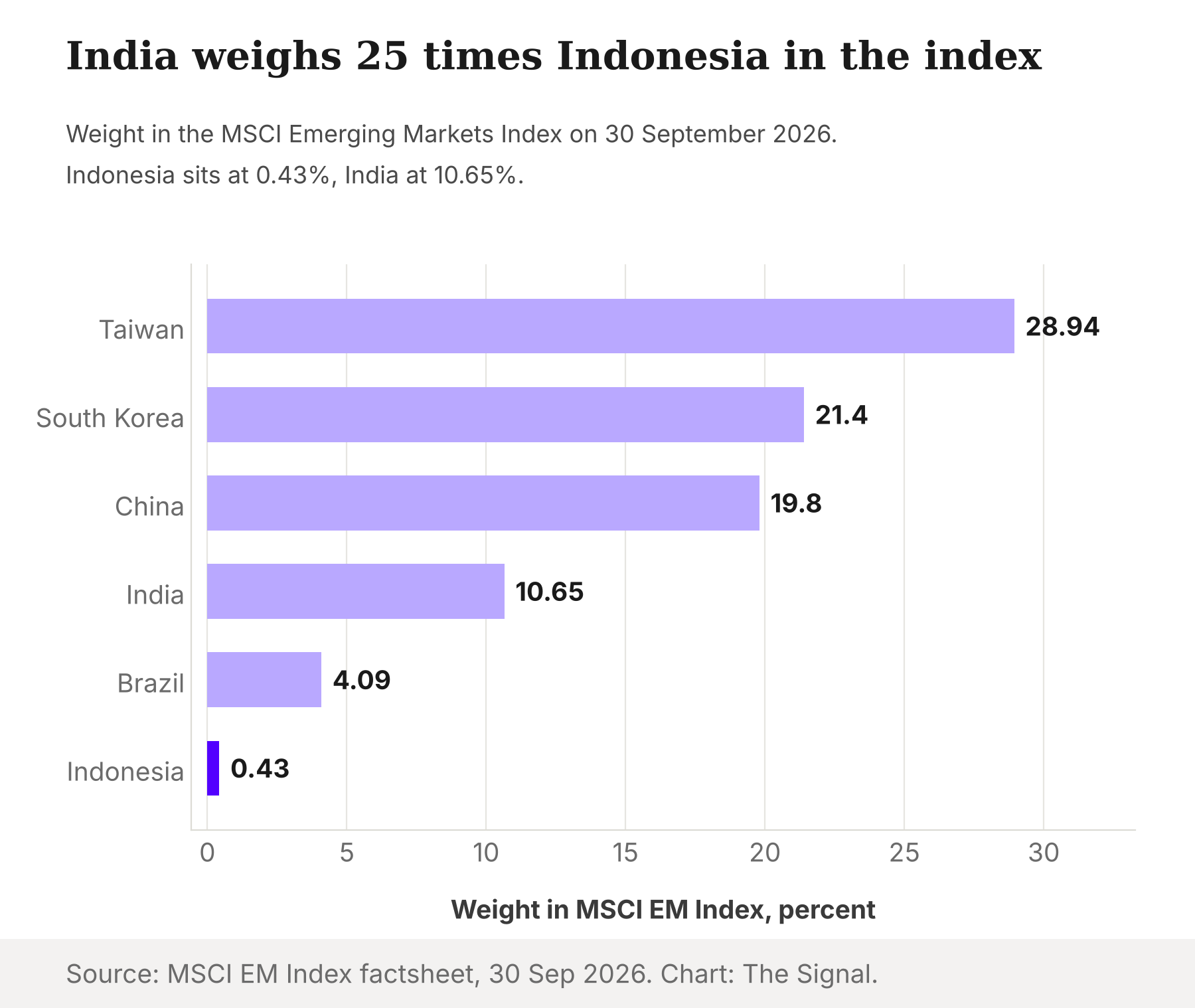
| Country | Weight in MSCI Emerging Markets Index, 30 September 2026 (percent) |
|---|---|
| Taiwan | 28.94 |
| South Korea | 21.4 |
| China | 19.8 |
| India | 10.65 |
| Brazil | 4.09 |
| Indonesia | 0.43 |
Source: MSCI Emerging Markets Index factsheet and MSCI's Indonesia consultation document, with the Indonesia figure from the same date.
Nothing in these documents suggests India faces a reclassification. The proposal and its concerns are specific to Indonesia. India's risk is different and slower: its weight is only as large as the float MSCI counts for each Indian company.
Here India has a structural answer. The Securities Contracts (Regulation) Rules, 1957, as hosted by SEBI, provide in Rule 19A that every listed company other than a public sector company shall maintain public shareholding of at least twenty five per cent. Compare that with the 15% minimum free float that Indonesia's authorities are on a roadmap toward. On the face of the two rules, India's floor is higher. The rule is a minimum, though, not a measure of how much stock truly trades freely, and the MSCI documents cited here say nothing on how MSCI scores Indian companies.
The honest objection
The strongest case against this reading, given the 0.43% weight, is that a thin market does not need big tracker money to break. A downgrade proposal also alerts active managers who benchmark to the index, and fear can empty a market faster than any weight suggests.
That case is real, and it can sit beside the free-float reading. But it explains the speed of the move, not its origin, and the public figures here cannot size any forced selling.
The Signal
The consensus reading is a flows story: a benchmark threatens, funds sell, prices fall. But Indonesia is 0.43% of the Emerging Markets Index, down from 1.16% in December 2025, and the market still lost 10.6% in a day.
For India, the lesson is not that exclusion looms. At 10.65% of the index, about 25 times Indonesia's 0.43%, India is in a different position. The lesson is that weight depends on trust in free float. MSCI froze changes to Indonesian weights from January 2026 and flagged free-float opacity in June 2026. The downgrade proposal came in October 2026.
Watch the calendar. Feedback is due on 30 April 2027 and MSCI's decision falls on or before 30 June 2027. The test for Jakarta is evidence of enforcement, not new rules. For Indian investors the standing question is how clearly Indian companies show who holds their shares. An index weight is a number you are lent, and it lasts only as long as the float behind it is believed.
Reporting basis: the proposal, the freeze, the index weights and the free-float concerns are from MSCI's own documents (press release, consultation document, Market Classification Review release and index factsheet), which are one origin. India's minimum public shareholding is from Rule 19A of the Securities Contracts (Regulation) Rules, 1957, as hosted by SEBI. The 16 October market move is per Business Today, as also reported by Nikkei Asia; neither is exchange data we checked. The reading that the fall priced a loss of trust is our inference and is not stated by any source. The 25 times multiple, the fall in weight and the market capitalisation check are The Signal's calculations from those figures.