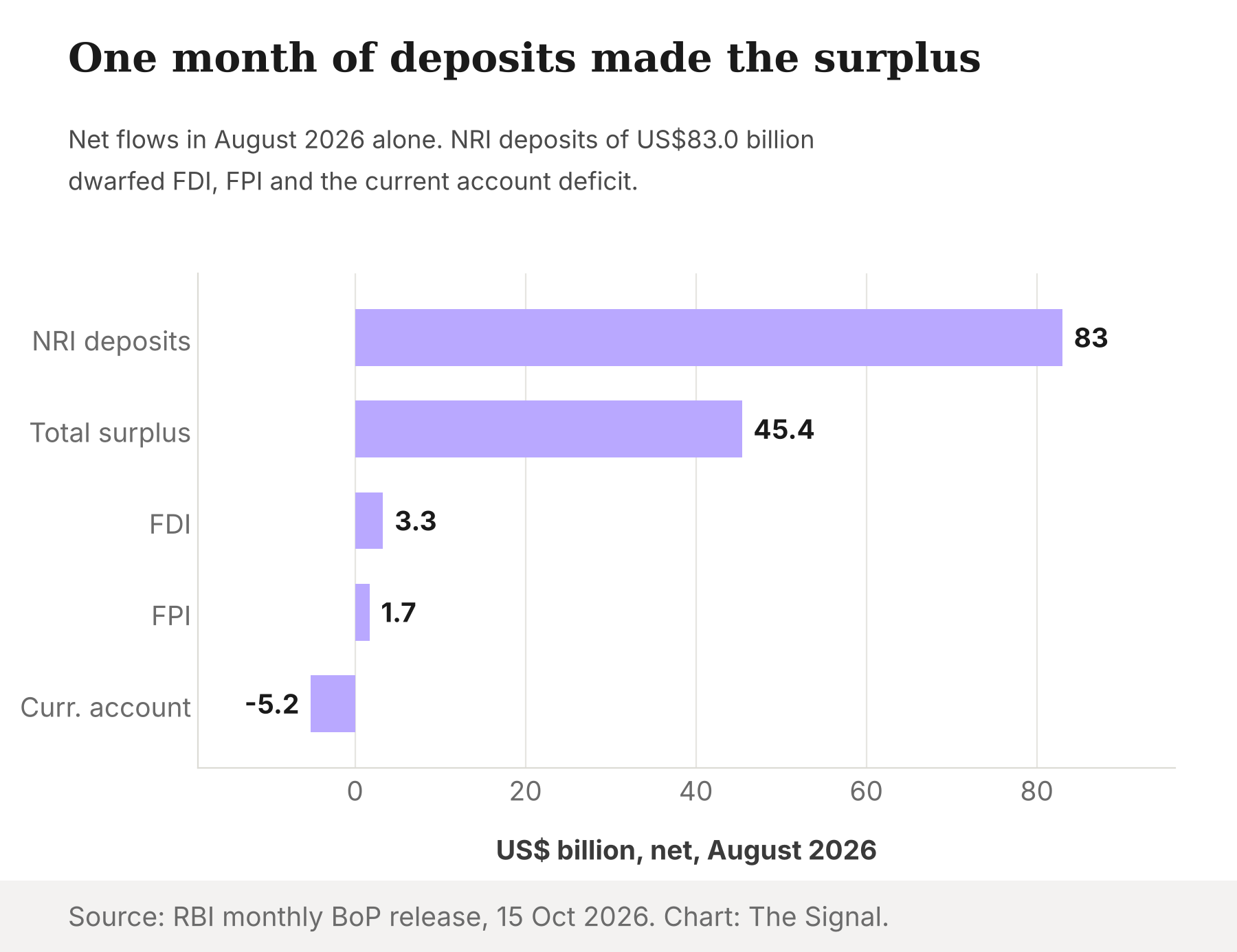
On 15 October the Reserve Bank of India published its monthly balance of payments for August, and the headline was easy to read as good news. The current account deficit narrowed to US$5.2 billion from US$6.1 billion a year earlier, according to the RBI's preliminary figures. The overall balance of payments swung to a surplus of US$45.4 billion, against a deficit of US$5.6 billion in August 2025. For April to August, the same release shows a surplus of US$58.0 billion. A country that adds US$58.0 billion to its external position in five months looks like a country in good shape.
It is worth slowing down on that. A balance of payments surplus is not earnings. It is the sum of what the country earned or lost on trade and services, plus what the world chose to lend or invest in it. Look at which of those moved.
The surplus is a deposit story
The RBI's table is plain on this. In August, net banking capital was an inflow of US$64.7 billion, against an outflow of US$4.7 billion a year earlier. Inside it, net deposits from non-resident Indians were US$83.0 billion, against US$1.0 billion in August 2025. Foreign direct investment was US$3.3 billion and foreign portfolio investment was US$1.7 billion. In one month, NRI deposits were about 16 times the current account deficit.
The five-month view is starker. Over April to August 2026, net NRI deposits were US$119.2 billion, the capital account total was US$76.3 billion, and the current account deficit was US$18.3 billion, up from US$12.8 billion a year earlier. NRI deposits alone were 6.5 times the deficit and more than twice the overall surplus of US$58.0 billion.
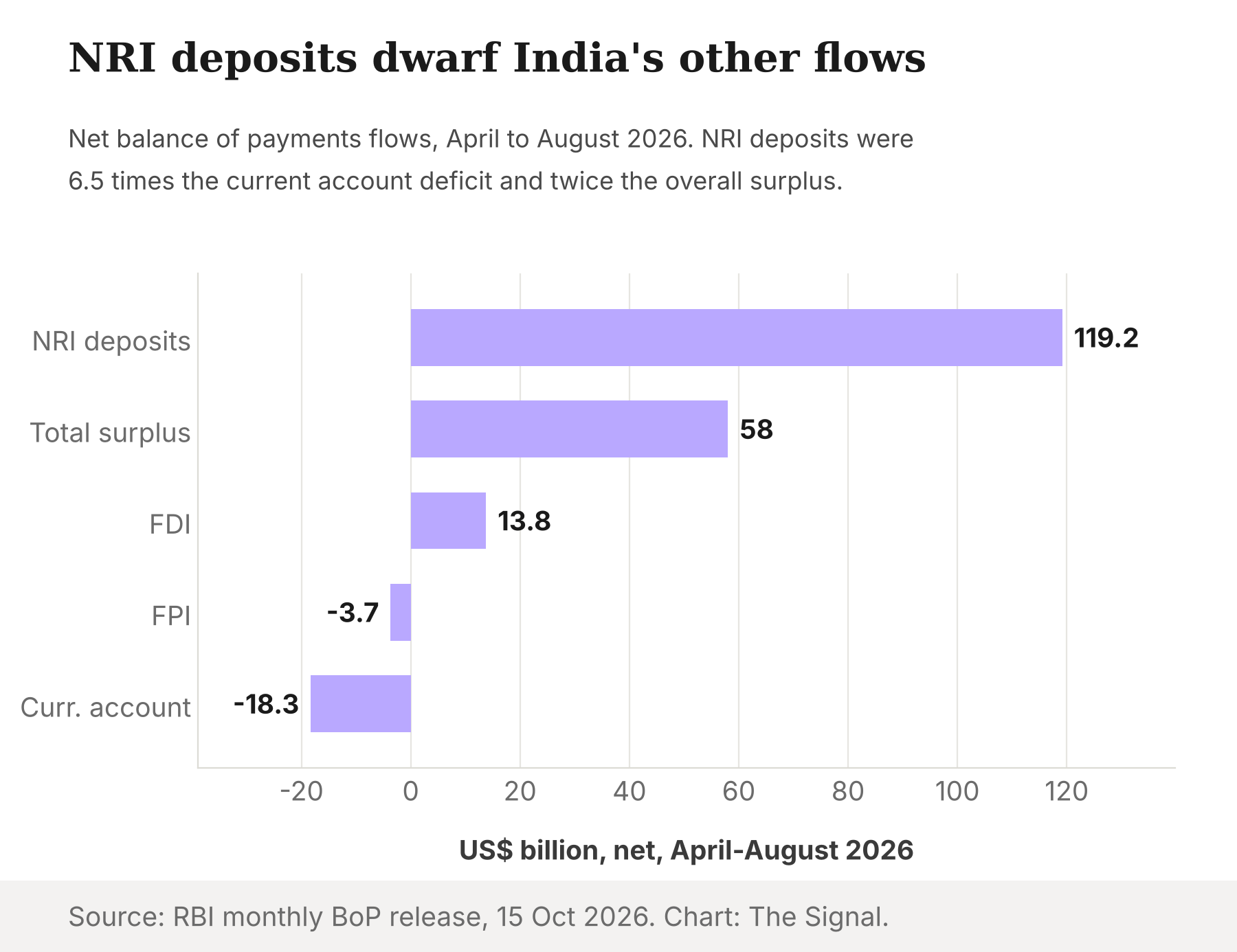
Take the deposits out and the picture inverts. Over the same five months, net FPI was an outflow of US$3.7 billion and net FDI was US$13.8 billion. Subtract the US$119.2 billion of NRI deposits from the US$76.3 billion capital account and the rest of the capital account was a net outflow of US$42.9 billion. Holding every other flow unchanged, the overall balance without the deposits would have been a deficit of about US$61.2 billion. Those last two figures are The Signal's calculations.
The current account itself is not improving. The merchandise deficit grew to US$146.0 billion for April to August, from US$124.7 billion a year earlier, about 17 percent more. The services surplus rose to US$85.8 billion from US$79.9 billion, which covered only part of the widening. August's smaller deficit is one month. The five-month deficit is bigger than last year's.
Where the deposits came from
The deposits did not arrive by accident. On 8 June the RBI opened a swap facility for fresh FCNR(B) deposits, foreign currency deposits held by non-residents. The deposits must run for a minimum of three years and a maximum of five. The bank sells the dollars to the RBI at the FBIL reference rate and agrees to buy the same amount back at the same rate when the deposit matures. The circular says the swap is "undertaken at par", carries a one-year lock-in on the deposit, and cannot be cancelled.
The scale followed. RBI data released on 21 September show forex inflows under the swap facility of US$143,596 million up to 18 September, of which FCNR(B) deposits were US$132,980 million, mobilised until 31 August. The balance of payments release does not say how much of the US$119.2 billion of NRI deposits ran through the facility, so the two totals should not be equated. They are, however, of the same order of magnitude, and the timing matches: the deposits surged after the window opened.
The contrast with the spring is sharp. In April to June, a quarter in which the window opened only on 8 June, the current account deficit was US$4.2 billion (0.5 percent of GDP) and reserves fell US$8.1 billion on a balance of payments basis, against an accretion of US$4.5 billion a year earlier. By the end of August, the five-month surplus stood at US$58.0 billion.
What the swap means
The deposits are liabilities. The dollars the banks sold to the RBI count toward its reserves today, and under the circular's terms the same dollars must be bought back at the same rate at maturity. For deposits mobilised between 8 June and 31 August 2026, with tenors of three to five years, that points to a repayment window running from 2029 to 2031. This is our reading of the circular's terms, not a figure the RBI has published.
That does not make the facility a mistake. It buys time and keeps the rupee from absorbing the whole weight of a widening current account. But it changes what the surplus means. A surplus earned through exports and investment stays. A surplus assembled from long-dated deposits swapped into the central bank is a loan from the diaspora, with the repayment date set in advance.
The honest objection
The strongest case against this reading is that long-dated deposits are about as stable as foreign funding gets. Three to five years, with a one-year lock-in, is far stickier than portfolio money, which can reverse in a week, and the portfolio line in the RBI's table shows that money is not what is coming in. The deposits also come from the diaspora, whose reasons for holding rupee-linked assets are different from those of a trading desk. If the current account deficit narrows over three years, the repayment becomes routine rollover, and the cushion will have done exactly what it was built to do.
That case is real. It explains why the structure is not alarming. It does not erase the arithmetic: the cushion exists because the deficit is being financed rather than closed, and over April to August the deficit grew to US$18.3 billion from US$12.8 billion.
The Signal
The surplus is a measure of how much was borrowed, not how much was earned. NRI deposits of US$119.2 billion cover a US$18.3 billion deficit more than six times over, which is why the number looks reassuring and why it should be read with care. Watch two things. First, whether the merchandise deficit, US$146.0 billion for April to August, stops widening before the 2029 maturities begin. Second, whether the portfolio line turns positive, which would mean markets, not only relatives, are buying India. A cushion filled by deposits is a good cushion until the day it has to be returned.
Reporting basis: every balance of payments figure, the swap facility's terms and the inflow totals are from the Reserve Bank of India's own monthly release, circular and data releases, so the piece rests on a single origin, and the RBI marks the August figures preliminary. The ratios, the two counterfactual totals, the merchandise percentage rise and the repayment window are The Signal's calculations from those figures.