Around 17 fund houses told their unitholders this week that they would restrict new subscriptions to gold ETF fund-of-fund schemes from 15 or 16 October 2026, depending on the fund house. Angel One reports that redemptions and existing systematic transactions continue. The timing is the obvious story: Dussehra and Diwali fall in India's gold-buying season, and the easy read is that someone wants a lid on a new channel for gold demand before it opens fully.
That reading is fair. It is also incomplete. HDFC Mutual Fund imposed similar limits in June, and what happened after that first round is the more useful fact.
The first curb came in June
On 4 June 2026, HDFC Mutual Fund published an addendum to its scheme documents. Direct subscriptions of Rs 25 crore or more into HDFC Gold ETF would not be accepted from 8 June, and lumpsum purchases into its gold fund of funds were capped at Rs 10 lakh per PAN per month. The fund house called the measures temporary and said it acted "in light of the broader economic and market conditions."
Reuters reported the same move, noting that the fund house cited broader economic and market conditions. Neither document says more than that. The reasoning behind the curbs was left for readers to infer.
The money kept coming
Here is the number that complicates the story. Gold ETFs drew Rs 4,450.61 crore of net inflows in September 2026, against Rs 2,596.70 crore in August, according to AMFI data as relayed by 5paisa. That is a rise of about 71 percent in a single month, three months after the first curbs.
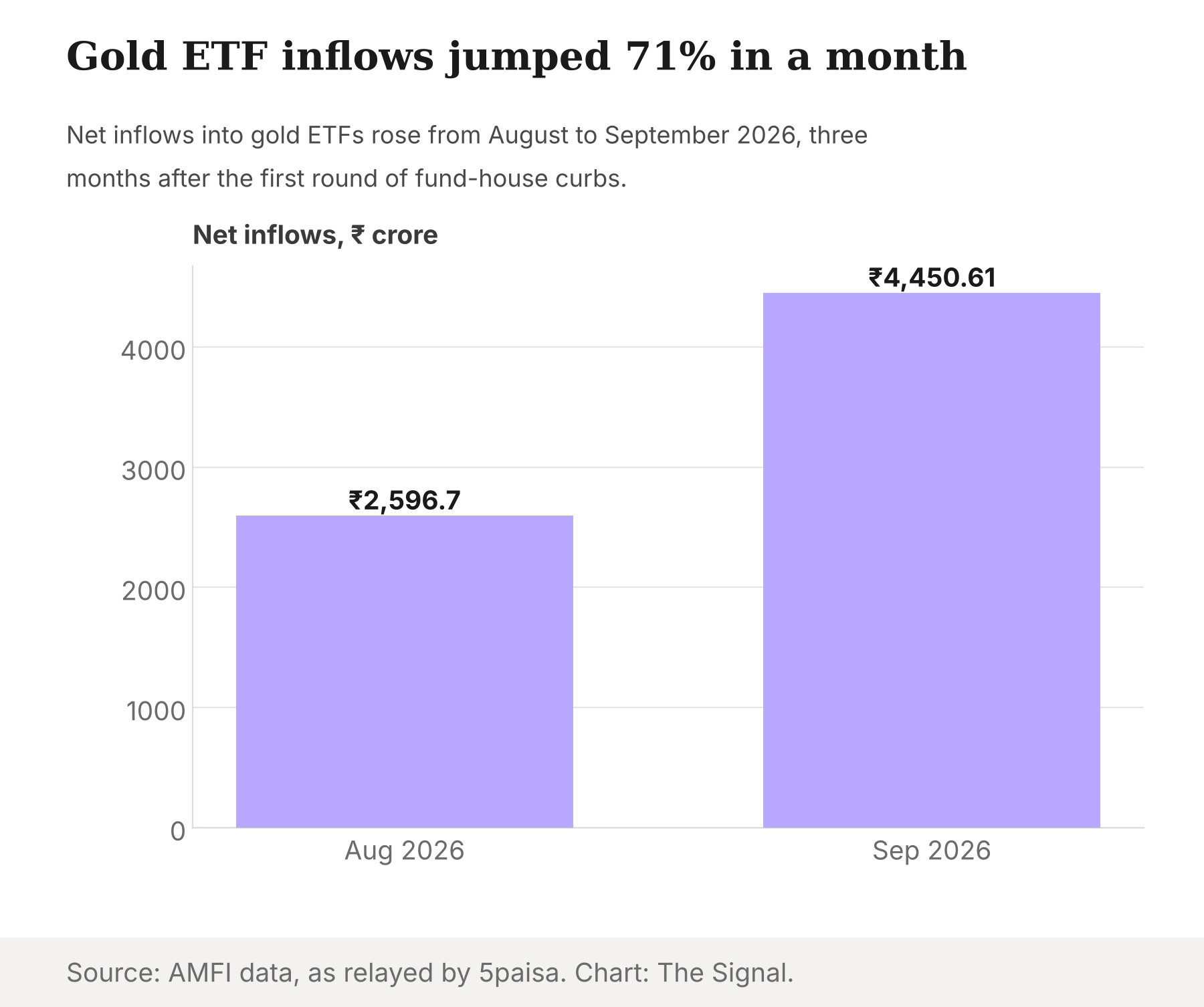
We cannot prove why. The June limits targeted large direct subscriptions and fund-of-fund lumpsums, not every route into gold. A plausible reading is that the first curb trimmed the top of the market while other demand carried on and grew. That is an inference from the pattern, not something any fund house has said.
A small channel carrying a large signal
Now set the channel against the whole market. The World Gold Council reports that Indian gold demand was 131 tonnes in the second quarter of 2026, down 6 percent from a year earlier. Gold ETF demand was about 4 tonnes in the same quarter. Four against 131 is roughly 3 percent. Net bullion imports, which dominate supply, were 98 tonnes, so ETFs were around 4 percent of that figure too.
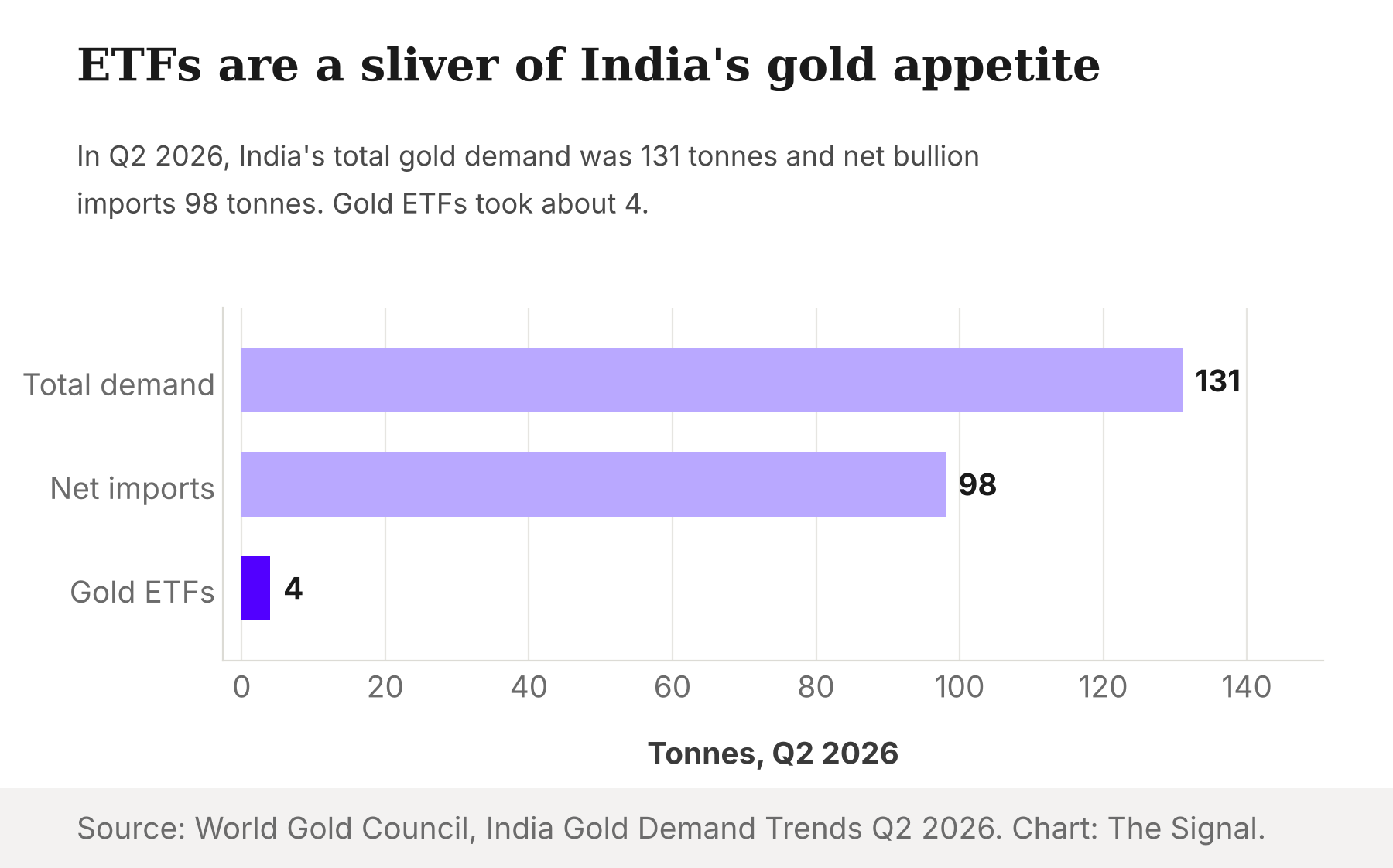
Two caveats apply. The World Gold Council figure covers the second quarter of 2026, before the September surge, so ETFs may now be a larger share. And the two data series differ: AMFI counts rupees of net inflow into funds, while the World Gold Council counts tonnes of demand.
Even so, the gap is wide. If the aim of a curb is to cut the volume of gold India buys, the ETF channel is a small lever. If the aim is to stop a fast-growing, easily scaled channel from becoming a large one just as the festive season opens, the logic is different. The curb is aimed at where demand could go, not where it is.
The honest objection
The strongest counter-argument is that a cap does not need to move the national total to matter. HDFC itself framed its June curbs as a response to market conditions. Fund houses that take in money must buy gold, and a surge of new units is something a fund manager might slow for operational reasons. On this view the curbs are about managing funds, not about managing imports, and reading policy into them is overreach.
That case has force, and the fund houses have given no specific reasons. But it does not explain why so many houses acted within a day or two of each other. Coordinated timing of that kind suggests a shared prompt. The honest summary is that the motive is unconfirmed, while the pattern is hard to read as coincidence.
Gold already sits in the reserves
The reserves are where official gold sits, and where the gold-import question ends up. The RBI's weekly statistical supplement shows gold reserves of US$113,816 million within total reserves of US$785,706 million as of 4 September 2026. That puts gold at about 14.5 percent of reserves on that date. The RBI has published newer weekly supplements since, so this is a lagged reading, and it says nothing about what India's gold buyers do next.
The Signal
The curbs are best read as a statement about direction, not size. Gold ETFs were a small share of quarterly demand, yet inflows rose sharply in a month while the first round of limits was in place. Fund houses can ration the one channel they can switch off with an addendum, and jewellers and bullion dealers do not answer to them.
Watch the next AMFI monthly flow figure for gold ETFs. If flows fall once the new curbs bite and gold buying simply moves to bars, coins and jewellery, the policy has moved demand rather than reduced it. A channel you can close is not the same as a demand you can contain.
Reporting basis: the October restrictions by the fund houses are per Angel One's compilation of their notices, which we have not checked against each notice. The June limits are per HDFC Mutual Fund's own addendum, as also reported by Reuters via MarketScreener. Monthly gold ETF inflows are AMFI figures as relayed by 5paisa, a single secondary source. Quarterly demand, ETF and import tonnage are from the World Gold Council. Reserve figures are from the RBI's weekly statistical supplement. The percentage changes, shares of demand and share of reserves are The Signal's calculations from those figures.