
On 15 October 2026 the Supreme Court dismissed the appeals against a Bombay High Court order, upholding the 2023 quashing of Yes Bank's Rs 8,415 crore Additional Tier 1 (AT1) write-off, according to Gujarat Samachar. The same day, Yes Bank stock slipped 9% to Rs 19.30 against a previous close of Rs 21.21, Business Today reported. The easy read is a one-bank story: a rescue from 2020 comes unstuck, and the lender owes someone money.
It is worth slowing down on that. AT1 bonds are not ordinary debt. They count as bank capital precisely because RBI's rules require them to be permanently written off or converted into shares when a bank reaches the point of non-viability. If a court decides a cancellation was not done properly, every holder of every AT1 bond in India has been handed a new piece of information about what the instrument is worth.
What an AT1 bond promises
AT1 is the cushion banks sell to investors so that losses fall on bondholders before they fall on depositors or taxpayers. RBI's Basel III rules say these instruments must either be permanently written off or converted into common shares at the point of non-viability, at RBI's option. The same RBI circular, issued in September 2014, says the pre-specified loss trigger for AT1 must be at least Common Equity Tier 1 capital of 6.125% of risk-weighted assets.
The bond, in other words, is sold with a loss clause. Investors accept a higher coupon in return. The price of that coupon is the possibility of a wipe-out.
In March 2020, that clause was used. RBI's draft Yes Bank scheme, published on 6 March 2020, said Basel III AT1 instruments issued by the bank shall stand written down permanently, in full, with effect from the appointed date. Per Moneylife's account of the Supreme Court hearing, AT1 bonds worth Rs 8,415 crore were fully written off on 14 March 2020.
The bonds are small. The precedent is not
The government's own numbers show why this is bigger than Yes Bank. Moneylife reported that, in submissions to the court in May 2026, Indian banks hold more than Rs 1 lakh crore of AT1 bonds. In the October hearing, Gujarat Samachar reported the Solicitor General put it at about Rs 1.81 trillion remaining active across Indian lenders. The two figures differ, and the sources do not reconcile them. On the larger one, Yes Bank's Rs 8,415 crore is under 5% of the stock.
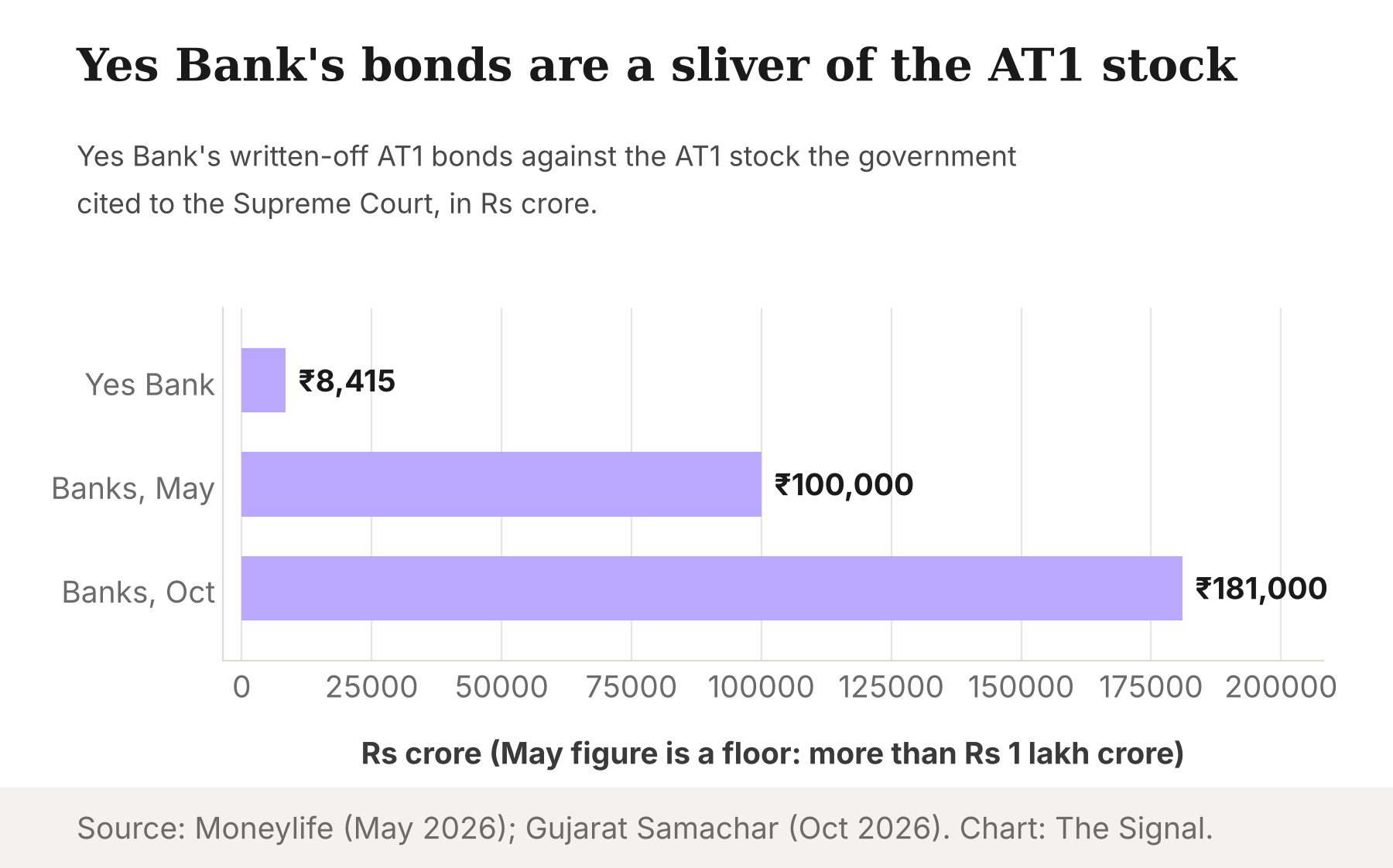
The bonds in dispute are a sliver. The legal test for cancelling one is now a question about all the rest.
Who held the paper, and what the rescue assumed
The retail slice was small in rupees. SEBI identified 1,346 retail investors who put in about Rs 679 crore, Moneylife reported. That is roughly 8% of the Rs 8,415 crore written off.
The government's defence was that the write-down was part of the deal. It told the court that SBI infused about Rs 8,000 crore into Yes Bank on the understanding that the AT1 bonds would be written down. Set side by side, the two amounts are close: Rs 8,415 crore of bonds cancelled, Rs 8,000 crore of fresh capital in.
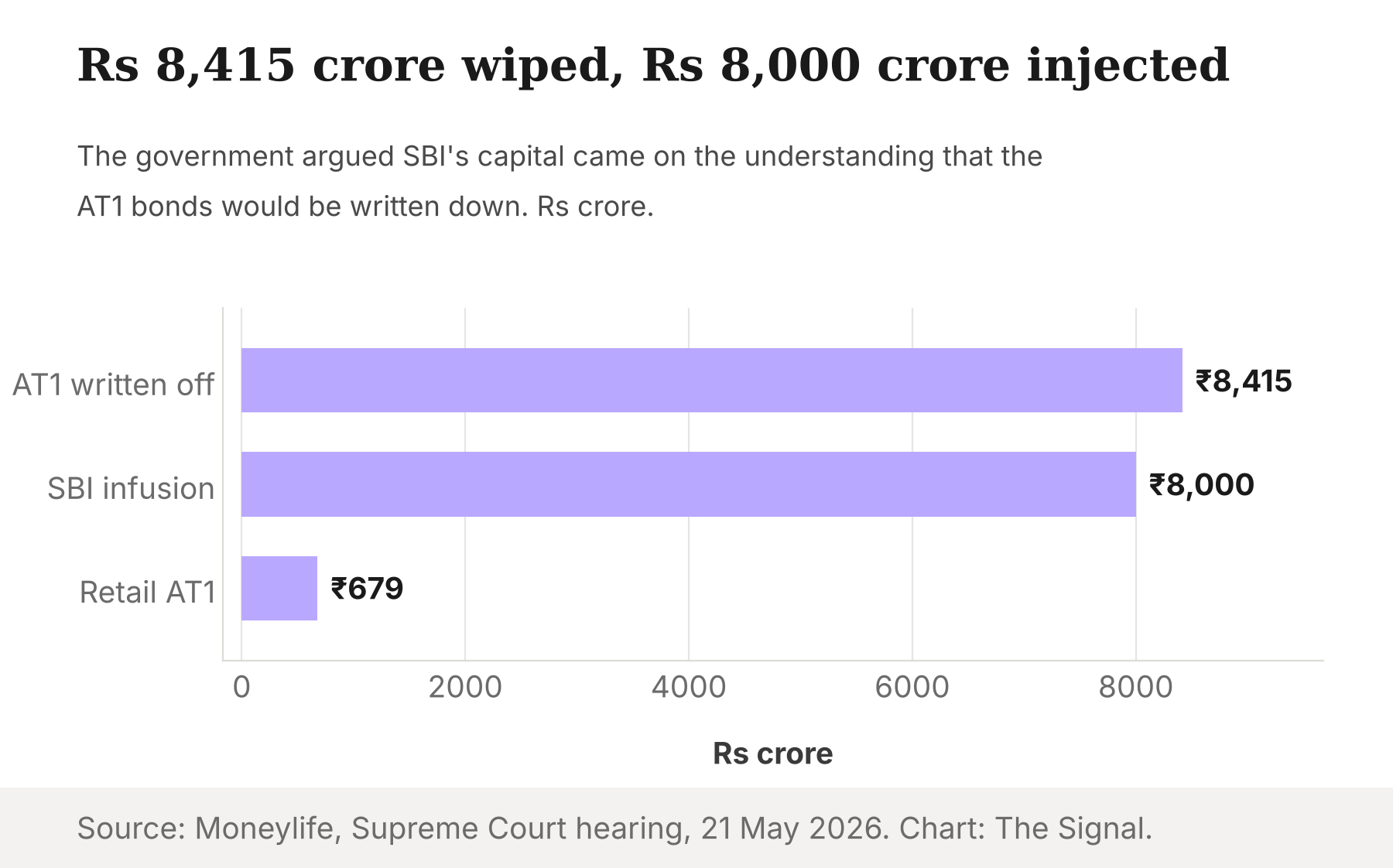
If the write-off was the price of the rescue and the court now says it was invalid, the question is who bears the gap. This article cannot answer it: the sources checked, such as Gujarat Samachar's report of the ruling, do not give the court's reasoning or any order on payment.
Why funding costs are the likely channel
The likely mechanism is a hedged one. Investors price AT1 on two risks: the bank getting weak, and the loss clause in RBI's rules being applied in a way that holds up. The ruling does not touch the first. It adds weight to the second. A bond whose cancellation can be reversed years later, after the money has gone elsewhere, is worth less than one whose cancellation is final.
That should show up in two places: the coupon banks must offer on new AT1, and who is willing to hold it. On the second, regulators already limit mutual funds. SEBI's 2021 framework capped a scheme at 10% of its debt portfolio value in such instruments, with 5% for a single issuer, from 1 April 2021. A buyer base already fenced in by rules has less room to absorb a higher-risk instrument.
The honest objection
The strongest counter-case is that this is a procedural ruling, not a verdict on AT1 as an instrument. The loss clause in RBI's rules is intact, and nothing in the sources suggests the court called AT1 write-downs unlawful in principle. Banks that follow the process correctly, the argument runs, lose nothing.
That may be right. But it concedes the point. If the risk is now in the process, the cost sits with the regulator, who must be able to show that process under time pressure. RBI published its draft scheme on 6 March 2020, and the bonds were written off on 14 March 2020. A bond investor reading that timeline will price in the chance that speed and process pull in different directions.
The Signal
The Supreme Court did not end AT1 bonds. It made a quiet claim about what it takes to cancel one. The bonds in this case are under 5% of the Rs 1.81 trillion the government cited, and the debate is about the rest.
Watch three things. First, whether Yes Bank discloses what it now owes holders and on what timeline. Second, the coupons on the next AT1 issues from state and private banks. Third, whether RBI changes how write-down triggers are documented. A loss clause only works if it can be used and survive afterwards.
Reporting basis: RBI's draft scheme and Basel III circular are primary documents, fetched from RBI's site. The AT1 stock figures, the retail investor numbers and the SBI infusion are per Moneylife, reporting the Supreme Court hearing of May 2026 and government submissions, and rest on that single outlet. The ruling, the Rs 1.81 trillion figure and the Solicitor General's argument are per Gujarat Samachar alone. The share price move is per Business Today, citing exchange prices. SEBI's mutual fund caps are per Moneylife's report of the March 2021 circular, not the circular itself. The judgment text was not reviewed. The under-5% share and the roughly 8% retail share are The Signal's calculations from those figures.