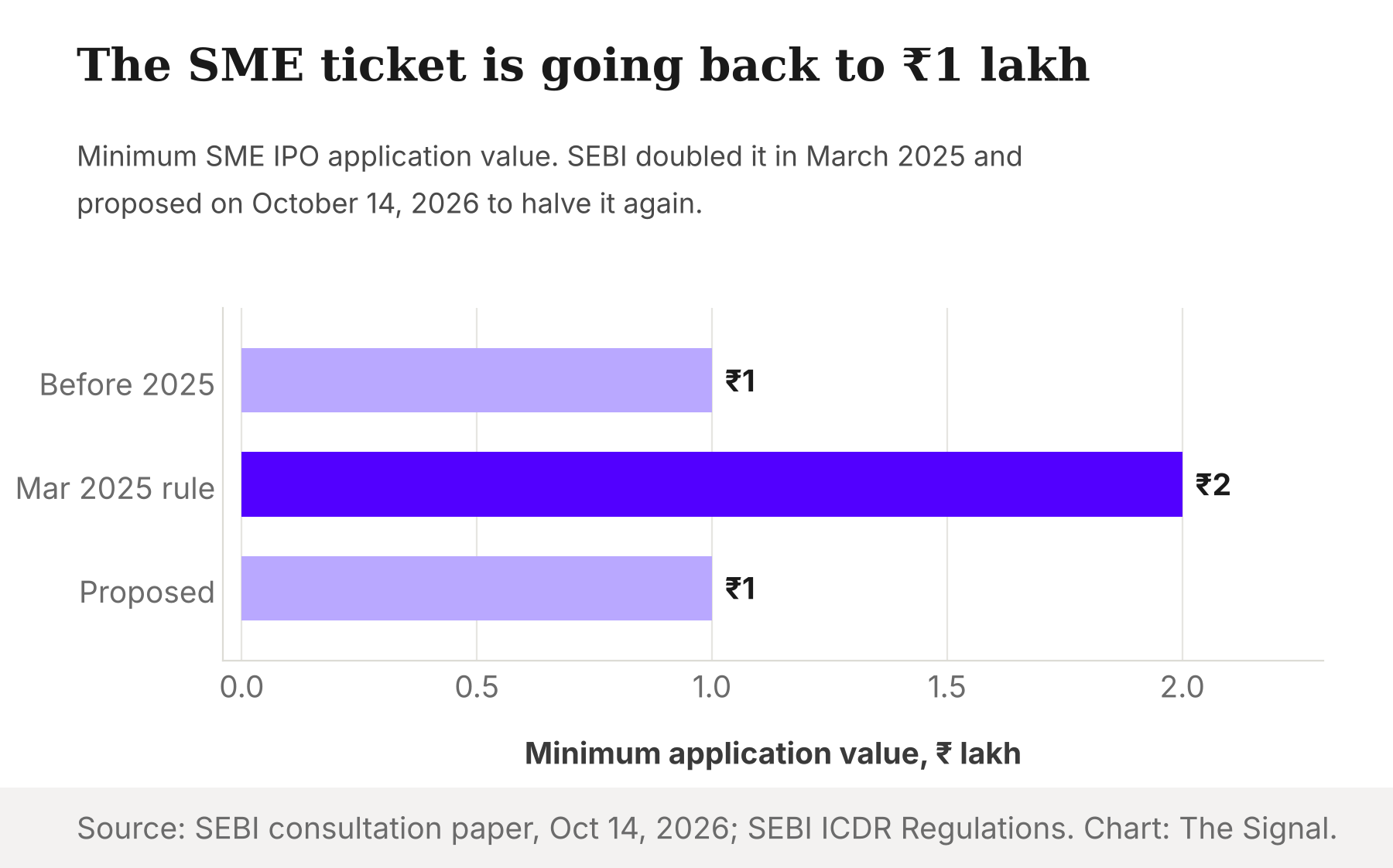
The headline version of SEBI's new proposal for small-company IPOs is a loosening. On October 14, 2026, the regulator published a consultation paper that would cut the minimum SME IPO application to Rs 1 lakh, in the paper's words, "reduced to ₹1 lakh from the existing requirement of ₹2 lakhs." A lower ticket means more ordinary investors can apply. Read that way, this is a regulator opening a door.
It is worth slowing down on that. The Rs 2 lakh figure is not an old relic. SEBI's paper itself says the March 2025 amendment raised the minimum "from ₹1 lakh to ₹2 lakh, with the objective of limiting participation by smaller retail investors in view of the higher risks associated with SME investments." The rule has been in force since March 8, 2025, under Regulation 267 of the ICDR rules, which sets two lots per application and a value above Rs 2 lakh.
That is 19 months. SEBI is proposing to put the ticket back where it started, after using it as a deliberate barrier.
The ticket was a risk tool
The 2025 floor was not an accident of drafting. In its January 2025 board memo, SEBI wrote that it proposed the higher size "in order to protect the interest of smaller retail investors", because SME IPOs "tend to have higher element of risks." The backdrop was a surge. Fiscal 2023-24 saw 196 SME IPOs, the highest number of SME issues since the platforms began, raising more than Rs 6,000 crore, and the next year had already seen 159 issues by October 15, 2024.
The October 2026 working group, set up by SEBI to review the framework, describes the earlier decision plainly. It "was intended, inter alia, to restrict participation by retail individual investors in SME issues." So the ticket was a rationing device. Make the entry price high enough, and only investors with an appetite for risk apply.
What changed in 19 months is not the stated danger. It is the toolkit SEBI wants to hold instead.
What replaces the price barrier
SEBI's reasoning for the reversal is that the ticket no longer has to do the work alone. The paper says the new framework carries "a broader set of safeguards", and that in that setting "retaining a ₹2 lakh minimum application value may unnecessarily restrict access to the SME" market. The mechanism is a lower lot value: each lot would be Rs 25,000, so an investor "would be required to apply for a minimum of four lots."
The safeguards are real, and they sit at the gate rather than at the counter:
| Rule | Today | Proposed |
|---|---|---|
| Minimum application value | Rs 2 lakh | Rs 1 lakh |
| Operating profit test | Rs 1 crore in two of three years | Average of at least Rs 3 crore a year over three years |
| Minimum allottees | 200 | 500 |
Source: SEBI consultation paper, October 14, 2026, and SEBI ICDR Regulations (Regulations 267 and 268).
On profit, the paper proposes "an Average Operating Profit of not less than ₹3 crore per year" over the preceding three financial years. Today's test asks for Rs 1 crore in two of three years, so the bar triples. On allottees, Regulation 268 requires at least 200, and the paper proposes to "increase the minimum number of allottees in an SME IPO from 200 to 500."
The second change is softer than it sounds. SEBI's working group, citing NSE data, found SME IPOs on NSE Emerge and BSE SME between January 2025 and March 2026 averaged "more than 1,000 allottees". A floor of 500 sits at or below half the observed average, so it would rarely bind.
The real tightening is the profit bar. SEBI is trading the investor-side filter for a company-side one.
The line SEBI wants to draw by size
The other half of the paper changes who counts as an SME. Today's test uses paid-up capital. The paper replaces it with market value: an issuer with post-issue market capitalisation up to Rs 1,000 crore would have to use the SME platform, those between Rs 1,000 crore and Rs 4,000 crore could choose, and larger ones would go to the main board.
Set that against what SME IPOs actually look like. The working group computed an average SME IPO market capitalisation of Rs 144 crore in fiscal 2023-24, Rs 184 crore in 2024-25 and Rs 192 crore in 2025-26. The same report's table shows the largest SME IPO reaching Rs 720 crore, Rs 748 crore and Rs 643 crore in those three years.
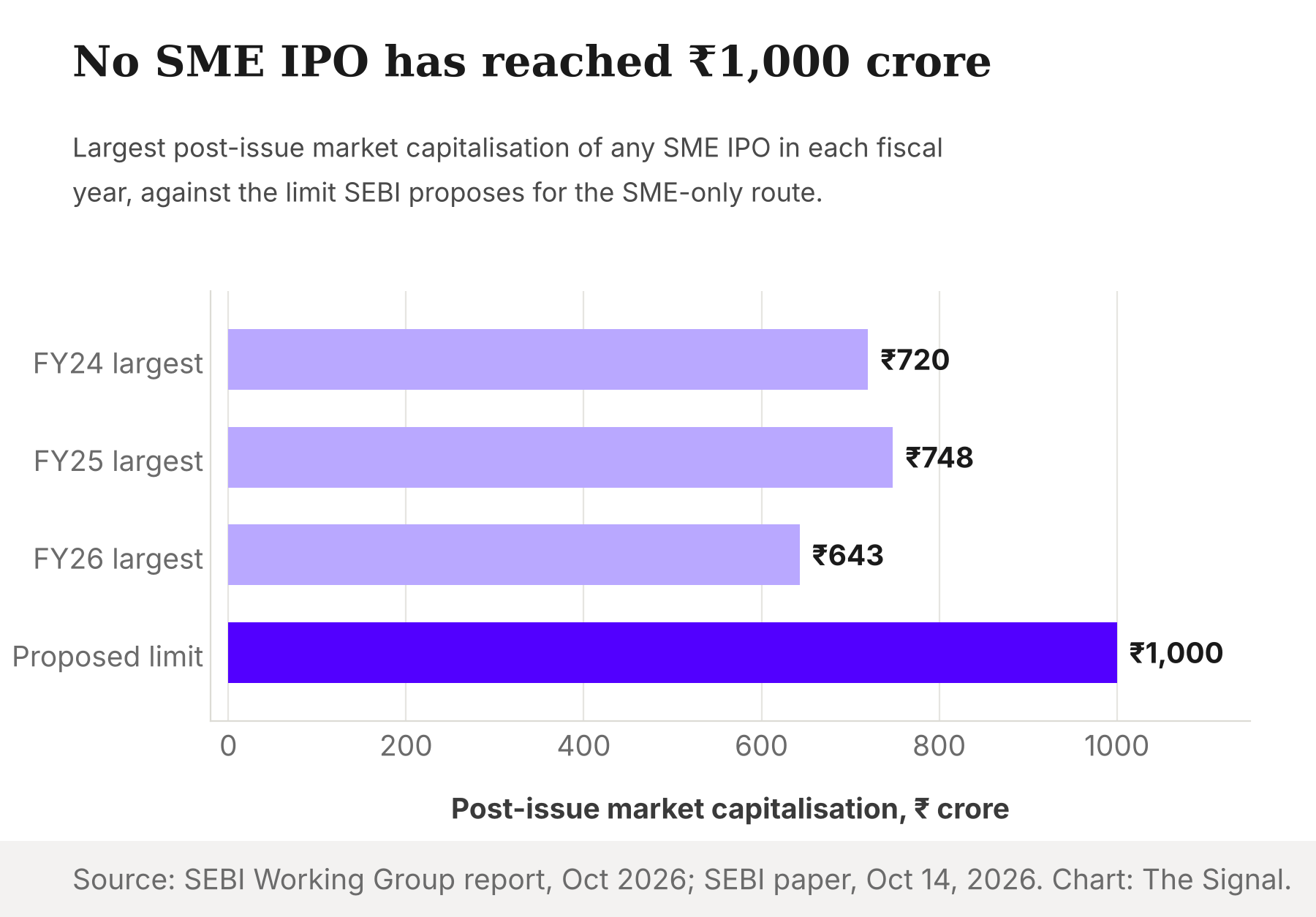
No SME IPO in the last three fiscal years reached Rs 1,000 crore. The proposed limit is about five times the fiscal 2025-26 average of Rs 192 crore, and the Rs 4,000 crore ceiling is more than five times the largest issue in the period, Rs 748 crore. The new size line therefore leaves the IPOs SEBI has actually seen on the SME side of it. Its main effect would be to make room above them, and to stop larger companies from using the lighter regime.
The segment it would govern is already sizeable. SEBI's paper, citing NSE and BSE data, puts total funds raised through SME IPOs since inception at Rs 40,222 crore as of July 31, 2026.
The honest objection
The strongest defence of SEBI is that this is not a flip-flop. A regulator can reasonably raise a barrier while it has no other tools, then lower it once better ones exist. The working group argues that retail exclusion is hard to defend in a market where the number of demat accounts has reached approximately 22.9 crore and monthly SIP contributions have risen to Rs 31,781 crore. Underwriting is another sign the old regime was built for weaker times: the working group notes that underwriters received an allotment in only 4 IPOs over three fiscal years, yet underwriting fees made up about 38.41 percent of issue expenses on NSE in fiscal 2025-26. Cutting those costs is a fair aim.
That case is real. But it explains why SEBI may now accept a lower ticket, not why it was right to double it first. The justification SEBI gives rests on safeguards it is only now proposing. It does not rest on evidence that the Rs 2 lakh floor failed, and its stated rationale does not say whether the floor worked. A floor that was worth having in 2025 because SME investing was risky is being dropped while the same investing remains, in SEBI's own words, higher risk.
The Signal
The ticket was a stand-in for a harder question: who should be allowed to buy into the least-scrutinised end of India's primary market. SEBI answered with price in March 2025, and it is now proposing to answer with company quality, the profit bar, and with a bigger crowd, the allottee floor. If the paper is adopted, the SME door gets wider for investors and narrower for companies.
Watch two things. First, the final profit threshold after the comment window closes, because a deadline of November 4, 2026 leaves the Rs 3 crore bar open to lobbying from issuers who now clear Rs 1 crore. Second, whether retail applications rise once the ticket drops, since the number of people who can apply is not the same as the number who should. A barrier set by price falls quickly. A barrier set by quality has to be earned.
Reporting basis: every figure in this piece comes from documents published by SEBI: its consultation paper of October 14, 2026 (which itself cites NSE and BSE data), the working group report published with it, the consolidated ICDR Regulations as amended with effect from March 8, 2025, and the board memo of January 2025. No outside outlet is relied on, so the piece rests on a single origin, the regulator, and SEBI's account of its own reasoning has not been tested against independent data on how the 2025 rule performed. The proposals are a consultation, not final rules. The tripling of the profit bar, the multiples of the market-capitalisation limits against SME IPO sizes, and the comparison of the 500-allottee floor with the observed average are The Signal's calculations from those figures.