Jio Platforms has told the market what it wants for itself. It set a price band of ₹1,065 to ₹1,119 per share for an all-fresh issue of up to ₹30,213 crore, and at the top of that band it would be valued at about ₹10.30 lakh crore ($106.43 billion). The easy read is a coronation. India's largest mobile operator by customers is about to become one of its most valuable companies, and the stock market is simply ratifying a lead the subscriber tables already show: Jio had 508.43 million mobile subscribers at the end of August 2026 against Airtel's 491.60 million.
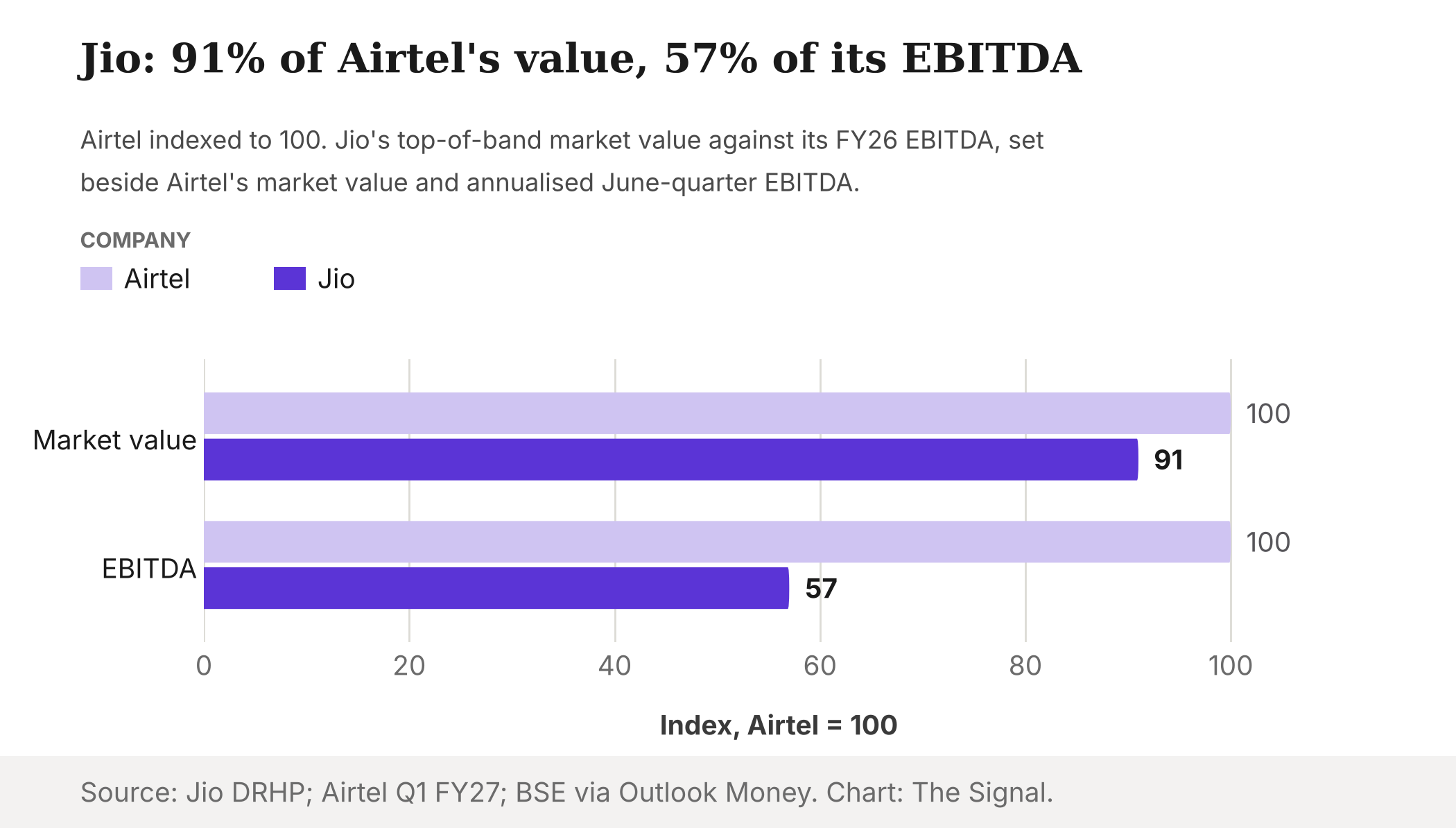
It is worth slowing down on the other half of that comparison. The same article that gives Jio's valuation notes that Bharti Airtel was worth ₹11.27 lakh crore on 9 October 2026. Jio, at the top of its band, would sit at 91 percent of that. The question the IPO really poses is not whether Jio is big. It is why a company priced almost level with Airtel earns so much less.
The earnings gap behind the price tag
Jio's draft prospectus, filed with SEBI, reports EBITDA of ₹7,62,554 million, or ₹76,255 crore, for the year to March 2026. EBITDA is operating profit before interest, tax and depreciation, and it is the standard yardstick for comparing telecom companies that carry very different debt and asset bases.
Airtel reported consolidated EBITDA of ₹33,599 crore for the quarter ended June 2026. Multiplied by four, that is about ₹1.34 lakh crore a year. Against that run rate, Jio's ₹76,255 crore is 57 percent of Airtel's: Airtel earns roughly 1.8 times as much operating profit.
Jio is priced at 91 percent of Airtel's value on 57 percent of its EBITDA.
The periods differ, which flatters Airtel slightly, because Jio's figure is a full year to March and Airtel's is a later, annualised quarter. The scale of the gap is too large for timing to explain.
What the premium per rupee looks like
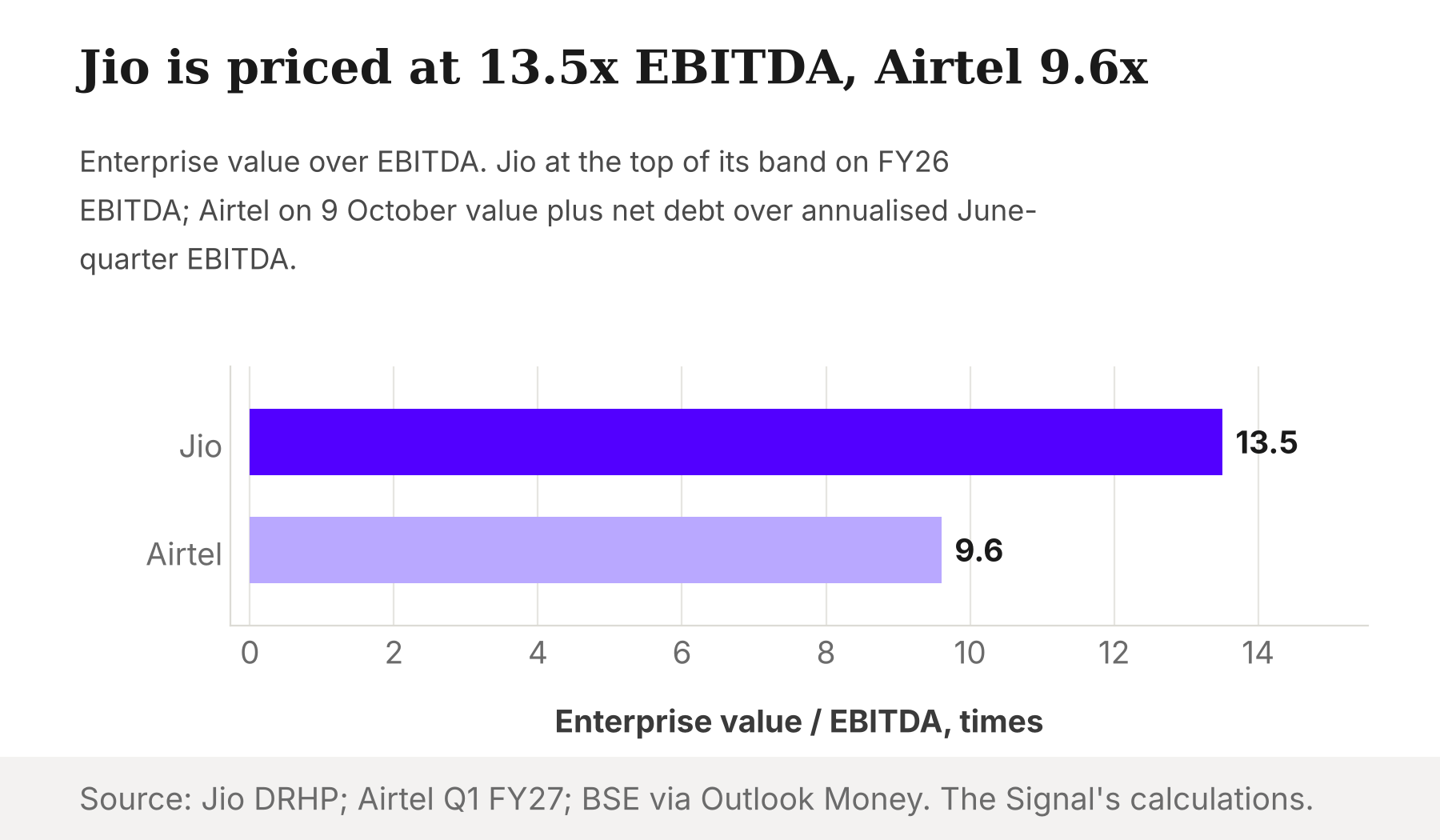
Divide value by earnings and the gap becomes a multiple. At ₹10.30 lakh crore, Jio's valuation is 13.5 times its FY26 EBITDA. Jio's cash position matters little here, because the net proceeds are meant to prepay borrowings of its subsidiary Reliance Jio Infocomm and its net debt was already only 0.36 times EBITDA, so after the issue enterprise value is close to market value.
Airtel carries more debt. Its net debt to annualised EBITDA stood at 1.17 at June 2026, which implies about ₹1.57 lakh crore of net debt. Add that to its ₹11.27 lakh crore market value and divide by annualised EBITDA, and Airtel trades at about 9.6 times. These are The Signal's calculations from the cited figures.
Jio would trade at roughly 40 percent more per rupee of EBITDA than Airtel.
| Measure | Jio | Airtel |
|---|---|---|
| EBITDA | ₹76,255 crore (year to March 2026) | ₹33,599 crore (June 2026 quarter) |
| Market value | ₹10.30 lakh crore (top of band) | ₹11.27 lakh crore (9 October 2026) |
| EBITDA margin | 51.91 percent | 57.4 percent |
Sources: Jio's DRHP (margin), Airtel's Q1 FY27 release, Outlook Money. Periods differ.
Jio's EBITDA margin was 51.91 percent in FY26, below Airtel's 57.4 percent. The buyer is paying more for a business that converts less of each rupee of revenue into operating profit.
The honest objection
The strongest case for the premium is growth, and it deserves full weight. Jio's EBITDA rose from ₹6,41,700 million to ₹7,62,554 million in the year to March 2026, up 18.8 percent. Its customer base grew to 524.4 million, with an exit-quarter ARPU of ₹214.0 a month, and Jio leads on broadband, with 538.03 million subscribers against Airtel's 386.39 million. Airtel also consolidates operations outside India, which a pure India comparison would strip out. On that narrower basis Motilal Oswal puts Jio at roughly 12 times FY28E EV/EBITDA against an implied 10.3 times for Airtel's India business, a premium of about 17 percent rather than 40.
That case is real, but it has a limit. Airtel's latest quarter is not a slower business: its EBITDA grew 19.3 percent year on year to ₹33,599 crore, against Jio's 18.8 percent for its full year. The two are growing at about the same pace. Growth therefore explains why both deserve a multiple. It does not explain why one deserves a higher one.
To see what the premium requires, ask how much EBITDA Jio needs for the market to be paying Airtel's 9.6 times. At ₹10.30 lakh crore, that is about ₹1.07 lakh crore, or 41 percent above FY26's ₹76,255 crore. At last year's 18.8 percent pace, that takes roughly two years, on the assumption that Airtel's multiple stays still.
Reliance holds the largest stake
Jio is not only an IPO. Reliance Industries held 66.43 percent of Jio Platforms before the issue. At ₹10.30 lakh crore that stake is worth about ₹6.8 lakh crore before dilution from the new shares, which is 43 percent of Reliance's ₹15.84 lakh crore market value on 9 October 2026. Motilal Oswal estimates that Reliance's share price implies a discount of 18 to 36 percent on its Jio stake. A public price for Jio gives investors a number to hold that discount against, and it also hands them a benchmark for Airtel.
The Signal
The IPO price band is a statement about the future dressed as a statement about size. On current earnings Jio is the smaller business, and its premium over Airtel rests on investors believing that its next two years will look better than Airtel's. Three numbers will test that belief: whether Jio's ARPU of ₹214.0 a month keeps closing on Airtel's ₹264, whether its 51.91 percent margin moves toward Airtel's 57.4, and whether Airtel keeps matching its growth. If they do, the 40 percent premium will look cheap in hindsight. If they do not, Jio's price will have paid for a lead in subscribers that the income statement does not yet show.
Reporting basis: Jio's financials, customer metrics, leverage and shareholding come from the draft red herring prospectus Jio Platforms filed with SEBI in June 2026, which is the document verified here. Airtel's EBITDA, growth, margin and leverage come from Bharti Airtel's own quarterly results release for the quarter ended June 2026. Subscriber and broadband counts come from TRAI's August 2026 release. The price band, the top-of-band valuation and the 9 October market values of Jio, Airtel and Reliance come from Outlook Money, which attributes them to BSE data and to Bloomberg's calculations from people familiar with the discussions; the price band is therefore reported, not confirmed in a final prospectus verified here. The forward multiples and the discount on Reliance's Jio stake are Motilal Oswal estimates as relayed by Outlook Business. The annualised Airtel EBITDA, the net debt figure, the two enterprise value multiples, the premium, the index values in the first chart and the EBITDA Jio needs to match Airtel's multiple are The Signal's calculations from those figures.