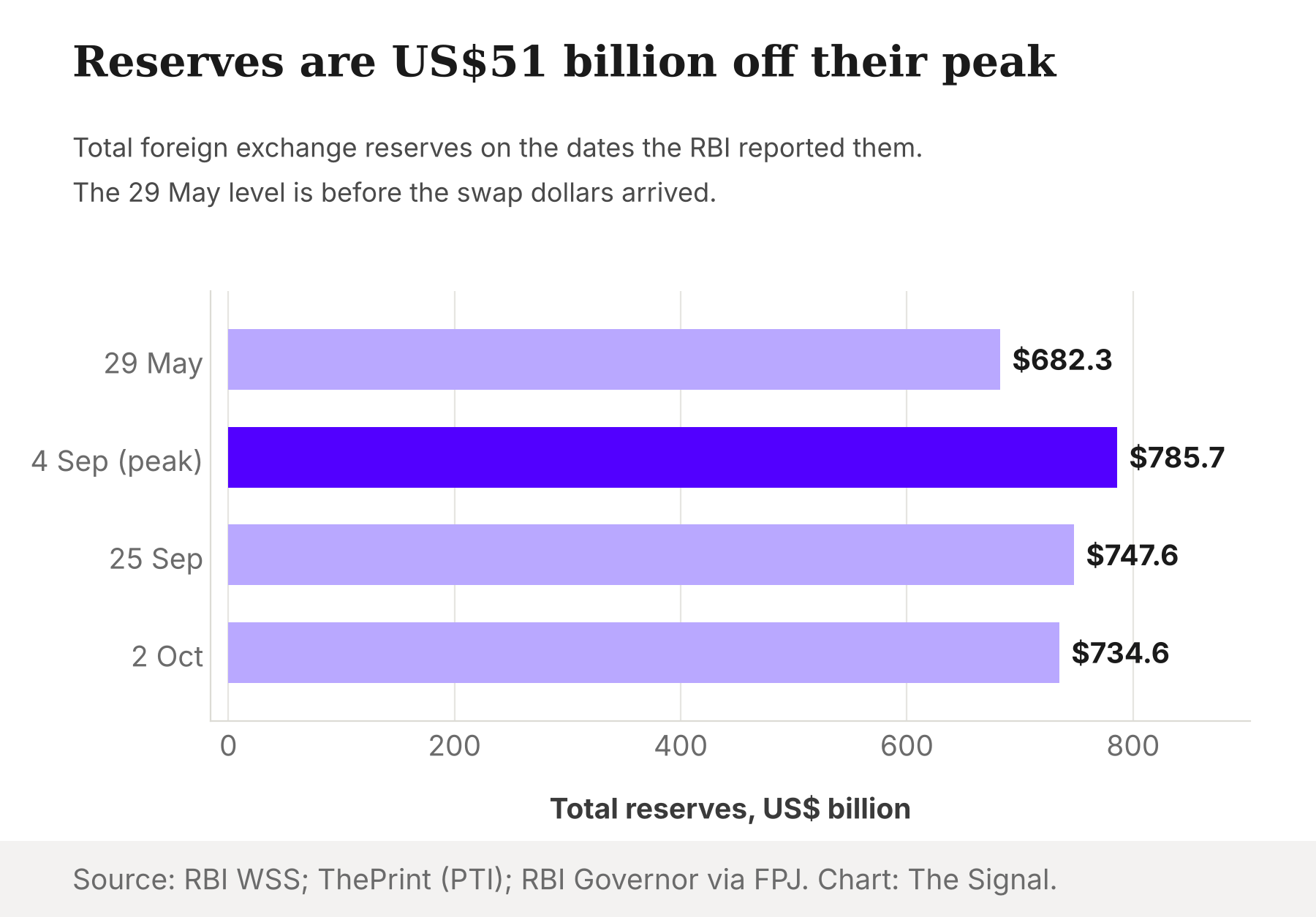
India's foreign exchange reserves stood at US$734.6 billion on 2 October 2026, the latest week the RBI has reported, down US$13.0 billion in a week. That was the fourth straight weekly fall. Reserves are now US$51.1 billion below their record high of US$785.7 billion, and the Free Press Journal reports that, by market estimates, the RBI sold roughly US$30 billion net in September alone. Read the top line and the rupee defence is burning through its ammunition.
It is worth slowing down on that. The record itself was unusual. In the week ended 4 September, reserves jumped by a record US$44.9 billion to US$785.7 billion, according to PTI's report on RBI data. The jump coincided with a wave of swap dollars that come with a promise to give them back.
Dollars with a return ticket
In June 2026 the RBI opened a special dollar-rupee swap facility for banks that raised fresh dollar deposits from non-resident Indians (FCNR(B) deposits), plus some foreign borrowing by companies. The FCNR(B) window closed on 31 August. By 18 September, the RBI says, FCNR(B) deposits had brought in US$133.0 billion and the whole facility US$143.6 billion.
From the RBI's side the facility is a plain buy/sell swap covering only the principal of the deposits, with a minimum original deposit tenor of three years. The RBI buys dollars now and sells the same dollars back later. The spot leg lands in the reserve total. The promise to sell them back lands in the RBI's forward book, which is a ledger of dollars it has committed to deliver.
That ledger exploded. At the end of July the RBI's net short forward position was US$136.8 billion. By the end of August, Bloomberg's calculations from RBI data show it rose US$63.3 billion to a record US$200.1 billion.
The number that does not fit
Compare two figures. Between 29 May, when the Governor put reserves at US$682.3 billion, and 2 October, reserves rose US$52.3 billion. Over a similar stretch, the swap facility drew in US$143.6 billion. The net gain is about 36 percent of the swap inflow. The rest left the total again.
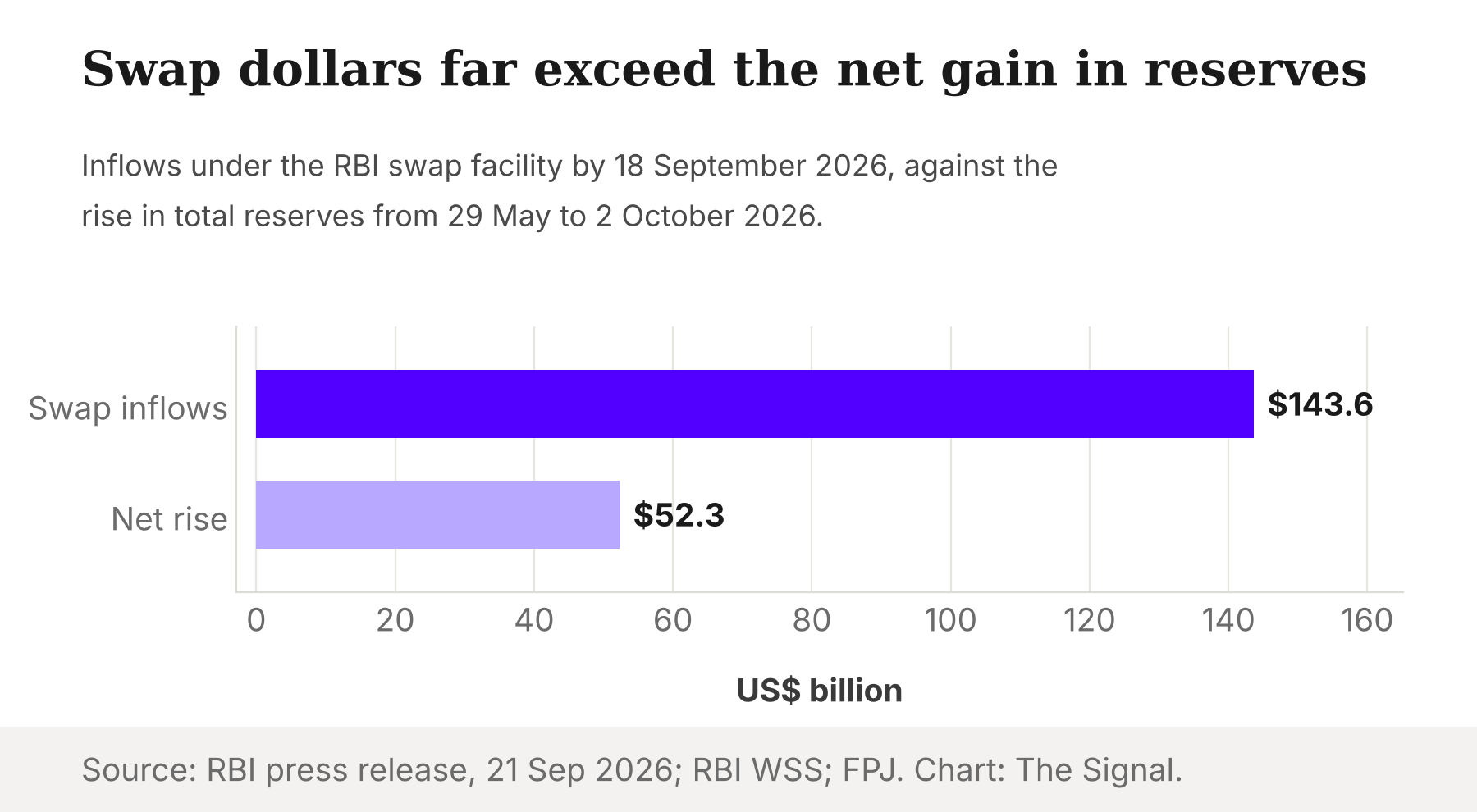
The two periods do not line up exactly, so this is a comparison of scale, not an accounting identity. Still, the point is plain: the headline total is not a measure of dollars the RBI owns outright.
What the forward book changes
Subtract the US$200.1 billion end-August forward book from the US$734.6 billion of reserves on 2 October and you get about US$534 billion, our calculation, using figures from two different dates. That is the cautious reading of what the RBI could spend if every forward came due at once. The maturity table shows why that is too cautious for the near term.
At the end of July, US$91.5 billion of the US$136.8 billion net short was due in more than a year. That is two thirds. The part due within a month was US$13.2 billion. The facility opened in June 2026 and requires a minimum original deposit tenor of three years, so the FCNR(B) legs cannot come due before mid-2029.
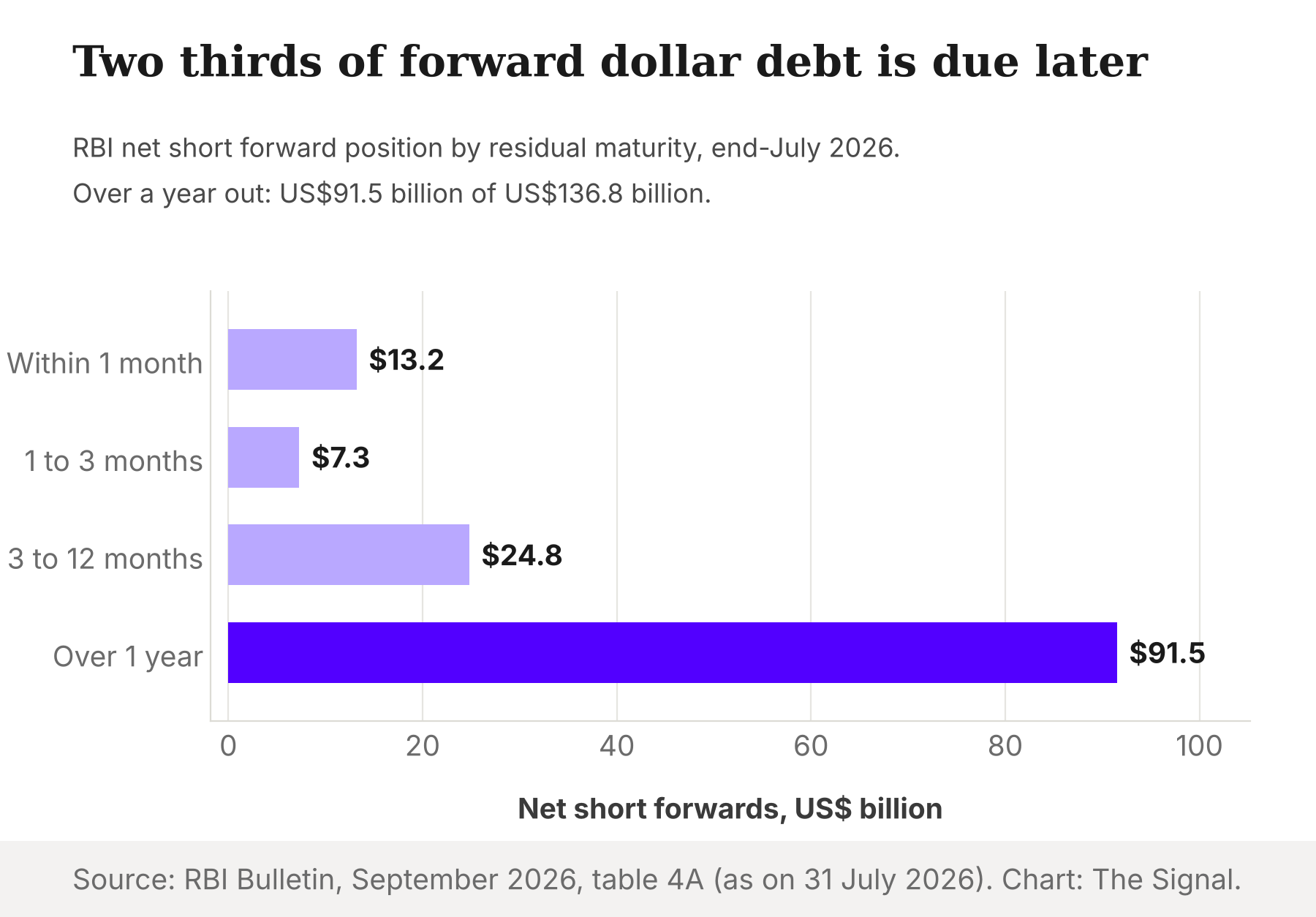
So the dollars the RBI can spend over the next twelve months sit somewhere between the cautious US$534 billion and the US$734.6 billion headline. The binding constraint on the rupee defence is not the size of the total. It is how many of those dollars carry a delivery date inside the window the RBI is defending.
The honest objection
The strongest case against this reading is that a forward book is a timing note, not a debt. The dollars the RBI bought are real dollars in its accounts today, and if the deposits are renewed at maturity the delivery date moves out again. On that view the US$200.1 billion costs nothing until 2029.
That case has force for the next year. It has less force for what comes after, because the swap is a fixed commitment and the RBI's FAQ says only that it covers the principal of the deposits. The RBI Governor said in June that reserves gave around 11 months of import cover. That figure was struck on 29 May, before the swap dollars arrived, and it has not been restated against the forward book.
The Signal
The fall from US$785.7 billion is the wrong thing to watch. Part of that peak was dollars on a return ticket, and as of end-July US$91.5 billion of the RBI's US$136.8 billion forward short was dated beyond a year. The numbers to watch are the maturity table in the next RBI Bulletin and the forward book it reports for September. If the position stops growing and the within-one-month slice stays near its end-July level of US$13.2 billion, the rupee defence has room. If the near-dated slice swells, the reserve total will stop being the number that matters. Reserves show what the RBI holds. The forward book shows what it has promised to hand back.
Reporting basis: weekly reserve levels are from the RBI's Weekly Statistical Supplement, the swap-facility inflows from an RBI press release, and the swap terms from the RBI's FAQ. The forward-book maturity breakdown is from the RBI's September 2026 Bulletin and covers end-July only. The record reserve level is per ThePrint's carriage of a PTI report on RBI data, and the September dollar sales are a market estimate per the Free Press Journal. The end-August forward position is Bloomberg's calculation from RBI data, as carried by The Edge Malaysia, and rests on that single secondary source. The 29 May reserves and import-cover figures are the Governor's, per the Free Press Journal. The net rise since 29 May, the 36 percent share, the two-thirds share and the US$534 billion figure are The Signal's calculations from those figures.