The headline from this month's mutual fund data is a strong one. Equity schemes took in net inflows of Rs 38,306.55 crore in September 2026, according to the Association of Mutual Funds in India (AMFI). That is up from Rs 29,328.62 crore in August, a rise of about 31 percent. Read quickly, it says Indian households are buying with confidence.
The month they bought in was not a confident one. The Nifty 50 ended the week to 1 October at 22,421.95, its eighth straight weekly loss, the longest such run in 25 years, with an eight-week fall of 8.74 percent. Foreign institutions were leaving. FII selling in September exceeded Rs 36,000 crore, according to DSIJ's market report.
It is worth slowing down on how those two numbers sit together.
The inflow and the exit are nearly the same size
Equity funds took in Rs 38,307 crore. Foreign institutions sold more than Rs 36,000 crore. The first is about 6 percent larger than the floor of the second, so the two are close to a one-for-one trade.
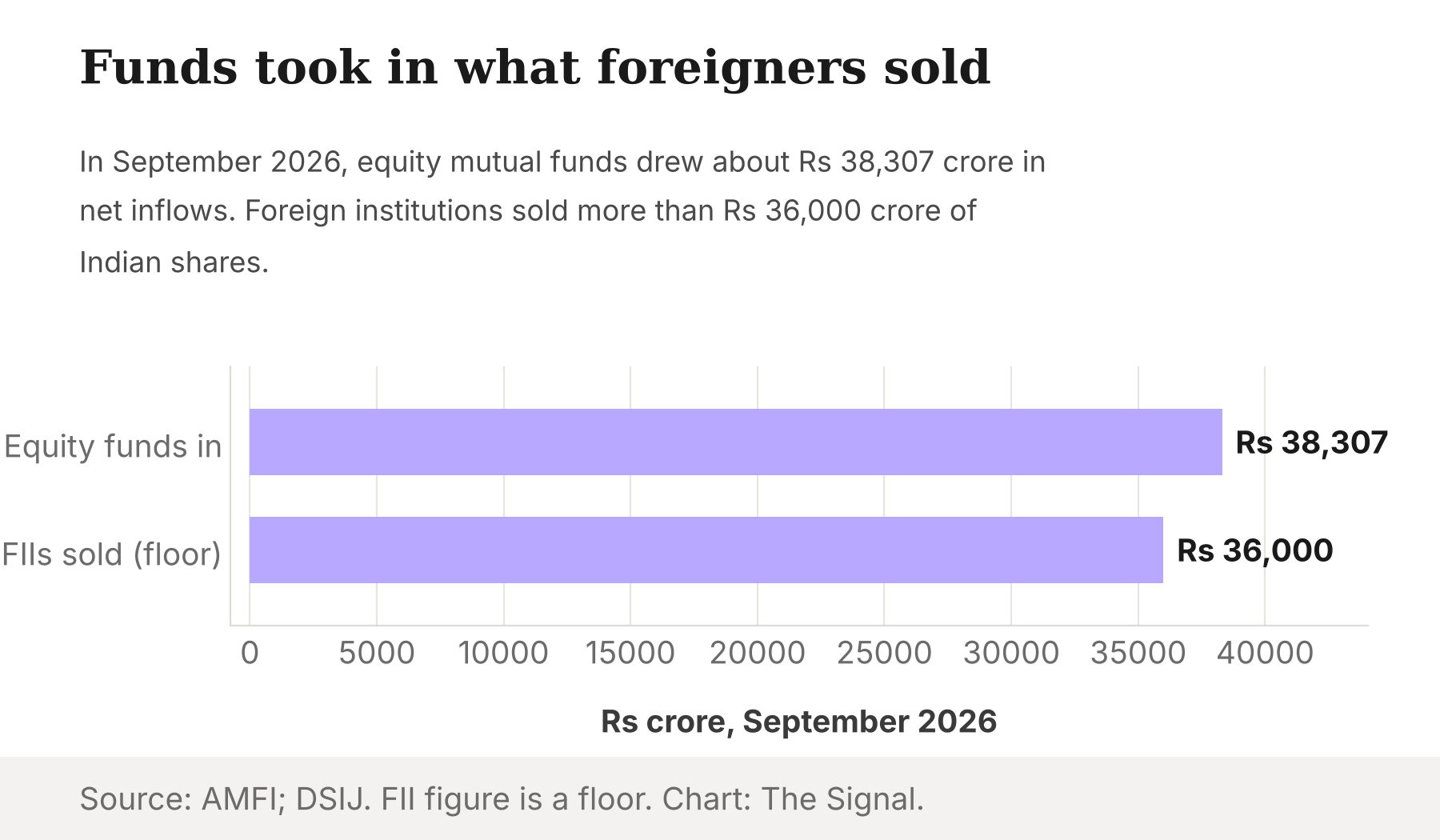
One caution about the foreign figure. Published totals for September foreign selling vary by source and cut-off date, and DSIJ gives only a floor. The comparison holds as a rough match, not an exact one.
Domestic institutions as a group were also heavy buyers. Business Today, citing the AceEquity database, reported that they bought Rs 64,758.56 crore of domestic equities in September, the 38th straight month of net buying since August 2023. That count was published on 30 September, so it may not cover the full month. On those figures, equity funds supplied roughly 59 percent of the domestic buying.
The reading that follows is a revealed-preference one. Foreign investors sold into a falling market. Domestic fund investors, by what they did rather than what they said, bought into it.
Nearly half of every rupee sold came back out
The net figure also hides churn. Of the money funds mobilised into equity schemes, Rs 74,831.96 crore went in and Rs 36,525.41 crore came out in September. Redemptions were about 49 percent of gross sales.
That is the real size of the support. A net Rs 38,307 crore arrived only because investors put in roughly twice as much as others took out. Any month when new money slows, the same redemption base would turn the net figure thin quickly.
The same report shows the industry shrinking
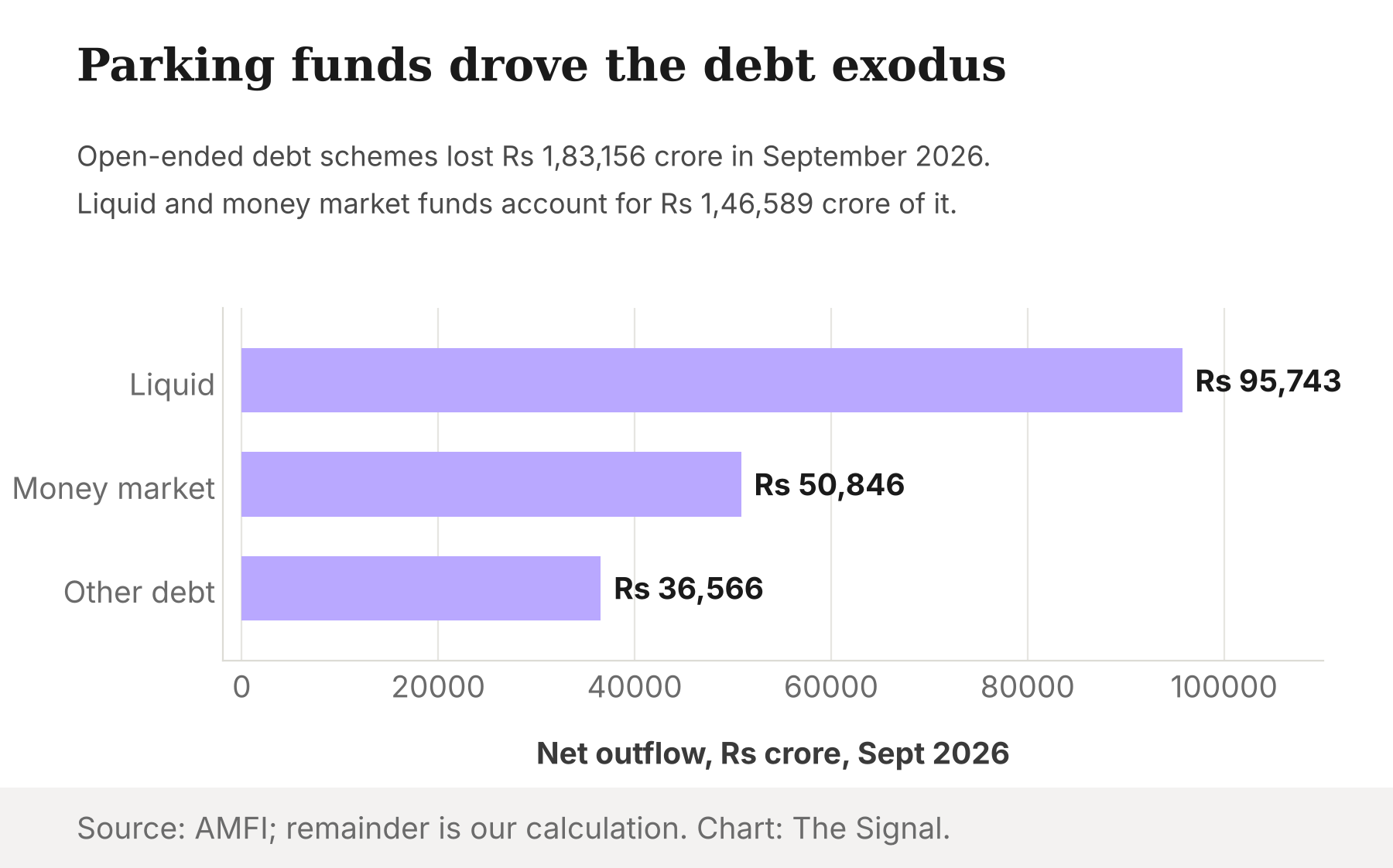
The AMFI report that carries the equity headline carries a much larger number beside it. Open-ended debt schemes saw net outflows of Rs 1,83,155.76 crore in September. Liquid funds lost Rs 95,743.20 crore and money market funds lost Rs 50,846.21 crore.
Those two categories account for Rs 1,46,589 crore, or 80 percent of the debt outflow. Both are short-term holding categories, which is where money sits between uses. A fall there tells you about cash being moved, not about a verdict on equities. The AMFI table does not say who moved it or why, and this piece does not guess.
Across every scheme type, the industry recorded a net outflow of Rs 1,33,375.57 crore in September, against a net inflow of Rs 41,353.60 crore in August. A reader who saw only the equity line would miss that the industry as a whole swung from gaining money to losing it.
The honest objection
The strongest case against the thesis is that equity inflows are mostly a calendar habit. Systematic investment plans send money in every month on a fixed date, whatever the Nifty did that week. On that view, the match with foreign selling is a coincidence of two unrelated numbers, and the inflow says little about conviction.
That is a fair reading, and the data here cannot rule it out. AMFI's report lists the totals, not the share that came from automatic instalments. It also fits the other point in this piece: a large gross inflow and a large redemption base can both exist in a month when nobody changed their mind.
The answer is that the effect does not depend on conviction. A rupee from a fixed instalment buys shares the same way a rupee from a confident investor does. What matters for the market in September was that the buyer existed and was large enough to take the foreign supply.
The Signal
India's market now has a domestic bid big enough to cover a foreign exit of more than Rs 36,000 crore in a month. That cushions prices when foreigners leave. It does not make the cushion free: nearly half of the gross equity money that came in also went out, and the wider industry lost Rs 1.33 lakh crore in the same month.
Watch the October AMFI report. If equity inflows hold near Rs 38,000 crore while foreign selling continues, the one-for-one match becomes a pattern. If the inflow falls back toward August's Rs 29,329 crore, the September match was a month, not a floor.
Reporting basis: The mutual fund figures come from AMFI's own September 2026 monthly report and its August report, which the association compiles from its member funds. The foreign selling floor is from DSIJ's market report, and the domestic institutional buying figure is from Business Today, citing the AceEquity database; each rests on a single outlet and the foreign total varies across other published sources. The Nifty streak is from Business Today. The 31 percent rise, the 6 percent gap, the 49 percent redemption share, the 80 percent debt share, the Rs 36,566 crore remainder and the 59 percent domestic share are The Signal's calculations from those figures.