For years, the price at which an Indian stock "closed" was an average. SEBI's January 16, 2026 circular says the closing price was the volume weighted average price of trades in the last thirty minutes of continuous trading. A big block deal late in the day could tug that average, and the regulator's fix was to replace it with a closing auction, introduced from August 3, 2026, for stocks that have futures and options.
The pitch was fairness. SEBI argued that a transparent closing price matters because it is the reference for derivatives settlement, index computation and mutual fund NAV. Pool every buy and sell order, find one price, and the close belongs to everyone.
It is worth slowing down on that. Pooling orders also means the closing price is now decided by an order book that participants can see forming and can change. SEBI's own interim order, issued on August 19, describes what happened ten days after launch.
The Sensex close on August 13
August 13 was a weekly Sensex expiry day. According to Outlook Money's account of the order, the Sensex closing price was determined at 78,079.96.
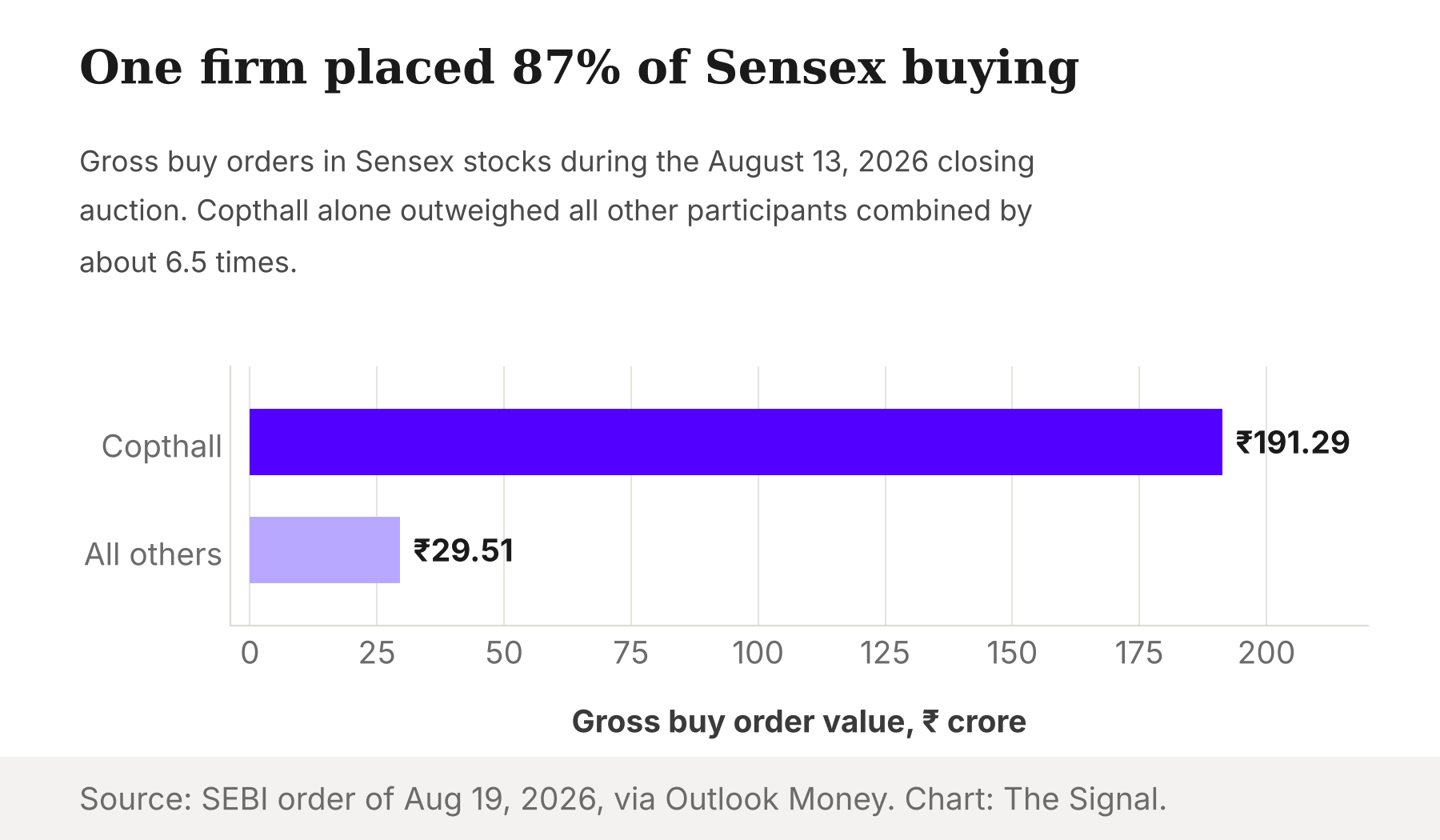
Start with 86.6. Outlook Money reports, citing SEBI's order, that Copthall, a unit of JPMorgan Chase, accounted for 86.6 per cent of the gross buy value in Sensex constituents during the auction, placing ₹191.29 crore of the ₹220.8 crore total. Subtract that from the total and everyone else combined placed about ₹29.51 crore. Copthall alone outweighed the rest of the market by roughly 6.5 times (our calculation).
Business Today reports, citing SEBI, that the third price spike, between 15:25:49 and 15:26:17, resulted in a 405.08-point jump in the index's indicative price. That is 28 seconds of order entry moving the Sensex by roughly half a percent, on a level near 78,000.
The second entity, Mansi Share and Stock Broking, allegedly worked the other side of the book. Outlook Money reports, citing SEBI's order, that Mansi cancelled 99.06 per cent of the 12.65 lakh shares covered by its sell orders within a 4 to 5 second window between 15:26:02 and 15:26:05. Orders that are never meant to execute can still move the indicative price while they sit in the book.
These are allegations. The order is an ex-parte interim order, and both firms have a right to respond.
The weakness moved, it did not disappear
The old system had a thin-liquidity problem: the closing price depended on what traded in thirty minutes. The auction replaced it with a different one. Orders can be entered and cancelled while the indicative price is visible, and the final price is set at the end. The tools of the manipulation SEBI describes are cancellations and timing, not traded volume.
SEBI's September 12 consultation paper identifies the pressure point. It notes that under the existing framework, trading in the derivatives segment continues while the underlying securities undergo closing price determination using the auction. On an expiry day, a trader holding options that settle on that price can watch the book and profit from nudging it.
So the paper proposes to separate the two. SEBI proposes either a blended VWAP based on actual transactions during the last 30 minutes of continuous trading and 10 minutes of the auction, or an interim methodology using only the last 30 minutes of continuous trading. Comments closed on October 3, 2026. In effect, the regulator is considering taking the derivatives settlement price back toward the average it abandoned in August, while keeping the auction for the cash-market close.
The honest objection
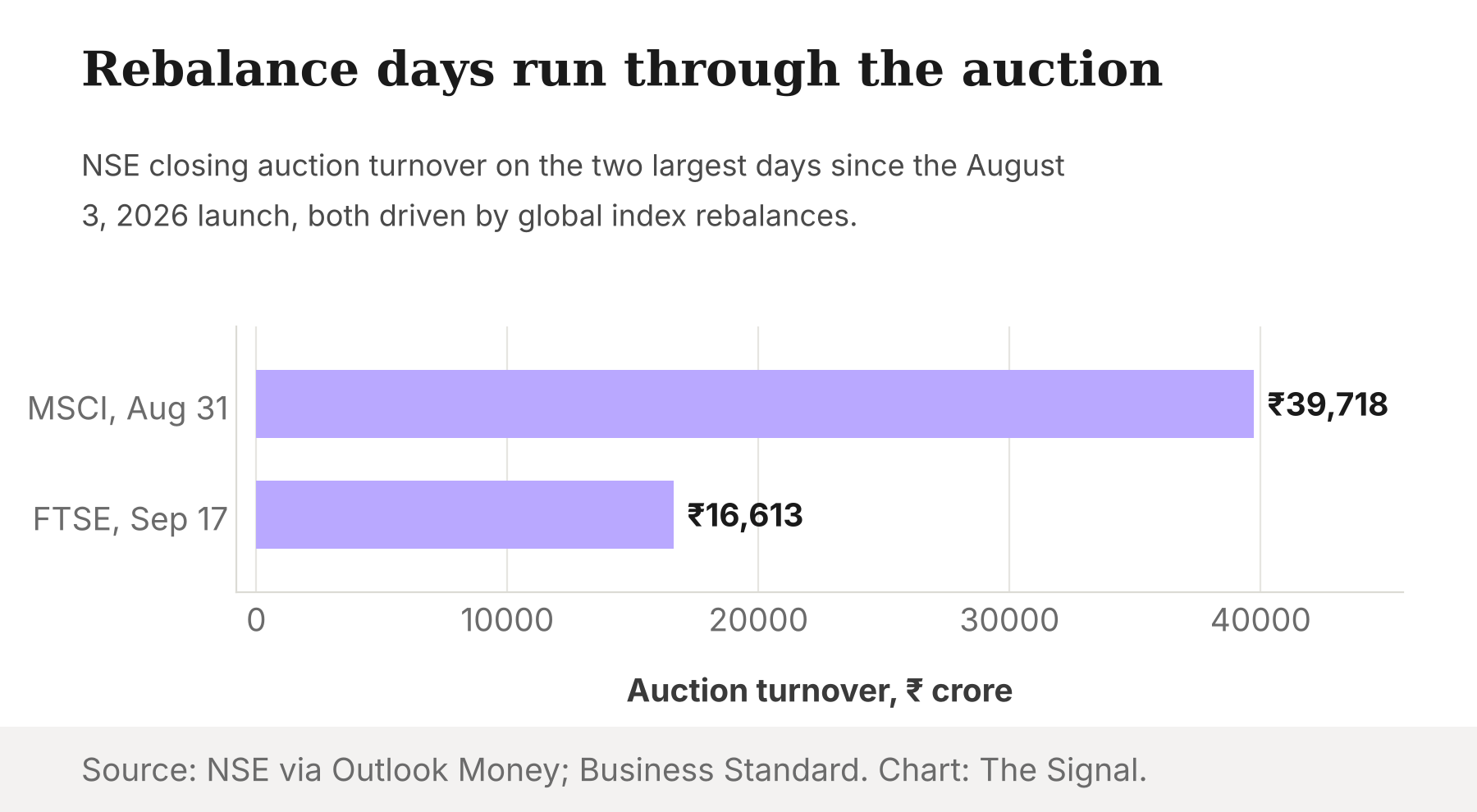
The strongest defence of the auction is that it is working as designed. Rebalancing days are the stress test, and it passed two. On August 31, an NSE release reported that the auction accounted for 22 per cent of the day's cash market turnover, with more than 98,000 unique investors participating and turnover about 42 times the previous session. On September 17, Business Standard reports that auction turnover jumped to ₹16,613 crore, driven by the FTSE rebalancing.
SEBI's chairman has also argued that the auction helps enforcement. On August 19, Free Press Journal reports, he said SEBI has stronger capabilities to identify manipulation under the auction compared with the earlier VWAP system. The order itself fits that claim: the regulator reconstructed the case from order logs six days after the expiry.
That case is real. But it answers a different question. Detection after the fact is not the same as a price that cannot be pushed in the moment, and the settlement of expiring options happens in the moment.
The Signal
The auction and the settlement price were bundled, and the August 13 order suggests they do not have to be. As a close for cash-market funds, indices and NAVs, the auction absorbed two rebalancing days. As the price on which expiring options settle, SEBI alleges it gave a determined trader an order book to lean on.
Watch the circular that follows the consultation. If SEBI keeps the auction for the close but moves derivatives settlement to a VWAP, as its consultation paper proposes, it will have conceded that one price cannot serve two jobs. A price that settles bets must be harder to move than a price that merely reports the day.
Reporting basis: the rationale and the description of the old VWAP close are from SEBI's own circular. The August 13 order details are from SEBI's interim order as reported by Outlook Money, with the index spike also reported by Business Today; neither account was checked against the order itself, so those figures rest on that reporting. The consultation paper details come from a TaxGuru copy of SEBI's paper, not from SEBI's site. The auction turnover figures are per an NSE release as reported by Outlook Money and per Business Standard. The chairman's remarks are per Free Press Journal. The non-Copthall buy value, the multiple of Copthall's buying and the index move as a share of its level are The Signal's calculations from those figures.