On 10 October the Reserve Bank of India announced two things in one day, and the market will read them as a single defence of the rupee. The first is that the RBI "will undertake sale of USD to the public sector OMCs through designated bank/s", meaning Indian Oil, HPCL and BPCL. The second is a package of curbs on rupee forex derivatives. The easy read is that a central bank under pressure is spending its reserves to hold a currency up. India's reserves look comfortable, so the read goes, and the RBI is simply using them.
It is worth slowing down on that. The RBI is not announcing a bigger sale into the open market. Per its own release, it is arranging for Indian Oil, HPCL and BPCL to buy their dollars from the central bank instead of the market.
What the window actually does
The RBI's press release says the window is meant to meet "the entire daily dollar requirements of three public sector oil marketing companies". It starts on Monday 12 October 2026 and stays in place until further notice. The release gives no dollar amount, no cap and no exchange rate.
Those details matter. A cap would make this a top-up. "Entire daily requirements" makes it a replacement. Every morning, the three companies that import crude for much of the country will settle their dollar needs with the central bank, through designated banks, rather than by bidding in the spot market.
Why does that matter for the rupee? Because of who these buyers are. Reuters reported in May that a large amount of dollar demand in India comes from oil companies. Dealers who see a large buyer arrive each morning can trade ahead of it. Take that buyer off the screen and one of the easiest demands to anticipate stops moving the price. The rupee does not need more dollars thrown at it. It needs fewer visible reasons to fall.
The reveal is in the timeline
This is not a sudden idea. In April, Reuters reported, citing sources, that the RBI had urged state-run oil refiners to curb spot dollar purchases and to use a special credit line instead. The rupee then stood at 92.80 against the dollar after crossing 95 in late March. That was guidance, not a rule, and it came from unnamed sources rather than a press release.
By mid-May the pressure had not eased. On 13 May the rupee hit an all-time low of 95.7950 per dollar, and Reuters noted it had fallen more than 5 percent since the Iran war began, while Brent was up nearly 50 percent and India imports over 90 percent of its crude. Two days earlier, Reuters had written that the RBI had not opened a direct dollar window for oil firms and had only nudged refiners toward the credit facility.
So the sequence over six months runs from an informal nudge in April, through a stated absence of any direct window in May, to a formal, open-ended window covering all daily needs in October. The RBI did not leap to this. It escalated to it, one step at a time, as the cheaper tools failed to hold.
Reserves are not the constraint
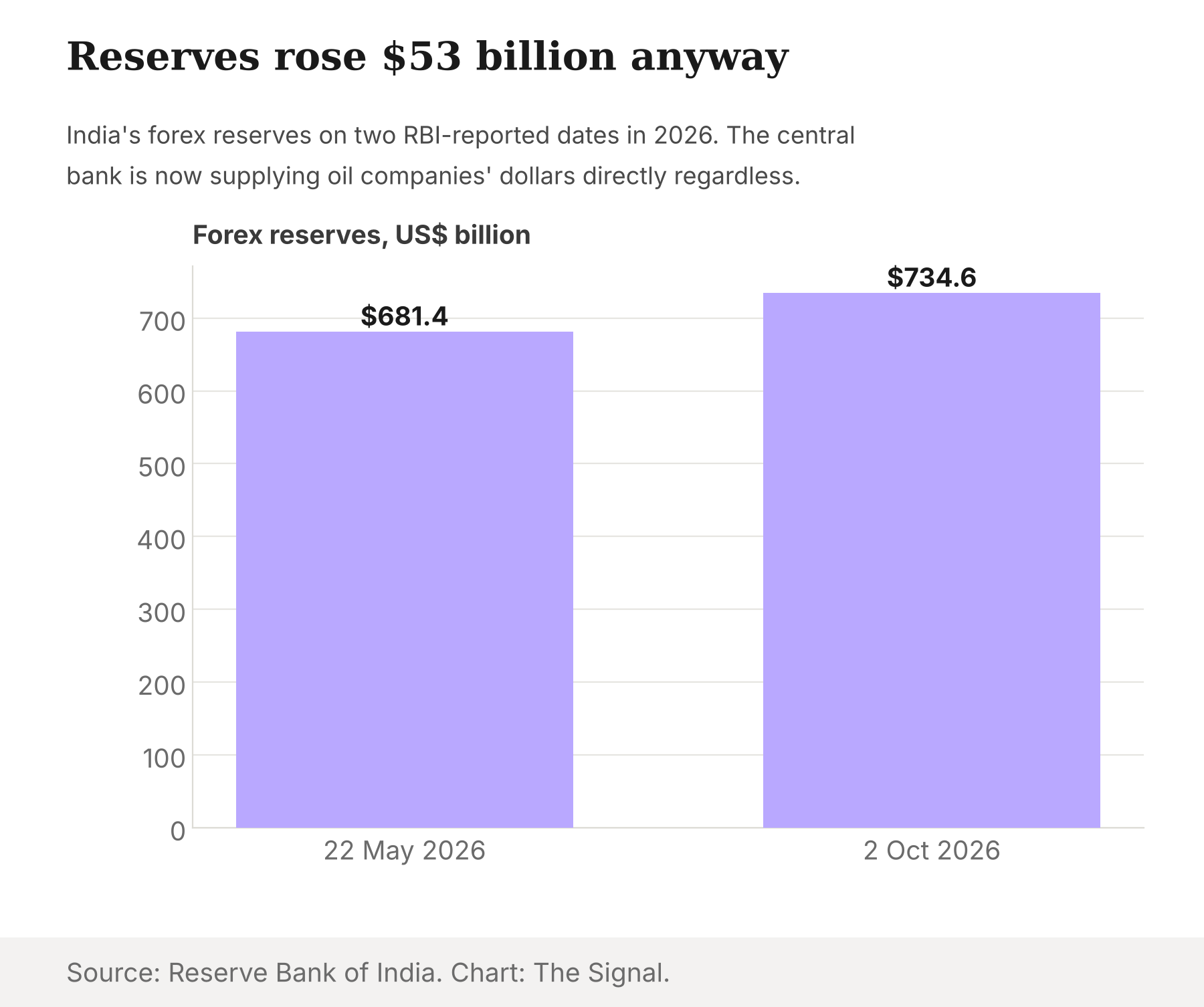
Here is the figure that carries the argument. India's forex reserves stood at US$734.6 billion on 2 October 2026, according to the Governor's statement of 7 October, with import cover of around 11 months. That is the latest figure in the statement, and it is eight days old today. Against that, reserves were US$681,384 million on 22 May 2026, in the RBI's weekly supplement.
Between those two RBI-reported dates, reserves rose by about $53 billion, roughly 8 percent, measured against the May level.
If reserves were the binding constraint, a window that covers the entire daily dollar requirements of the three companies would be a poor use of them. That the RBI chose it anyway suggests the problem was less the size of the stock than the price at which the flow was clearing. A central bank with that much in reserve can afford to sell dollars. What it cannot afford is a market that treats each sale as a signal to push the rupee lower.
The derivatives rules close the other door
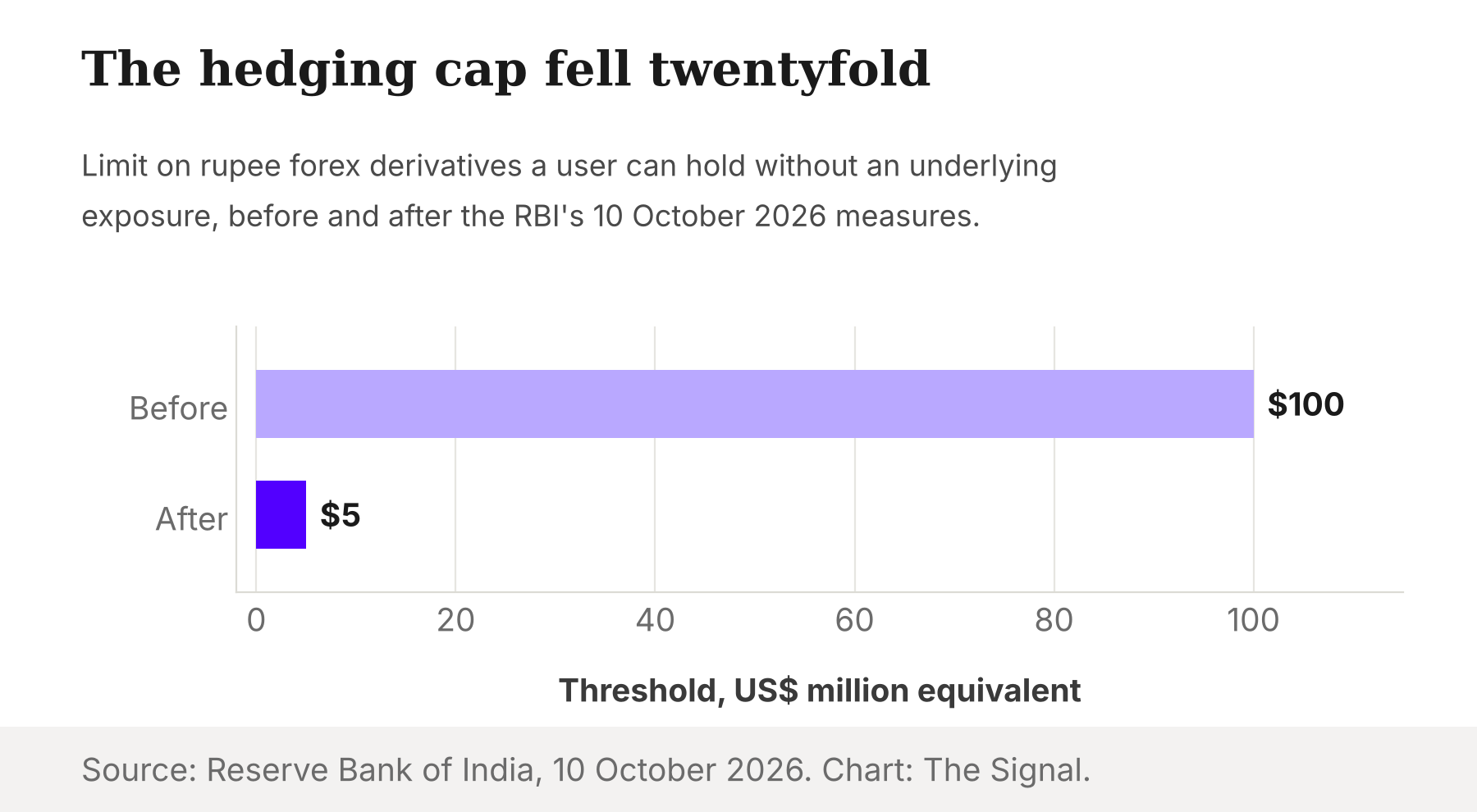
The same day, the RBI reduced the threshold for hedging rupee derivatives without an underlying exposure from USD 100 million to USD 5 million equivalent, both over the counter and on exchanges. That is a twentyfold cut. It also barred users from rebooking rupee forex derivative contracts that were cancelled, while leaving rollovers at maturity permitted.
The sharpest tool is the reserve requirement. Authorised dealers must now hold a cash Foreign Exchange Risk Reserve with the RBI equal to 20 percent of the rupee notional of each qualifying transaction, for contracts above USD 2 million that hedge current account exposures where the user buys foreign currency against rupees. In plain terms, a bank that helps an importer buy dollars forward has to park a fifth of the rupee value with the central bank in cash. That makes the trade costlier to offer, and costlier to pass on.
Read together, the design looks deliberate. The window takes three large buyers out of the spot market. The derivative rules make it costlier for everyone else to build a bet on the rupee's fall, or a precautionary hedge that behaves like one. One closes the front door and the other closes the side window.
The honest objection
The strongest objection is that this is a distinction without a difference. Selling dollars to three companies directly is still selling dollars. The reserves go down either way, and the RBI is simply moving the same intervention from one ledger to another. Markets are not naive, and traders will see the window's existence and price it in.
That case has force. A direct window does not conjure dollars, and if the underlying pressure from oil prices and outflows persists, the reserves still pay. The Governor's statement notes that foreign portfolio investors recorded net outflows of US$10.3 billion between April and 5 October 2026, a drain that no oil-company window touches.
But the objection misses what is being bought. Open-market intervention pays reserves and also advertises the pressure. A direct window pays reserves and hides the demand. The cost in dollars may be similar. The cost in signalling is not. A central bank that can keep one visible source of demand off the screen also keeps one visible source of fear off it.
The Signal
The reserves figure says India can afford this. The package says the RBI no longer trusts the spot market to digest it. The 12 October window and the 10 October derivative rules are a bet that the rupee's problem is a crowd, not a shortage, and that a crowd can be thinned by plumbing instead of by pouring in dollars.
Watch two things. The first is whether later RBI reserves releases show the window's dollar cost, since the release disclosed no amounts. The second is whether the rupee stabilises without further tightening. If the pressure leaks out through another channel, the window will have bought time, not a fix.
A defence you can see is a defence you can trade against. This one is designed so you cannot.
Reporting basis: the oil-company dollar window, the forex derivative measures and the reserve requirement come from the RBI's own press releases of 10 October, which were read directly. The latest reserves figure, the import cover and the portfolio outflow total come from the RBI Governor's statement, and the May reserves figure from the RBI's weekly statistical supplement. The April refiner request, the rupee levels and the May record low are per Reuters, via MarketScreener, and the April request rests on unnamed sources; those Reuters pieces count as one independent origin. The claim that oil companies are a large source of India's dollar demand is Reuters' assertion, with no figure given. The reserves increase, its percentage and the twentyfold cut in the hedging threshold are The Signal's calculations from those figures.