Jio Platforms is lining up what would be India's largest public offering. Business Today, citing Bloomberg, reports that the company is likely to price shares at Rs 1,065-1,119 and raise about Rs 30,213 crore, opening on 21 October. In the same days, the Reserve Bank of India tightened on several fronts at once. The easy read is a collision: a record issue competing with a central bank that is pulling cash out of the banking system.
It is worth slowing down on that. Put the issue next to the RBI's own numbers and it shrinks.
The issue is a rounding error beside the RBI's operations
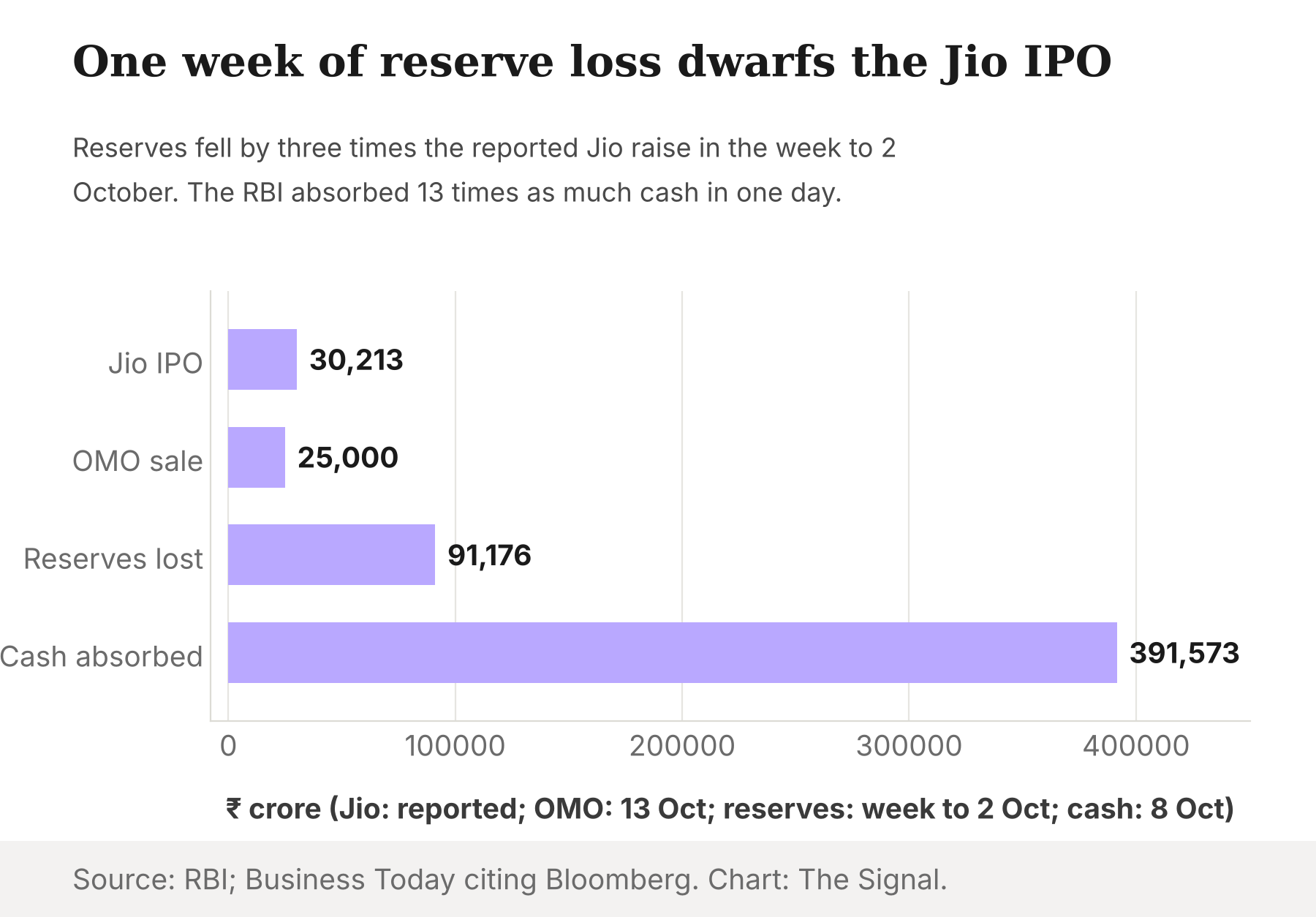
Start with the size of Jio's raise. The draft prospectus filed with SEBI proposes a fresh issue of up to 270,000,000 equity shares, with no offer for sale. At the reported top of the band, Rs 1,119, that is about Rs 30,213 crore. The price band is a media report, not a final term, so treat the figure as provisional until the red herring prospectus is filed.
Now the RBI's side. On 8 October the central bank's net liquidity operations were an absorption of ₹3,91,573 crore, meaning the system had that much surplus cash parked with the RBI. That is about 13 times the reported size of the Jio issue, in one day.
The RBI absorbed 13 times Jio's reported raise in a single day.
Add the next scheduled step. The RBI will run an OMO sale of ₹25,000 crore of government securities on 13 October, selling bonds to pull cash out. That is a little over four-fifths of the Jio issue by itself.
What the RBI is actually tightening
The liquidity move is real. Business Standard reports that the RBI raised the minimum daily CRR maintenance requirement from 90% to 99%, effective from the fortnight beginning 16 October. CRR is the share of deposits banks must keep with the RBI. The average requirement is not reported to have changed. What changed is that banks can no longer run a thin balance on some days and make it up on others. That is a tool for draining idle cash, and it sits alongside the bond sale.
So the surplus, not a shortage, is what the RBI is working against. A Rs 30,213 crore issue draws on a pool that the central bank absorbed at ₹3,91,573 crore on 8 October. On liquidity alone, Jio does not strain the system.
The bigger number is the rupee
Here is the figure that does matter. India's total forex reserves were US$734,606 million on 2 October, down US$12,952 million in the week, according to the RBI's weekly statistical supplement. In rupee terms that supplement shows a fall of ₹91,176 crore. Divide it by the reported Jio raise and the answer is 3.0. India's reserves fell by three Jio IPOs in seven days.
One week's reserve loss of ₹91,176 crore was three times the reported size of the Jio IPO.
Part of a reserve fall can be valuation, since gold and foreign bonds are marked to market, so the number is not all spending to defend the currency. But the policy response points to the same pressure. On 10 October the RBI cut the hedging threshold without an underlying exposure from USD 100 million to USD 5 million, and the same release requires a cash reserve of 20 per cent of notional on certain rupee derivative contracts above USD two million. Those rules target speculative positioning against the rupee, not equity issuance.
The honest objection
The strongest counter is that size is not the point. A marquee issue can still matter to sentiment and to how other issuers price, and the CRR change can raise short-term funding costs for those who finance applications.
That is fair, and the sources here cannot rule it out. Nothing in the RBI releases links the CRR change to the IPO. But sentiment effects are a different claim from a liquidity squeeze, and the 8 October operations do not support the squeeze.
The Signal
The headline fight is Jio against the RBI for rupee liquidity. The data show a surplus: the central bank absorbed ₹3,91,573 crore on 8 October, and the issue is roughly a thirteenth of that. What is under pressure is the dollar side. Reserves lost ₹91,176 crore in a week, and the RBI answered with limits on derivatives, not on equity.
Watch two things as the issue opens. Whether it is priced where the reports say, and whether the weekly reserve number keeps falling. If it does, the real test is not whether Jio fills its book. It is whether the rupee can hold while it does.
Reporting basis: the liquidity, OMO, reserve and derivatives figures come from the RBI's own releases (OMO, money market operations, weekly supplement, FX measures), which were read directly. The share count comes from Jio Platforms' draft prospectus hosted by SEBI, which leaves price blank. The band and the raise are reported by Business Today, citing Bloomberg, and are unconfirmed until a red herring prospectus is filed. The CRR change rests on one outlet, Business Standard, and was not checked against an RBI notification. The ratios (13 times, three times, four-fifths) are The Signal's calculations from those figures.