The surface read of India's currency is simple: the rupee keeps sliding. The Federal Reserve's H.10 series shows the rupee averaging 84.01 to the dollar in October 2024 and 95.51 in September 2026, so a dollar now costs about 14 percent more rupees. On 7 October, the Reserve Bank's Monetary Policy Committee voted unanimously to raise the repo rate by 25 basis points to 5.50 percent and moved to a stance of calibrated tightening. Weak currency, tighter policy. The story seems to write itself.
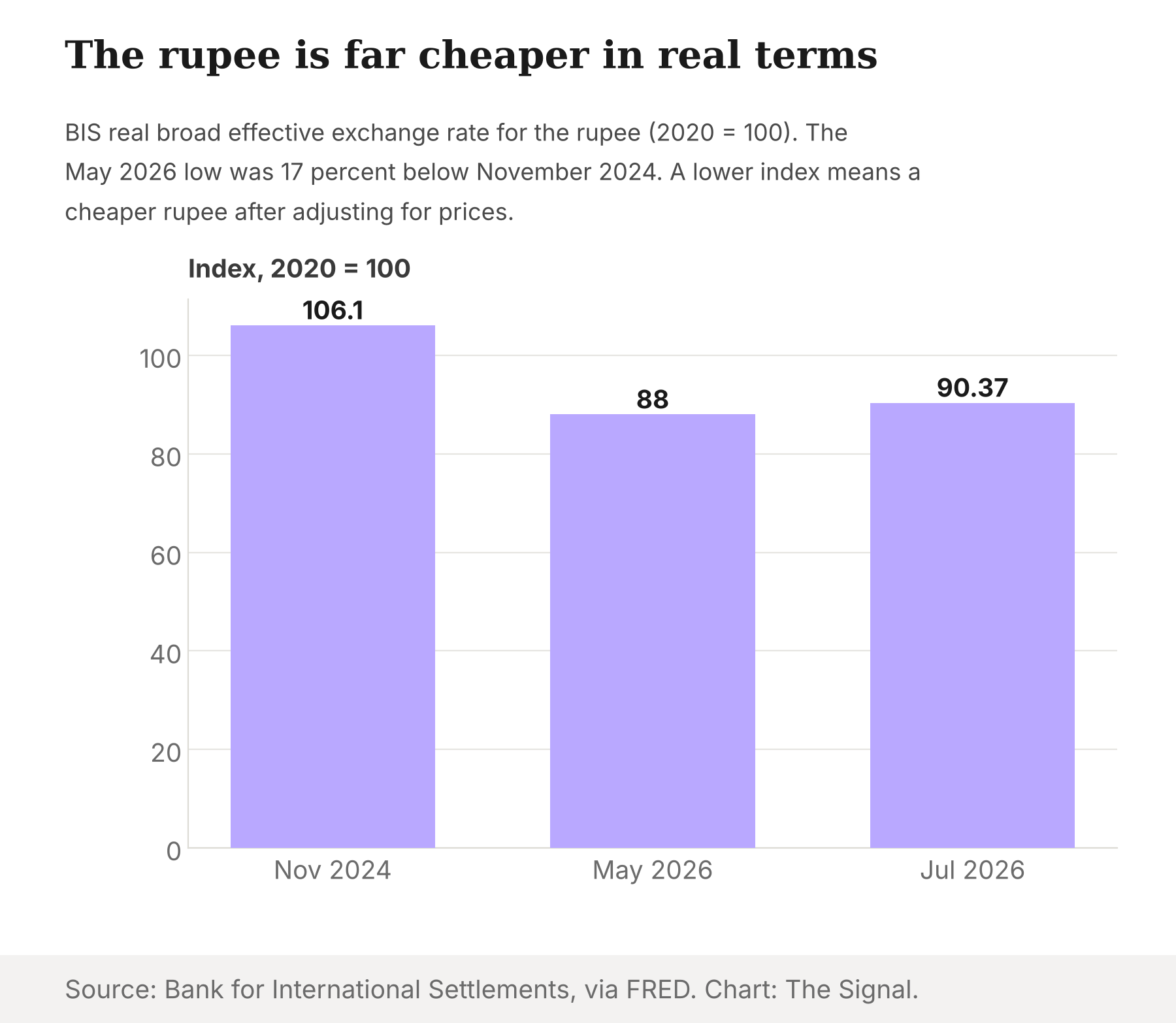
It is worth slowing down on that, because a nominal slide against the dollar is the least informative way to measure a currency. The better gauge adjusts for prices and averages across trading partners. The Bank for International Settlements' real broad effective exchange rate for the rupee, indexed to 100 in 2020, stood at 106.10 in November 2024, fell to 88.00 in May 2026 and was 90.37 in July 2026. That is a 17 percent drop to the May low and still about 15 percent below November 2024 two months later. By this measure the rupee is roughly 10 percent cheaper than its 2020 average.
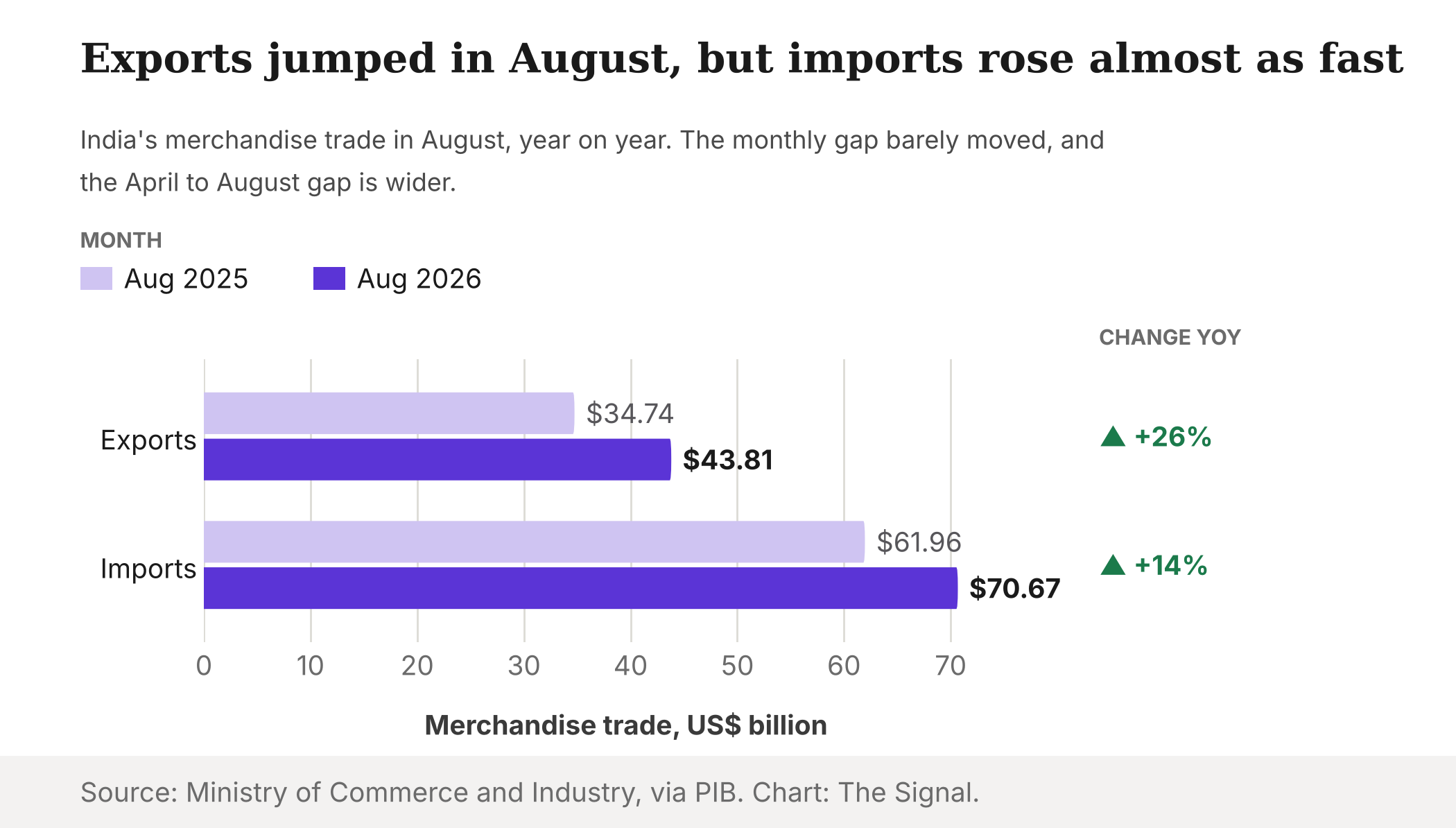
A cheaper currency is supposed to do two things: sell more exports and make imports dearer. The first is visible. India's merchandise exports were US$43.81 billion in August 2026, against US$34.74 billion a year earlier, and imports were US$70.67 billion, against US$61.96 billion. Exports rose 26 percent. Imports rose 14 percent.
The gap did not close
Strip the percentages out and look at the dollars. Exports rose by about US$9.1 billion and imports by about US$8.7 billion, which puts the August merchandise gap at about US$26.9 billion, against US$27.2 billion a year earlier. That is a real improvement, but a small one.
The cumulative picture is less kind. The merchandise trade deficit for April to August 2026 was US$147.09 billion, against US$123.88 billion in the same months of 2025. That is US$23.2 billion, or 19 percent, wider. A currency that is 15 to 17 percent cheaper in real terms has not, over five months, narrowed the goods gap.
The reason is arithmetic. Imports were US$363.00 billion in April to August, against exports of US$215.91 billion, so exports need to grow much faster than imports for several more months before the cumulative gap turns. August is a first sign of that, not proof.
Who is financing the cheap rupee
If the trade account is not closing the gap, the financing side must. Here the RBI's own numbers are specific. Foreign portfolio investors were net sellers of US$10.3 billion between April and 5 October 2026. In June, the RBI had reported net FPI outflows of US$13.7 billion for 2026-27 up to 2 June. The two cut-offs differ, but together they imply that portfolio investors have been small net buyers since June, not heavy sellers. They have not come back in force.
The money that did come is deposit money. Net inflows under non-resident deposits were US$119.2 billion in April to August 2026, against US$5.6 billion a year earlier, roughly 21 times as much. That surge followed a June measure under which the RBI offered to bear the full hedging cost of fresh three to five year FCNR(B) deposits taken by banks, a facility set to run until 30 September 2026. The same statement said the RBI does not target any specific level or band for the exchange rate. The RBI does not say how much of the deposit surge that measure explains, but the direction is clear: the support came through an incentive, not through investors choosing Indian assets on their own.
The result shows in reserves. India's reserves were US$734.6 billion on 2 October, against US$682.3 billion on 29 May: a rise of US$52.3 billion in about four months. So the rupee is cheap, the trade gap is wide, and the cushion is growing anyway, on money that depends partly on the terms of an RBI incentive.
What the hike is really about
Set the hike next to the inflation path. MoSPI put year-on-year CPI inflation at 4.82 percent in August 2026. The RBI now projects 6.0 percent for the October to December quarter and 5.7 percent for January to March. That is a jump of about 1.2 points in one quarter.
The cost of that path is not shared evenly. The MPC said rate cuts are off the table in the near term and that the next move can only be a hike or a pause. A borrower on a floating-rate loan now has no cut to wait for. An importer gets a dearer dollar and a dearer rupee loan at once.
The honest objection
The strongest case against this reading is that the cheaper rupee is simply working, only slowly. Export growth of 26 percent in a single month is large, and trade volumes can take many months to respond to a currency move. On that view the five-month deficit is a rear-view mirror, and August is the front windscreen. That may prove right. One month of improvement in the gap, from US$27.2 billion to US$26.9 billion, is not enough to say. If the next few releases show the monthly gap shrinking by more than a rounding error, the objection wins.
The other defence is that a cheap currency is a feature. A real index of 90.37 in July 2026, against 100 in 2020, makes Indian goods cheap abroad, and a central bank that says it does not target a level is not fighting it. All true. But that describes the competitive benefit, not the bill, and the bill is arriving through the interest rate.
The Signal
India's cheap rupee is real: the BIS index was 90.37 in July 2026, below its 2020 base of 100. What it has not yet bought is a smaller cumulative trade gap, and the capital behind it is deposit-led rather than investor-led. Watch three things. The monthly merchandise gap in the September trade release. The September CPI print, due on 12 October, against the RBI's 6.0 percent path for the next quarter. And whether non-resident deposit inflows hold up after the hedging-cost facility's end date. A cheap currency is a bet that exports arrive before the bills do.
Reporting basis: the rate decision, stance and "cuts off the table" language are from the RBI's MPC resolution. The inflation projections, portfolio and non-resident deposit flows, and October reserves are from the Governor's October statement; the hedging-cost measure, exchange-rate policy line, earlier outflow figure and May reserves are from the Governor's June statement. August CPI is from MoSPI. Trade figures are from the Ministry of Commerce and Industry, via PIB. The real effective exchange rate is a BIS series and the rupee-dollar rate is the Federal Reserve's H.10 series, both published through the St. Louis Fed's FRED database. The three RBI documents are one origin for several figures. The percentage changes, gap comparisons, implied portfolio flow since June, deposit multiple and reserves change are The Signal's calculations from those figures.