The headline version of this week's bond story is generous to India. Jefferies puts 25% of its global sovereign bond portfolio in Indian rupee 15-year government bonds yielding 7.38%, against a portfolio average yield of 6.97%, Business Today reports, citing the firm's GREED & fear report. Read the top line and a global investor has looked at India's long bond and liked the price.
It is worth slowing down on that. A portfolio allocation is a view, not a flow of money. What tests the view is what foreign investors actually did with Indian government bonds in the same month, and that points the other way.
The buyers went the other way
India's long bonds sit in a part of the market foreigners can buy freely. The fully accessible route, or FAR, is the set of government securities open to foreign portfolio investors without limits. Foreign portfolio investors pulled Rs 9,192 crore out of FAR bonds in September, Business Standard reports, citing data from the Clearing Corporation of India. That ended a five-month run in which they net bought Rs 60,332 crore.
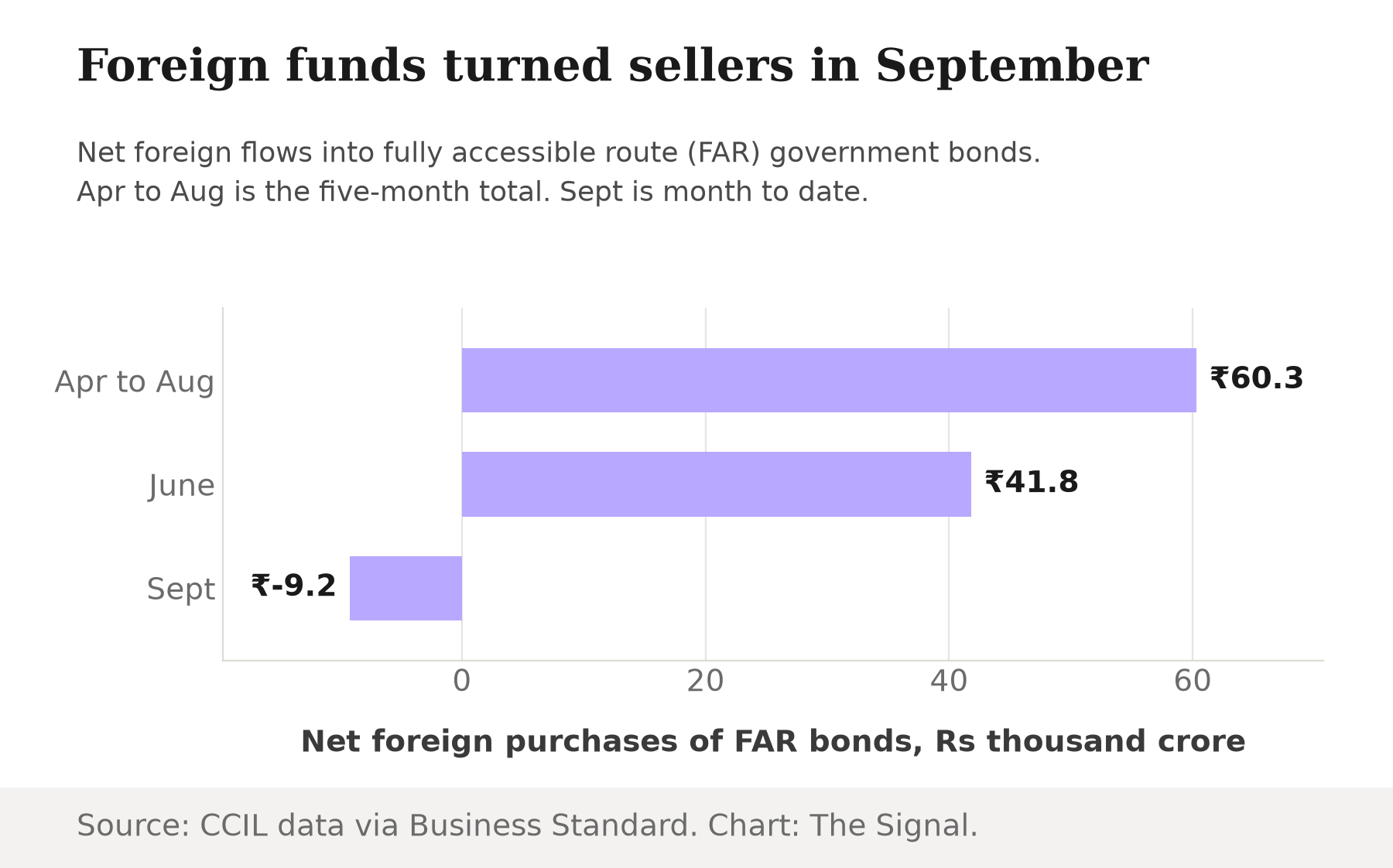
The reversal matters more because of what drove the earlier buying. The same report says FAR inflows peaked at a record Rs 41,774 crore in June, after the government exempted foreign investors from tax on government-security interest and gains from April 1, 2026, and the RBI moved all newly issued 15-, 30- and 40-year bonds into the FAR basket. The 15-year bond that Jefferies holds is therefore the very instrument policymakers opened up to attract foreign money.
A tax break and a wider basket changed the price foreigners would accept, but not the weather. A bond that is cheap in March can still be sold in September if the rupee, oil and US rates move against it.
What moved instead
The prices around the bond moved too. The US 10-year Treasury yield closed at 5.29% on September 30 and 5.24% on October 1, according to Federal Reserve data via FRED. India's 10-year yield rose to 7.21% on October 1, a two-year high, according to Trading Economics. The gap between them is about 197 basis points, and it is the margin a foreign buyer is paid to hold rupee risk.
That margin is thinner than the headline yield implies once the currency is counted. The rupee hovered around 96.0 per dollar on October 1, Trading Economics reports, with likely RBI intervention limiting the decline. A 7.38% yield on the 15-year bond sits only 17 basis points above the 7.21% on the 10-year, from the two figures above. Stretching to a longer maturity pays little extra for the added duration, which is a thin cushion against a currency that needs official support to stay near 96.
Who paid the difference
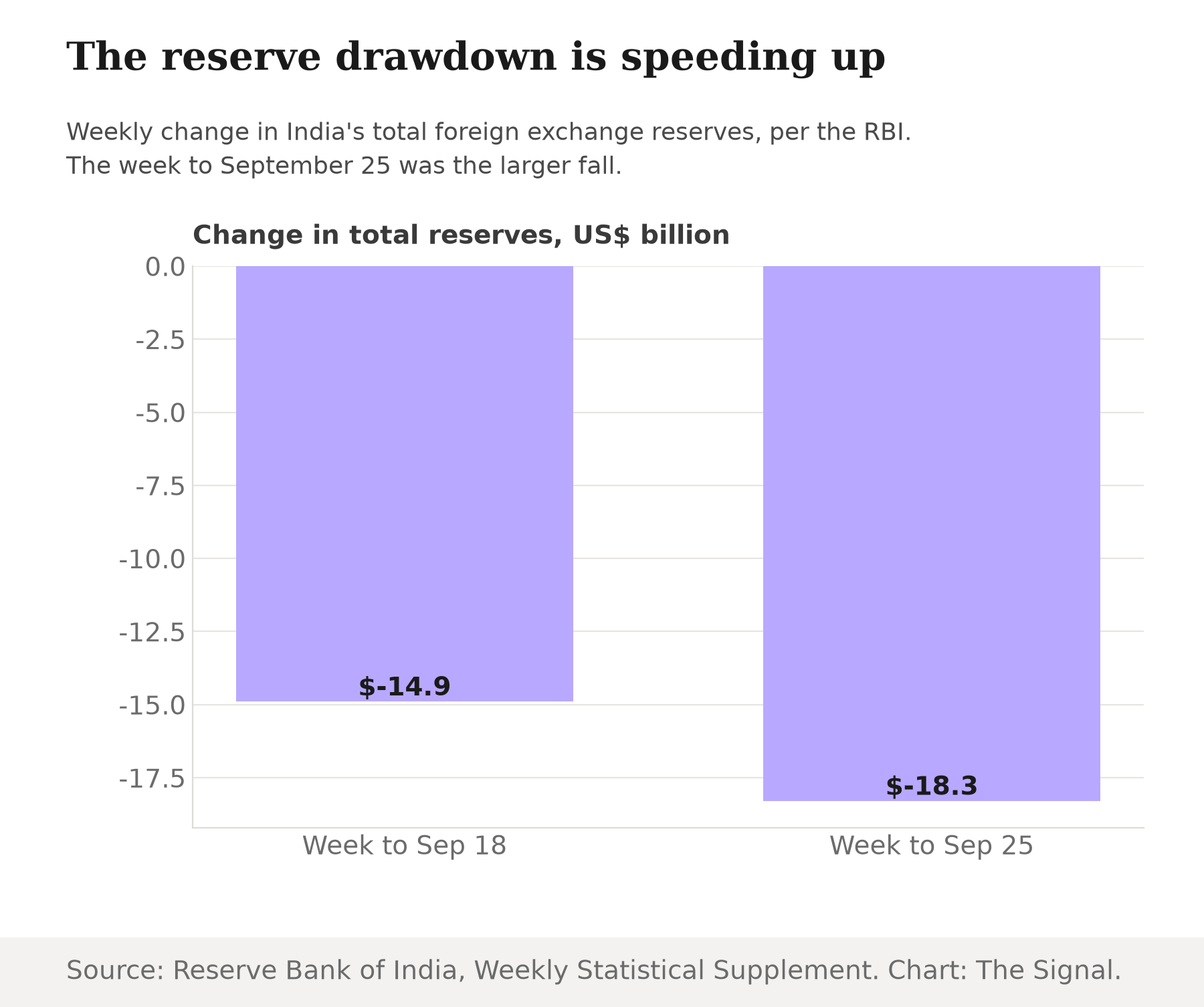
If foreign funds sell bonds and the rupee still holds near 96, someone is on the other side of the trade. The RBI's own weekly data shows who. India's total reserves fell US$18,343 million in the week to September 25, to US$747,557 million, the RBI's Weekly Statistical Supplement reports, with foreign currency assets down US$15,570 million. A week earlier, reserves had fallen US$14,881 million to US$765,901 million in the week to September 18.
Add the US$18,343 million and the US$14,881 million and reserves fell about US$33.2 billion in two weeks. The RBI reports these as weekly changes in reserves, and a fall can include valuation effects as well as dollar sales. It does not say how much of the drop was intervention. The timing, with FAR selling and a rupee defended near 96, is consistent with the central bank absorbing part of the foreign exit. The data does not prove it.
The most recent figure is for the week ended September 25, the latest the RBI had reported on October 3, 2026. Any week since then is not in these numbers.
The honest objection
The strongest case against reading this as a warning is that a long-bond view and a one-month flow are different things. Jefferies is making a call on where yields settle over years, and long-horizon buyers tend to arrive when short-horizon holders leave. The September selling is also small. Foreign investors bought Rs 60,332 crore of FAR bonds from April to August and sold Rs 9,192 crore in September, so by simple subtraction they are still net buyers of about Rs 51,140 crore since April.
That case is real. It explains why a yield can look attractive while flows turn. But it answers a different question. If the portfolio view is right, the foreign buyer arrives later, perhaps at a lower price. If the view is early, the cost of being early lands on the RBI's reserves and on the rupee. Neither outcome makes the allocation a signal that foreign money is coming. It is a signal that one firm thinks the price is fair.
The Signal
India's external position leans on debt more than it used to. Debt made up 56.9 per cent of India's external liabilities at end-June 2026, the RBI reports, and in the same quarter non-residents' portfolio equity investments declined by US$14 billion. A market that leans on bond inflows needs those inflows to hold when equities are leaving.
The next test is close. The RBI is expected to raise policy rates at its October 5 to 7 meeting for the first time in over three-and-half years, Deccan Herald reports, with inflation above its 4% target for a third straight month in August. A hike would raise yields on new money. It would not by itself bring foreign funds back to a currency being defended with reserves. Watch two numbers: whether the next weekly FAR flow turns positive, and whether the reserves fall repeats. A yield is a price, and a price needs a buyer who is not the central bank.
Reporting basis: the Jefferies allocation and yields are per Business Today, reporting Jefferies' GREED & fear report; we did not read the report itself, so those figures rest on that single outlet. FAR flows, the tax exemption and the basket change are per Business Standard, citing Clearing Corporation of India data. Reserves and the external-liability share are from the Reserve Bank of India's Weekly Statistical Supplement and its International Investment Position release. US Treasury yields are from Federal Reserve data via FRED. India's 10-year yield and the rupee level are per Trading Economics, and the expected rate hike is per Deccan Herald's analyst survey. The 197 basis point gap, the 17 basis point spread, the US$33.2 billion two-week fall and the Rs 51,140 crore net since April are The Signal's calculations from those figures.