The read this week is simple: dollars have become expensive, so anyone in India who borrows in them is in trouble. The US 30-year Treasury yield closed at 5.56 percent on September 28, up from 4.99 percent on June 1. The 10-year yield sat at 5.24 percent the same day. On September 16, the Federal Reserve raised its target range by a quarter point to 3-3/4 to 4 percent. And the rupee settled at 95.97 against the dollar on September 28, its second breach of 96 in two weeks, with Brent near $108 a barrel.
Read that way, a company raising dollars abroad is paying more every week, on top of a currency that keeps sliding.
It is worth slowing down on that. The rupee has barely moved next to the yield, and the RBI has fixed the price of the hedge for eligible borrowers.
The yield moved far more than the rupee
Set the two series side by side from the same starting day. The 30-year yield rose from 4.99 to 5.56 percent between June 1 and September 28, a rise of about 11 percent. Over roughly the same window, the rupee went from 94.99 to 95.81 per dollar (the latest daily figure in that series is for September 25), a slide of under 1 percent.
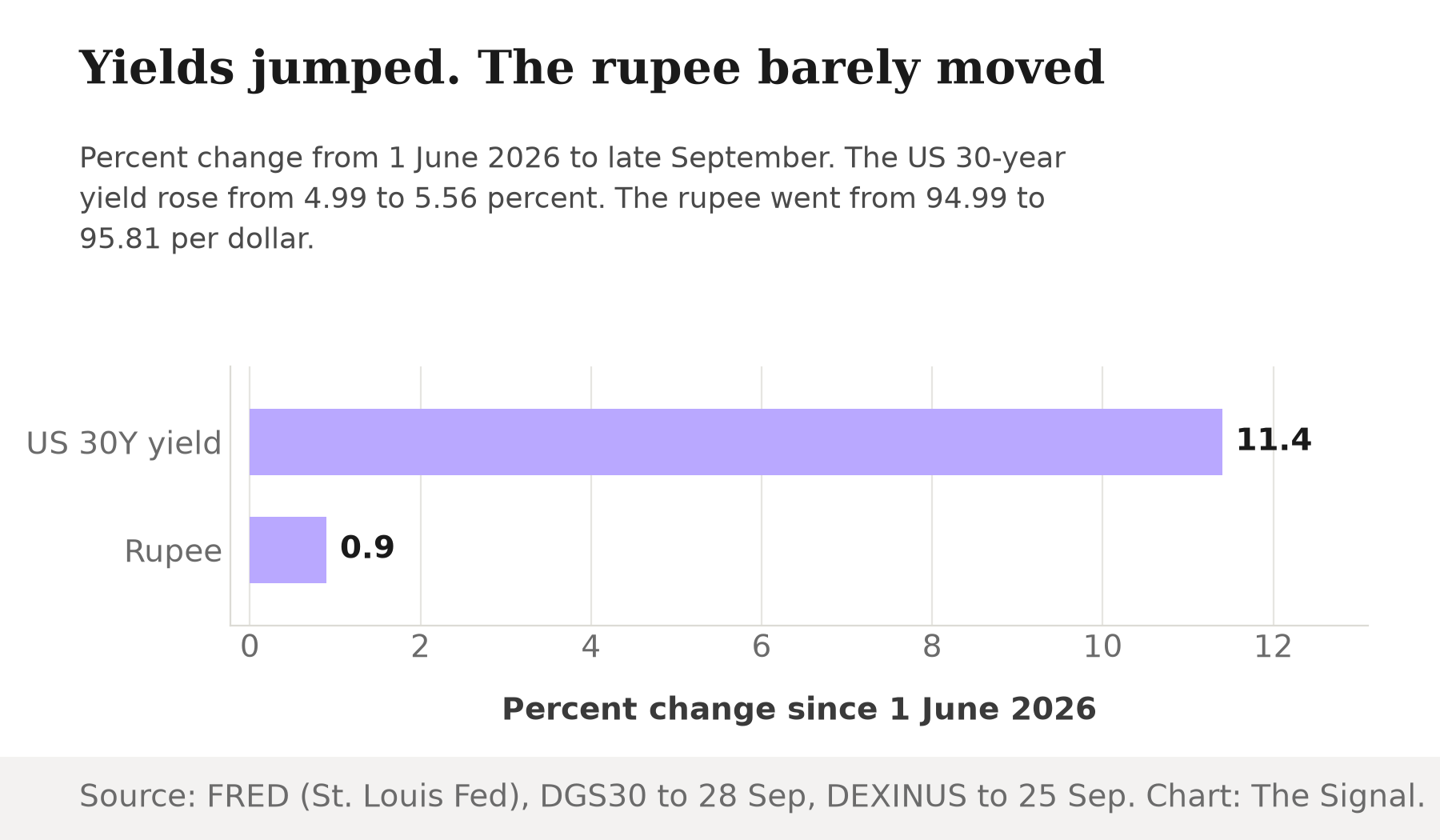
The gap matters because a dollar borrower carries two risks: the dollar interest rate and the rupee's path. The 30-year yield rose 57 basis points over the period, while the rupee lost under 1 percent. The story of the summer is a rate shock, not a currency collapse.
The hedge has a fixed price
The reason sits in a circular the RBI issued on June 8. Under the facility, the swap rate is 1.5 percent per annum, compounded semi-annually, and banks sell dollars to the RBI at the FBIL reference rate and agree to buy the same amount back at maturity, per EY's summary of the circular. The RBI's own FAQ adds that external commercial borrowings of average maturity of three years and above are eligible.
Consider what a fixed rate means in a week like this one. A market hedge reprices as conditions change, and the swap rate stays at 1.5 percent whatever the market does. If market hedging costs rise, an eligible borrower does not feel it. The gap has to land somewhere, and the only party on the other side of the swap is the RBI. The circular does not say the RBI is subsidising anyone, and we do not claim that. The narrower point is that a risk a market hedge would price in sits on the central bank's side of the swap.
Most of the money never came from bonds
The bigger surprise is who used the window. The Ministry of Finance said the facility mobilised $73 billion by August 21: $65.40 billion in FCNR(B) deposits, $4.86 billion in overseas borrowing by banks, and $2.59 billion in external commercial borrowing, in a release carried by DD News.
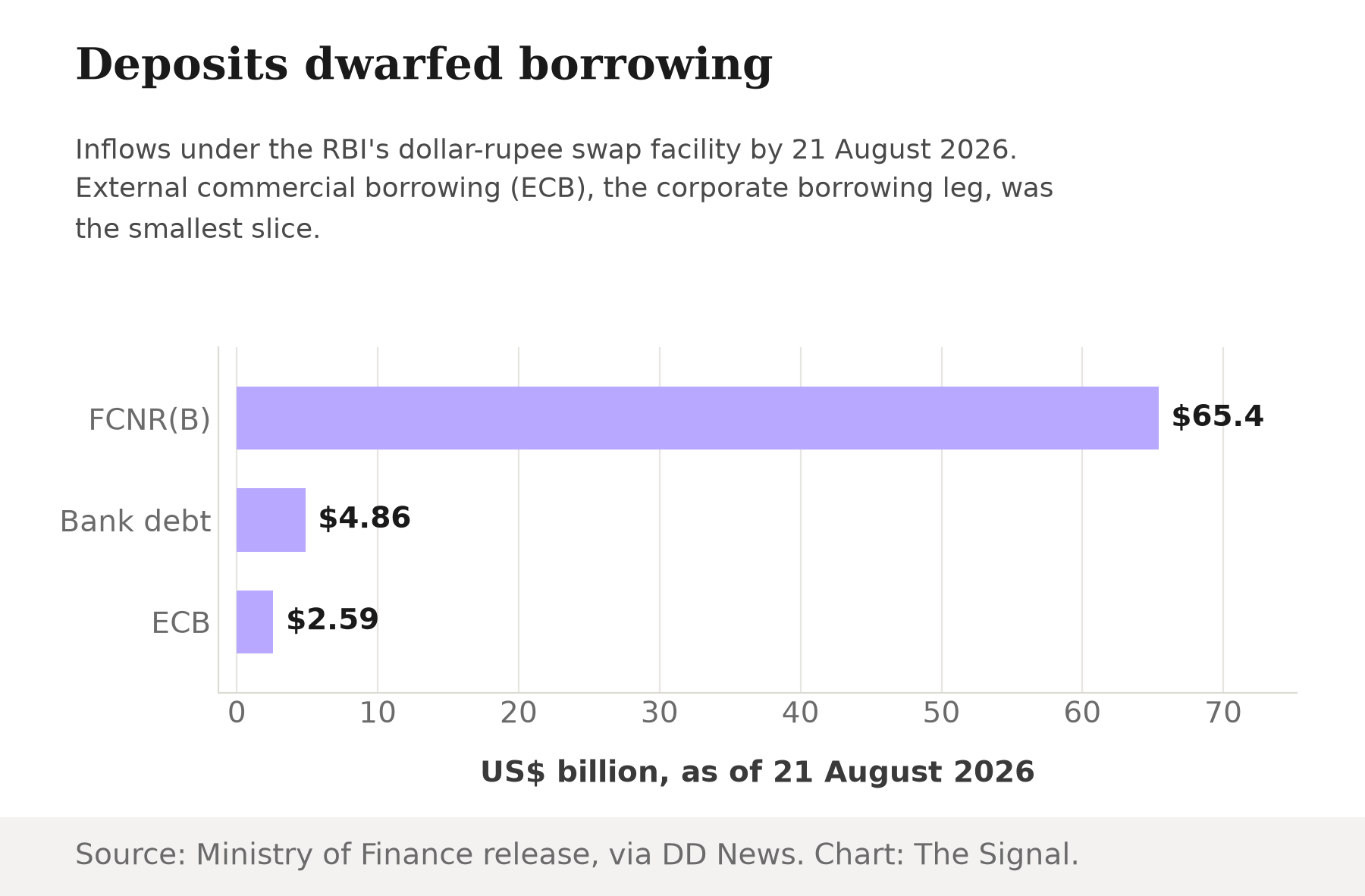
FCNR(B) deposits are foreign-currency accounts held by non-resident Indians. In the ministry's figures they were about 90 percent of the total (65.40 out of 73). External commercial borrowing, the leg that most resembles an Indian company raising dollars abroad, was under 4 percent (2.59 out of 73).
So the picture of Indian borrowers rushing into an expensive dollar bond market does not match the ministry's numbers. Deposits, not borrowing, brought in most of the dollars. The window worked as a deposit magnet.
The honest objection
The strongest case against this reading is timing. The $73 billion figure is as of August 21. Since then the rupee has hit 95.97 and the 30-year yield has kept rising. Corporate borrowers may have moved after the data stops, and the ECB slice could look very different in the next release.
That is fair, and it is why the ECB figure is a snapshot, not a verdict. It does not rescue the consensus read. The largest inflows came through a channel with a fixed price, and the rupee's slide over the period was under 1 percent.
The Signal
The dollar squeeze is real in the yield, not in the currency, and part of the difference is the RBI's decision to hold the price of the hedge at 1.5 percent. That buys calm for borrowers. It also leaves the central bank carrying the difference if US yields keep rising and the rupee gives way. The next Ministry of Finance update on the swap window will show whether external commercial borrowing has grown from under 4 percent of inflows. If it has, companies are betting the fixed hedge will outlast the yield. A fixed price is only a promise until someone else is holding the risk.
Reporting basis: US Treasury yields and the rupee-dollar rate are Federal Reserve Board series (H.15 and H.10), via the St. Louis Fed's FRED. The September 16 rate decision is the Federal Open Market Committee's own statement. The swap rate and mechanics are per EY's summary of the RBI's June 8 circular, a secondary source, and the eligibility rule is from the RBI's FAQ. The $73 billion mobilisation figures are a Ministry of Finance release as carried by DD News, and the September 28 rupee close and Brent price are PTI copy carried by ThePrint. Each of those rests on a single source. The percent changes and the deposit and borrowing shares are The Signal's calculations from those figures.