India's biggest stock exchange is about to become a listed company. NSE's Rs 22,562 crore initial public offering is the biggest Indian issue of 2026 and the second-largest ever, trailing only Hyundai Motor India's Rs 27,870 crore offer in 2024. The issue was subscribed 5.71 times over its three-day bidding window, and the exchange fixed its price band at Rs 1,700 to Rs 1,785 a share, valuing the company at up to Rs 4.42 lakh crore at the top of the range. Read the size of the raise and the subscription numbers, and this looks like a routine story about a blockbuster listing.
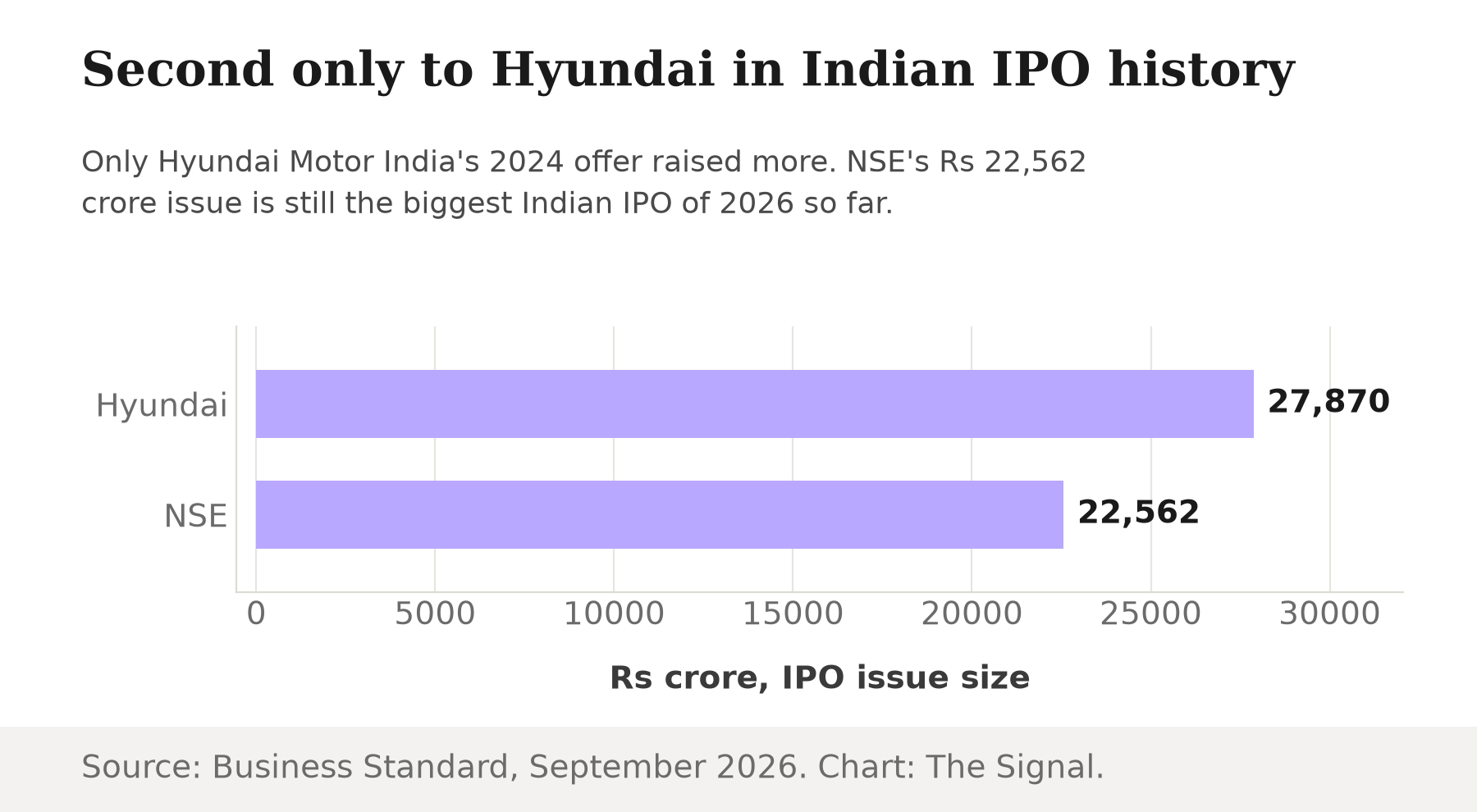
NSE's IPO, by the numbers.
| Metric | Figure |
|---|---|
| Issue size | Rs 22,562 crore |
| Price band | Rs 1,700 to Rs 1,785 per share |
| Valuation at top of band | Up to Rs 4.42 lakh crore |
| Subscription | 5.71 times over three days |
| Scheduled listing date | Thursday, September 24, 2026 |
| Rank among Indian IPOs | Second-largest ever, after Hyundai Motor India (2024) |
Source: Business Standard; Business Today; India TV News.
It is worth slowing down on where those shares are actually going to trade. NSE's own SEBI-filed offer document names BSE, not NSE, as the exchange its shares will list on, and states plainly that BSE will be the Designated Stock Exchange for the offer. The company that runs India's largest stock market, home to the Nifty and the country's dominant venue for equity and derivatives trading, could not put its own shares on its own exchange. It had to list on the exchange it competes with. That is not a footnote. It is the shape of the whole story: a decade of delay, and an arrival that still could not happen on NSE's own turf.
The case that started the clock
The delay traces to a single regulatory order. SEBI passed its ruling in the NSE co-location matter on April 30, 2019, and the case was contested through three separate appeals to the Securities Appellate Tribunal. That 2019 order directed NSE to disgorge about Rs 625 crore plus 12 percent annual interest running from April 2014, a case over preferential server access that let some algorithmic traders reach NSE's trading systems faster than others. NSE fought the order at the tribunal and then at the Supreme Court for years. The Supreme Court finally allowed a settlement on September 18, 2026, closing the co-location case together with a related dark fibre matter for a combined amount of about Rs 1,492 crore, just days before the IPO. The bill more than doubled between the original order and the final settlement, and the case that had to close first was the one that opened seven years earlier.
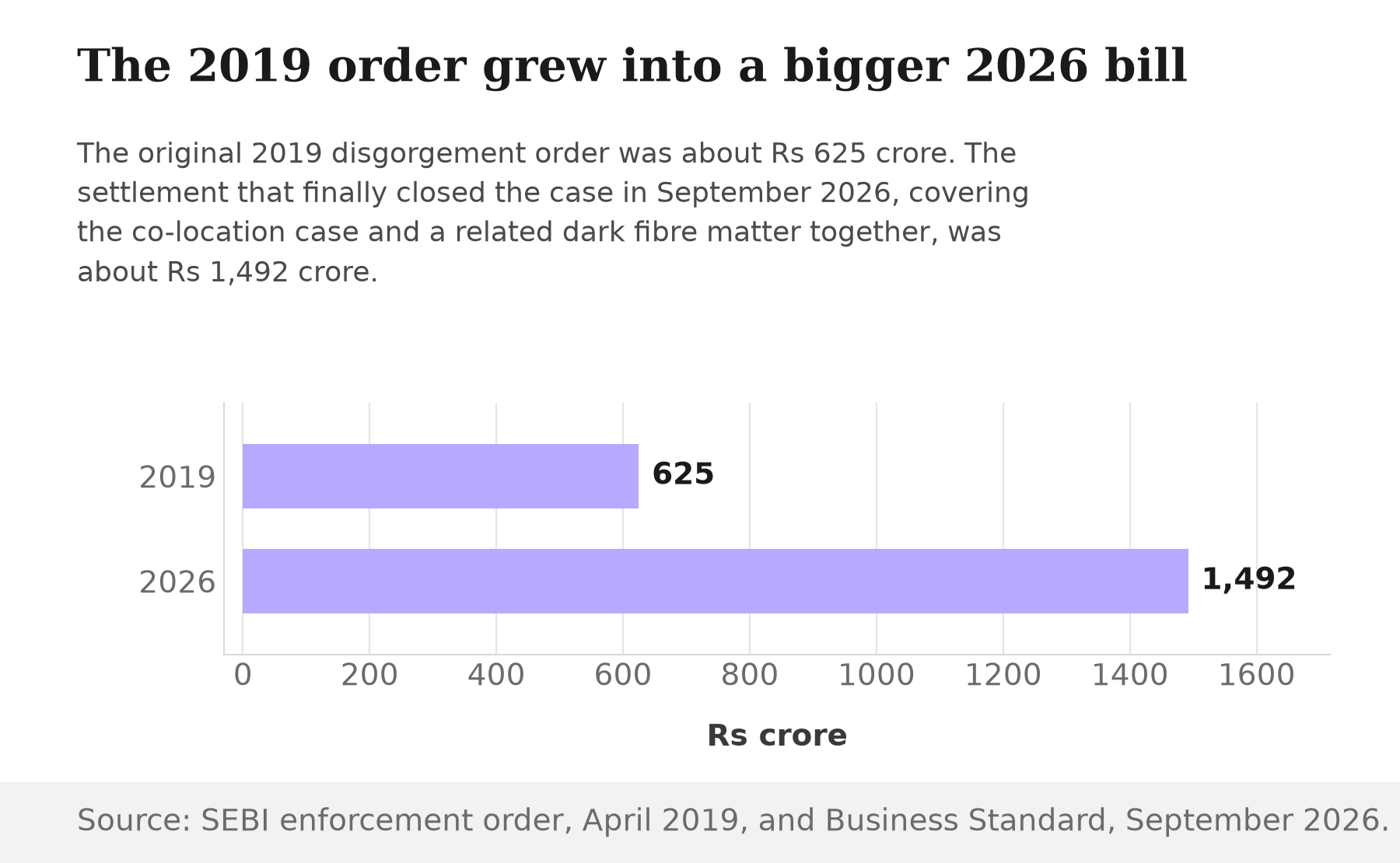
Ten years, two filings
The co-location case was not the only thing standing between NSE and a listing. NSE first filed draft IPO papers with SEBI in 2016, but was prevented from proceeding by ongoing regulatory proceedings and investigations, only receiving SEBI's no-objection certificate to refile earlier in 2026. As a SEBI-regulated entity, NSE needed its own regulator's sign-off before it could even begin the IPO process again, and that sign-off did not come until the unresolved cases against it had run their course. Ten years after the first attempt, the second filing finally went through.
The other case in the file
NSE's governance troubles in that decade did not stop at co-location. In February 2022, a SEBI order found that former NSE managing director Chitra Ramkrishna had shared confidential exchange information for years with an unidentified person she described as a Himalayan spiritual guide, and that NSE's own board knew of the exchange and chose not to report it to SEBI. NSE is also India's primary self-regulatory market institution, the body that is meant to police conduct on its own exchange before SEBI has to step in. For a stretch of that decade, the self-regulator was the thing being regulated: a co-location order first, then a boardroom secrecy finding.
A rule that applies to every exchange
NSE is not being singled out by having to list elsewhere. BSE, India's other major exchange, made its own debut nine years earlier, on February 3, 2017, becoming the first Indian stock exchange to go public and closing 32.6 percent above its Rs 806 issue price. Every Indian exchange that lists has had to do it on someone else's platform. That rule is not new, and it is not what delayed NSE. What delayed NSE was the decade it spent as a defendant before it could act as an issuer at all.
The honest objection
The strongest case for the process working as intended is that a decade of scrutiny is what a self-regulatory market institution should get before it is allowed to raise public money from retail investors. NSE ran the exchange other companies had to satisfy SEBI to list on; holding it to the same bar, and letting the Supreme Court be the one to finally close the case, is not dysfunction, it is the system doing its job on the institution that enforces it on everyone else.
That case is real, and it is also incomplete. The process closed one exchange's case in 2026. It did not resolve the structural conflict that produced it: a market-infrastructure institution that both runs the rules and, eventually, wants to raise capital under them, with no separate arbiter built into the design until a dispute forces one in. NSE's decade is over. The question the settlement does not answer is what happens the next time a market-infrastructure entity behind it in the queue ends up on both sides of that same line.
The Signal
NSE's listing tomorrow is not just a big number clearing the tape. It is the resolution of a specific conflict: the institution that was supposed to police co-location and information leaks on its own platform spent a decade proving it could not fully police itself, and had to be cleared by its regulator and the Supreme Court before it could sell shares in itself, on someone else's exchange. That conflict does not disappear once NSE lists. It moves to whichever market-infrastructure institution is next in line to test how a self-regulator behaves when it is also an applicant. Watch that queue, not the listing-day pop.
Reporting basis: NSE's SEBI-filed offer document is the source for the Designated Stock Exchange designation. SEBI's own enforcement-orders register is the source for the 2019 co-location order and its associated appeals, and for the 2022 order on Chitra Ramkrishna. The September 2026 Supreme Court settlement and the 2016 draft filing and 2026 no-objection certificate are as reported by Business Standard. The subscription figure is as reported by Business Today. The price band and valuation are as reported by India TV News. Each is the sole source for the figures it is cited on. BSE's 2017 listing debut is per Business Standard's reporting from that year. The comparison between the 2019 order amount and the 2026 settlement amount, and the ranking of NSE's IPO against Hyundai Motor India's, are stated directly from those cited figures.