
On September 24, SEBI's board cleared a package that touches nearly every layer of how professional money reaches India's markets. Portfolio managers can now put client funds directly into IPOs and primary-market debt issues, and up to 10 percent of a client's assets into investment-grade unlisted debt, SEBI's board meeting press release states. Foreign portfolio investors can now trade non-agricultural commodity derivatives, provided they exit their positions three days before a contract expires, the same press release states. And SEBI agreed to move faster against itself: an entity under investigation now gets a 60-day settlement notice before any formal show-cause charge, SEBI's board meeting press release states, and 90 days to settle after a show-cause notice does land, up from 60, the press release states. Read as a set, it looks like an across-the-board loosening, a regulator in a deregulating mood.
It is worth slowing down on that. The change that reshapes the competition for India's money sits in two much narrower numbers, one at the bottom of the wealth ladder and one at the top, and neither shows up in the "SEBI eases rules" framing.
Start at the bottom. SEBI's existing Portfolio Managers Regulations bar a manager from accepting a client bringing less than Rs 50 lakh, the SEBI (Portfolio Managers) Regulations, 2020, as amended, state. The board's new PRIM route, short for Portfolio Managers Route for Investing in Mutual Funds, lets a manager take that same client at a minimum ticket of Rs 25 lakh, provided the manager's PRIM-only business carries at least Rs 2 crore in net worth and caps its fee at 1 percent of assets under management, SEBI's board meeting press release states. That is not a rounding adjustment. It is half the entry price SEBI itself has enforced since the current rulebook was written.
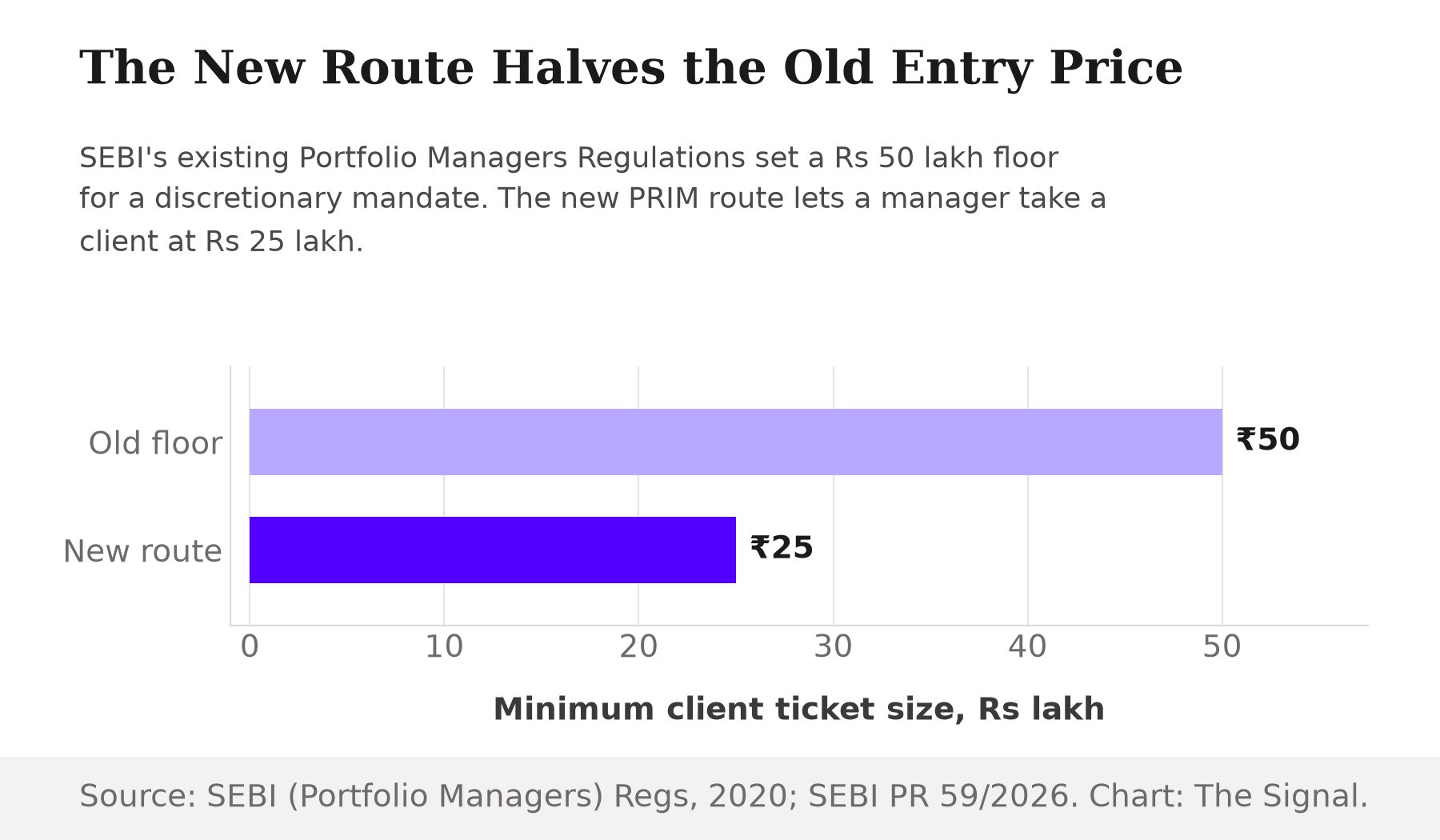
Half the price, a narrower product
PRIM is not full discretionary portfolio management. A manager using the route can only place a client's money into direct plans of mutual funds, including ETFs, index funds and the newly created Specialized Investment Funds, SEBI's board meeting press release states. So this is a new, narrower product priced under the floor of the old one, not the same product sold cheaper. It is built for an investor who wants a manager picking funds without being able to write the fifty-lakh check that full discretionary management still requires.
The supply side got easier in the same meeting. Portfolio managers running under Rs 10 crore in assets no longer need a dedicated dealing room, a relief SEBI says covers 48 percent of currently registered portfolio managers, and any graduate can now serve as principal officer rather than only those meeting narrower qualifications, SEBI's board meeting press release states. Nearly half the industry just got cheaper to run, in the same board meeting that made it cheaper for a client to walk in the door.
Who is actually competing for this money
The bigger question is how much money that fifty-to-twenty-five-lakh gap actually unlocks. India's portfolio managers reported total assets under management of Rs 44,10,822 crore as of July 31, 2026, across 514 reporting entities, SEBI's monthly portfolio managers data show. That headline figure is not the affluent, self-directed book PRIM is built to reach. Only Rs 9,02,868 crore of it sits outside EPFO and pension-fund mandates, SEBI's monthly portfolio managers data show. The rest, nearly four-fifths of the industry's reported AUM, is retirement money running on its own track, not client money that a bank's wealth desk, a boutique PMS shop, a mutual fund or an FPI can win by cutting a ticket size.
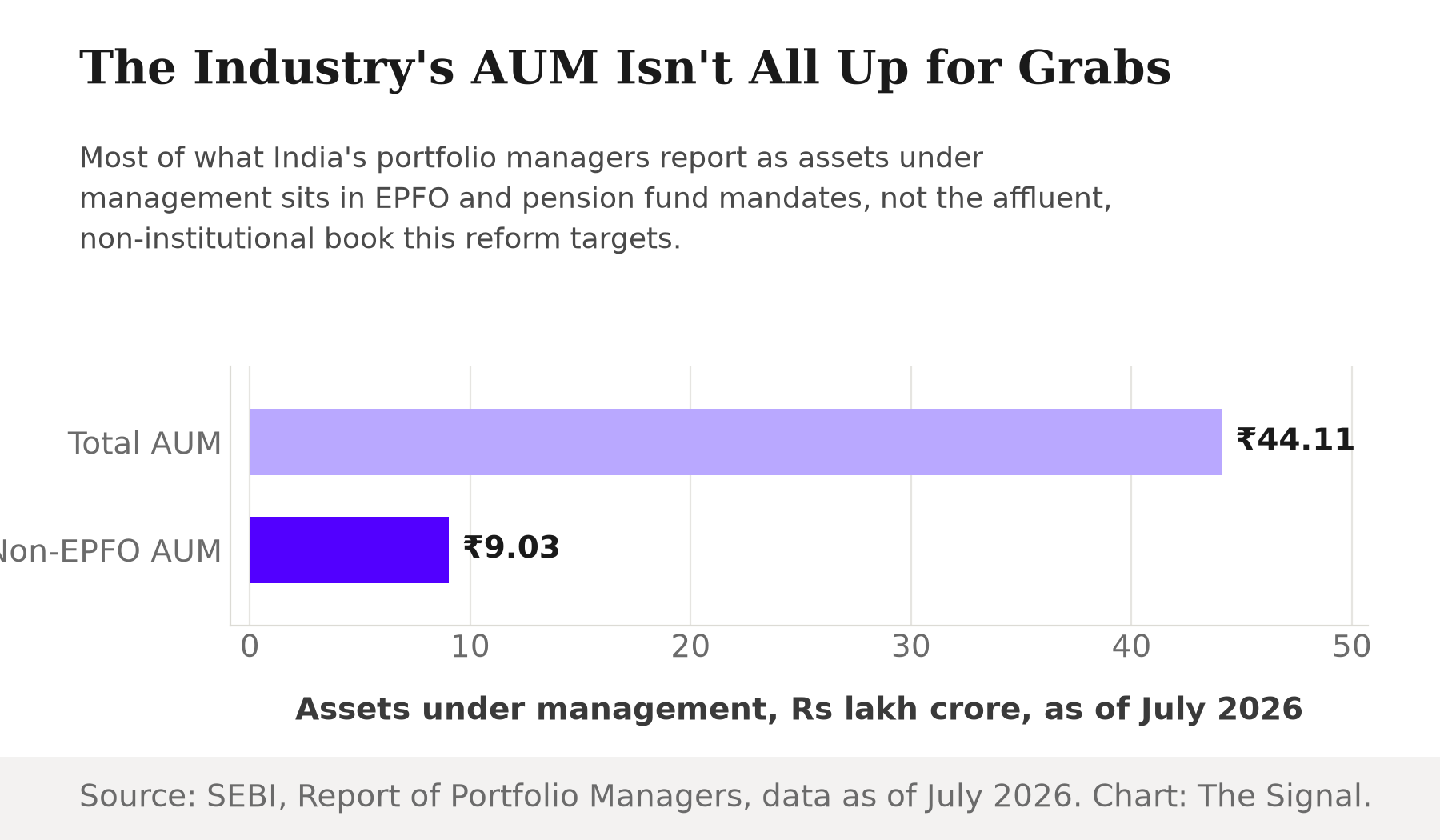
Strip out the retirement money and the contestable pool looks a lot smaller than a "Rs 44 lakh crore industry" suggests, which is exactly the pool a lower entry ticket is meant to expand.
The other end of the ladder
SEBI widened access at the opposite end of the wealth spectrum on the same day. The reworked Accredited Investor framework adds a securities-market-exposure test: Rs 5 crore for individuals, HUFs, family trusts and sole proprietorships, and Rs 20 crore for body corporates and other trusts, SEBI's board meeting press release states. Every foreign portfolio investor is now automatically deemed an accredited investor, with no separate application, the press release states. And certifying who qualifies no longer sits only with dedicated accreditation agencies: managers of AIFs, AMCs offering Specialized Investment Funds, and registered portfolio managers can now accredit investors themselves, with that accreditation valid for three years and portable across AIF, SIF and PMS products within the same group, SEBI's board meeting press release states.
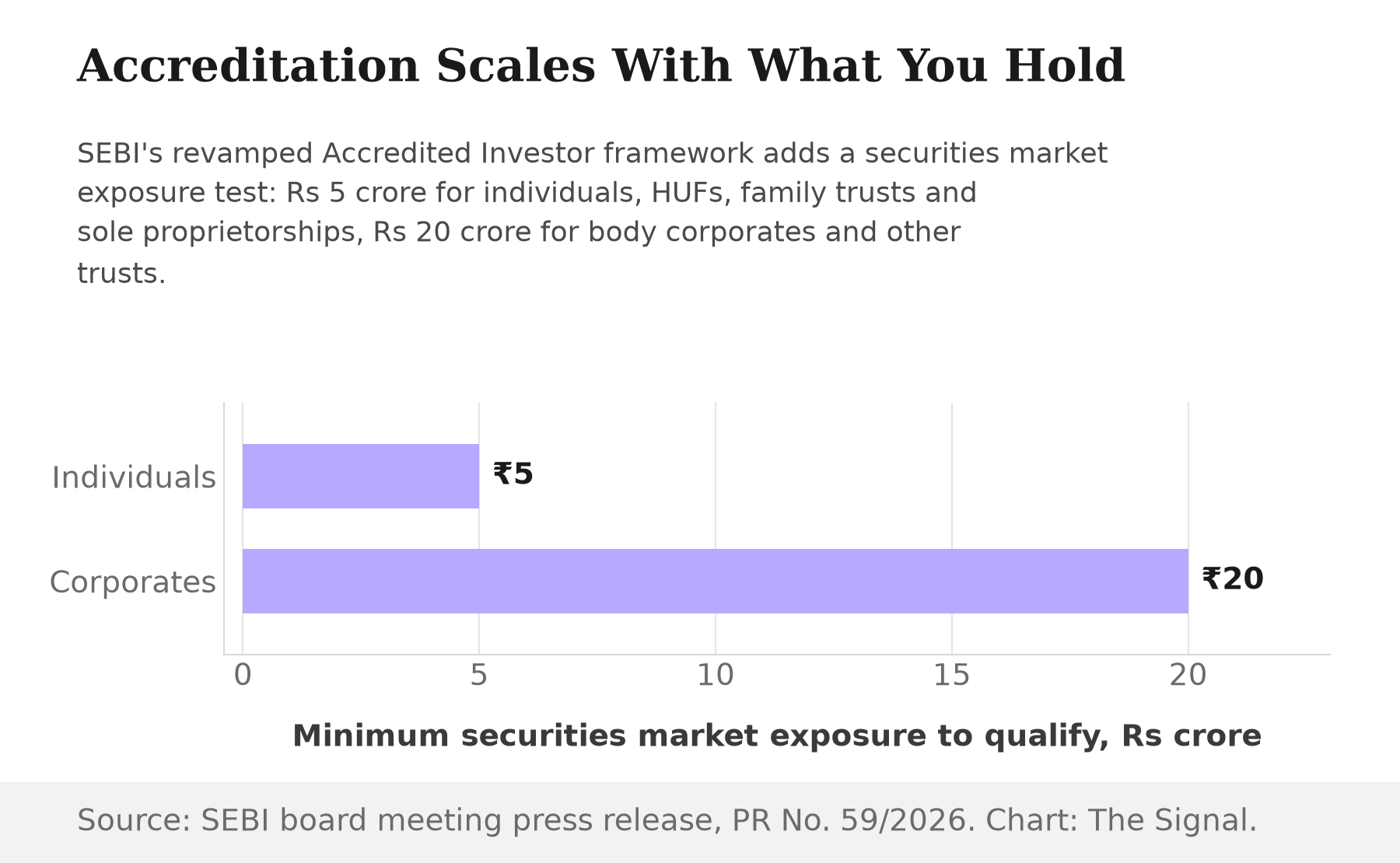
Put the two ends together and this is not a single act of easing. It is SEBI redrawing the terms of competition for India's investable wealth at both edges at once: a cheaper way in for the merely affluent, and a faster, self-certified way to unlock the truly wealthy and foreign money for the AIF, SIF and PMS products that used to have to wait on an outside agency to vouch for a client.
The honest objection
The strongest case against reading this as a competitive reshuffle is that PRIM is a narrow product, not full portfolio management. A manager using it can only buy fund units, not pick stocks or bonds directly, and the Rs 2 crore net worth and 1 percent fee cap apply specifically to a PRIM-only registration, SEBI's board meeting press release states. On this reading, cutting the ticket from Rs 50 lakh to Rs 25 lakh does not open discretionary portfolio management to a new class of investor. It gives fund-of-funds investing a portfolio manager's letterhead, nothing more.
That case has real force and deserves to be taken seriously rather than waved off. But it undersells what a lower, standing minimum does to a market that already prices access by net worth. Once one SEBI-regulated route accepts Rs 25 lakh, every competitor selling the same ambition to the same investor (a bank's wealth desk, a boutique PMS shop, a mutual fund's direct plan) has to explain why its own minimum still sits twice as high. A product can be narrow in what it invests in and still move the number every rival has to answer to.
The Signal
SEBI's board did not simply loosen rules on September 24. It repriced access to professional money management from both ends at once: a Rs 25 lakh door at the bottom, cut against the Rs 50 lakh floor that still stands everywhere else, and a self-certifying, exposure-based accreditation ladder at the top that scales from Rs 5 crore to Rs 20 crore and waves every FPI through automatically. Watch where client money actually moves over the next few quarters, not the announcement itself. If assets flow into PRIM mandates in real volume, the fifty-lakh floor becomes a number defended mainly by managers with a reason to keep it there. If PRIM stays a rounding error against the far larger non-institutional book still sitting outside it, SEBI will have widened the door on paper and left the room the same size.
Reporting basis: every figure in this piece, the PRIM ticket size and net worth and fee terms, the dealing-room relief, the settlement-process changes, the FPI derivatives access, and the Accredited Investor thresholds, comes from a single origin, SEBI's own board meeting press release, PR No. 59/2026, dated September 24, 2026. The Rs 50 lakh existing regulatory floor it undercuts is per the SEBI (Portfolio Managers) Regulations, 2020, as amended, a second SEBI primary document. The industry AUM and non-EPFO figures are from SEBI's own monthly portfolio managers statistics, a third SEBI primary source. All three are the regulator's own documents rather than independent reporting or a third-party analysis, so this piece rests entirely on SEBI's self-disclosure of its own decisions and data, not on outside corroboration; readers should weigh the framing accordingly. The comparison between the new PRIM minimum and the existing PMS floor, and the share of industry AUM sitting outside EPFO and pension funds, are The Signal's calculations from those figures.