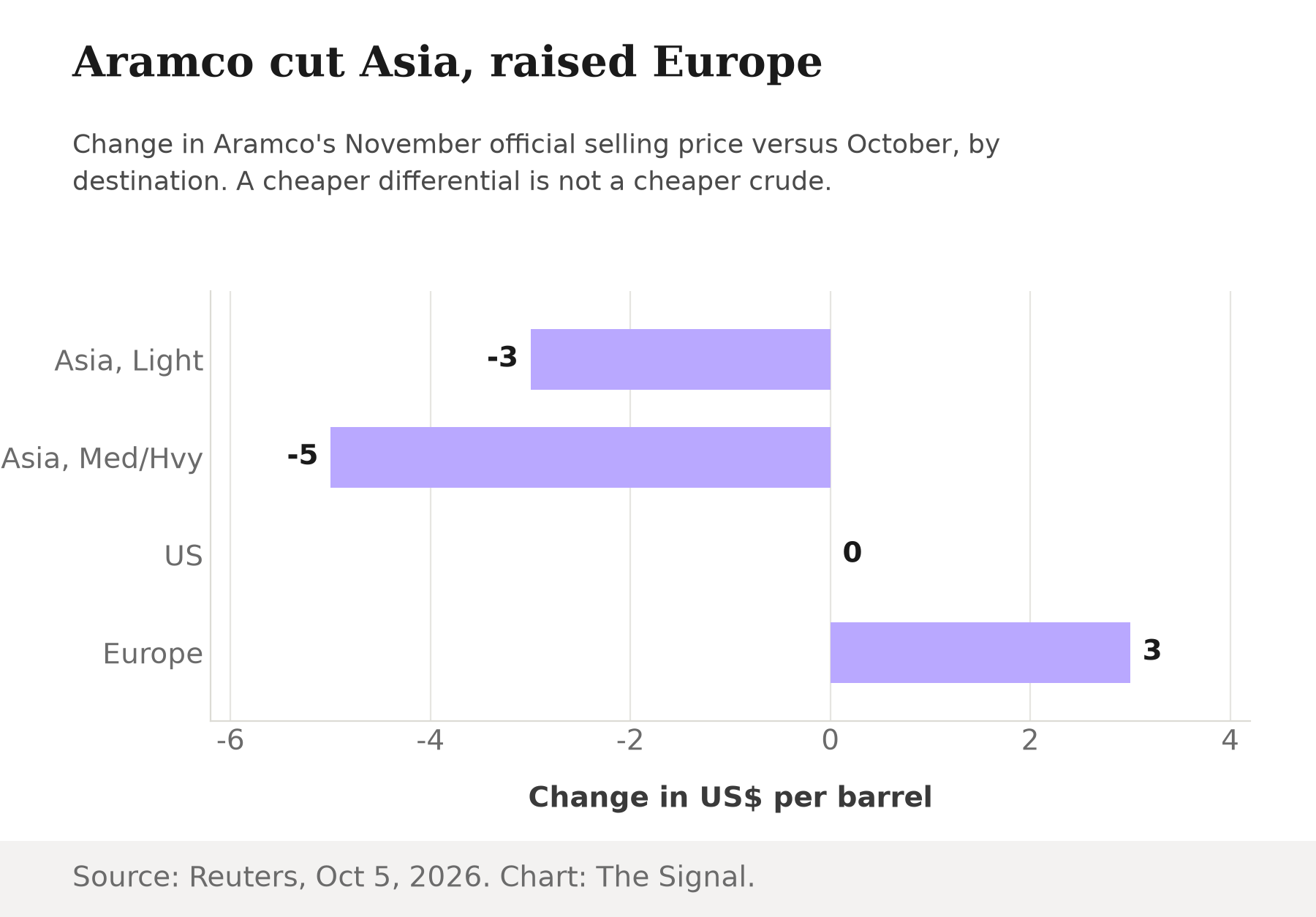
The headline reading of Monday's Saudi pricing document is easy to state. Saudi Arabia set its November Arab Light price for Asia at $5 a barrel below the average of Oman and Dubai prices, down $3 from the previous month, the widest discount since June 2020, according to Reuters. A survey of traders had expected the opposite move, a hike of up to $5 a barrel. The world's largest crude exporter cutting when the market expected a rise looks like a producer losing its nerve, or a market-share war.
It is worth slowing down on that. The same document raised prices elsewhere. Aramco raised November prices for northwest Europe by $3 a barrel across all grades and left US prices unchanged. A producer worried about demand does not raise prices for one continent while it cuts for another. Whatever is pulling Asia's price down is specific to Asia.
The number that explains the cut
Official selling prices, or OSPs, are the monthly prices Aramco sets for its customers, quoted as a premium or discount to a regional benchmark. Asia's benchmark is the average of Oman and Dubai crude. A cut is therefore a cut in the discount Asian buyers receive, not in the price of oil.
The reason sits in the shipping market. Reuters reports that three Asian refining sources said the cuts appeared aimed at compensating buyers for elevated freight costs. The freight market supplies the number: booking a very large crude carrier, which hauls 2 million barrels, from the Gulf to China cost $1.2 million a day on Friday, October 2, against about $80,000 a day a year earlier, according to LSEG data. That is a 15-fold rise.
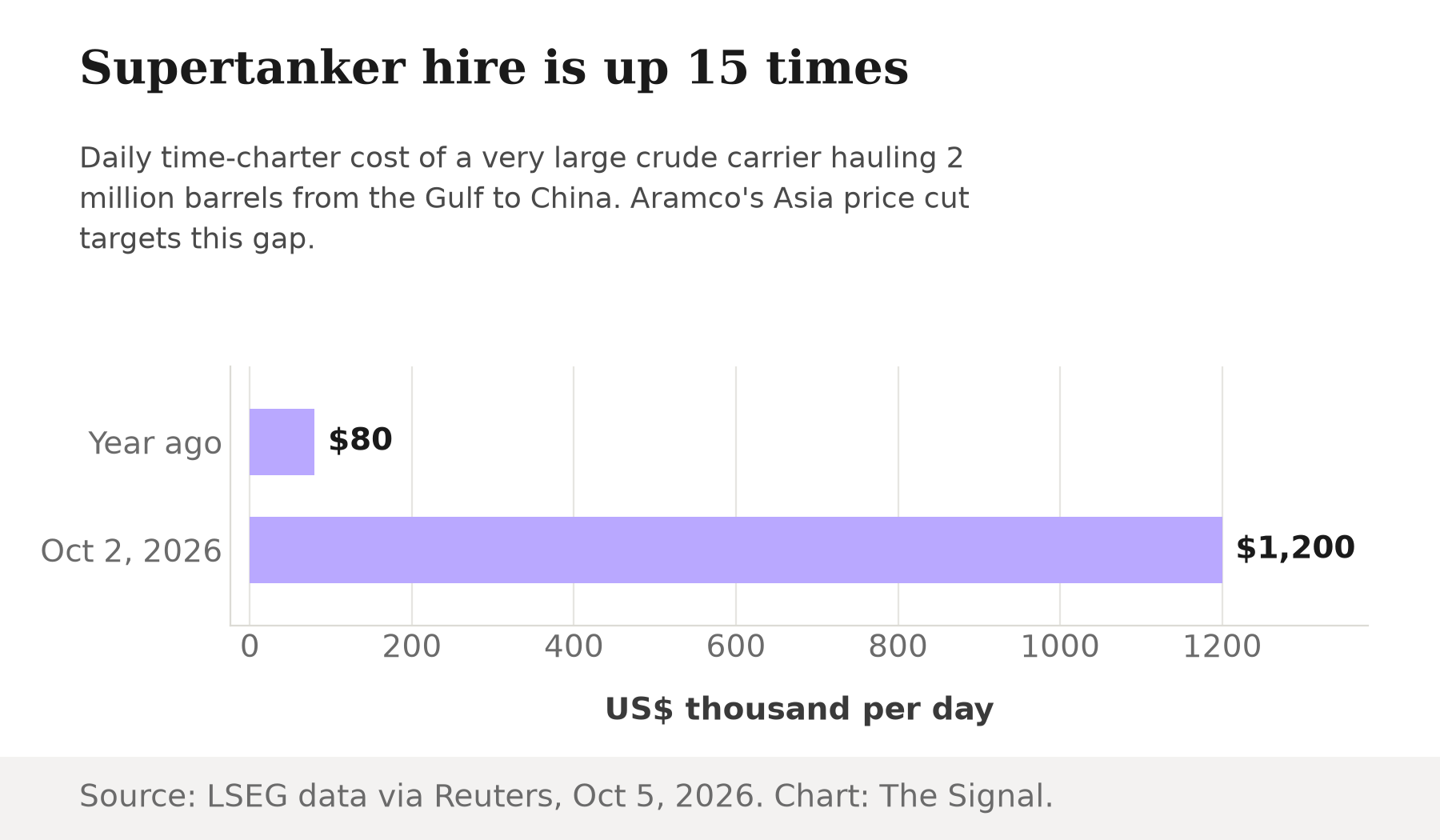
Divide that daily rate by the cargo and the freight meter becomes visible. At $1.2 million a day for a 2 million barrel carrier, the ship costs $0.60 per barrel for every day it is hired. A year ago, at $80,000 a day, the same arithmetic gave $0.04. The $3 cut Aramco made is therefore worth five days of ship hire at today's rate, and the full $5 discount is worth a little over eight. These are rates per day of hire, not a full voyage cost, but they show why a $3 move is the right order of magnitude for a freight rebate and too large to be a rounding adjustment.
Why Asia is the market being paid
The shipping problem is a Hormuz problem. The US and Iran signed a memorandum of understanding on June 18, and the US Energy Information Administration said in July that shipping traffic through the Strait of Hormuz had increased following the agreement. Reuters adds that since September Aramco has sold millions of barrels through ship-to-ship transfers outside the strait, pushing flows through the waterway to pre-conflict levels, and resumed loading at Yanbu on the Red Sea after a drone attack shut its East-West pipeline.
Barrels are flowing, then, but through workarounds. One Asian refining source also said the lower OSPs could offset the waiting time and longer voyage for Saudi oil exported from the Egyptian port of Sidi Kerir, where cargo loadings have been delayed. The pattern in the table below fits that account: Aramco cut where buyers carry the delay and the freight bill, and raised where they do not.
Aramco's November price changes show a freight adjustment, not a global retreat.
| Destination | Change in November price vs October |
|---|---|
| Asia, Arab Light | cut by $3 a barrel, to $5 below Oman/Dubai |
| Asia, Arab Medium and Arab Heavy | cut by $5 a barrel |
| Northwest Europe, all grades | raised by $3 a barrel |
| United States | unchanged |
Source: Reuters, October 5, 2026, via Business Standard.
What it means for India
India sits at the receiving end of this arrangement. India imported 5.251 million barrels a day of crude in September through the 27th, according to Kpler data. Saudi Arabia supplied 570,000 barrels a day of that, behind Russia at 1.742 million and Iraq at 579,000. Saudi crude was about 11 percent of the total, while Russia supplied about a third.
The cut will help at the margin, but it does not make crude cheap. The scale of the problem is in the import bill. India's crude import bill rose 48.4 percent to $74.8 billion in April to August, even though volumes were nearly flat, according to Business Standard's reading of PPAC data. That is a price story, not a volume story. And the OSP only moves the discount to a benchmark that has itself risen: Brent averaged $91 a barrel in August, $7 higher than in July, the EIA's September outlook says. In July the agency had forecast Brent at $74 a barrel for the third quarter. August came in $17 above that.
The honest objection
The strongest case against the freight-rebate reading is the one Reuters itself offers: Aramco is seeking to protect its market share after disruptions from the war affected exports. On that view a cut is a cut, and freight is an excuse. There is also a caveat on the evidence: the freight explanation comes from three Asian refining sources who spoke anonymously, and Aramco has not explained its own decision in the material reviewed.
That case is real, and the two readings are not mutually exclusive. But a pure market-share move would not obviously explain why Europe's price rose $3 across all grades in the same document that cut Asia's. The rebate reading accounts for both the direction and the geography of the changes.
The Signal
Aramco's cut tells Asian buyers less about Saudi Arabia's view of demand than about what it now costs to move oil east. The EIA assumes some constraints on Middle East exports will persist through the end of the year, keeping regional output below pre-conflict averages until the second quarter of 2027. If freight stays near $1.2 million a day, expect the next OSP to show whether the discount is a one-month patch or a standing subsidy. If Asia's discount widens again while Europe's premium holds, it is paying for shipping. If both move together, it is a price war. At $0.60 a barrel for every day at sea, the cheapest barrel in Asia is the one that does not have to travel far.
Reporting basis: the Aramco price changes, the survey expectation, the freight figure and the ship-to-ship transfer detail are per Reuters, relayed by Business Standard; the freight rate is LSEG data as reported by Reuters, and the freight explanation rests on three anonymous Asian refining sources cited by Reuters. India's September crude import figures are per Kpler, as reported by Business Standard. The crude import bill is per the Petroleum Planning and Analysis Cell, as reported by Business Standard, and was not checked against the PPAC release itself. Brent figures, the July forecast, the Hormuz traffic statement and the export-constraint assumption are from the US Energy Information Administration. The per-barrel freight rates, the days-of-hire equivalents, the 15-fold rise, the Saudi and Russian import shares and the gap between the July forecast and August's Brent price are The Signal's calculations from those figures.