By the time bidding closed on 21 September 2026, NSE's Rs 22,561-crore IPO had been subscribed 5.69 times over. By the usual shorthand of Indian IPO coverage, that is an unambiguous hit: India's own stock exchange, the venue that lists nearly every other company's shares, drew nearly six times more demand than it had stock to sell. Shares begin trading on BSE on 24 September.
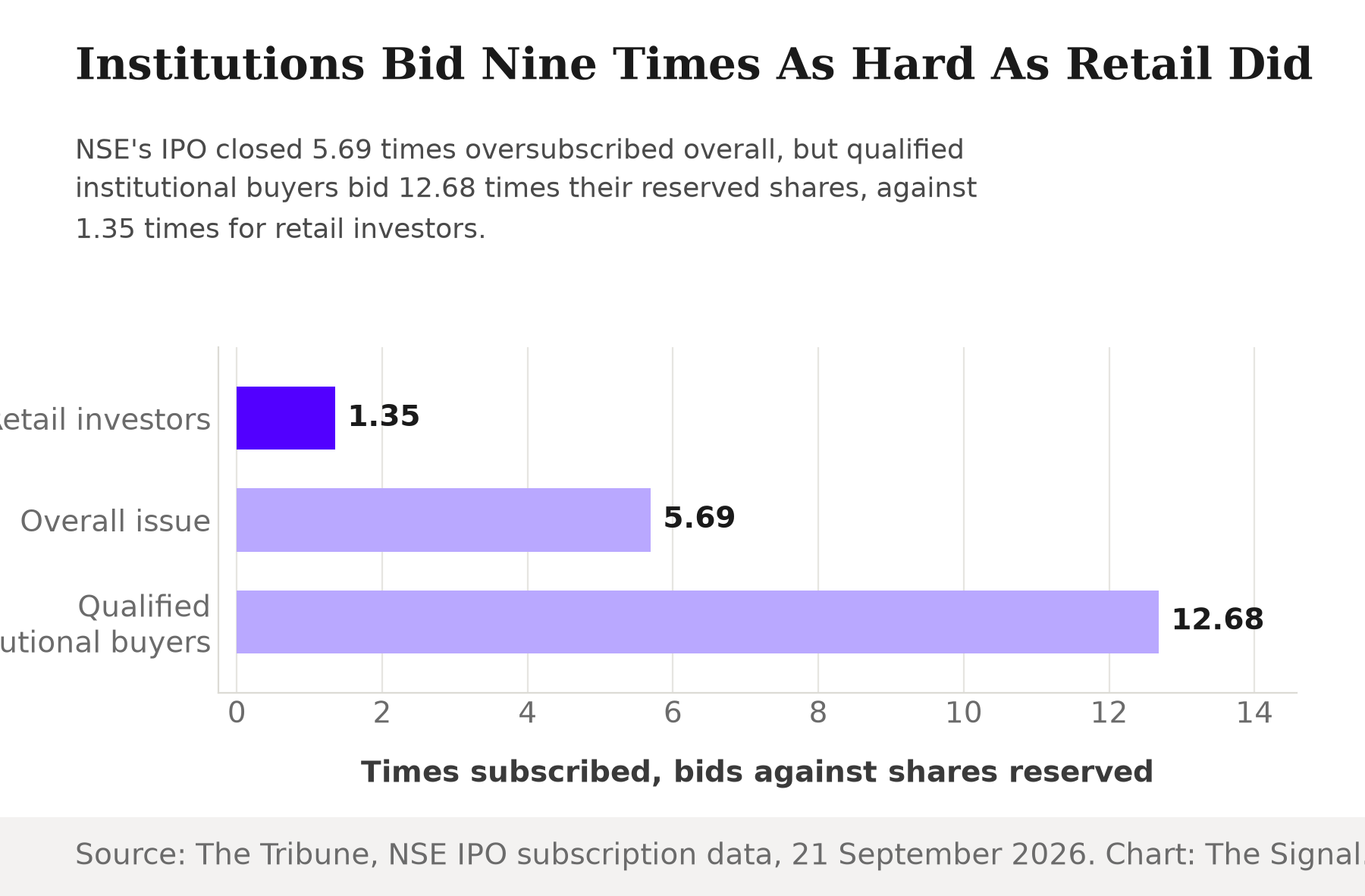
That single multiple is also doing a lot of work to look uniform. The qualified institutional buyer portion of NSE's IPO was subscribed 12.68 times, against bids for 31.97 crore shares versus 2.52 crore reserved for the category. The retail individual investor portion covered just 1.35 times its quota, with bids for 5.96 crore shares against 4.41 crore reserved. Institutions bid over nine times as hard, on a like-for-like basis, as the retail investors NSE's own trading terminals serve every day.
Qualified institutional buyers bid 12.68 times their quota. Retail investors bid 1.35 times theirs.
There is a detail worth sitting with before going further: NSE's own IPO is structured entirely as an Offer for Sale by existing shareholders, with no fresh-issue component, so the exchange itself raises no primary capital from the listing, and the shares are set to list on BSE rather than on NSE's own exchange. India's dominant exchange could not list on itself. It is a technical, regulatory quirk, not a scandal, but it sets up the pattern that follows: this IPO keeps producing numbers that look cleaner from a distance than they do up close.
A price above Nasdaq's own
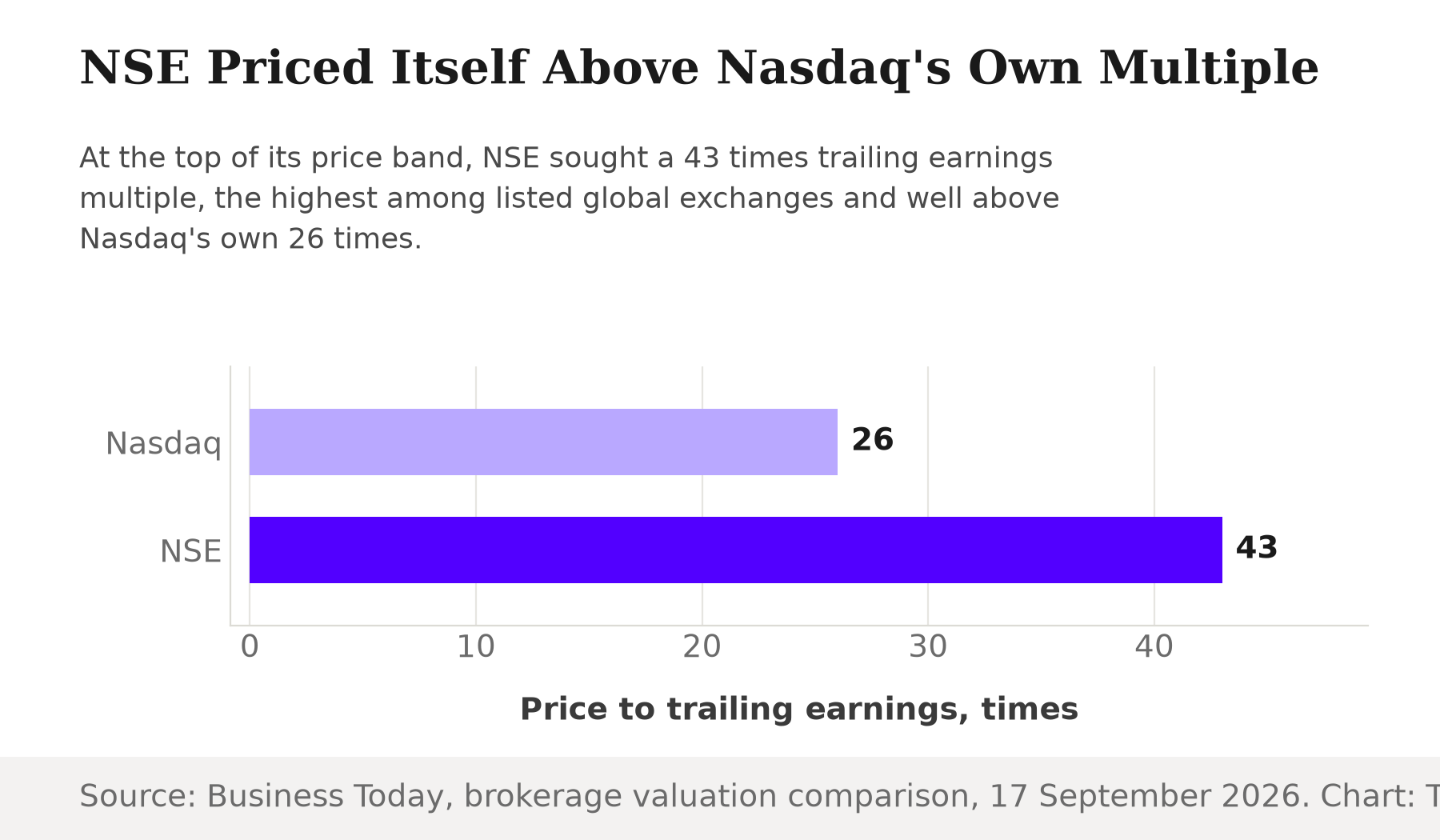
The valuation NSE sought was not modest. At the top of its price band, NSE was seeking a price-to-earnings multiple of 43 times trailing earnings, the highest among listed global exchanges, comfortably above Nasdaq's own 26 times. That band implied a company valuation of up to Rs 4.42 lakh crore, about $46.31 billion, and it came after NSE had already trimmed the deal size by more than 15 percent from its original filing. A domestic monopoly exchange, priced richer than the world's best-known technology bourse, after shareholders had already agreed to sell less of it than first planned.
NSE's asking price was the highest multiple of any listed exchange in the world.
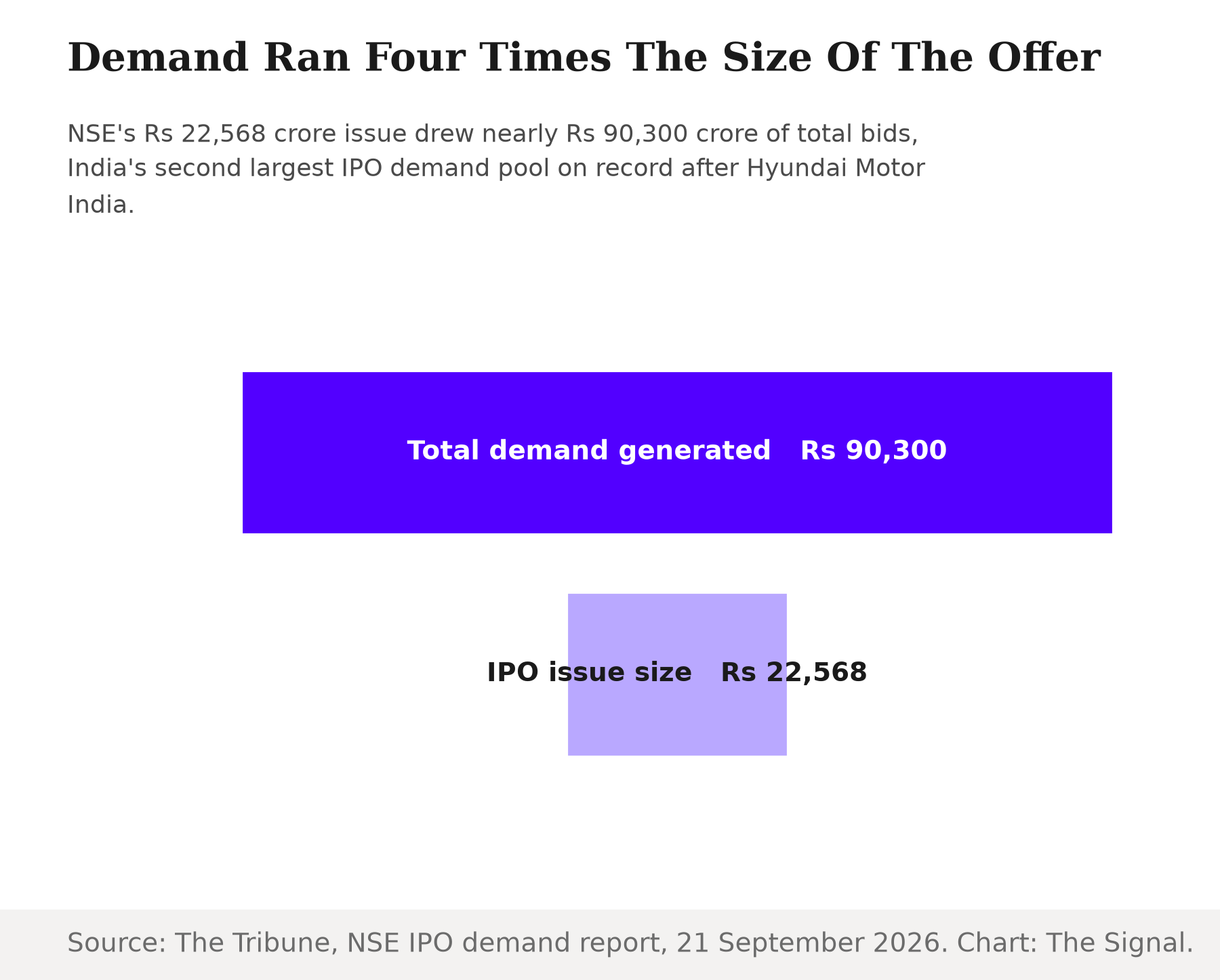
Institutional buyers paid that price anyway, and did so with more conviction than the overall multiple suggests. Total bids, including anchor-investor commitments, reached Rs 964.76 billion, or $10.07 billion, at the top of the Rs 1,700-1,785 price band. That is roughly a fifth of NSE's own implied enterprise value, bid for in the space of a few trading days. Separately, the book as a whole generated nearly Rs 90,300 crore of total demand against the Rs 22,568-crore issue size, making this India's second-largest public issue by demand on record, behind only Hyundai Motor India's Rs 27,870-crore IPO in 2024. Demand ran almost exactly four times the size of the offer.
Total bids ran to nearly four times the size of NSE's own issue.
What institutional conviction usually means
It is worth asking why the QIB-retail split matters, rather than treating it as a footnote to an otherwise strong subscription number. Academic research on IPO book-building has found that institutional allocation carries private information about first-day returns that is not already reflected in public pre-market demand, consistent with institutions being the more informationally advantaged bidders relative to retail investors. That finding is old, from a 2002 NBER working paper, but the mechanism it describes, institutions pricing an IPO with information retail does not have, is structural to how book-building works rather than tied to any one market cycle. If that mechanism holds here, the QIB book's 12.68 times is a more information-rich signal than the retail book's 1.35 times, not simply a bigger number from richer buyers.
The honest objection
The strongest case against reading anything into the gap is that it is barely a gap at all by historical standards: institutional quotas in Indian IPOs almost always fill faster than retail quotas, because institutions move in blocks and retail investors decide individually, so a QIB-to-retail ratio near nine or ten is closer to normal than alarming. On this view, NSE's book reads as an ordinary large-cap IPO rather than a warning sign, and the "own exchange, own investors" framing is simply a coincidence: retail investors have no special reason to distrust NSE just because it happens to be the issuer.
That case weakens against NSE's own recent history. Hyundai Motor India's Rs 27,870-crore IPO, until NSE's the largest in Indian history, drew strong demand when it opened in October 2024, but still fell 7.16 percent on its stock-market debut. Heavy pre-listing demand has not reliably converted into listing-day gains for India's biggest offerings, which is precisely the case in which a wide QIB-retail split should carry the most weight, not the least.
| Metric | NSE (September 2026) | Hyundai Motor India (October 2024) |
|---|---|---|
| Issue size | Rs 22,568 crore | Rs 27,870 crore, previously India's largest IPO |
| Pre-listing demand | 5.69 times oversubscribed, 12.68 times among QIBs | Strong demand ahead of its October 2024 listing |
| Listing-day outcome | Grey market pricing implies about a 3.5 percent gain, ahead of the 24 September listing | Fell 7.16 percent on debut |
Source: The Tribune; Business Today; The Week.
That last row is the tell. As of the eve of listing, grey-market pricing implied only about a 3.5 percent listing-day gain for NSE shares, a far more muted signal than a 12.68-times institutional bid-to-offer ratio would suggest on its own. Two different pools of market participants, the QIB desks that filled the book and the informal grey-market traders pricing the listing itself, are not telling the same story about NSE's opening day.
The Signal
None of this means NSE's IPO failed. A 5.69-times subscription and a $10 billion bid pool are, by any ordinary measure, a strong listing. What the split shows is that the strength sits almost entirely in one investor class, the one book-building theory says holds better information, while the class NSE depends on for daily trading volume treated the exchange's own listing with far less conviction than the headline number implies. Watch the grey-market gap on listing day: if NSE opens closer to the QIB book's confidence than to the retail book's, this quarter's IPO wave has more room to run on institutional demand than retail investors currently believe. A listing closer to the muted 3.5 percent grey-market signal, or worse, would mean the smart money simply got there first, the way it usually does.
Reporting basis: the subscription figures by investor category, the total demand pool, and the Hyundai Motor India comparison are as reported by The Tribune and Business Today, both citing exchange bidding data. The 43-times valuation multiple and its comparison with Nasdaq's 26 times are per Business Today's brokerage-sourced comparison table. The anchor-inclusive bid total and dollar conversion are per MarketScreener. The implied valuation and the deal-size trim are per Finimize. Grey-market pricing ahead of listing is per The Week, citing market trackers, and rests on that single source. The offer structure and BSE listing venue are from NSE's own SEBI-filed prospectus. The institutional information-advantage finding is from a 2002 NBER working paper by Aggarwal, Prabhala and Puri, describing a general mechanism in IPO book-building rather than this listing specifically. The over nine-times institutional-to-retail bid ratio and the roughly fourfold demand-to-issue-size ratio are The Signal's calculations from those figures.