The headline this week reads like a defeat for China's push to route trade around the dollar. Saudi Arabia's central bank, SAMA, has exited mBridge, the cross-border digital currency platform built with the Bank for International Settlements and the central banks of China, Hong Kong, Thailand and the UAE. Read only the alert and the story writes itself: the dollar-bypass project just lost a founding member.
It is worth slowing down on the date. SAMA says it completed its mBridge proof of concept on 13 May 2025 and ceased to be a participating member after that date, calling it consistent with its original plan rather than any dispute. That is not a decision made this week. It is one made more than a year ago that stayed unannounced until now, quietly enough that it needed a Financial Times account to surface at all.
A platform already downsizing
Saudi Arabia is not the first departure from mBridge's top table. The BIS itself ended its own involvement in the project on 31 October 2024, handing governance entirely to the founding central banks. BIS general manager Agustin Carstens was explicit about why: "The BIS is leaving that project, not because it was a failure and not because of political considerations but instead because we have been involved for four years and it is at a level where the partners can carry it on by themselves." Read plainly, it means the institution that gave mBridge its neutrality stepped back a full seven months before Saudi Arabia quietly followed.
What is left standing is smaller than the BRICS-payments narrative suggests. The BIS's own Project mBridge page lists five full participants: the central banks of China, Hong Kong, Thailand, the UAE and Saudi Arabia, against roughly 32 observing institutions, a group that includes the Reserve Bank of India but not as a full member. India, for all the domestic talk of a BRICS payment alternative, has never held a seat at mBridge's table, only a chair in the audience.
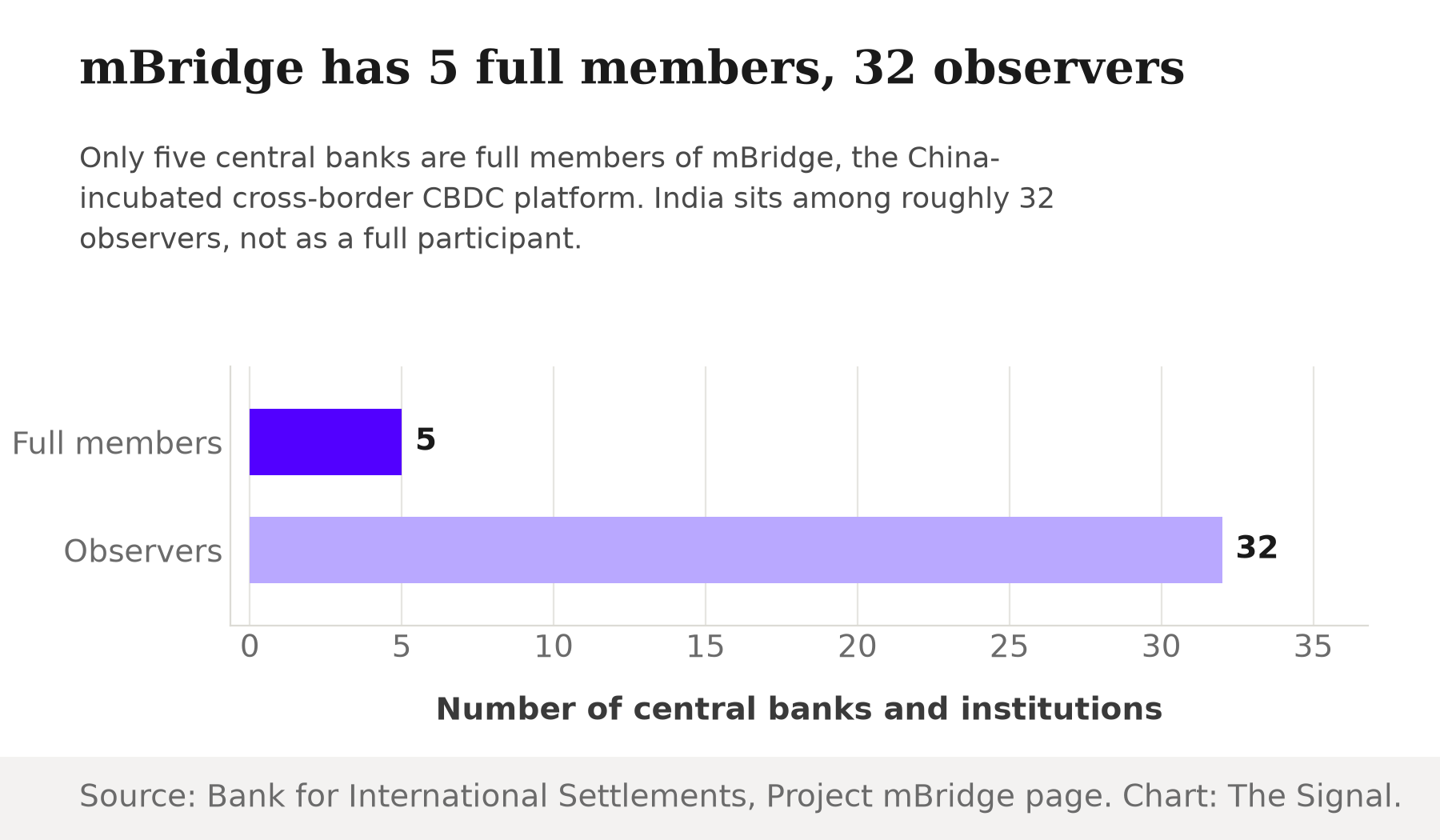
Source: BIS, Project mBridge. Chart: The Signal.
Strip Saudi Arabia out, per SAMA's own account of when its participation ended, and full membership is down to four: China, Hong Kong, Thailand and the UAE. Two of those, Hong Kong and China, are effectively one monetary system.
The volume tells the same story
None of this means mBridge is dead as a payments rail. Cumulative transaction volume on the platform has surged to roughly $55.49 billion, a 2,500-fold increase since its early-2022 pilots, per the Atlantic Council's GeoEconomics Center, which tracks central bank digital currency projects worldwide. That is real growth. But the same tracker reports that China's e-CNY accounts for more than 95% of total settlement volume on mBridge. A platform pitched as a multilateral alternative to dollar clearing has, in practice, become almost entirely a channel for one country's digital currency.
That concentration is the mechanism behind Saudi Arabia's exit. A platform where almost the entire flow belongs to one partner is not a bridge between equals; it is China's settlement rail with four other flags attached for legitimacy. For a country managing its own currency credibility as carefully as Saudi Arabia does, being a minority flag on someone else's rail carries real governance exposure and little independent upside.
The anchor that never moved
That anchor is the riyal-dollar peg, and it explains why the mBridge exit was never a hard call for Riyadh. SAMA states plainly that it "remains committed to maintaining the exchange rate at the official rate of 3.75 riyals to the dollar as an anchor of monetary and financial stability." A central bank that defines its own credibility around a fixed dollar rate has little reason to build deep infrastructure for a platform whose premise is settling trade in anything but dollars. Testing the technology cost Saudi Arabia little; staying in it after the test ended would have cost it the appearance of hedging on a peg it has no intention of abandoning.
That is the honest reading of "de-dollarization" as Gulf states practice it: rhetorical hedging with the technology, real commitment to the currency. The two stay uncontested until an actual decision has to be made. When Saudi Arabia had to choose, it chose the peg.
The honest objection
The strongest case against reading too much into one exit is that SAMA calls this a planned, technical wind-down, not a rejection of the platform's premise: $55.49 billion in cumulative transaction volume is a real payments rail, and the remaining four, China, Hong Kong, Thailand and the UAE, still cover meaningful trade. A platform can shed one founder and still matter to those who stay.
That case holds for mBridge's survival as a China-Thailand-UAE-Hong Kong corridor. It does not hold for the wider "BRICS is building a dollar alternative" framing. The dollar's own numbers undercut that framing further. The US dollar sat on one side of 89.2% of all foreign-exchange trades in the BIS's April 2025 Triennial Survey, up from 88.4% in 2022, even as the Chinese renminbi's share climbed to 8.5% of global turnover, continuing its rise since 2013. The renminbi is gaining share, from a small base, nowhere near the dollar's.
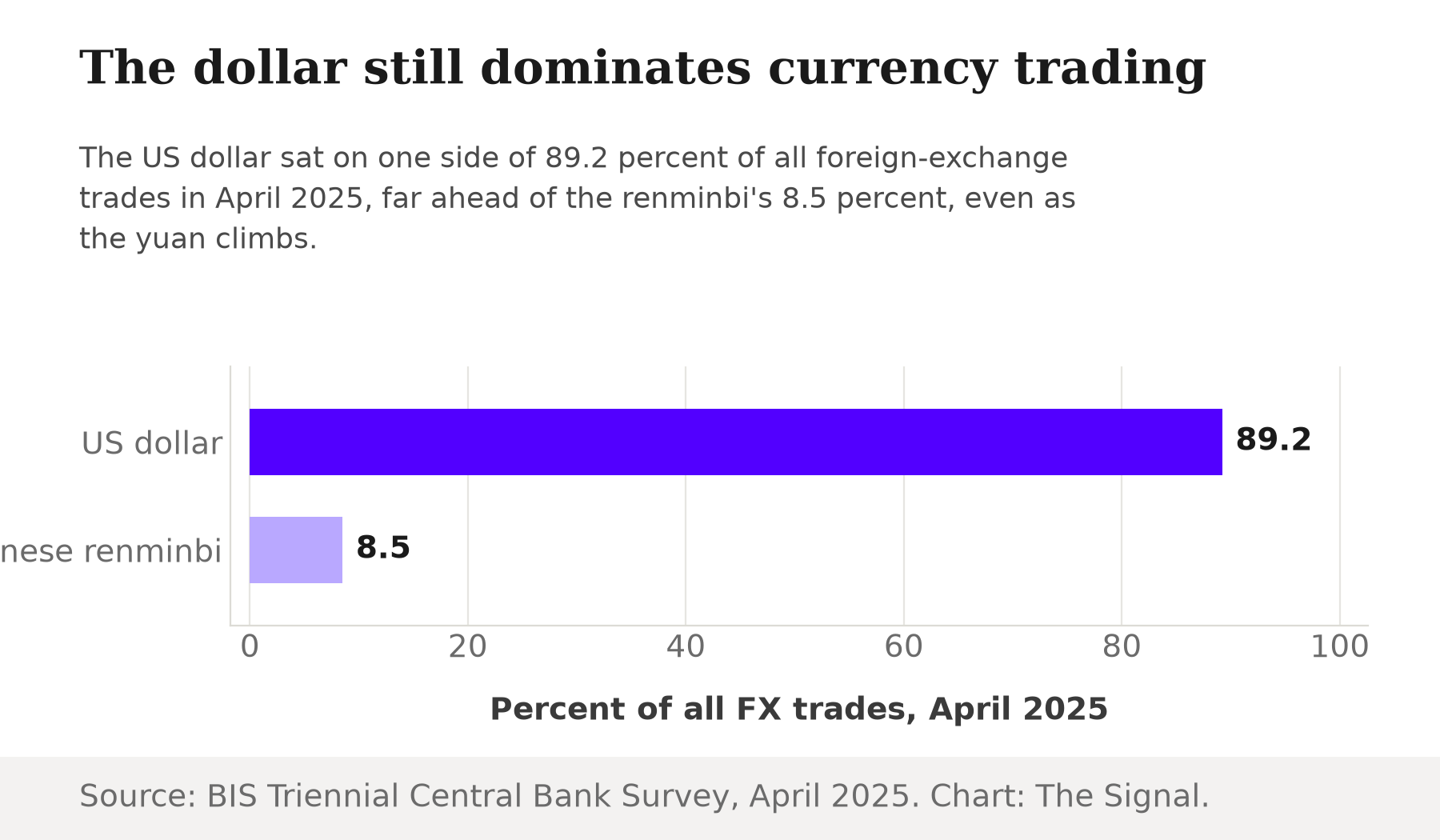
Source: BIS Triennial Central Bank Survey, April 2025. Chart: The Signal.
Central bank reserve managers tell a similar, slower story. The dollar's share of global central bank reserves fell to 56.77% in the fourth quarter of 2025, down from 56.93% the prior quarter, per the IMF's COFER survey. That is a real trend worth tracking. It is also a quarter-point move on a currency that still holds well over half the world's reserves. mBridge losing a founder and the dollar's reserve share ticking down a fraction of a point are both true, and neither is the collapse the "de-dollarization" framing implies.
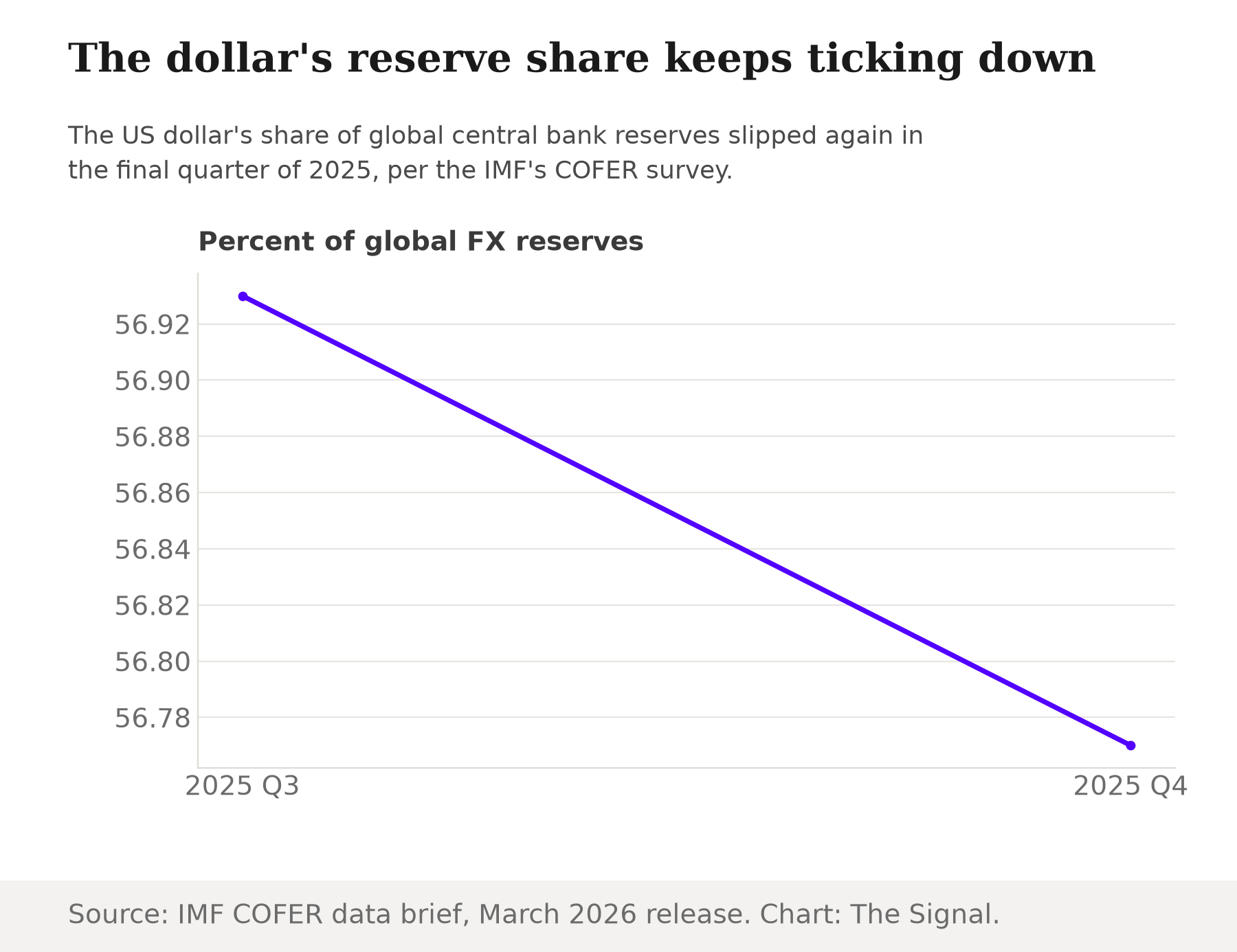
Source: IMF COFER data brief, March 2026. Chart: The Signal.
What this means for India's own rupee push
India has its own version of this bet, built on plumbing rather than a blockchain platform. The government has told the Rajya Sabha that the RBI has permitted 123 correspondent banks from 30 trading-partner countries to open 156 Special Rupee Vostro Accounts with 26 Indian banks, the mechanism underpinning India's push to settle trade directly in rupees. That is genuinely different infrastructure from mBridge, built bank to bank rather than central bank to central bank, and it carries none of mBridge's single-currency concentration problem. But it shares mBridge's basic constraint: a settlement network only moves as much trade as the countries at the other end are willing to route through it, and both networks remain small relative to the trade flows they hope to eventually carry.
| Metric | mBridge (CBDC bridge) | India's rupee network (SRVA) |
|---|---|---|
| Full/direct participants | 5 central banks (China, Hong Kong, Thailand, UAE, Saudi Arabia) | 26 Indian banks |
| Countries reached | 5 full members, roughly 32 observers | 30 trading-partner countries |
| Network nodes | Not disclosed | 123 correspondent banks, 156 accounts |
| Currency concentration | e-CNY, over 95% of volume | Rupee, by design |
| Cumulative scale | $55.49 billion volume | 156 accounts opened |
Source: BIS, Project mBridge; Atlantic Council GeoEconomics Center; Business Standard, citing a Rajya Sabha written reply.
The caution for India is not that either network is failing. It is that Saudi Arabia, the world's top crude oil exporter, pumping 9.5 million barrels a day in 2023 and topping OPEC's own producer rankings, had genuine leverage to demand settlement flexibility from its buyers, and it still let its central bank quietly exit the multilateral option rather than risk its own currency arrangement. If the country with the strongest hand at the table folded rather than build on it, a smaller network built on a floating currency faces the harder version of the same test: getting foreign banks to actually route volume through the corridor, not just open the accounts that make it possible.
The Signal
Saudi Arabia's mBridge exit is being read as a fresh blow to de-dollarization. It is really confirmation of something already true: Riyadh finished testing the alternative sixteen months ago and quietly walked back to the peg that anchors its monetary credibility, and nobody noticed until a Financial Times account forced the disclosure. That gap between the decision and its discovery is the real story. Every country weighing its own alternative to dollar clearing, India included, is watching a founding member of the actual working prototype choose dollar-clearing convenience over the alternative it helped build, quietly enough that the choice stayed hidden for many months. Watch what participants do with their membership, not what they say about de-dollarization at a summit. Saudi Arabia already showed its hand. It just took sixteen months for anyone to see the cards.
Reporting basis: the SAMA exit date and its characterization as a planned wind-down are per Business Today, itself relaying a Financial Times account of SAMA's statement, one origin. The BIS's own withdrawal timeline and rationale come directly from a BIS-published speech by its general manager. mBridge's participant and observer counts are from the BIS's own Project mBridge page. Cumulative transaction volume and the e-CNY settlement share are from the Atlantic Council GeoEconomics Center's CBDC tracker. The riyal-dollar peg statement is SAMA's own published exchange-rate policy note. Global FX turnover shares for the dollar and renminbi are from the BIS's Triennial Central Bank Survey. The dollar's reserve-currency share is from the IMF's COFER data brief. India's Vostro-account network figures are per Business Standard, reporting a government written reply to the Rajya Sabha. Saudi Arabia's standing as the world's top crude oil exporter and its 2023 production volume are from the US Energy Information Administration's country analysis. The comparison table pairing the two settlement networks is The Signal's own compilation from those sources.