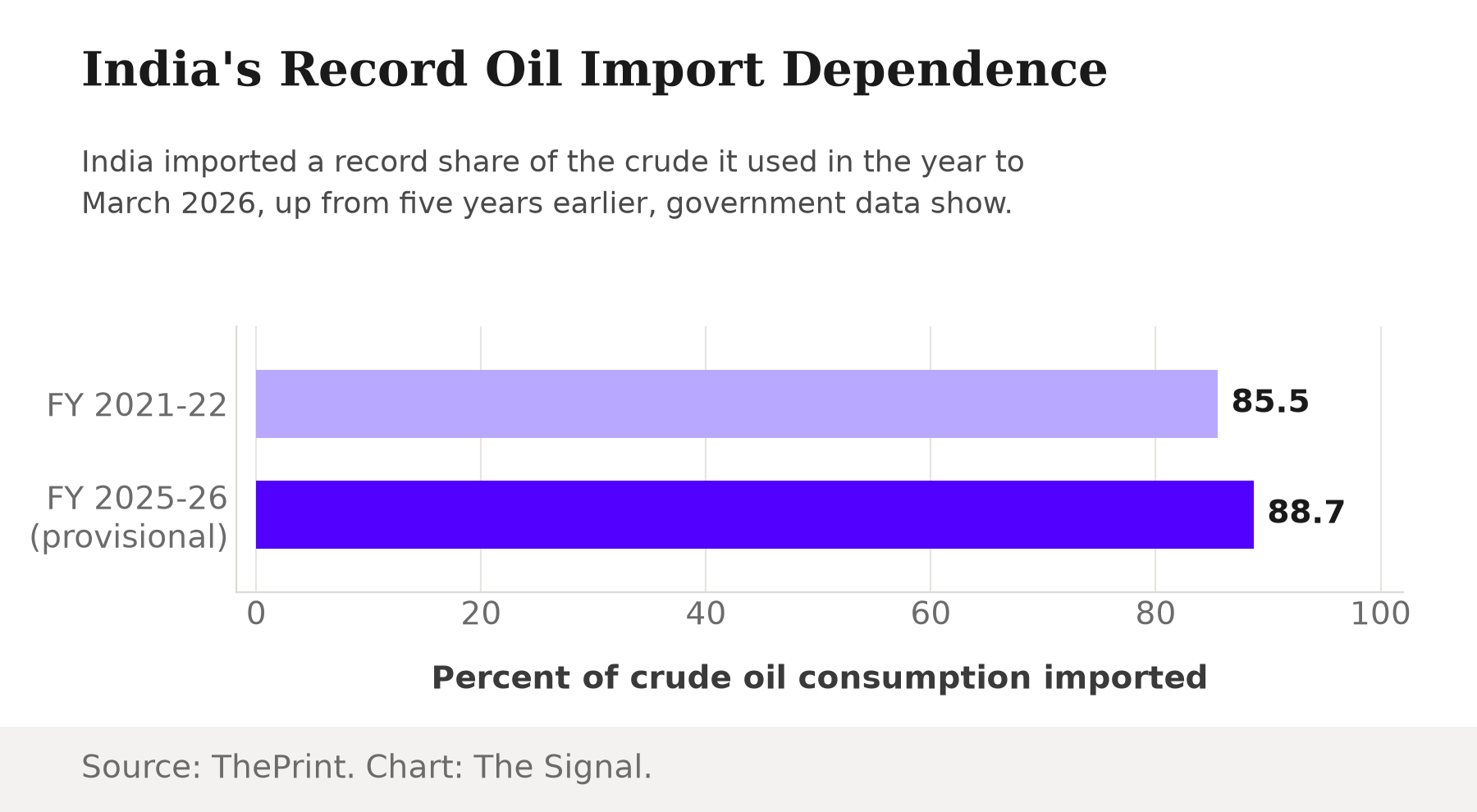
India now imports a record 88.7 percent of the crude oil it uses, in the year to March 2026, up from 85.5 percent five years earlier. That dependence is exactly why a headline like this week's should worry an Indian reader more than most. Attackers hit Saudi Arabia's East-West pipeline in September 2026, and a Reuters satellite-imagery analysis, reported by The Jerusalem Post, found damage at three pumping stations, more than initial reports suggested. Aramco told at least two European refiners their October term-contract allocations are zero, because the pipeline that had been carrying 4 million to 5 million barrels a day across the kingdom to the Red Sea port of Yanbu was down. Three sabotaged pumping stations, a major exporter zeroing out a continent's allocation: on paper, this is the kind of shock that used to send oil markets into a panic. It is exactly the shock a country importing nearly nine of every ten barrels it burns would expect to feel immediately, at the pump and in the trade balance.
Brent crude kept falling regardless, the third straight session it dropped.
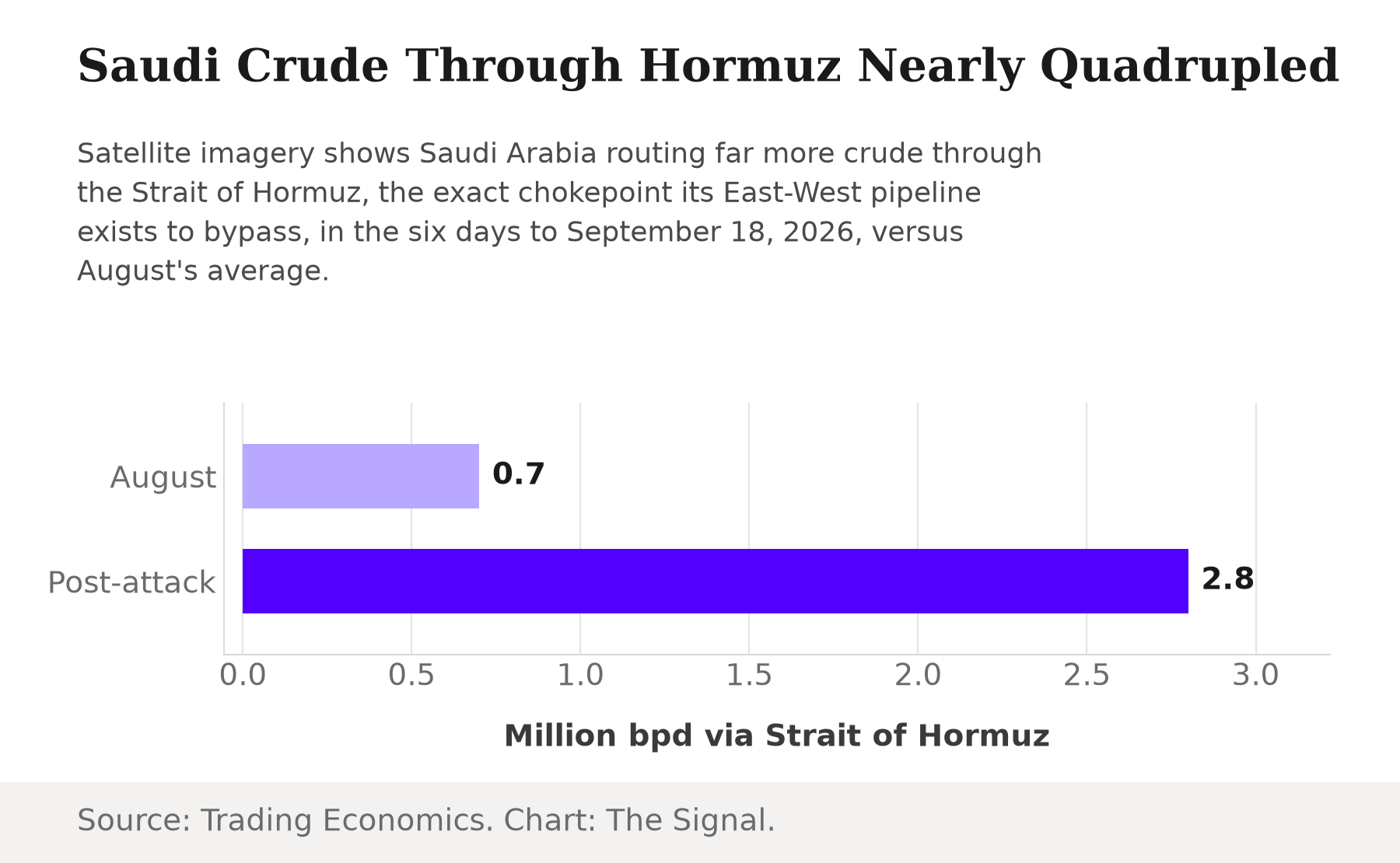
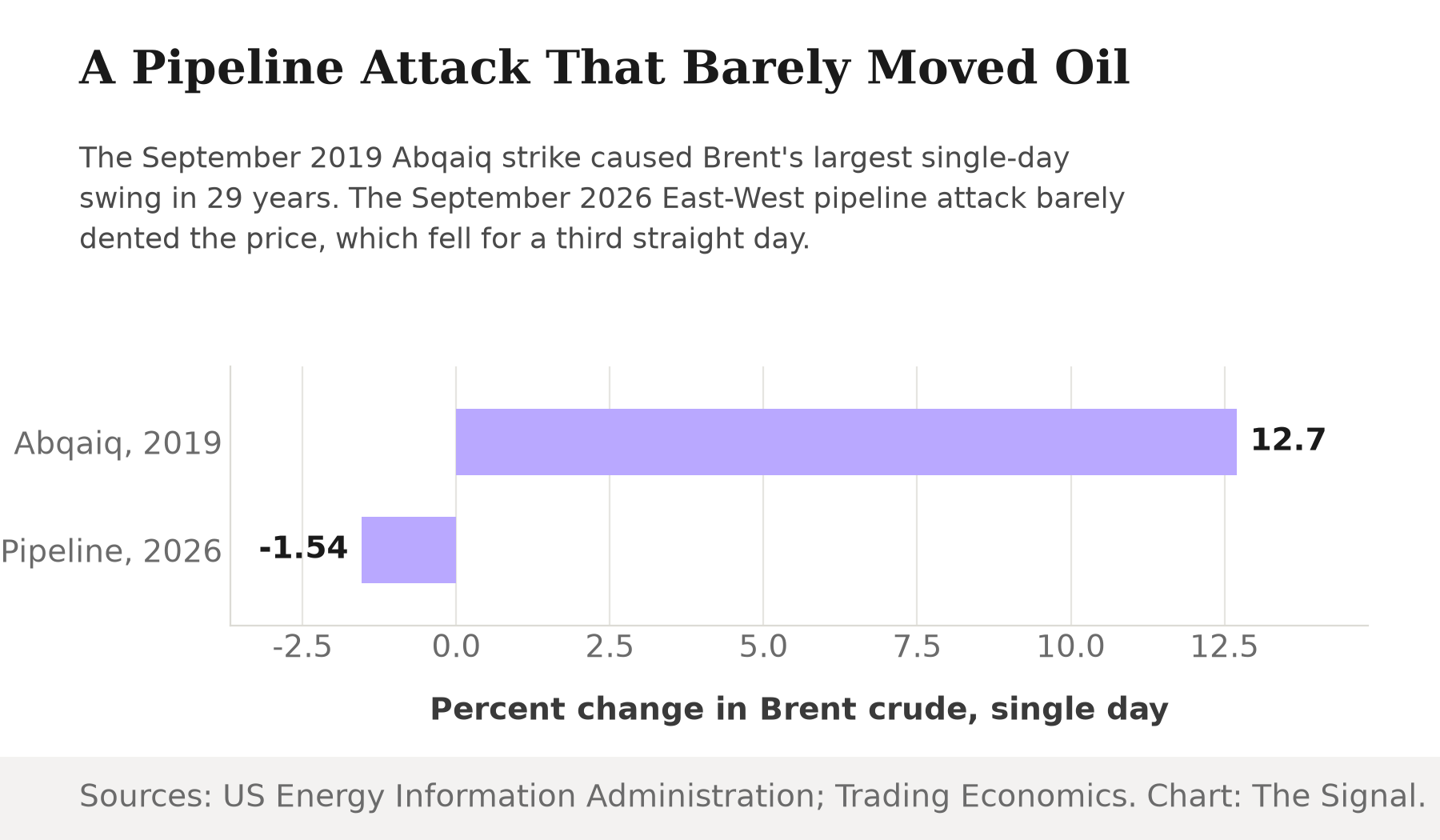
It is worth slowing down on that. Brent settled at $103.21 a barrel on September 18, 2026, down 1.54 percent from the previous session and its third consecutive daily decline, even with three pumping stations down and a major buyer cut off. Here is why: satellite imagery shows Saudi Arabia moved 2.8 million barrels a day of crude through the Strait of Hormuz over the six days to September 18, versus just 700,000 barrels a day in August, nearly four times as much. That is the paradox worth sitting with. The East-West pipeline exists specifically so Saudi Arabia can move crude to the Red Sea without sending it through the Strait of Hormuz, the route it has leaned on since the Iran war began. Knock out the bypass, and the kingdom's answer was to send more oil straight through the chokepoint the pipeline was built to avoid, and the market barely blinked.
Why a pipeline attack barely moved the needle
The gap between the surface read and the price action comes down to a rerouting option that simply did not exist, or was not needed, the last time an attack of this kind made headlines. Two regional officials briefed on the matter told the Associated Press that repairs could take three to five weeks, which is a real disruption, not a rounding error, for the roughly 4 million barrels a day the line has carried around Hormuz since the Iran war started. But Saudi Arabia has spare export routing, and it used it. The 2.1 million barrel-a-day jump in Hormuz throughput, from 700,000 to 2.8 million barrels a day, covers a meaningful share of the volume the pipeline would otherwise be moving, and that is the difference between a supply shock and a supply reroute.
Compare that with the last time an attack this size hit Saudi Arabia's oil infrastructure.
| Event | What was hit | Price reaction | Repair timeline |
|---|---|---|---|
| September 2019, Abqaiq | World's largest crude processing plant, 7.0 million barrels a day of capacity, about 7 percent of global crude output, cut to 2.0 million barrels a day on September 17, 2019 | Brent's 12.7 percent single-day swing, the largest daily move in 29 years | Not in this dataset |
| September 2026, East-West pipeline | Three pumping stations on a line moving 4 million to 5 million barrels a day to Yanbu | Brent down 1.54 percent on September 18, a third straight decline | Three to five weeks, per two regional officials |
Sources: US Energy Information Administration; OilPrice.com; Trading Economics.
Abqaiq processed nearly double the volume the East-West pipeline carries, and losing five of its seven million barrels a day overnight in September 2019 left almost nothing for Saudi Arabia to substitute with, because Abqaiq stabilizes crude before most of it can be exported at all. A damaged pipeline is a routing problem. Losing a processing plant that handles 7 percent of the world's crude output is a capacity problem instead, and only the routing problem has a workaround sitting three hundred nautical miles away in the form of a strait Saudi Arabia already uses every day.
Why this still lands on India's import bill
None of this makes the attack costless. Aramco is still telling at least two European refiners they get zero crude under their October term contracts, which forces those buyers into the spot market at whatever price it clears. India does not import crude through that specific pipeline, but it buys heavily from the same Gulf sellers, and it does so from a weaker position than it did five years ago: crude import dependence has climbed from 85.5 percent in the 2021-22 financial year to a record 88.7 percent (provisional) in the year to March 2026, as domestic output keeps falling. A market that shrugs off a Saudi pipeline attack is good news for an economy that imports nearly nine in ten barrels it uses. But if it stops pricing that risk premium at all, it also has less margin to absorb the next attack, whenever the workaround stops being available.
The honest objection
The strongest case against reading this as markets "shrugging off" Gulf risk is that the story is not finished. Repairs are estimated at three to five weeks, and European refiners are already at zero October allocation. If repairs slip past five weeks, if the Iran war escalates and the Hormuz reroute itself comes under threat, or if a second facility is hit while the East-West line is still down, the price reaction could look nothing like September 18's quiet decline. Three days of falling prices is not evidence that Gulf risk is gone; it may only be evidence that this particular attack, on this particular day, did not remove enough capacity to matter yet.
That case is real, but it describes a risk to watch, not a mispricing today. The market is not ignoring the attack, it is pricing the specific fact that Saudi Arabia had a working alternative route and used it within days. The 2.8 million barrels a day now moving through Hormuz is itself the tell: if that route runs into its own capacity limits, or the repair timeline blows past five weeks without a clear fix, that is precisely when the premium the market is not currently charging would show up. Until then, the honest read is that this was a routing shock a well-supplied market absorbed, not a capacity shock it ignored.
The Signal
The 2019 and 2026 attacks tested the same country's infrastructure and got opposite verdicts from the same market, and the difference was not the size of the headline, it was whether Saudi Arabia had somewhere else to send the oil. Watch two things from here: whether the East-West pipeline comes back inside the three-to-five-week window regional officials described, and whether Hormuz throughput keeps climbing well past 2.8 million barrels a day, which would suggest the kingdom is leaning harder on its backup than is comfortable. A pipeline attack that gets absorbed in days is a market with slack. A pipeline attack that forces a country back through the strait it built an entire line to avoid is a reminder of how little slack is actually left once the backup itself runs out of room.
Reporting basis: the pumping-station damage assessment is a Reuters satellite-imagery analysis, as reported by The Jerusalem Post. Aramco's October allocation cuts and the East-West pipeline's normal throughput are per OilPrice.com. The repair timeline is per two regional officials briefed on the matter, as reported by the Associated Press and relayed by OilPrice.com. Brent's September 18, 2026 price and the Strait of Hormuz throughput comparison are from Trading Economics. The September 2019 Abqaiq attack's price impact and facility capacity are both from the US Energy Information Administration. India's crude import dependence figures are from The Print. The Hormuz throughput rise as a share of the pipeline's typical volume is The Signal's own calculation from the cited figures.