On September 18, 2026, the Supreme Court disposed of SEBI's appeals against the National Stock Exchange in the decade-old colocation case, after SEBI accepted a combined settlement of about ₹1,492 crore covering the colocation matter and a related dark-fibre dispute. The disposal landed a day after NSE's own initial public offering had already opened for subscription on September 17, with the issue set to close September 21 at a price band of ₹1,700 to ₹1,785 a share. Read the sequence at face value and it is a clean handoff: the exchange's oldest legal overhang clears just as it goes to market.
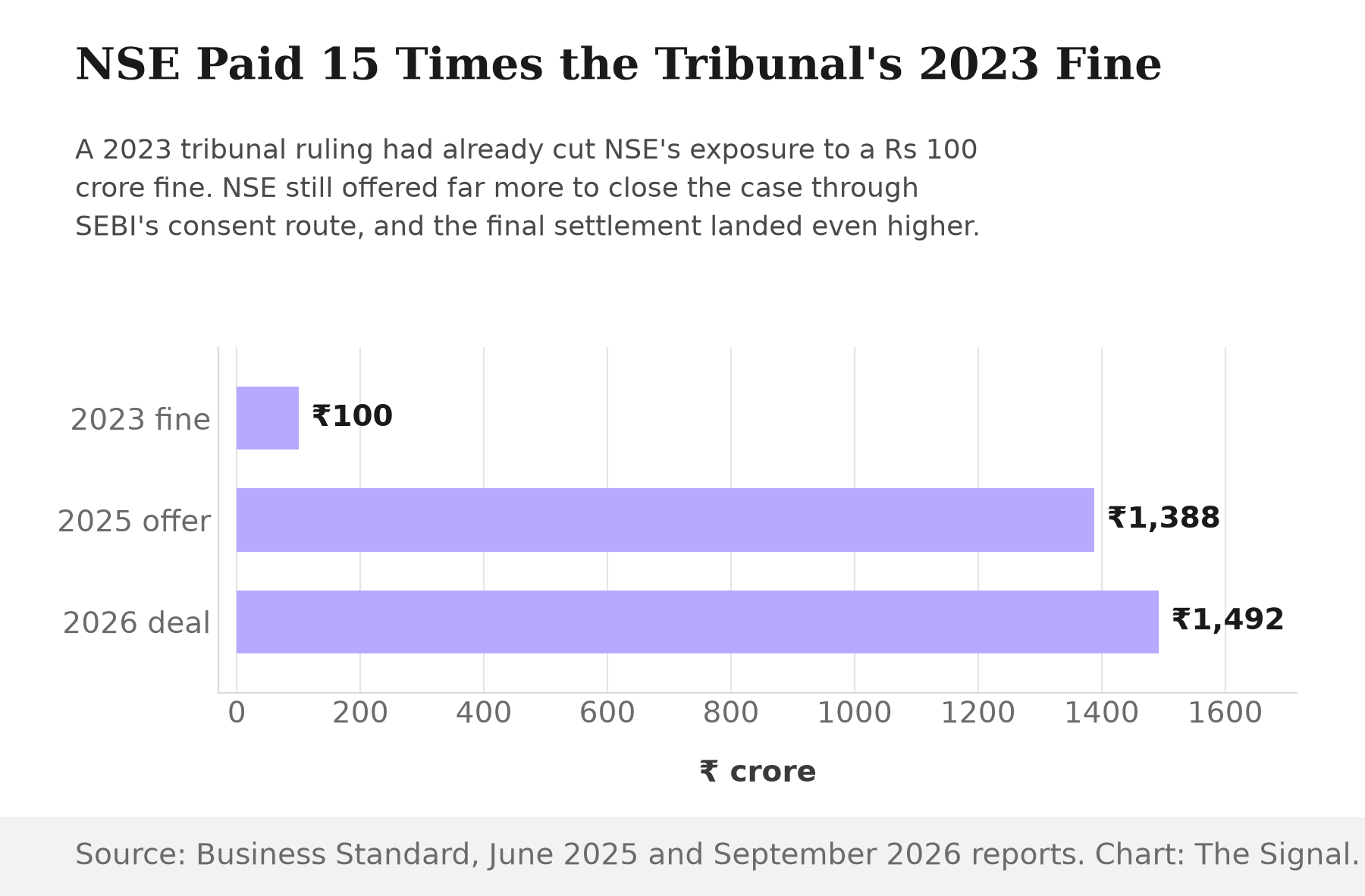
It is worth slowing down on how that case actually closed. NSE did not fight the matter to a verdict. It resolved the case through SEBI's consent settlement mechanism, which lets a party pay to close a file without confirming or denying guilt. And it did not settle at the number the courts had already set for it. In January 2023, the Securities Appellate Tribunal set aside the original disgorgement order and imposed instead a fine of ₹100 crore on NSE for due-diligence lapses, while the Supreme Court separately directed SEBI to refund NSE ₹300 crore related to the case. NSE's own legal exposure had, by that point, shrunk sharply.
NSE paid nearly 15 times the tribunal's reduced fine to close the case on its own terms.
Rather than rest on that reduced exposure, NSE itself proposed a ₹1,388 crore settlement to SEBI in June 2025, its biggest-ever settlement plea, and the case finally closed in September 2026 for a combined amount of around ₹1,492 crore. That is nearly 15 times the ₹100 crore fine a tribunal had already cut the case down to.
The order this closes
The case traces to a SEBI order dated April 30, 2019 (Order No. WTM/GM/EFD/03/2018-19), concerning preferential access some trading members allegedly received to NSE's colocation facility. Colocation is the practice of renting server space inside the exchange to shave milliseconds off trades. The case centered on Delhi-based broker OPG Securities, whose managing director Sanjay Gupta was arrested by the CBI in June 2022; investigators alleged the firm gained its edge by consistently logging in first on selected NSE Tick-by-Tick servers on most trading days between 2010 and 2014, and through multiple logins and access to secondary servers, shaving crucial time off its rivals' trades. That 2019 order had directed NSE to disgorge ₹625 crore plus 12 percent annual interest running from April 1, 2014, a liability that had been compounding for more than a decade by the time of the final settlement. The tribunal's 2023 ruling and the Supreme Court's separate ₹300 crore refund order both cut in NSE's favor. The consent settlement came after those wins, not before them.
That sequence is the point. A company that had already reduced its own downside chose to pay well above that reduced number to make the file disappear entirely, rather than let SEBI's appeal to the Supreme Court run its course. Certainty, and a case that never produces a finding of guilt, was worth more to NSE than the money.
What the IPO is actually selling
The settlement closed two days after SEBI issued an observation letter clearing NSE's proposed ₹30,000 crore IPO on September 4, 2026. None of that money reaches NSE itself: the issue is structured entirely as an offer for sale of up to 148,905,525 equity shares by existing shareholders, with no fresh issue by the company. Existing shareholders are cashing out; the company is not raising growth capital.
NSE's IPO, in the numbers that describe what a buyer is actually pricing.
| Metric | Figure | As of |
|---|---|---|
| IPO price band | ₹1,700 to ₹1,785 per share | Subscription window Sept 17 to Sept 21, 2026 |
| SEBI clearance | Observation letter for a ₹30,000 crore issue | September 4, 2026 |
| Offer structure | Entirely an offer for sale; no fresh issue by NSE | Filed June 2026 |
| FY26 revenue from operations | ~₹16,601 crore | Year ended March 31, 2026 |
| FY26 profit for the year | ~₹10,302 crore | Year ended March 31, 2026 |
| Implied market capitalisation at the IPO price band | ~₹4.2 to ₹4.4 lakh crore | At listing |
Source: The Tribune (ANI); IANS; NSE's SEBI-filed draft prospectus. The implied market capitalisation is the filing's own figure, combining share count with the price band.
The settlement news did not visibly spook bidders. By the afternoon of the IPO's second day, NSE's issue was subscribed 1.03 times overall, with non-institutional investors' portion subscribed 1.44 times and qualified institutional buyers' 1.32 times, while retail investors lagged at 0.68 times, the day after the Supreme Court disposal made headlines. Institutional demand, not retail enthusiasm, is carrying the book so far.
The business the case was about kept growing
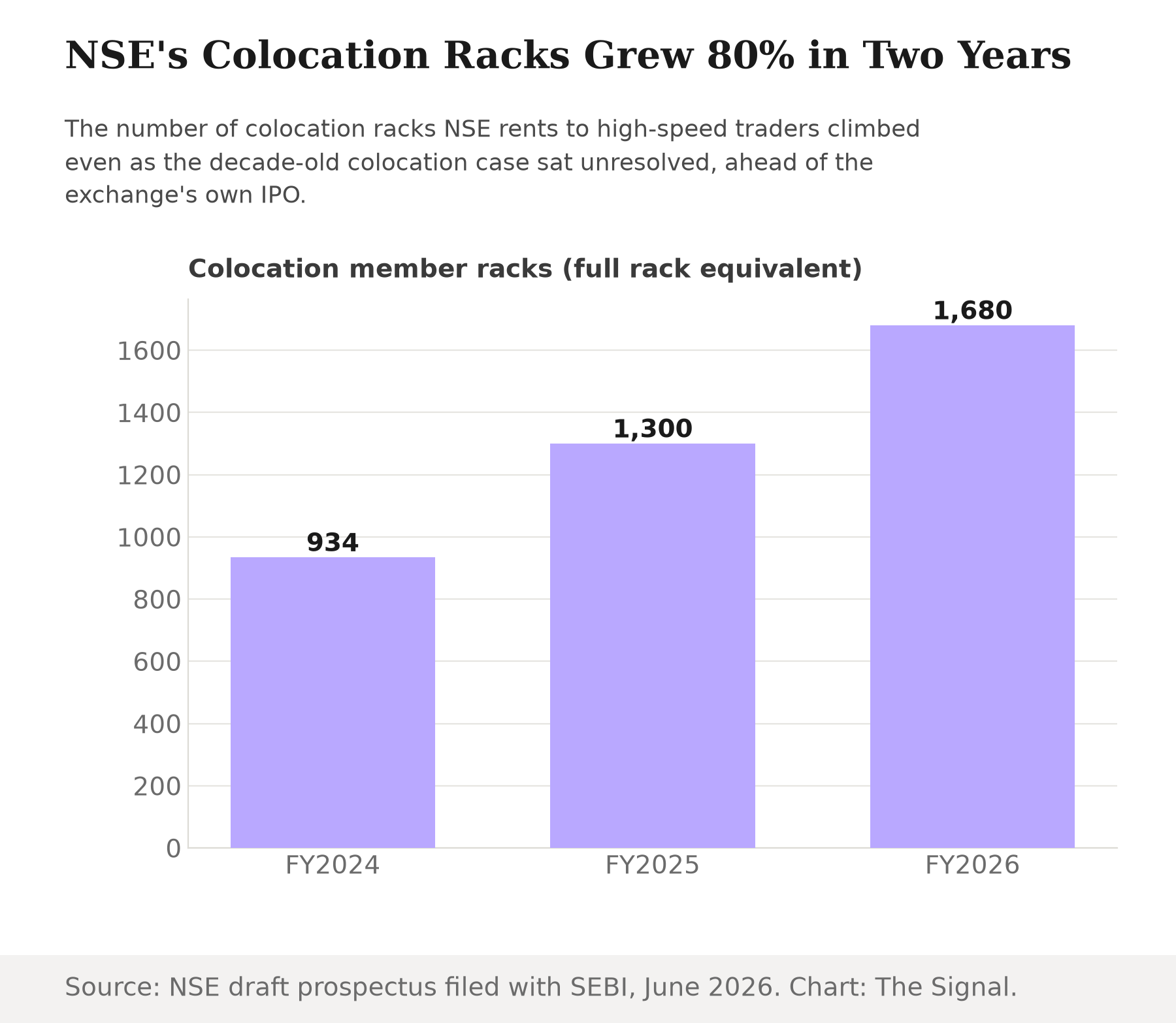
The colocation facility at the center of the case is not a legacy footnote. NSE's colocation member racks rose from 934 in fiscal 2024 to 1,680 in fiscal 2026, up about 80 percent, even as the market capitalisation of all NSE-listed companies rose to ₹411.25 trillion in fiscal 2026 from ₹384.21 trillion in fiscal 2024. The product the case was about kept expanding while the case itself sat open.
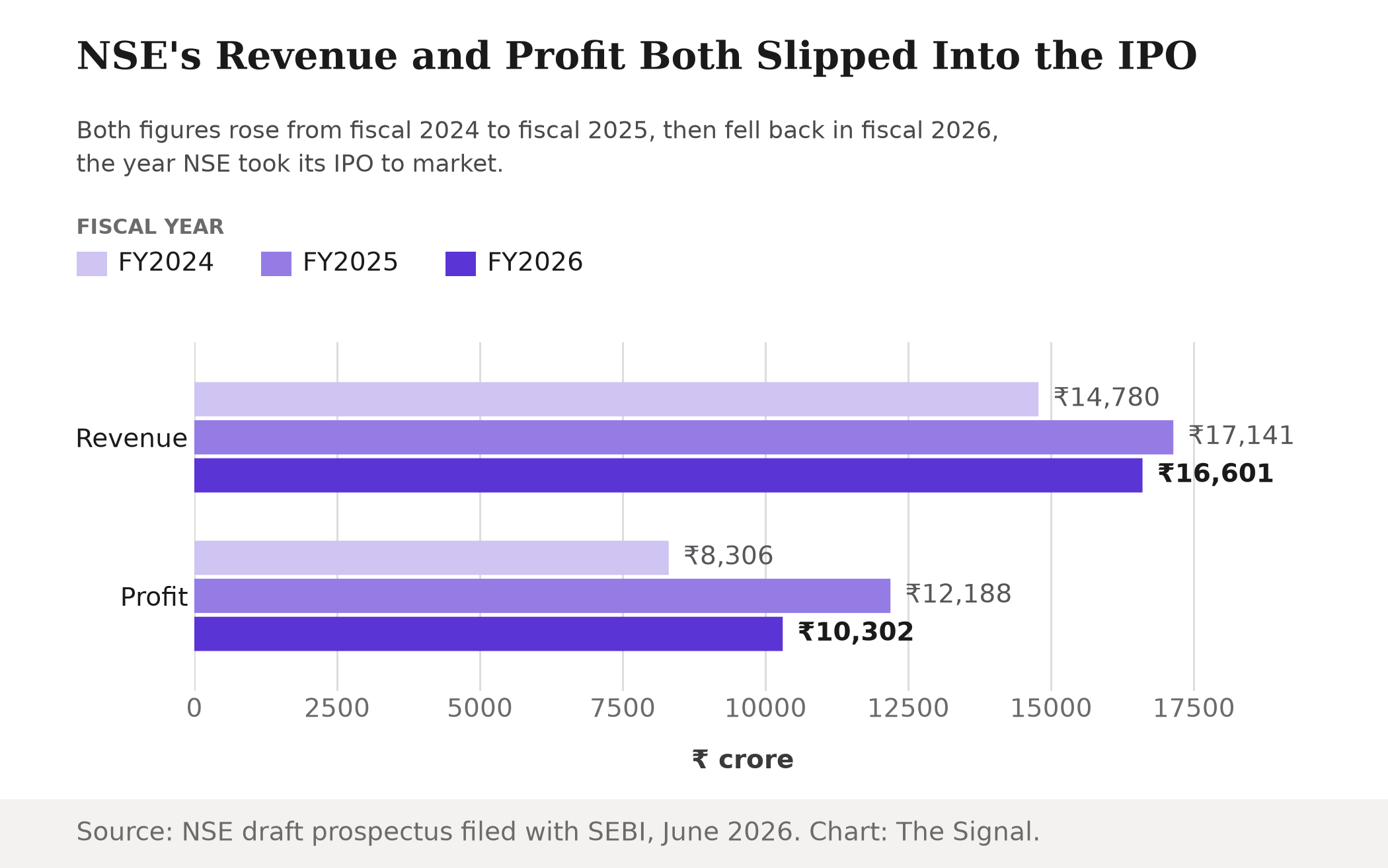
The company's own numbers complicate the growth story, though. NSE's revenue from operations and profit both rose from fiscal 2024 to fiscal 2025, then fell back in fiscal 2026: the same year it took the IPO to market.
The honest objection
The strongest case for NSE's approach is that a securities case, even a reduced one, is worse for a ~₹4.2 to ₹4.4 lakh crore listing than a known, one-time cost. An open appeal at the Supreme Court is an unpriceable risk hanging over a prospectus; investors pricing a ₹30,000 crore share sale do not want a live SEBI matter in the disclosures. On this reading, NSE was not buying an escape from a strong case against it. It was buying finality ahead of a listing where certainty is worth more than the marginal crore, and the ₹300 crore refund the Supreme Court had already ordered SEBI to pay NSE shows the company was not settling from a position of pure weakness.
That case is real, and it explains why NSE would pay a premium for closure. It does not explain why the mechanism it chose is one that produces no finding either way. If NSE's legal position was genuinely strong enough to win a ₹300 crore refund and a tribunal-imposed fine of only ₹100 crore, a company confident in that position could have let the Supreme Court rule and taken a result it could point to. Paying nearly 15 times that fine to avoid a ruling either way is a bet that ambiguity, not vindication, is the more valuable outcome to carry into a public listing.
The Signal
NSE is going public with its oldest scandal closed on paper and unresolved on the record. Investors buying into the ₹4.2 to ₹4.4 lakh crore listing are getting a business whose colocation racks grew 80 percent while the case over that same facility sat open, and a settlement that cost nearly 15 times what the courts had already decided NSE owed, in exchange for a file that never says what happened. The IPO prospectus can now say the case is settled. It cannot say NSE was right, and it cannot say NSE was wrong. For a company asking the public market to trust it with ₹4.2 lakh crore of value, that silence is the price of the ₹1,492 crore, not a footnote to it.
Reporting basis: the Supreme Court's September 18, 2026 disposal of the case and the settlement value are per Business Standard, which also reported NSE's June 2025 settlement offer and the 2023 tribunal and Supreme Court rulings that preceded it. The consent-mechanism framing is per ETV Bharat. IPO subscription dates and the price band are per The Tribune, carrying an ANI wire report. SEBI's IPO observation letter is per IANS. The original 2019 enforcement order and its case number come from SEBI's own September 2024 order in the matter, the primary document. NSE's revenue, profit, share count, colocation rack count and the NSE-listed market capitalisation figures are all from NSE's own draft prospectus filed with SEBI in June 2026, one filing used across those figures. The 15-fold comparison between the tribunal's 2023 fine and the final settlement is The Signal's calculation from those two reported figures. The naming of OPG Securities and Sanjay Gupta, and the mechanism of preferential server access, are per The Tribune (PTI), reporting Gupta's June 2022 CBI arrest. Day-2 IPO subscription figures are per Business Standard.