September 17 read, on the surface, like a non-event for Indian monetary policy. Coverage of the day's RBI communication reported the repo rate held steady while real GDP growth for the current fiscal was reaffirmed at 6.9 percent. The framing cast it as a signal that the rate-setting committee sees the economy on stronger footing than earlier estimates suggested. No rate move, no shift in stance. For a market that has spent the past year absorbing IPOs, budget signals and global rate noise, September 17 looked like a day to file away and move on.
It is worth slowing down on that. The same day, RBI ran the first tranche of an OMO government-bond sale auction for Rs 50,000 crore, the opening move in a three-tranche program worth Rs 1,00,000 crore in total, with the remaining Rs 25,000-crore tranches scheduled for September 21 and September 28. RBI's own press release states the auctions exist because, "on a review of current and evolving liquidity conditions, the Reserve Bank has decided to conduct OMO sale auctions." That is not a rate move. It is a balance-sheet move, and its direction is the opposite of "nothing changed."
The mechanism: selling bonds pulls cash out of banks
An OMO (open market operation) sale works by RBI selling government securities to banks, which pay for them in cash. Every rupee a bank hands over for a bond is a rupee it can no longer lend out overnight. Run at scale, a sale program drains system-wide liquidity the same way a rate hike raises the cost of that liquidity, just through the balance sheet instead of the price. RBI's own press release frames the September 17 tranche explicitly as liquidity absorption, not routine bond-market housekeeping.
The three-tranche program totals Rs 1,00,000 crore, timed for September 17, 21 and 28.
The full schedule is public and specific: three tranches, three dates, one stated purpose.
| Tranche | Date | Amount (Rs crore) |
|---|---|---|
| 1 | September 17, 2026 | 50,000 |
| 2 | September 21, 2026 | 25,000 |
| 3 | September 28, 2026 | 25,000 |
Source: RBI press release.
Sizing the drain against what RBI itself reported six days earlier
The number that puts the drain in context is the surplus it is draining from. As of September 11, 2026, RBI data showed the banking system's net liquidity in a surplus of Rs 10.43 trillion, with core liquidity estimated at Rs 13 trillion to Rs 14 trillion, reported by Business Standard citing RBI figures and Governor Malhotra's remarks. Against that base, the first tranche is a small fraction of the surplus, and the full Rs 1,00,000-crore program still leaves most of it in place.
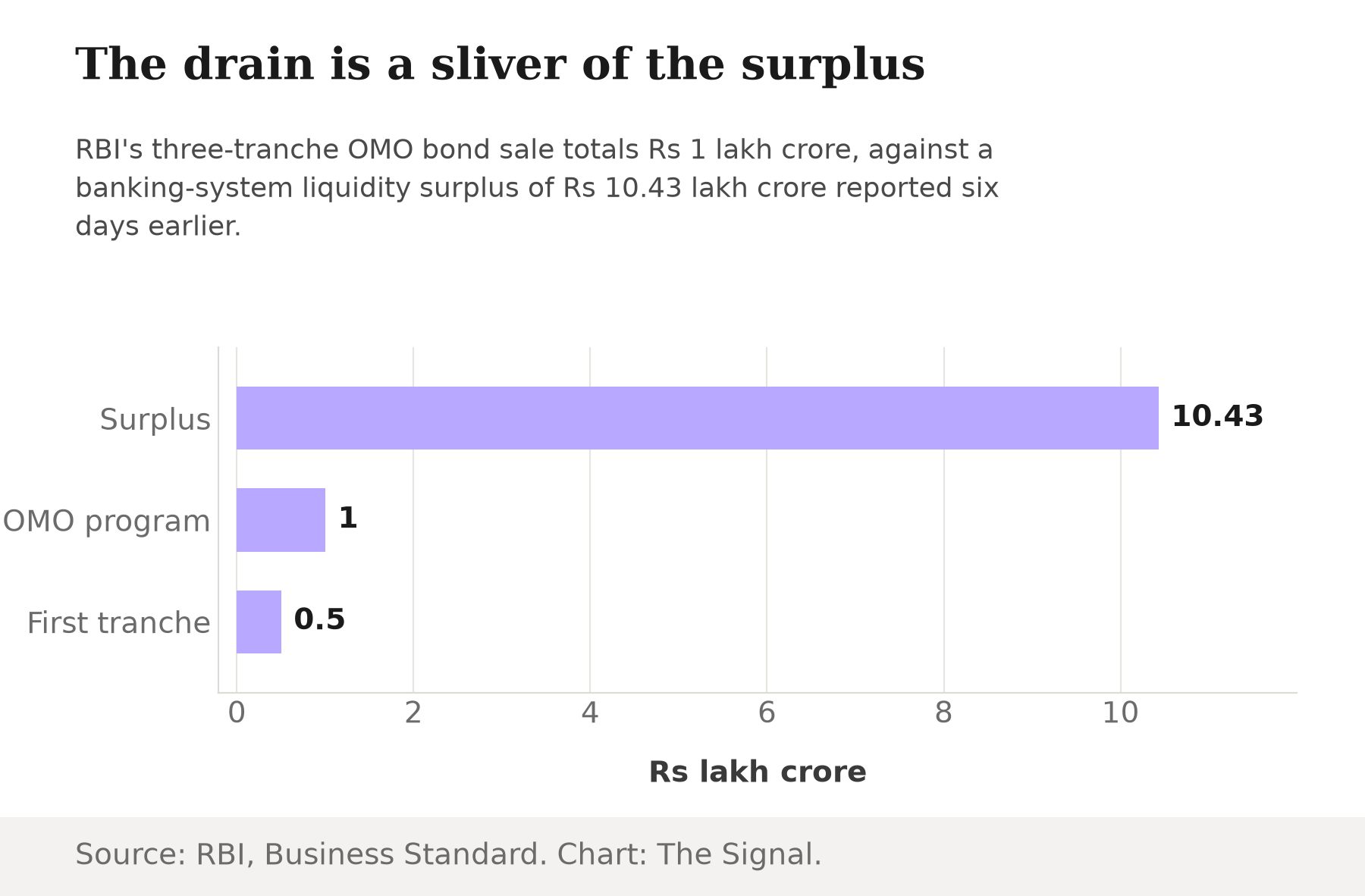
The same Business Standard report carries the detail that gives the timing its edge: the next scheduled Monetary Policy Committee review is not due until October 5-7, 2026, meaning the drain lands squarely between rate-setting meetings, where it draws far less notice than a headline rate change would. RBI does not need to touch 5.25 percent to tighten. It can do it through the plumbing, on a date the calendar does not flag.
The rate has looked stable. The growth number has not
The repo rate's own recent record supports the "nothing changed" read at face value: it was 5.50 percent in October 2025, then 5.25 percent from April 2026 onward, held there through June and reported unchanged again on September 17. One cut, then a hold. Read alone, that is a genuinely stable picture.
The growth forecast that RBI pairs with the rate decision each time is less steady than the "reaffirmed" framing suggests. In October 2025, RBI revised its FY2025-26 growth forecast up to 6.8 percent. In its first bi-monthly statement for FY2026-27, announced April 8, 2026, RBI projected growth for the new fiscal year at 6.9 percent. Its June 2026 policy resolution then put that same fiscal year's projection at 6.6 percent, a full three-tenths of a point below the April figure. By September 17, coverage of RBI's decision put the number back at 6.9 percent, describing it as reaffirmed.
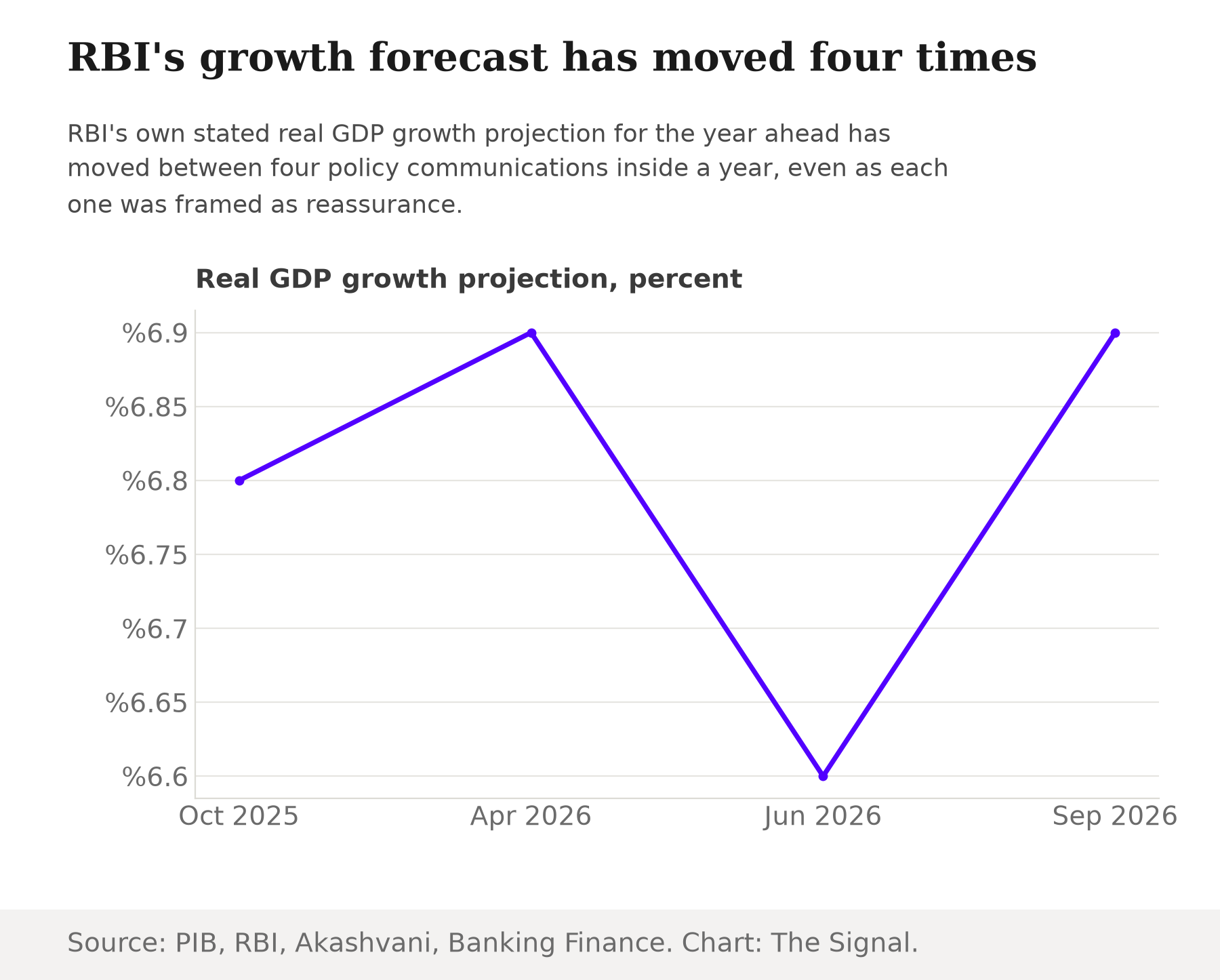
A number that moves from 6.9 to 6.6 and back to 6.9 across four statements in eleven months is not the same thing as a number that never changed. Calling the September figure "reaffirmed" implies continuity the June number does not support.
The honest objection
The strongest case against reading any of this as a hidden tightening is that liquidity management and rate-setting are supposed to be separate tools doing separate jobs, and RBI's own data backs that division. RBI's July 21, 2026 money-market operations release reported net systemic liquidity absorption of about Rs 69,596 crore that day, with the overnight triparty repo weighted-average rate trading at 5.25 percent, exactly in line with the policy repo rate. That is liquidity management doing precisely what textbooks say it should: keeping the overnight rate anchored to the policy rate, not moving the economy's cost of money. On this view, September's OMO sales are routine housekeeping against a large surplus, not a signal that contradicts the neutral stance.
That case holds for a single day's operation. It strains against a Rs 1,00,000-crore, three-tranche program that RBI itself describes as liquidity absorption, timed to land between MPC meetings, against a surplus RBI's own data had put at Rs 10.43 trillion six days earlier. A single day's WACR sitting at the repo rate is evidence the plumbing works as designed. Shrinking the surplus that plumbing draws on over a three-tranche, multi-week program is a different matter: a policy choice, made in the same window the growth forecast was being called stable.
The Signal
Markets watch the repo rate, but it is the liquidity surplus that decides what banks can actually lend at, and RBI has just spent three tranches shrinking it while the headline rate stayed put and the growth forecast was called unchanged. Watch what happens after the third tranche settles on September 28, when RBI's core liquidity estimate gets its next public reading. If the surplus keeps shrinking beyond this program, or a fourth tranche follows before the October 5-7 MPC meeting, the "neutral stance" language will have described a policy that was already moving. The repo rate tells you what RBI says. The OMO calendar tells you what it is doing.
Reporting basis: the September 17, 2026 OMO auction details, the June 2026 policy resolution and the July 21, 2026 money-market operations data are all from RBI's own press releases. The October 2025 rate decision and growth revision are per a Press Information Bureau release on RBI's policy. The April 2026 bi-monthly statement and rate decision are per All India Radio's Akashvani/newsonair.gov.in, reporting RBI's communications; both April items come from the same origin. The September 11, 2026 liquidity surplus, core liquidity estimate and the October 5-7 MPC meeting date are per Business Standard, citing RBI data and Governor Malhotra's remarks. The September 17 framing of the repo hold and reaffirmed growth figure is per Banking Finance, a BFSI trade publication. The comparison of the OMO program's scale against the reported liquidity surplus, and the sequencing of the four growth-forecast figures across statements, are The Signal's own compilation from those cited releases.