On September 14, 2026, Solar Industries' South African step-down subsidiary agreed to buy Omnia Holdings, a 73-year-old mining and agriculture group operating in 23 countries, for close to Rs 12,951 crore in an all-cash deal. Goldman Sachs described the move as a chance for Solar Industries to "create a global platform for Commercial Explosives and Blasting Solutions", language that reads like an endorsement of exactly the ambition India's defense manufacturers are supposed to have: build genuine scale abroad, not just supply a domestic order book.
The market's answer arrived the next trading day. The Nifty India Defence index fell as much as 5.48 percent intraday to 9,190.60 on September 15, 2026, against a 0.82 percent slide in the broader Nifty 50, while Solar Industries itself slumped nearly 14 percent to Rs 19,225. HAL and BEL, which together with Solar Industries account for more than half the index's weight, fell 3 to 3.5 percent alongside it, according to SBI Securities' Sunny Agrawal.
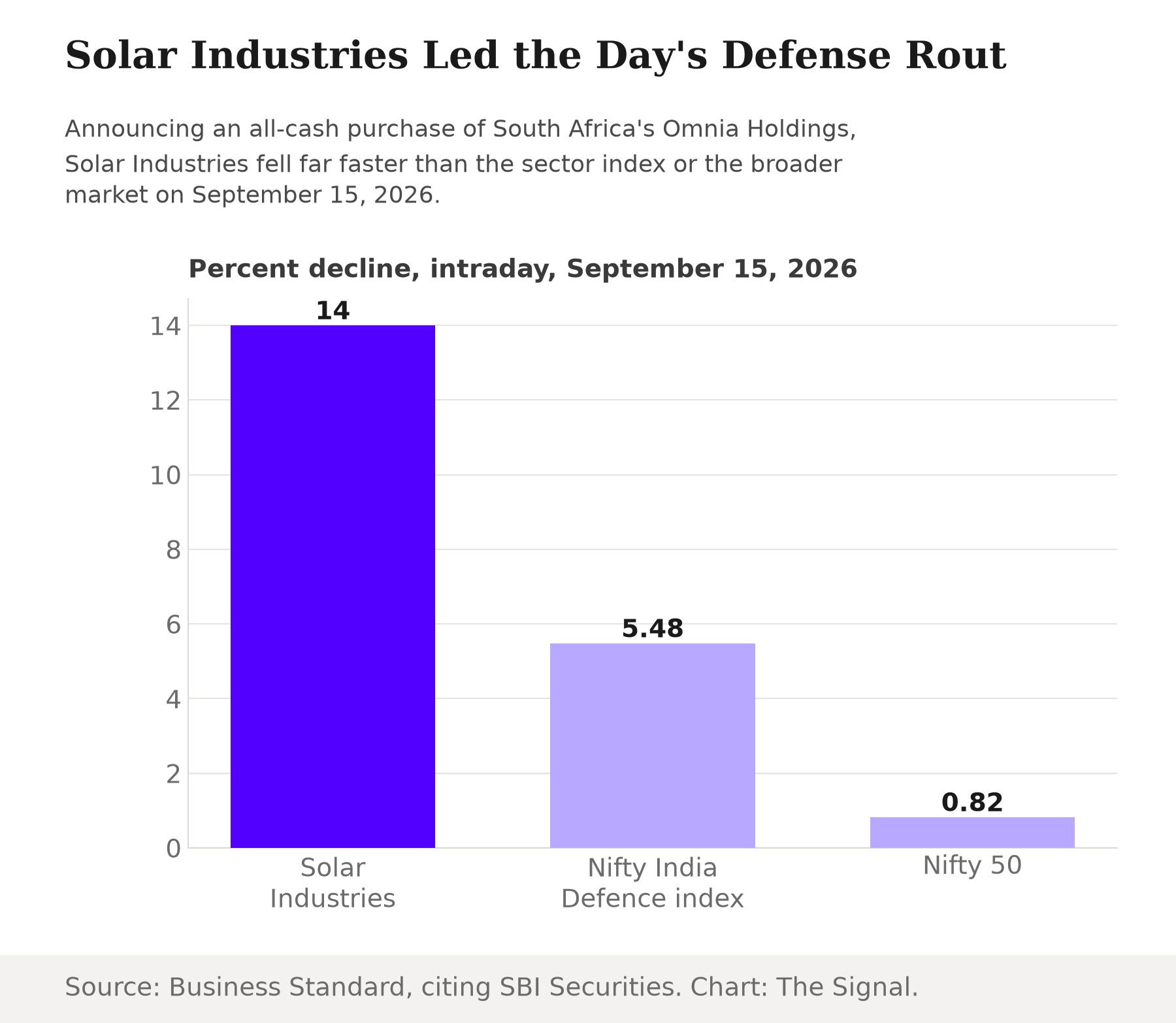
It is worth slowing down on that reaction. Read plainly, it looks like ordinary deal skepticism: a large, debt-free explosives maker suddenly writing an all-cash cheque for a foreign company in mining chemicals and agriculture, businesses it has no operating history in. But the selloff did not stay contained to the acquirer. Mishra Dhatu Nigam, Data Patterns, Paras Defence, MTAR Technologies and Apollo Micro Systems all fell alongside Solar Industries that morning, dragging the Nifty India Defence index down as much as 4.1 percent to an intraday low of 9,322.05, even though none of those companies had anything to do with Omnia.
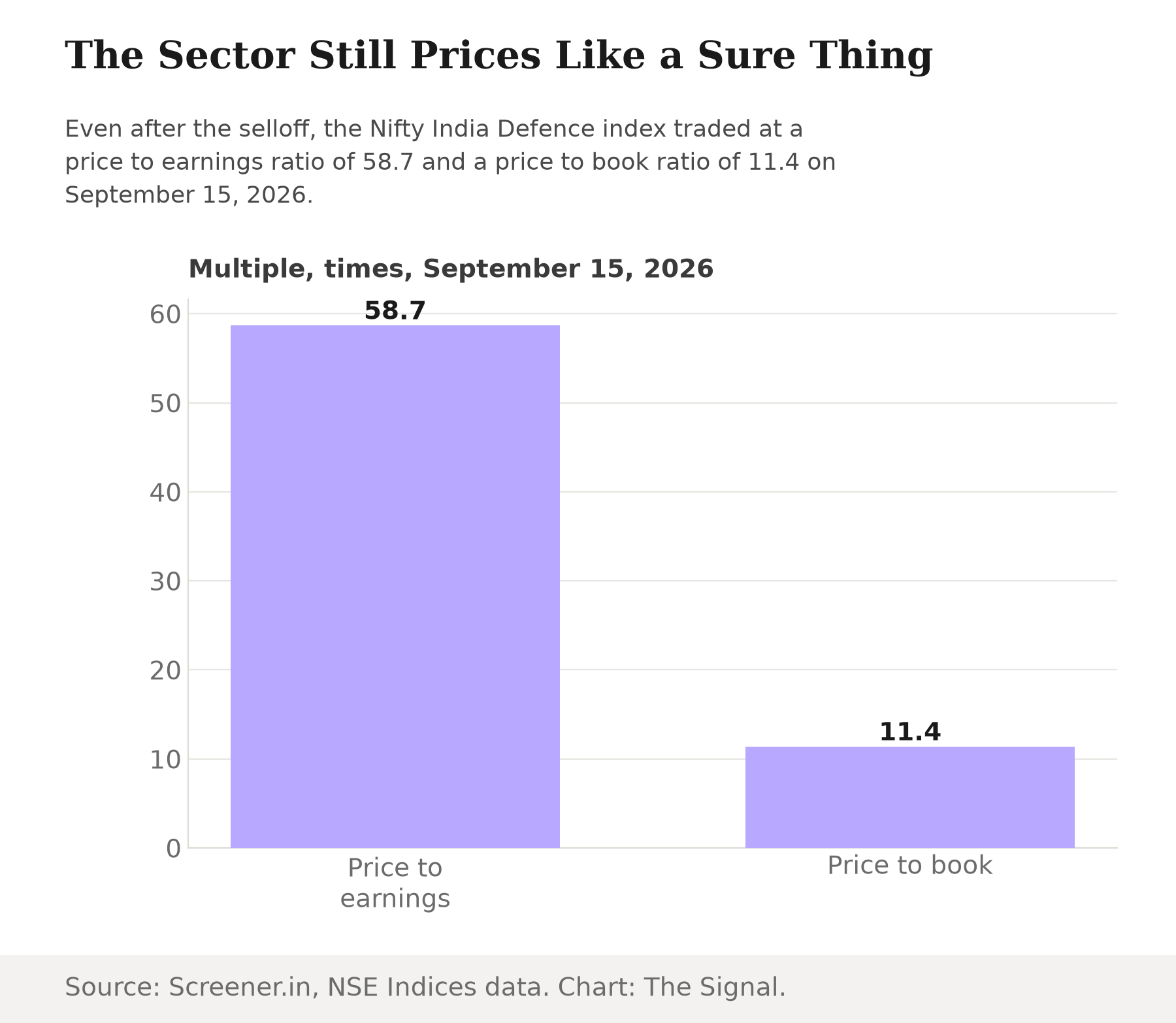
A number sits behind that spillover. On September 15, 2026, the Nifty India Defence index still traded at a price to earnings ratio of 58.7 and a price to book ratio of 11.4. That is not a multiple a market usually assigns to a sector selling mostly to one buyer, the Indian government, at negotiated prices. It is a multiple that assumes real, compounding, global scale, precisely the story a foreign acquisition ought to confirm rather than complicate.
The export boom is a public-sector boom
India's defense exports did hit a record in the fiscal year that ended in March 2026: Rs 38,424 crore, up 62.66 percent, or Rs 14,802 crore, from Rs 23,622 crore the year before, according to the Ministry of Defence. That headline growth is real. Split it by ownership, though, and the story splits too: state-run defense public sector undertakings grew their exports 151 percent in FY2025-26, while private companies managed just 14 percent, and PSUs now account for 54.84 percent of total defense exports against 45.16 percent for private firms.
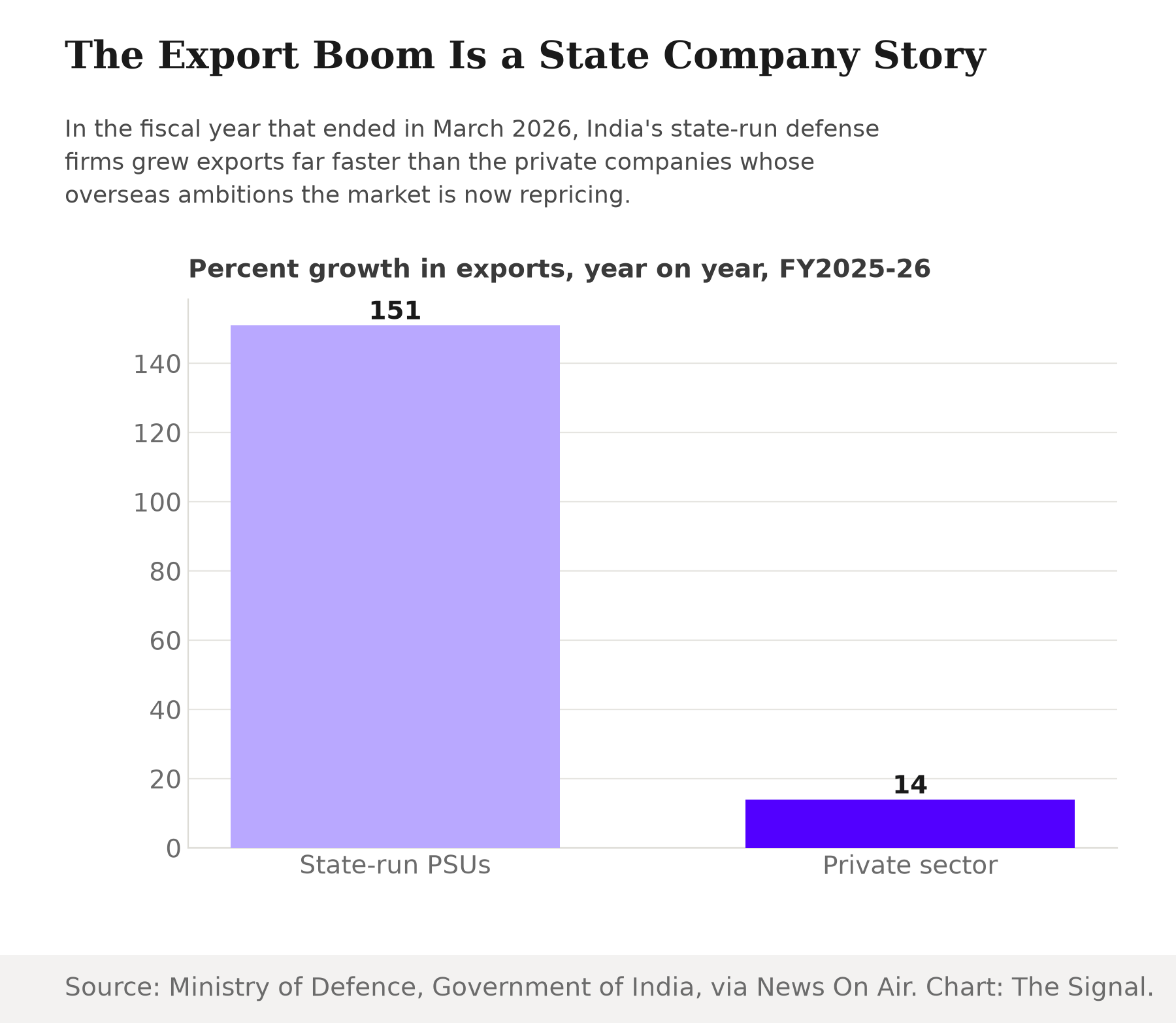
That split matters because the market's defense premium is substantially a private-sector premium: Solar Industries, Data Patterns, MTAR and the rest are the listed names carrying the 58.7 multiple, and they are also the segment growing exports at a tenth the PSU pace. More than a year before the selloff, in August 2025, DRDO Chairman Samir V Kamat said India was targeting Rs 50,000 crore in defense exports by 2028-29, the figure set by the Defence Minister, and expected exports to roughly double in the next two to three years on the strength of interest in Indian systems after Operation Sindoor. Hitting that target on the current trajectory means the private companies closing the gap with the state-run exporters, not the other way around.
Sold more than ever, still outside the club that matters
Even a record year has not put India inside arms-exporting's top table. Global arms exports remain concentrated: the world's 25 largest suppliers accounted for 98 percent of total export volume between 2020 and 2024, and the top five alone, the United States, France, Russia, China and Germany, accounted for 71 percent, according to SIPRI's Yearbook 2025. India did not rank among those 25 largest exporters over the same five years, even as it became the world's second-largest arms importer in 2024 with an 8.3 percent share of global imports.
The country buying the second most weapons on earth is not yet selling enough of its own to register on the list that measures who sells them. That is the gap an Indian industrial company building scale abroad was supposed to help close, even if commercial explosives and blasting systems sit adjacent to, not inside, the arms trade SIPRI's figures cover.
The honest objection
The strongest case against reading this as a verdict on the export story is that the selloff may simply be ordinary acquisition risk, priced the way markets price any large company suddenly committing close to Rs 12,951 crore in cash to a business thousands of kilometers from its home base, in sectors it has never operated in. On that reading, Goldman Sachs' "global platform" language is the same banker enthusiasm that accompanies many pricey acquisitions, and investors were simply protecting themselves against integration risk rather than repricing an entire industrial narrative.
That case is real, and the fact that Solar Industries absorbed by far the sharpest decline supports it. But it does not explain why HAL and BEL, with zero exposure to Omnia or South Africa, also fell 3 to 3.5 percent the same morning, or why five smaller, unrelated defense names slid enough to pull the sector index down as much as 4.1 percent on its own measure. A single company's deal risk does not usually travel through an entire index unless the market already suspected the index's pricing rested on a story that deal had just complicated.
The Signal
The Nifty India Defence index still trades at 58.7 times earnings for a sector where private companies grew exports 14 percent against the state sector's 151 percent, and where India itself sits outside the world's 25 largest arms exporters despite buying more weapons than almost any country on earth. A closed domestic order book can support a multiple like that for a while. A credible global one is what is supposed to make it durable enough to survive a Tuesday. What to watch next is not whether Solar Industries integrates Omnia cleanly, but whether the next Indian defense manufacturer that announces genuine overseas expansion gets priced as the export story the government is counting on, or as a discount to the closed one the market just re-confirmed it prefers.
Reporting basis: the Omnia Holdings acquisition terms are per Solar Industries' company statement, as reported by The Tribune. The September 15, 2026 index and stock declines, and the HAL and BEL comparison, are per Business Standard, citing SBI Securities' Sunny Agrawal; the smaller-cap declines and Goldman Sachs' characterization of the deal are per Upstox market news, citing Goldman Sachs research. The Nifty India Defence index's valuation multiples are Screener.in's aggregation of NSE Indices data. The FY2025-26 export total and the PSU-private split are from the Ministry of Defence, as released via News On Air. The 2028-29 export target and DRDO Chairman Samir V Kamat's remarks are per The Tribune's report of his August 2025 statement. Global arms-export concentration figures and India's absence from the top 25 exporters are from SIPRI's Yearbook 2025; India's status as the second-largest arms importer is per ThePrint's report of the same SIPRI data. No figure in this piece is The Signal's own calculation.