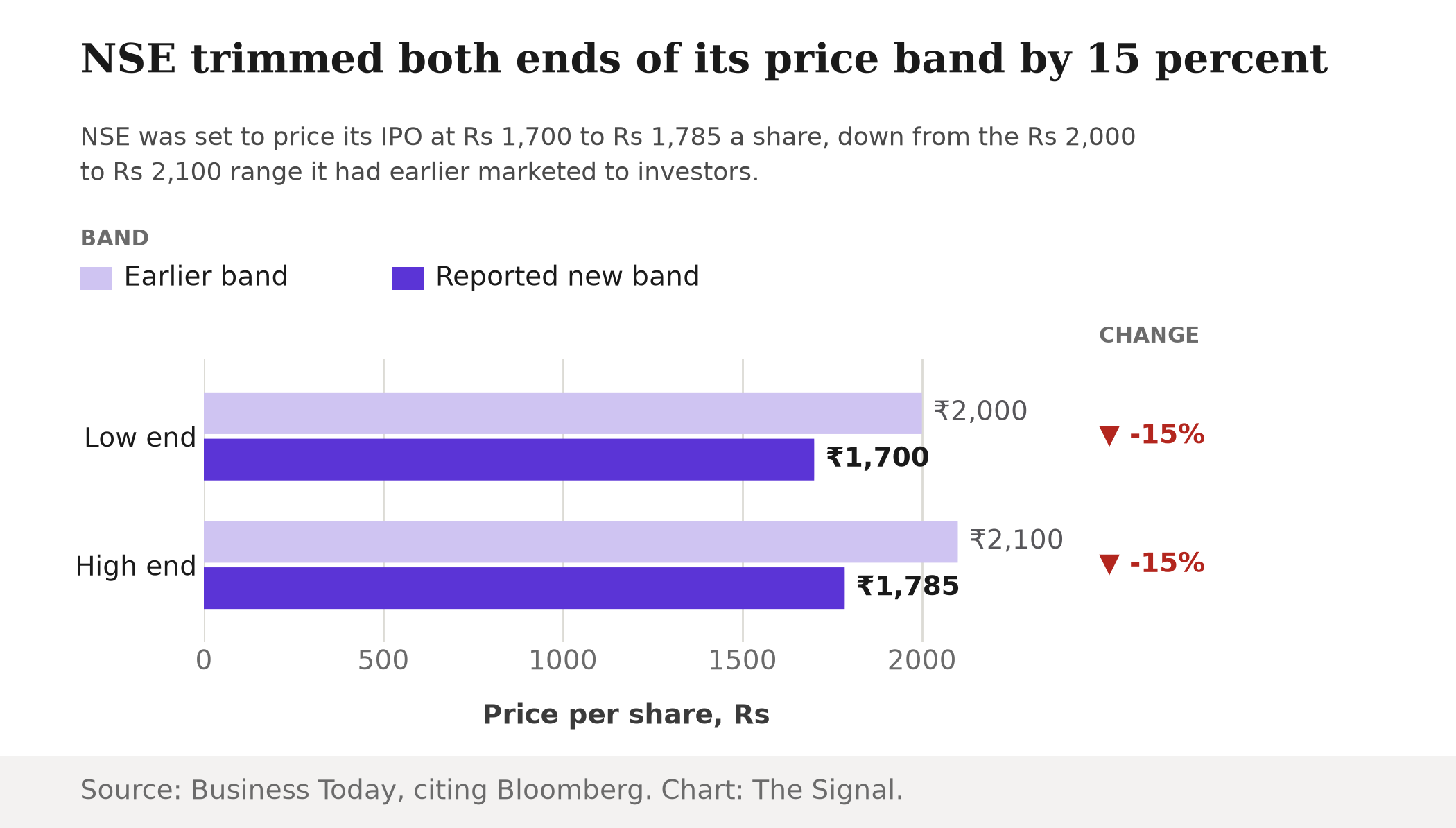
India's own stock exchange is about to list on itself, and it just marked down its own asking price. NSE is set to price its IPO at Rs 1,700 to Rs 1,785 a share, below the Rs 2,000 to Rs 2,100 range it had earlier marketed to investors, a cut of exactly 15 percent at both ends of the band. At the top of the new band, the 5.5% stake sale would raise about Rs 24,300 crore and value NSE at up to Rs 4.42 lakh crore, down from a previously targeted valuation of up to Rs 5.26 lakh crore.
The timing is what makes it strange. Six mainboard IPOs, including the country's biggest exchange operator, are opening for subscription this same week, and 11 mainboard companies are together raising Rs 7,055 crore between September 7 and 15. Read the volume alone and the story is a boom. NSE is the exchange that lists every one of these companies, and it is the one that could not get the price it wanted.
NSE cut both ends of its price band by exactly 15 percent.
Source: Business Today, citing Bloomberg.
What the cut actually costs
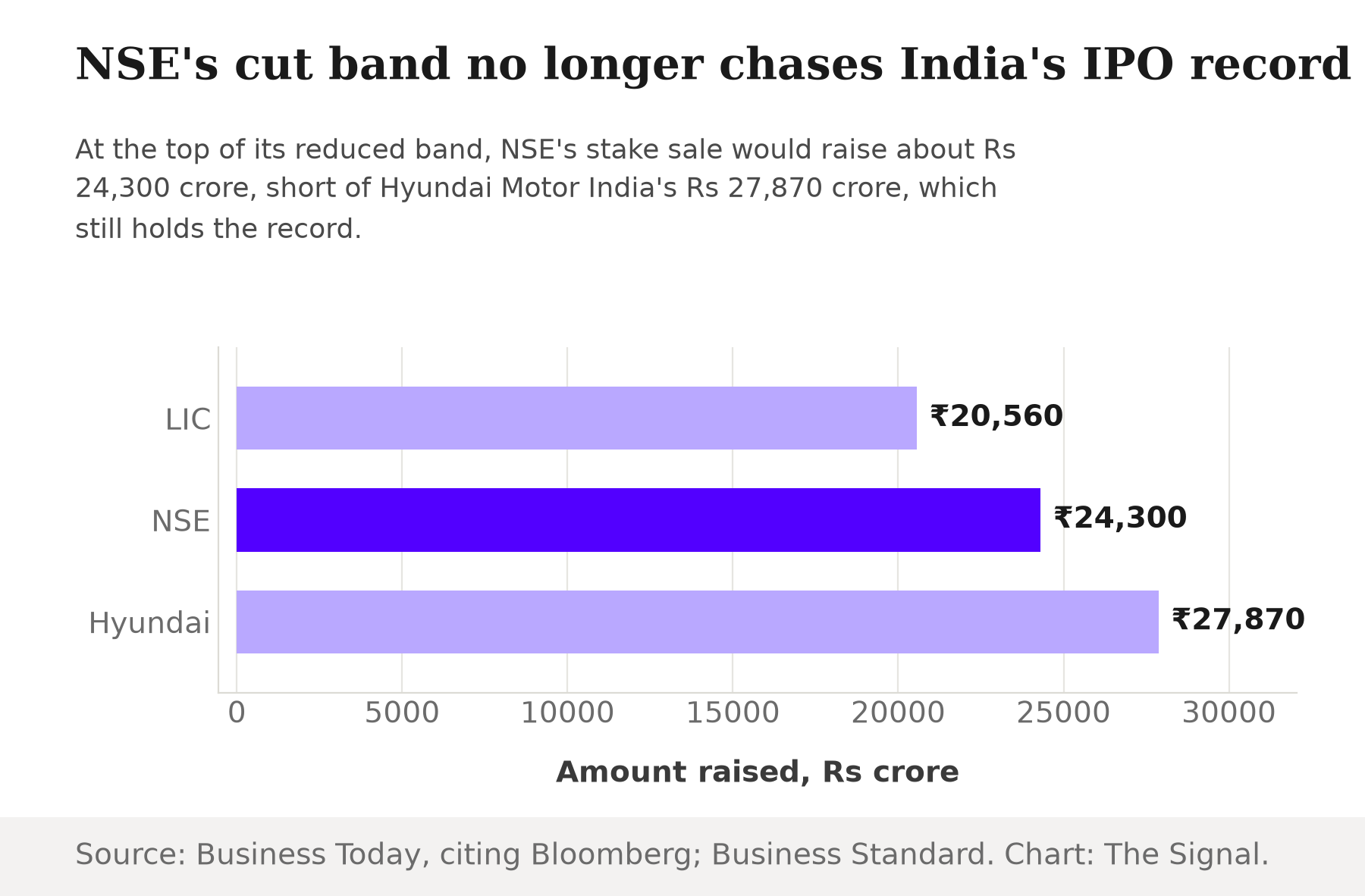
Run the earlier numbers forward. A 5.5% stake sold at the previously targeted valuation of up to Rs 5.26 lakh crore would have raised close to Rs 28,930 crore, above Hyundai Motor India's Rs 27,870 crore, which has held India's IPO record since its October 2024 listing (our calculation, from NSE's reported valuation range and Hyundai's confirmed raise). At the reduced band's top end, that same stake raises about Rs 24,300 crore instead, comfortably short of Hyundai's mark. The exchange that stood a real chance of becoming India's biggest-ever listing will now settle for third place, behind Hyundai and roughly level with LIC's Rs 20,560 crore (about $2.7 billion) raise in May 2022, the record before Hyundai.
| IPO | Date | Amount raised |
|---|---|---|
| LIC | May 2022 | Rs 20,560 crore |
| NSE (new band, top end) | September 2026 | up to Rs 24,300 crore |
| Hyundai Motor India | October 2024 | Rs 27,870 crore (record) |
NSE's figure is Bloomberg's reported top-end estimate for the reduced band; the others are confirmed raises. Sources: Business Today, citing Bloomberg; Business Standard; Business Standard.
It is worth asking why the exchange running the busiest IPO calendar in years could not command a record price on its own listing. The answer sits in how crowded that calendar actually is.
The record week that crowded it out
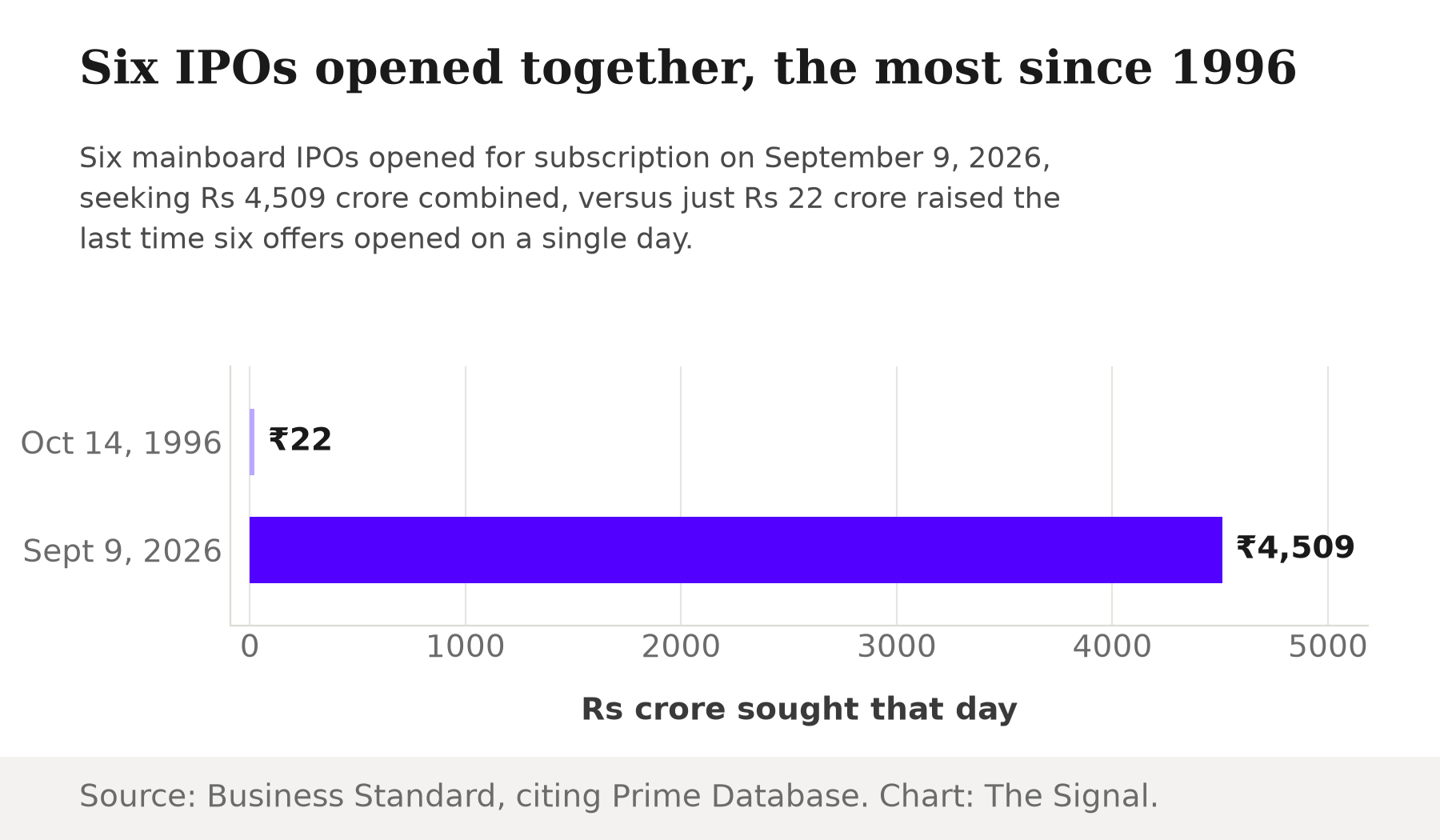
Six mainboard IPOs opened for subscription on September 9, the first time that many opened together on a single day since October 14, 1996. Between them they sought Rs 4,509 crore, against just Rs 22 crore raised on that single day three decades ago, a gap of more than 200 times even though it took the same six-IPO count to set both records.
Six IPOs opened on one day, the most since 1996.
Source: Business Standard, citing Prime Database.
That single day sits inside a bigger stack of issuance. Eleven mainboard companies are raising a combined Rs 7,055 crore in IPOs between September 7 and 15, and 61 percent of that money, Rs 4,333 crore, is an offer for sale by existing shareholders rather than fresh capital going into the companies. Most of what investors are being asked to fund this week is existing holders cashing out, not new business, and all of it is competing for the same pool of buyers in the same fortnight.
Zoom out further and the pool itself looks smaller than the calendar suggests. India's IPO market has raised almost $10 billion so far in 2026, less than half of the more than $20 billion raised in each of the previous two record years. A calendar this crowded is not landing on a deeper well of capital. It is landing on a shallower one.
A rougher market to price into
The same week made the backdrop worse. Brent crude reached $96.02 a barrel on September 1, climbing toward $100 amid US-Iran tensions, and the BSE Sensex fell about 460 points, or 0.6 percent, to 75,125 on September 9, extending a selloff tied to rising crude prices and escalating Middle East tensions, the same day six IPOs opened for bids. NSE and ten other companies were competing with each other for investor cash while the broader market moved against them too.
The honest objection
The strongest case against reading this as a capital squeeze is that NSE's cut may simply reflect a bigger deal, not a thinner market. An addendum to NSE's draft red herring prospectus, filed with SEBI on August 10, added State Bank of India, offering up to 15,969,410 shares, and SBI Capital Markets, offering up to 8,780,590 shares, as additional sellers in the offer for sale. More shares chasing the same demand mechanically requires a lower clearing price, whatever else is happening in the market. On this reading, NSE simply added sellers to its own offer, and the price band did the arithmetic any expanded sale would demand.
That case is real, but it does not explain why the whole market is thinner, not just this one listing. NSE's added sellers can account for its own repricing. They cannot account for 2026's total IPO haul already running at less than half of each of the prior two record years, a shortfall set before this week's crowding or NSE's own addendum. A single company adding sellers is a supply story, but a record IPO calendar landing on a shrunken pool, in the same week crude climbs and the Sensex falls, is a demand story, and NSE's cut fits both at once.
The Signal
NSE runs the exchange every one of these listings needs to trade on, and it still could not set its own price above what a crowded, thinning market would bear. That is the tell. When the operator of the market cannot escape the market's own arithmetic, the "IPO boom" story is really a story about how many issuers are competing for a pool of capital that stopped growing to match them. Watch what happens after this week's six offers price: if demand clears comfortably and the discounted NSE issue still gets covered many times over, the squeeze was temporary. But if the newer, smaller names on this week's list struggle to fill their books at the bottom of their own ranges, NSE's markdown was no one-off: it simply admitted, ahead of the rest, what the whole calendar will eventually have to price in.
Reporting basis: NSE's revised and prior price bands, the resulting valuation range, and the 2026-versus-prior-years IPO total are as reported by Business Today and Investing.com, both citing Bloomberg. The September 7-15 IPO calendar and its offer-for-sale share are per The Free Press Journal. The six-IPO single-day record and its 1996 comparison are per Business Standard, citing Prime Database. Hyundai Motor India's raise is per Business Standard's October 2024 reporting and LIC's per its May 2022 reporting. Brent crude's September 1, 2026 price is from the U.S. Energy Information Administration, via the St. Louis Fed's FRED series, and the September 9, 2026 Sensex move is per Trading Economics. The SBI and SBI Capital Markets addition to NSE's offer for sale is from the addendum to NSE's draft red herring prospectus filed with SEBI. The would-have-raised figure at NSE's earlier valuation, and its comparison against Hyundai's confirmed raise, are The Signal's calculations from those figures.