India's foreign exchange reserves closed the week ended August 28, 2026 at an all-time high of $740.803 billion, up $11.475 billion in a single week, the Reserve Bank of India's Weekly Statistical Supplement reports. The headline writes itself: a record pile, a fortress balance sheet, a central bank stacking dollars faster than ever. Read only that line and India looks like it is simply getting richer in reserves.
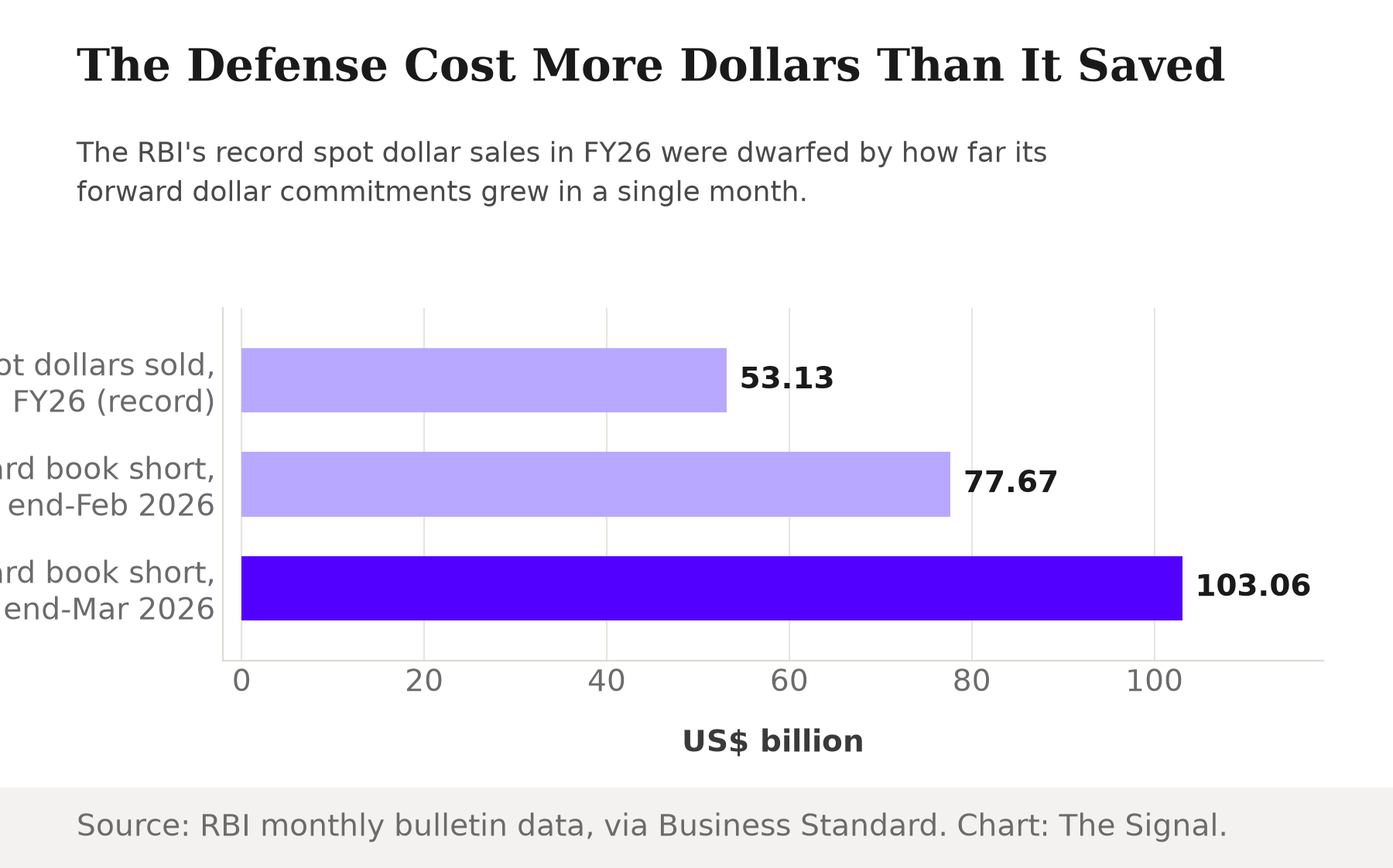
It is worth slowing down on that. To arrive at a record in August, the RBI first had to claw back from a sharp slide, and getting there was not free. In the fiscal year to March 2026 alone, the RBI net-sold a record $53.13 billion in the spot forex market, the largest such intervention in a single fiscal year on record. Over the same stretch, its forward dollar book, the commitments it owes counterparties later rather than dollars it holds today, swelled to a net-short $103.06 billion by end-March 2026, up from $77.67 billion just a month earlier.
The forward book grew by $25 billion in a single month while defending the rupee.
The "record reserves" line is a snapshot of a balance sheet that has been fighting hard, not simply accumulating.
The dip before the record
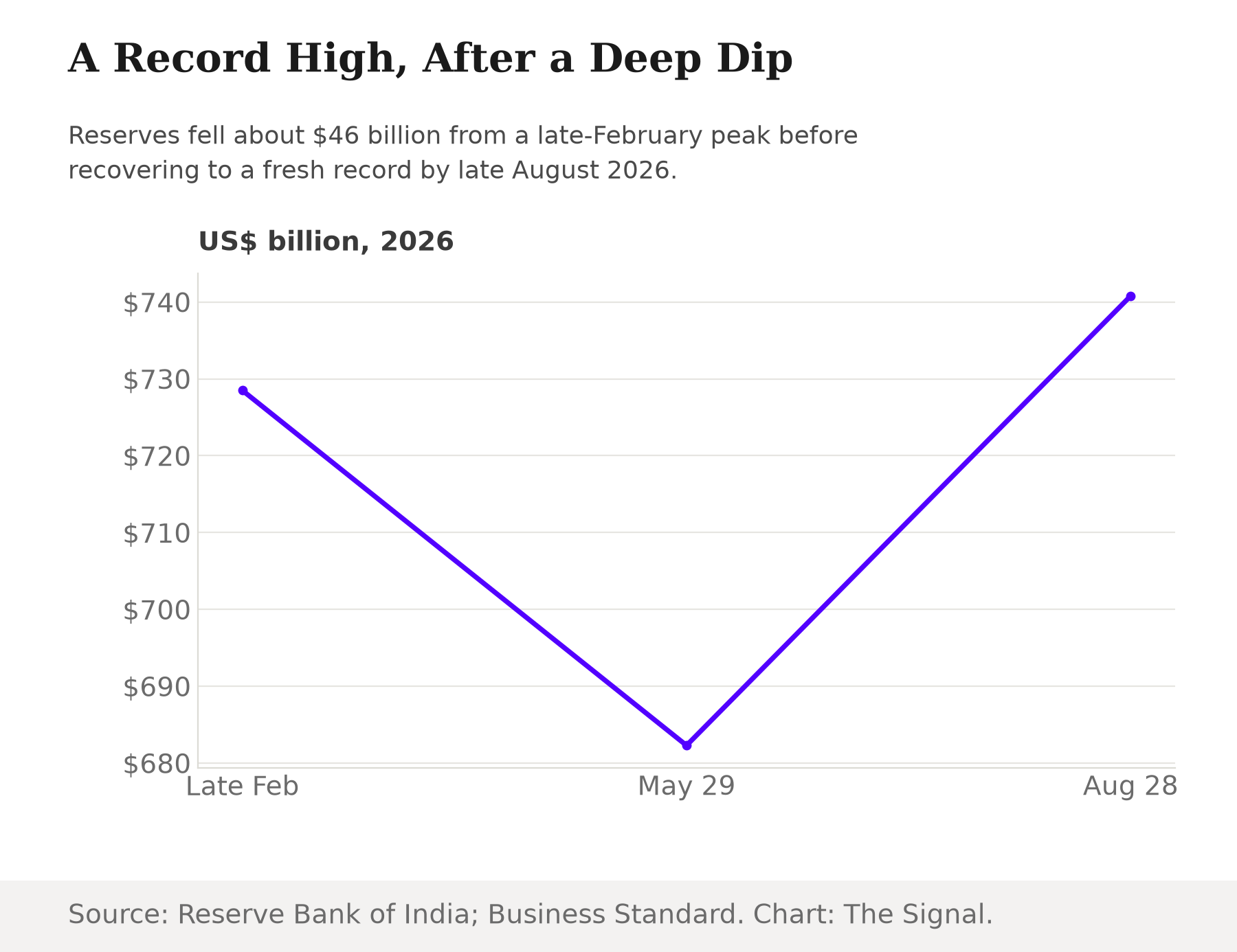
The road to $740.8 billion ran through a real trough first. Reserves had peaked near $728.494 billion in late February 2026 before the West Asia conflict pulled them down to $682.3 billion by May 29, 2026, Governor Sanjay Malhotra said, still calling the level "healthy" and adequate on standard metrics including about 11 months of import cover: a roughly $46 billion slide in three months. The same quarter shows up on the balance-of-payments side too: India's reserves depleted by $8.1 billion on a BoP basis in the April-June 2026 quarter, a sharp reversal from a $4.5 billion accretion in the same quarter a year earlier, as the current account deficit widened to $4.2 billion. Part of that quarter's damage was not even active spending. RBI's own accounting shows a $14.4 billion valuation loss in April-June 2026, mostly from a lower gold price and a stronger US dollar, against a $25.3 billion valuation gain in the same quarter a year earlier: a $39.7 billion swing driven by markets, not policy.
What the defense actually cost
Reserves do not refill themselves. Alongside the record spot dollar sales, the RBI reached for an extraordinary tool: its special swap facility for FCNR(B) deposits, external commercial borrowings and overseas foreign-currency borrowings had drawn $136,377 million in inflows on a provisional basis by August 31, 2026, a scheme built specifically to pull dollars back onto the RBI's books rather than wait for them to arrive on their own. Those dollars mostly sat there without moving the currency: the rupee was at 95.71 per dollar on June 8, 2026, when the swap scheme launched, and closed at that same 95.71 level on August 21, 2026, even with tens of billions of dollars already pulled in under the scheme by then. And even with the record spot sales and the swap facility running, the defense did not stop the currency from breaking: the rupee hit an all-time low of 99.82 per US dollar in March 2026 before partially recovering to around 94.4 by early September 2026.
Spot sales rose to a record. The forward book rose faster still.
Put the three defense numbers side by side and the picture sharpens: a record $53.13 billion sold outright in FY26, next to a forward book that alone grew $25.39 billion in the single month of March 2026 to reach $103.06 billion short, a bigger number than the entire year's spot selling.
Why the pressure hasn't let up
The reason the RBI keeps having to fight is sitting on the other side of the Pacific. The US Federal Reserve held the federal funds rate at 3.50 to 3.75 percent at its July 2026 meeting, its fifth consecutive hold, keeping US yields elevated relative to India and giving global capital less reason to sit in rupee assets. India's own central bank, meanwhile, has been easing the other way: the RBI's Monetary Policy Committee held the repo rate at 5.25 percent at its June 2026 review and projected FY2026-27 real GDP growth at 6.6 percent. A lower Indian policy rate next to a central bank in Washington still holding firm is exactly the setup that sends capital hunting for dollar yield instead of rupee yield, which is the pressure the RBI has been absorbing with its own reserves.
| Central bank | Policy rate | Set at | What it signals |
|---|---|---|---|
| Reserve Bank of India | 5.25% (repo rate) | June 5, 2026 review | Growth-supportive; FY2026-27 GDP growth projected at 6.6% |
| US Federal Reserve | 3.50-3.75% (federal funds rate) | July 29, 2026, fifth straight hold | Still restrictive; keeps US yields attractive against emerging markets |
Source: RBI Monetary Policy Statement, June 2026; Federal Reserve FOMC statement, July 29, 2026.
The honest objection
The strongest case against reading any of this as trouble is that spending reserves to defend a currency is exactly what reserves are for. Governor Malhotra himself called the $682.3 billion May level "healthy" and adequate by the standard tests of import cover and external debt, and a war chest that never gets drawn down is not proof of strength, it is proof it was never tested. On that view, the RBI absorbed a West Asia-driven shock, kept about 11 months of import cover intact throughout, and rebuilt to a fresh record within three months. That is a central bank doing its job, not one under strain.
That case holds up to a point, but it does not explain the shape of the rebuild, or what the pile is actually invested in. As of end-March 2026, $465.61 billion of RBI's $552.28 billion in foreign currency assets, 84.31 percent, sat in securities, with the rest split between deposits at other central banks and the BIS and deposits with overseas commercial banks: a conventional, defensively-positioned portfolio geared toward safety over return. Import cover and reserve levels describe what the RBI holds today. They say nothing about what it now owes tomorrow. A forward book that grew $25 billion in a single month is a claim on future dollars, not a buffer sitting in the vault, and the rupee still touched an all-time low during the very period the reserves were supposedly doing their protective job. A record headline number that arrived alongside a record spot-selling year and a ballooning forward commitment is not the same record it would have been without either.
The Signal
The $740.8 billion headline is real, and so is every dollar of the record spot sales, the swap-facility inflows and the forward book behind it. The question the headline alone cannot answer is what kind of reserve pile this now is: a buffer the RBI can spend again if the next shock arrives, or a number partly rebuilt on commitments it will have to unwind at a cost later. Watch the forward book, not the reserves line. If it keeps growing every time the rupee comes under pressure, the record on the cover page is not the record it looks like.
Reporting basis: the reserve levels and weekly variation are from the Reserve Bank of India's own Weekly Statistical Supplement; the valuation losses from its Sources of Variation in Foreign Exchange Reserves release; the balance-of-payments depletion from its Balance of Payments release for Q1:2026-27; and the swap-facility inflows from its own update on that facility. The Monetary Policy Committee's rate decision and growth projection are from the RBI's own Monetary Policy Statement. The Federal Reserve's rate decision is from the FOMC's own statement. The record spot dollar sales and the forward book figures are as reported by Business Standard, citing the RBI's monthly bulletin data, and Governor Malhotra's characterization of the May 2026 reserve level is also as reported by Business Standard. The rupee's all-time low and its subsequent level are from Trading Economics market data. The rupee's flat level across the swap scheme's opening months is as reported by Business Standard. The foreign-currency-asset composition figures are from the RBI's own Half-Yearly Report on Management of Foreign Exchange Reserves. The $46 billion peak-to-trough decline, the $39.7 billion valuation swing and the $25.39 billion one-month growth in the forward book are The Signal's calculations from those figures.