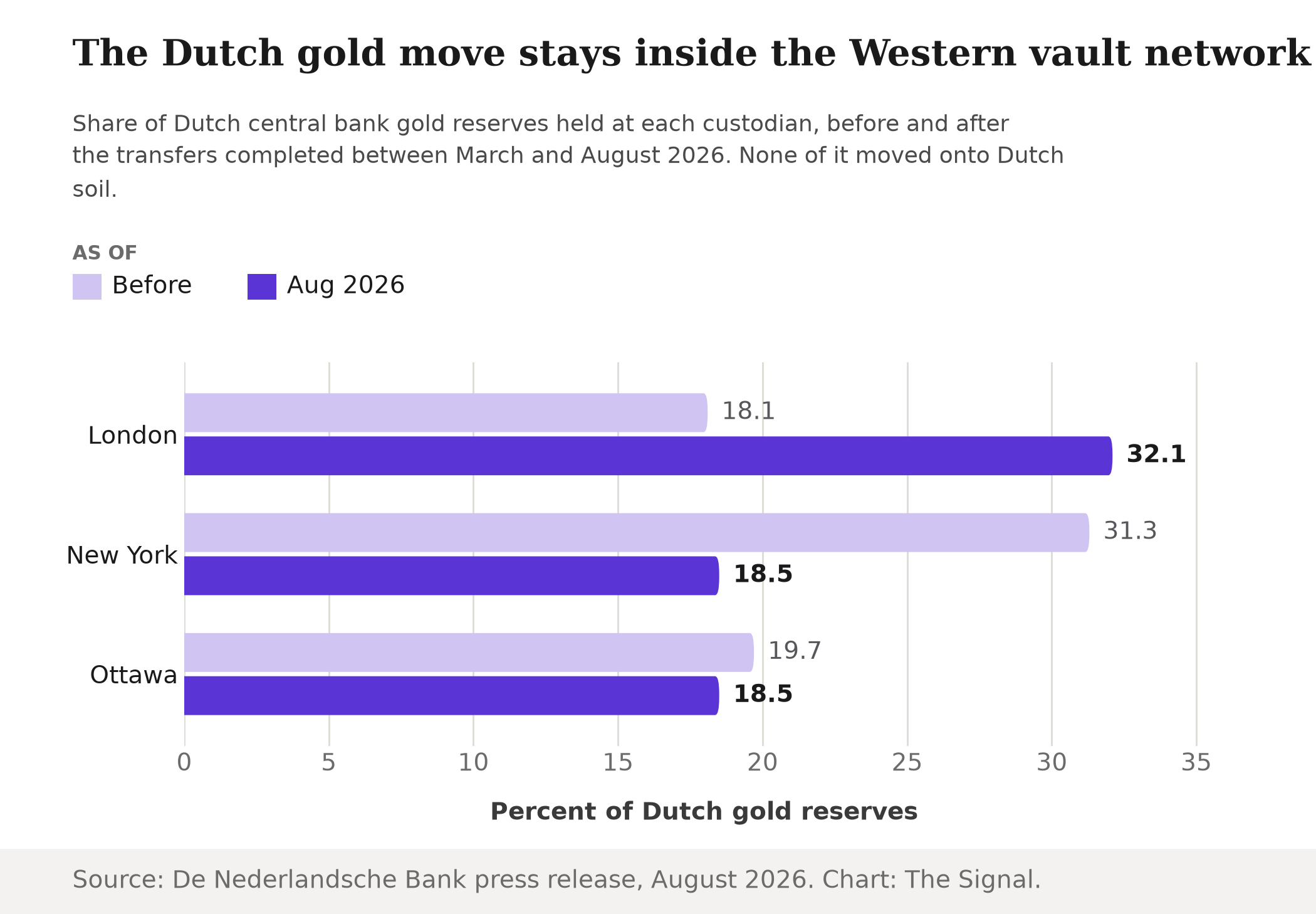
Between March and August this year, the Dutch central bank, De Nederlandsche Bank, moved about 86 tonnes of gold from vaults in New York and Ottawa to London. The bank's own explanation was blunt: "in view of increasing geopolitical unrest," it was "strengthening its crisis preparedness." London's share of the Netherlands' gold rose from 18.1% to 32.1% in the process, while New York's fell from 31.3% to 18.5% and Ottawa's from 19.7% to 18.5%. Read only the announcement, and the story looks obvious: after the West froze Russia's foreign reserves in 2022, its own central banks are finally rethinking where they keep their gold too.
It fits a pattern. The Banque de France ran a similar exercise between mid-2025 and January 2026: it sold older gold bars held at the Federal Reserve Bank of New York and repurchased an equivalent volume in Europe, realigning about 5% of its reserves and booking an exceptional EUR 11 billion currency gain for 2025. Its total holding, 2,437 tonnes, did not change. The bars simply moved to Paris.
It is worth slowing down on what these moves actually did. Not one gram of Dutch gold went to Amsterdam. DNB's transfer swapped custodians inside the same circle of Western allies, New York and Ottawa handing weight to London, and left the metal exactly as reachable by a coordinated Western order as it was before. The Banque de France's shift did land on French soil, but the bank itself described it as aligning bars with "technical guidelines," not as a hedge against seizure. Measured by where the gold actually sits rather than by the press release, Europe's 2025-2026 "rethink" is smaller than it sounds.
India already went further, years before either announcement.
As of the end of March 2026, the Reserve Bank of India held 880.52 tonnes of gold, worth roughly $115 billion and equal to about 16.70% of its $691.11 billion in total foreign exchange reserves that same month. Of that gold, 680.05 tonnes, 77% of the total, sat in domestic vaults; only 197.67 tonnes remained abroad in safe custody with the Bank of England and the Bank for International Settlements. In September 2022, before that repatriation drive gathered pace, just 296.48 of 785.35 tonnes, about 38%, were held at home, with 447.30 tonnes still overseas. The domestic share roughly doubled, from about 38% to 77%, in three and a half years, as RBI moved roughly 384 tonnes of gold onto Indian soil.
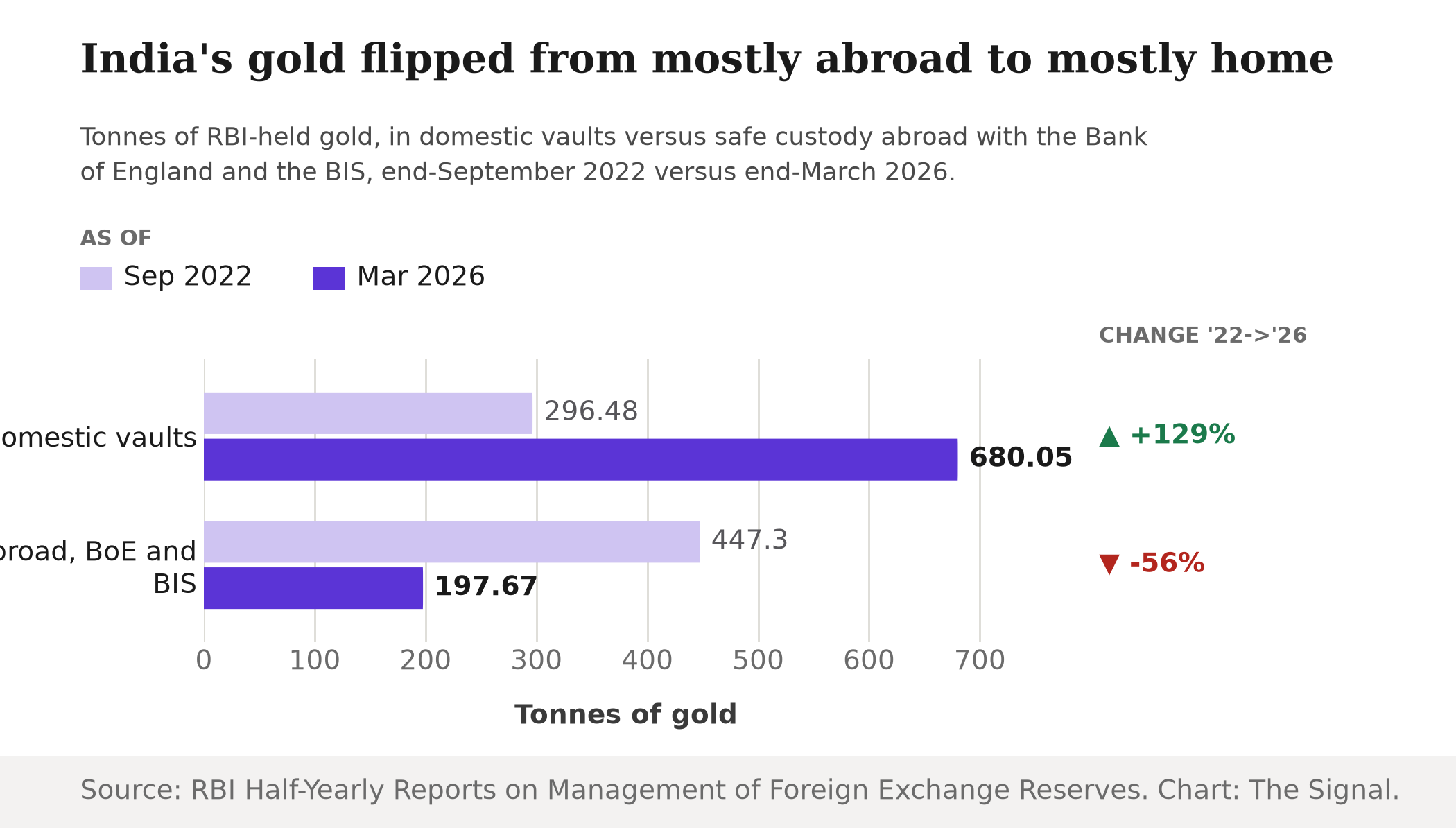
Where each move actually went
Lay the four best-known central-bank gold moves of the last decade side by side and the difference stops being subtle.
Three European moves rotate custody among Western allies. Only India's leaves that circuit.
| Central bank | What moved | When | Where it ended up |
|---|---|---|---|
| De Nederlandsche Bank (Netherlands) | About 86 tonnes | March-August 2026 | New York and Ottawa to London; still with Western allies |
| Banque de France | About 5% of 2,437 tonnes, bars sold and repurchased | Mid-2025 to January 2026 | New York Fed to Paris; bank calls it a technical realignment |
| Bundesbank (Germany) | 674 tonnes | Completed 2017, three years early | Paris and New York to Frankfurt; large share still with the Fed and Bank of England |
| Reserve Bank of India | About 384 tonnes; domestic share rose from 38% to 77% | September 2022 to March 2026 | Onto Indian soil, out of the Western custodial system |
Sources: De Nederlandsche Bank; Banque de France; Bundesbank; RBI, March 2026 and RBI, September 2022.
Germany's Bundesbank ran the highest-profile European repatriation of the last decade, finishing in 2017, three years ahead of its own 2020 target: it moved 674 tonnes from Paris and New York to Frankfurt and eliminated German gold storage in Paris entirely. Even that ambitious move left a large share of German gold sitting with the Federal Reserve in New York and the Bank of England in London. Whatever each bank calls its own reasoning (geopolitical unrest, a technical bar standard, an anniversary target), the pattern holds across three separate European moves spanning nine years: custody rotates among Washington, Ottawa, London, Frankfurt and Paris, and rarely leaves that circuit.
What sits behind the reconsideration
Western governments have frozen at least $280 billion of Russia's central bank reserves since 2022, the G7, EU and Australia's own joint estimate as of a June 2025 analysis, with Russia's central bank and other experts putting the true figure as high as $300 billion to $330 billion. That is the backdrop every reserve manager in Europe has been working against since 2022, whatever any single bank's press release chooses to say about its own motives.
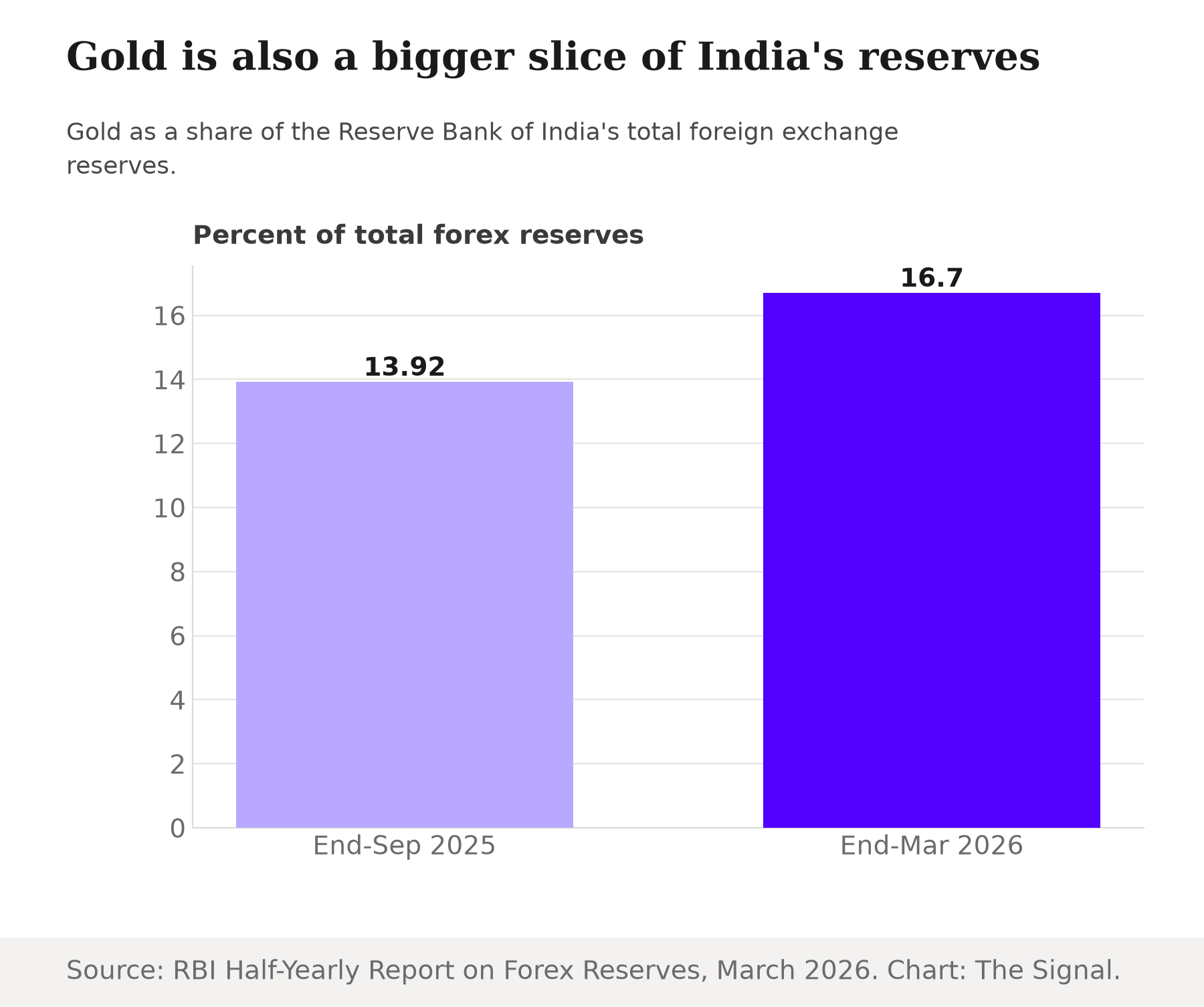
Central bank gold buying stayed historically elevated through 2025, even as the pace cooled from the record run of the prior three years: year-to-date net purchases through October 2025 totalled 254 tonnes, with the National Bank of Poland the largest single buyer at 83 tonnes. The World Gold Council's 2026 survey of central banks found a matching split in stated motive: 85% of emerging-market and developing-economy respondents, a group that includes India, rated gold's role as a geopolitical risk hedge as relevant to their reserve decisions, against 56% of advanced-economy respondents, the group Europe's central banks sit in. Gold's own weight inside India's reserves has been rising too. The share of gold in the RBI's total foreign exchange reserves rose from 13.92% at the end of September 2025 to about 16.70% at the end of March 2026, a further sign that gold, and where it physically sits, has become a bigger part of the reserve conversation everywhere, not just in India.
The honest objection
The strongest case against reading a sanctions-hedging story into any of this is that the central banks involved never said that is what they were doing. DNB's own language was about "improving the liquidity and tradability" of its reserves, not fear of seizure. The Banque de France's language was a technical bar-standard realignment that happened to produce a currency gain, not a security measure. On that view, 2025-2026 was a routine operational year for two large, unremarkable reserve managers, and finding a geopolitical thesis in balance-sheet housekeeping says more about the observer than the data.
That case deserves to be taken at face value. But it does not change where the metal sits when the paperwork is done. Gold that stays inside the New York, Ottawa, London and Paris circuit remains reachable by the kind of coordinated freeze that hit Russia's reserves; gold that sits inside India's own vaults is not. Individual technical explanations can all be true, and the aggregate pattern, reserves tilting toward assets a single coordinated order cannot reach, can still be real. RBI has never framed its own repatriation as a hedge against a Western freeze either; its own half-yearly filings describe it only as reserve management. The revealed preference is what is left after the words are set aside: what a central bank actually does with the location of its gold, not what it says about why.
The Signal
Two things are happening at once, and they are not the same thing. Europe's central banks spent 2025 and 2026 optimising custody inside a system built on trusting Washington and London. India converted that trust into geography instead, years before Europe's reshuffle began. If a future freeze ever reached beyond Russia, the DNB and Banque de France moves would not protect a single bar of the gold involved. RBI's would. Watch whether Europe's next move actually crosses that line, gold landing on Dutch or French soil instead of swapping desks in New York, because that is the difference between managing a portfolio and hedging a system. Until then, Europe is rearranging the furniture in someone else's house, and India has already moved out.
Reporting basis: the Dutch central bank's transfer and custodian percentages are per De Nederlandsche Bank's own press release. The Banque de France's bar realignment and 2025 currency gain are per the Banque de France's press release. The Bundesbank's 2017 repatriation is per the Bundesbank's own press release. The Reserve Bank of India's domestic and overseas gold holdings, for both March 2026 and September 2022, and the gold share of its total foreign exchange reserves, are per RBI's own half-yearly filings on the management of its foreign exchange reserves. The Russian reserve-freeze figure is from a Brookings Institution analysis citing the REPO Task Force and Russia's own central bank. Central bank gold-buying volumes, including Poland's, are from World Gold Council data. The emerging-market/advanced-economy split on gold as a geopolitical risk hedge is from the World Gold Council's Central Bank Gold Reserves Survey 2026. India's domestic gold share in September 2022, the tonnes of gold moved home since then, the doubling of that domestic share, and the dollar value of RBI's March 2026 gold holding, are The Signal's calculations from those same RBI filings.