On September 2, 2026, the Japan Credit Rating Agency upgraded India's long-term foreign- and local-currency issuer ratings to A- from BBB+, with a stable outlook, and raised the country ceiling to A. That is a rating that sits comfortably inside investment grade, from an agency that rates sovereigns independently rather than as a courtesy. The easy read is straightforward: India's growth and reform story has finally been vindicated by a credit rater, and the rest of the market will catch up.
It is worth slowing down on that. JCR is not one of the three agencies whose grades actually decide how cheaply India borrows abroad and whether its bonds sit inside the world's big global bond indices: S&P Global Ratings, Fitch Ratings and Moody's Ratings. None of the three has matched JCR's move. And the bond market itself did not treat the upgrade as good news either. On the same day JCR announced it, India's 10-year government bond yield rose to around 6.98%, extending a fourth straight session of gains. A rating upgrade is supposed to lower the risk premium investors demand, which pushes yields down. India's yields did the opposite, for the fourth day running.
India's bond market gave the upgrade a shrug, not a rally.
That gap between one agency's grade and everyone else's is the story. It is not that JCR is wrong. It is that the agencies and the market that actually price India's debt are revealing, through what they do rather than what anyone says, that they are not yet convinced.
The agencies do not agree
Line up the four ratings side by side and the picture is a lot less tidy than "India got upgraded."
None of the big three gatekeepers rates India as high as JCR just did.
| Agency | Current rating | Outlook | Latest action |
|---|---|---|---|
| Japan Credit Rating Agency (JCR) | A- | Stable | Upgraded, September 2, 2026 |
| S&P Global Ratings | BBB | Stable | Affirmed, August 27, 2026 |
| Fitch Ratings | BBB- | Stable | Affirmed, August 11, 2026 |
| Moody's Ratings | Baa3 | Stable | Affirmed, September 30, 2025 |
Source: JCR; S&P via ThePrint; Fitch via ThePrint; Moody's via Prasar Bharati's Akashvani News.
S&P Global Ratings did move once this cycle, upgrading India to BBB from BBB- with a stable outlook on August 14, 2025. But that was over a year ago, and its most recent review, on August 27, 2026, was an affirmation, not a second upgrade. Fitch affirmed at BBB- on August 11, 2026, and Moody's has not reviewed India at all since affirming Baa3 on September 30, 2025. JCR is the only one of the four to move in the past year, and it moved further than any of the others have moved in the past five years.
What JCR's own case still flags
JCR's rationale is not a blank cheque either. The agency's own rating report notes that the central government cut its fiscal deficit from 4.7% of GDP in FY2025 to 4.4% in FY2026, while central government debt stood at 56.1% of GDP at the end of FY2026. That is real progress, and it is the number JCR pointed to.
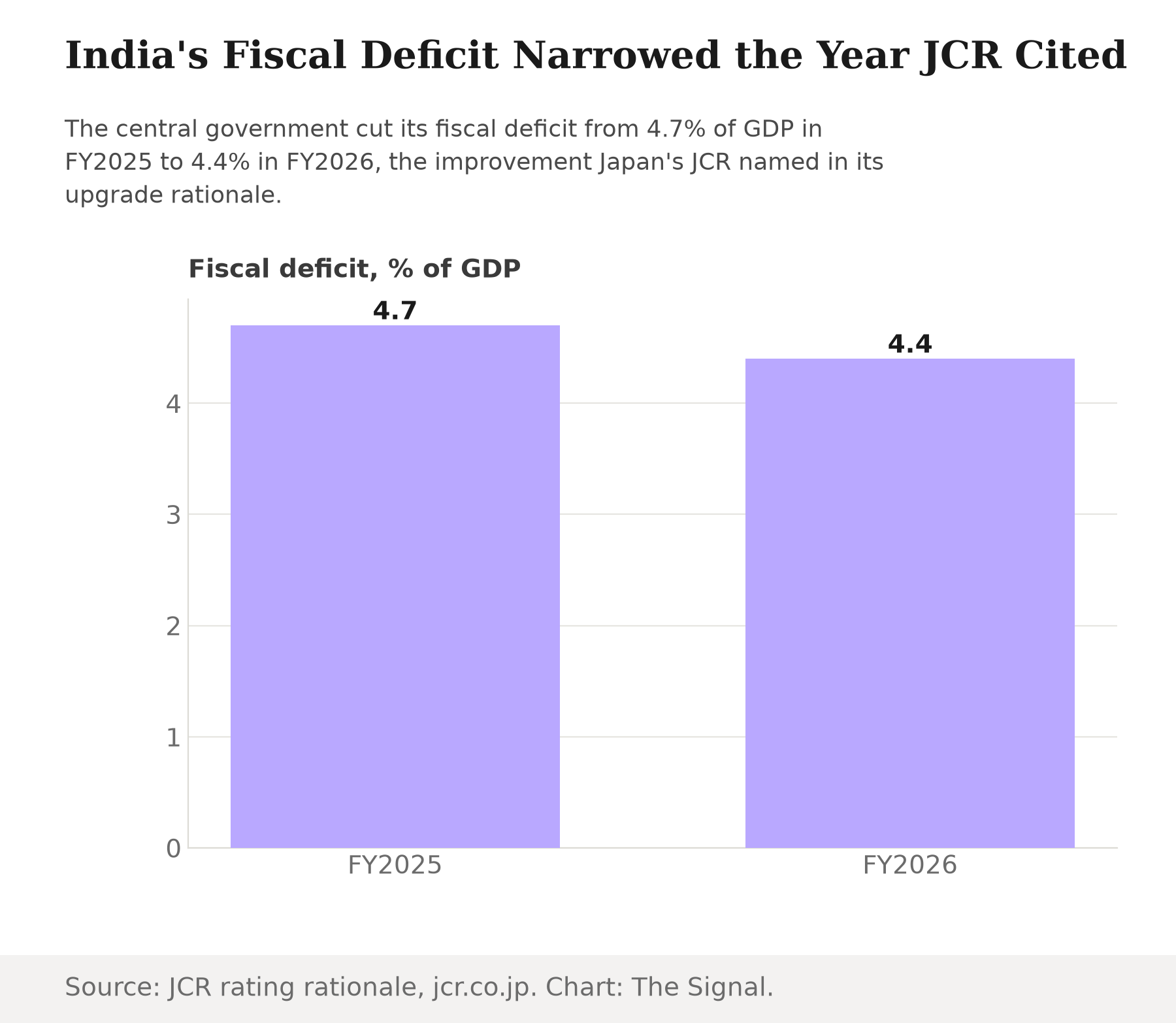
Source: JCR's rating rationale. Chart: The Signal.
JCR's own report adds a caveat in the same breath: general government debt, including the states, and the associated interest burden remain high. Fitch, in withholding its own upgrade, points at exactly that broader number. Fitch's affirmation cites high fiscal deficits, debt and debt service compared with peers as continuing credit weaknesses, and notes that the FY27 Union Budget targets a debt-to-GDP ratio of just 55.6%, against 56.1% in FY26.
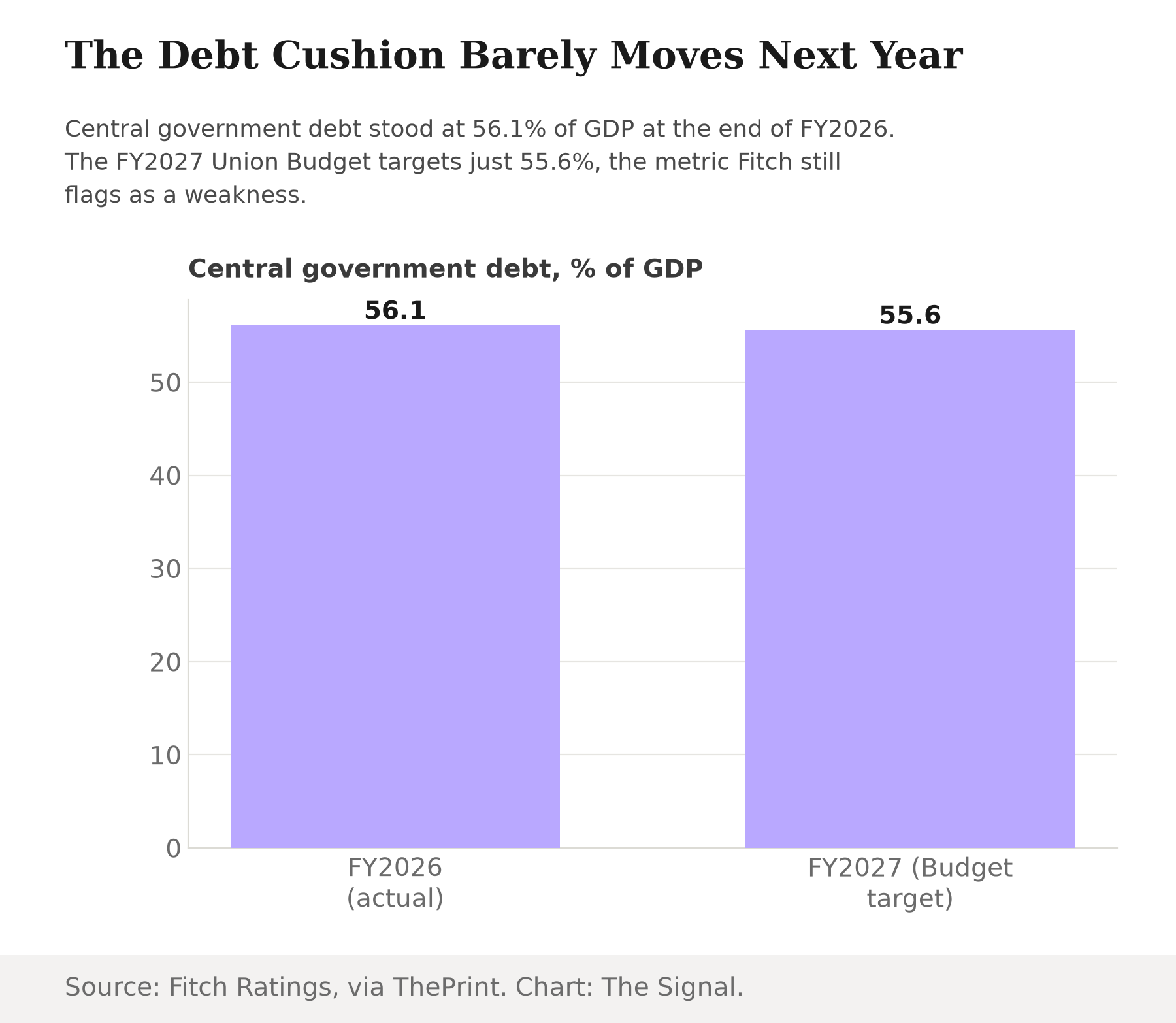
Source: JCR's rating rationale; Fitch Ratings, via ThePrint. Chart: The Signal.
Half a percentage point of planned improvement in a year is not the kind of move that changes an agency's read. That is the specific number to watch: not the fiscal deficit JCR already credited India for narrowing, but the slower-moving debt and interest-burden figure that both JCR and Fitch flagged as the unresolved part of the case.
The growth and banking case for optimism
The counterweight is real. India's real GDP grew 7.7% in FY2025-26, up from 7.1% in FY2024-25, per the government's provisional estimates, growth that accelerated in the same stretch the deficit narrowed.
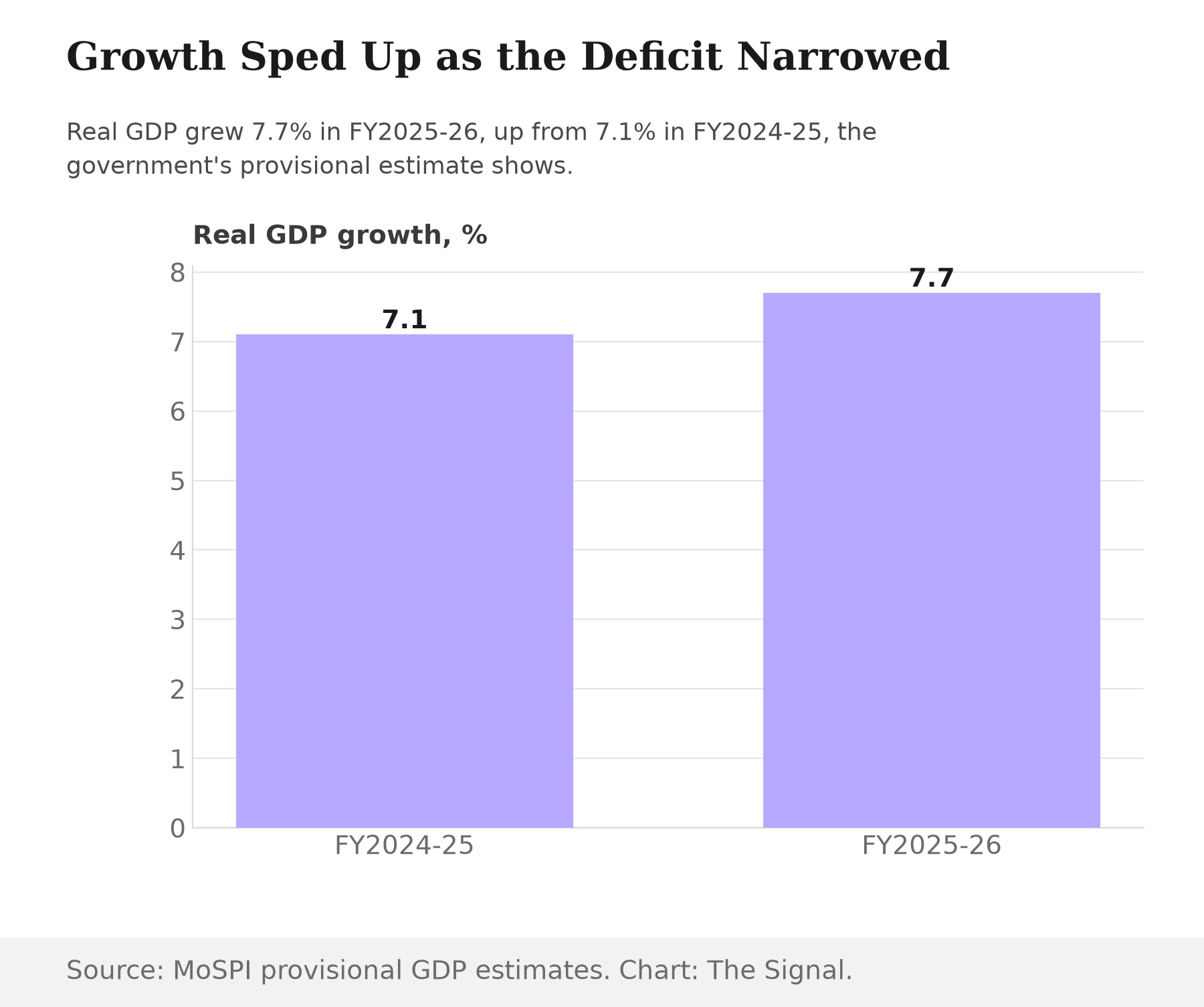
Source: MoSPI's provisional GDP estimates. Chart: The Signal.
The banking system backs that up. Gross non-performing assets at India's scheduled commercial banks fell to a multi-decadal low of 2.3% as of March 2025, the cleanest bank balance sheets the country has had in decades. Faster growth and a healthier banking system are exactly the kind of evidence that eventually moves a sovereign rating. They are also what JCR cited alongside the fiscal numbers in reaching A-.
The honest objection
The strongest case against reading this as a gap is that the big three are not frozen. They are sequenced. S&P has already validated part of the improvement once, with its August 2025 upgrade. JCR's larger move a year later could simply be an early read on where S&P and Fitch are headed next, arriving first because JCR reviews sovereigns on a different clock than the big three do.
That case would be more convincing if the big three's trajectory were still pointed the same direction JCR's is. It is not, at least not right now. S&P's most recent review, seven months after its upgrade, was only an affirmation, and it came attached to a weaker near-term call: S&P affirmed India at BBB on August 27, 2026, projecting growth would ease to 6.6% amid an energy shock and weak agricultural conditions, a caution note, not a momentum signal. Fitch's affirmation three weeks earlier read the same way. The path that briefly looked aligned (JCR and S&P both moving up within the same year) split again well before JCR's September upgrade. The big three stalled roughly where they were a year ago while JCR kept climbing on its own.
The Signal
A rating that only one of four agencies has given is not a verdict on India's credit. It is a forecast that three other graders and a bond market have not yet signed onto. The metric that would change that is the slower, broader number both JCR and Fitch flagged in the same breath as their good news, general government debt and its interest burden, the figure the FY27 Budget only nudges from 56.1% to 55.6%, rather than the fiscal deficit that JCR already credited India for narrowing to 4.4% of GDP. Watch what the FY28 Budget targets on that line, and watch whether S&P or Fitch's next review is an upgrade or another affirmation. Until one of the big three moves, or India's own bond yields start falling on rating news instead of rising through it, JCR's A- is a minority opinion, not a consensus.
Reporting basis: JCR's rating action and its accompanying rationale are from the agency's own rating list and rating report. S&P's August 2025 upgrade and Moody's September 2025 affirmation are as reported by Prasar Bharati's Akashvani News, both citing the agencies directly; S&P's August 2026 affirmation and Fitch's August 2026 affirmation are as reported by ThePrint, also citing the agencies directly. India's real GDP growth figures are from the Ministry of Statistics and Programme Implementation's provisional estimates. The gross non-performing assets figure is from Akashvani News, citing Reserve Bank of India data. The bond yield figure is from Trading Economics. The characterization of the debt-to-GDP trajectory as a half-percentage-point move is The Signal's reading of the JCR and Fitch figures cited above.