On August 12, 2026, SEBI Chairman Tuhin Kanta Pandey said India's markets regulator had not observed any manipulation in the newly introduced closing auction session that determines closing price levels, and that mutual fund participation in the mechanism had climbed from roughly 5 to 6 percent on its first trading day to roughly 20 to 25 percent since. Read at face value, that is a regulator watching a new market structure settle in exactly as designed: a young mechanism, gaining institutional trust, with no manipulation to speak of.
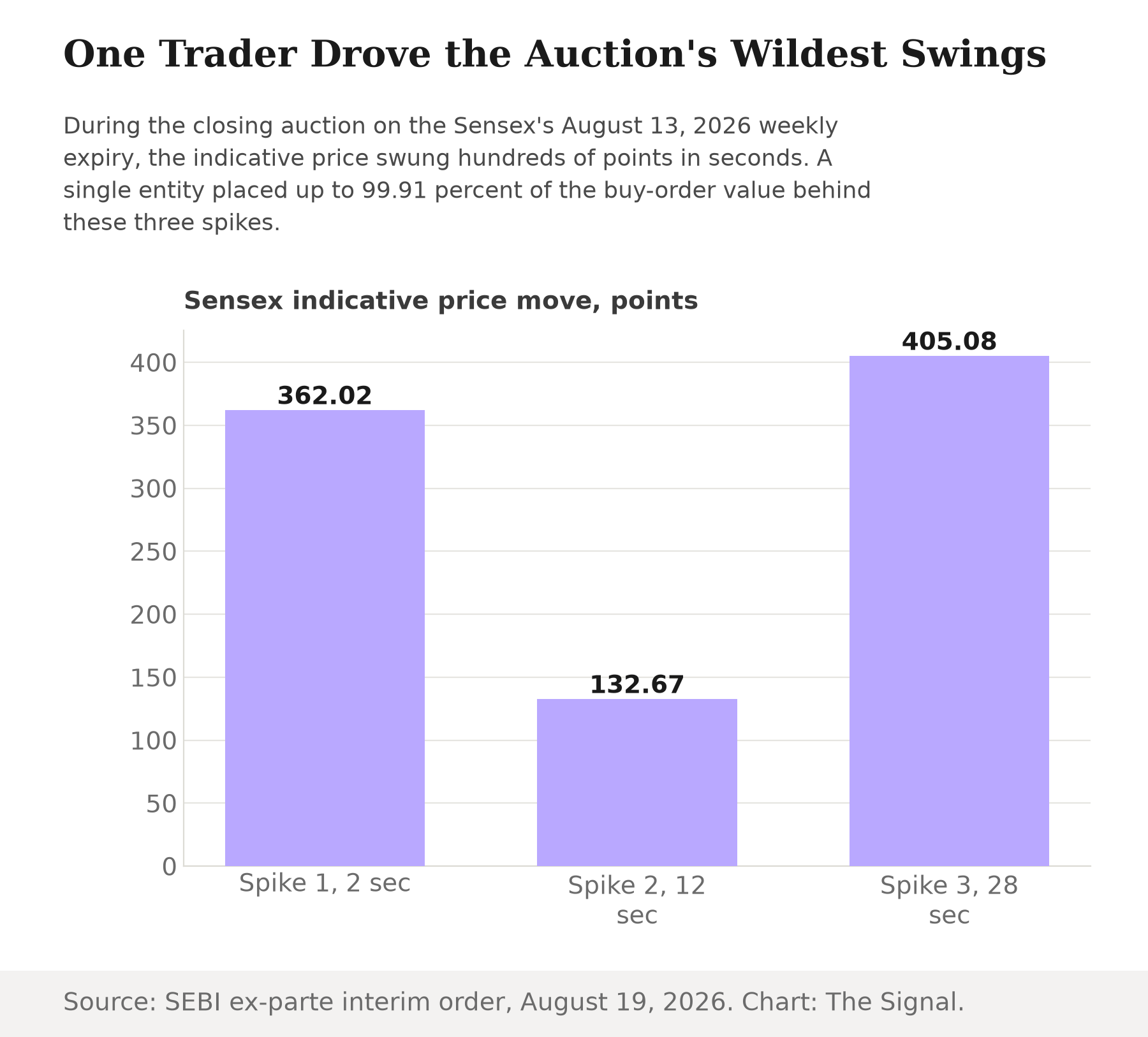
It is worth slowing down on that. One day after Pandey spoke, on the Sensex's August 13, 2026 weekly options-expiry session, the auction's indicative price spiked 362.02 points in two seconds, then 132.67 points in twelve seconds, then 405.08 points in twenty-eight seconds. SEBI's own ex-parte interim order, issued August 19, 2026, found that a single entity, Copthall Mauritius Investment Limited, had placed 99.91 percent, 96.09 percent and 85.21 percent of the buy-order value behind those three spikes. The regulator impounded Rs 3.68 crore combined from Copthall and Mansi Share and Stock Broking and barred both from the securities market and from the auction "until further orders."
SEBI found one entity behind up to 99.91 percent of the buy-order value in the worst of those three spikes, its order shows.
That is the mechanism built to stop manipulation catching manipulation inside itself, nine days into its life. SEBI can clearly catch bad actors. The real question is why a fix for closing-price manipulation is producing swings this large.
A short window with a gap built into it
The Closing Auction Session, or CAS, exists to solve a specific problem: India's cash-market closing price used to be computed from the last few minutes of continuous trading, which left it exposed to last-second nudging. CAS replaces that with a call auction, and SEBI's January 2026 circular introducing it states that the equity derivatives segment shall continue to operate up to 3:40 p.m. on all trading days, even though the auction fixes the cash-market closing price by 3:30 to 3:35 p.m. through a twenty-minute window. That gap is deliberate: the derivatives market, where expiry-day options settle against the cash close, keeps trading for minutes after that number is already locked in.
SEBI was not blind to the manipulation risk in the auction's design. Its August 2025 consultation paper on CAS states that a lower time window for computing the reference price would keep it closer to the last traded price "while mitigating the potential for price manipulation," and the regulator cut that window from a proposed 30 minutes to 15 minutes before CAS ever launched, anticipating exactly the kind of gaming that hit the Sensex on August 13. Shortening the reference window and closing the cash-derivatives gap were two different fixes, and only one shipped before launch.
The volatility started on day one
CAS was not quiet before the enforcement order, either. Its very first session, on Monday, August 3, 2026, produced a sharp divergence between the 3:15 p.m. pre-auction price and the auction-discovered closing price, pushing the Nifty higher at the close; NSE publicly explained the gap as the auction's separate order book, not a sudden jump. The explanation held for exactly one more day. On August 4, 2026, the Nifty and Sensex diverged for a second consecutive session, and CAS turnover was overwhelmingly concentrated on one exchange: the NSE accounted for Rs 1,542.4 crore, or 99.4 percent, of total CAS turnover, while the BSE recorded just Rs 9.4 crore, or 0.6 percent.
Almost all of the new auction's money sits on a single exchange.
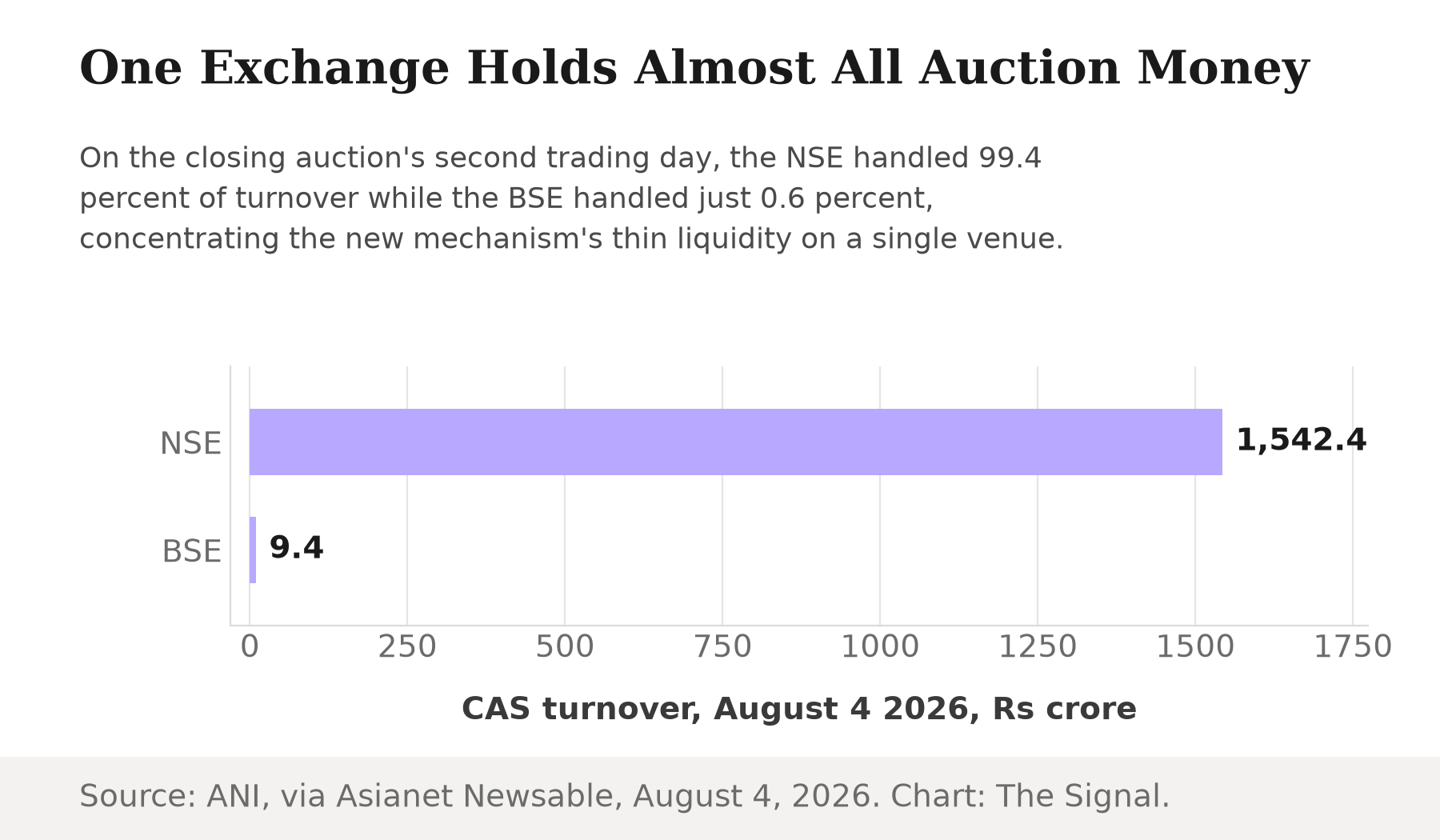
A twenty-minute call auction is only as stable as the liquidity inside it, and in CAS's first days that liquidity ran almost entirely through one venue. Thin liquidity concentrated into a short window is exactly the condition in which a handful of large orders can move the reference price.
What SEBI's order actually found
The enforcement order that landed August 19, 2026 is the clearest evidence that the design gap is not theoretical: SEBI's surveillance flagged the three spikes above as coming disproportionately from Copthall's orders, and the regulator barred both Copthall and its broker, Mansi Share and Stock Broking, from the market. That is a functioning enforcement arm, and proof that one well-capitalised participant could put the Sensex's official closing level within reach of a handful of orders placed in a multi-second window, on the very mechanism sold as the fix for that kind of manipulation.
The swings did not stop after the enforcement order
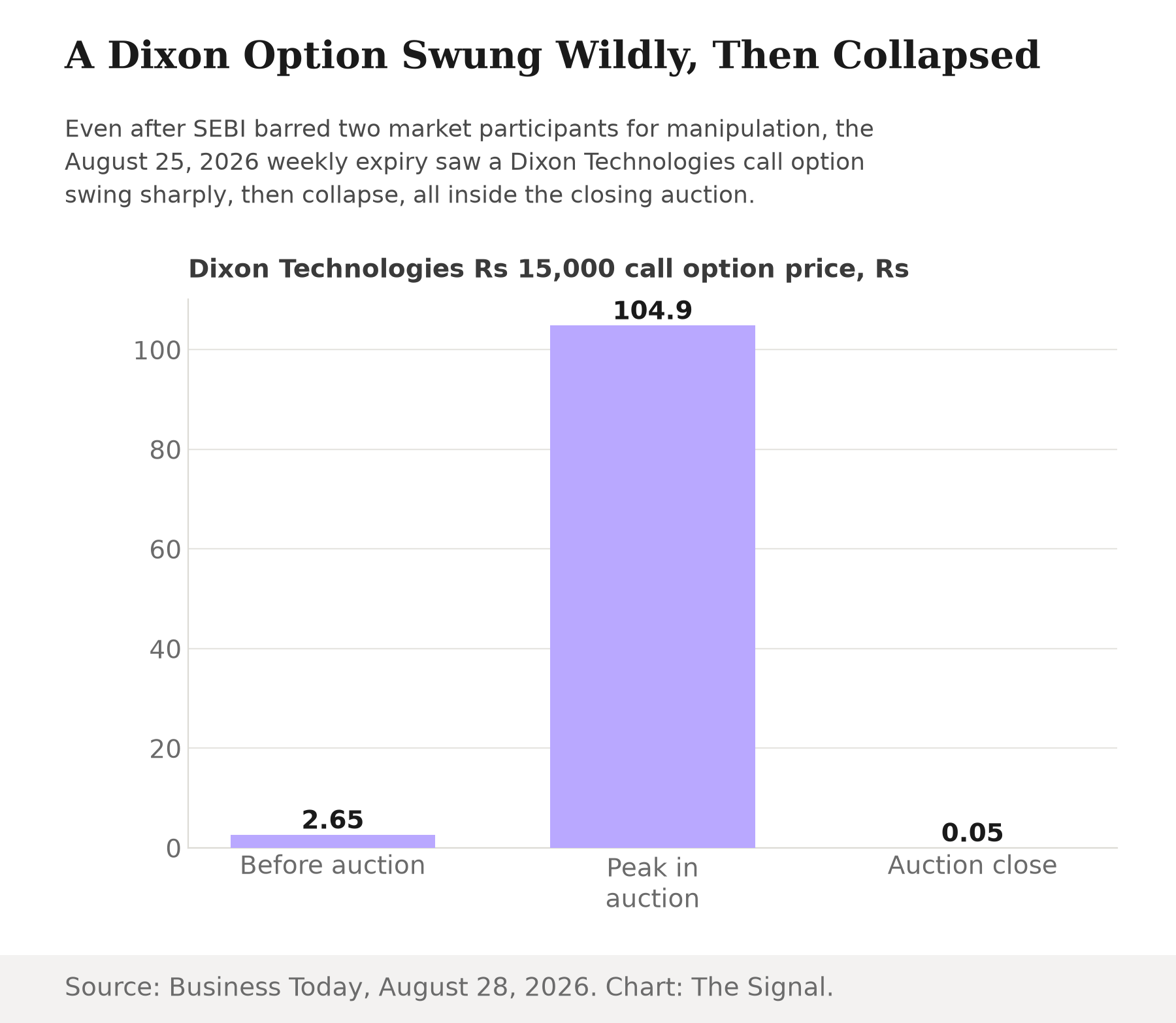
If the August 19 order had closed the loophole, the story would end there. It has not. On the August 25, 2026 weekly expiry, Dixon Technologies' 15,000-strike call option moved from Rs 2.65 to Rs 104.90, before closing at Rs 0.05 inside the auction, a nearly 40-fold spike followed by a near-total collapse, all inside a twenty-minute window. Two days later, on the August 27, 2026 monthly derivatives expiry, the BSE Sensex moved over 2,000 points within minutes during CAS.
A single option went from a few rupees to over a hundred, then to near zero, inside one auction.
An enforcement order bars two named parties. It does not change the twenty-minute window, the cash-derivatives timing gap, or the concentration of liquidity on one exchange that made the August 13 spikes possible. Punishing the trader behind one episode is not the same as fixing the mechanism that made it possible.
| Date, 2026 | What happened | Source |
|---|---|---|
| August 3 | CAS's first session; pre-auction and closing prices diverge sharply | Business Standard |
| August 4 | Second divergence; NSE handles 99.4% of CAS turnover, BSE 0.6% | Asianet Newsable, via ANI |
| August 12 | SEBI chairman says no manipulation observed; MF participation up to 20-25% | Business Standard, via Reuters |
| August 13 | Sensex IEP spikes up to 405.08 points in seconds on weekly expiry | SEBI ex-parte order |
| August 19 | SEBI bars Copthall and Mansi Share and Stock Broking, impounds Rs 3.68 crore | SEBI ex-parte order |
| August 25 | Dixon Technologies option swings from Rs 2.65 to Rs 104.90 to Rs 0.05 | Business Today |
| August 27 | Sensex moves over 2,000 points within minutes on monthly expiry | Business Today |
Source: SEBI filings and orders; Business Standard; Asianet Newsable; Business Today.
The honest objection
The strongest case for patience is that CAS is genuinely new and still finding its liquidity. Mutual fund participation in the auction rose from roughly 5 to 6 percent on its first day to roughly 20 to 25 percent by August 12, 2026, a real, fast increase in exactly the large, price-insensitive institutional flow that deepens a call auction. The early data backs that story: the Nifty's price movement inside the auction window fell from 82.4 basis points on CAS's first day to 5.5 basis points by that Friday, a roughly 15-fold calming in under a week. On that view, the August 13 spikes are what a thin, early-stage auction looks like before liquidity fully arrives, not evidence the design is broken, and the BSE's near-total absence from turnover is adoption lag, not a permanent flaw.
That case would be stronger if the swings had stopped once liquidity visibly grew. They have not: the window's volatility had already calmed to 5.5 basis points by August 7, weeks before the August 13 spikes, the Dixon Technologies option swing and the 2,000-point Sensex move. Each of those came after mutual funds had already scaled up their participation and after SEBI had already made an example of the one entity it caught. A deepening pool of mutual fund orders can crowd out a single manipulator. It does nothing about the structural gap between the cash close and the derivatives close that SEBI's own circular sets, or about a reference window SEBI itself judged wide enough to invite manipulation before cutting it.
The Signal
CAS was built to answer one question, whether a short call auction prices the close more honestly than the last few minutes of continuous trading it replaced. Nine days after launch, SEBI caught a single trader supplying nearly all the buy-side pressure behind swings of hundreds of points in seconds, and even after barring that trader, the auction kept producing swings large enough to move an options price 40-fold and the Sensex by thousands of points in minutes. Rising mutual fund participation is the case that this settles with time. A structural gap between the cash close and the derivatives close, and a reference window SEBI itself once judged wide enough to game, are the case that it will not settle on its own. Asked directly about the renewed divergence on August 27, 2026, Pandey said SEBI is "not seeing any changes right now," and that "the system is running as it is." That is the timing gap SEBI's own circular built in, and the regulator has now said, on the record, it is leaving it exactly as it is. A mechanism built to stop manipulation that still needs a chairman's reassurance nine days after an enforcement order, and that its own regulator has decided not to redesign three weeks after that, has not yet done the one thing it was built to do.
Reporting basis: the design and timing of the Closing Auction Session is per SEBI's January 2026 circular; the reference-window change is per SEBI's August 2025 consultation paper. The Copthall and Mansi Share and Stock Broking enforcement details, including the spike magnitudes, order percentages and impounded amount, are per SEBI's August 19, 2026 ex-parte interim order. Chairman Tuhin Kanta Pandey's comments and the mutual fund participation figures are as reported by Reuters via Business Standard. The August 3 and August 4 divergence and turnover figures are per Business Standard and per Asianet Newsable's reporting of ANI figures, respectively. The August 25 and August 27 swings rest solely on Business Today's account, with no corroborating outlet in the matrix. The nearly 40-fold move in the Dixon Technologies option is The Signal's calculation from the figures Business Today reported. Early auction-window volatility narrowing is per Business Standard's August 7, 2026 reporting; Chairman Pandey's August 27, 2026 comment that CAS is not being redesigned is per Asianet Newsable's reporting of ANI's wire coverage.