On August 28, 2026, SEBI issued its observation letter clearing Jio Platforms' initial public offering, the final regulatory step before what is set to be India's biggest listing yet. The draft prospectus, filed June 19, 2026, comprises a fresh issue of up to 270 million equity shares, with no promoter or existing investor selling a single held share into it. At filing, the offering was targeting a raise of about Rs 37,700 crore, valuing the business at nearly Rs 9.5 trillion, or roughly Rs 9.5 lakh crore. That is the headline every outlet will run this week: after six years as India's biggest unlisted growth story, Jio Platforms is about to become India's biggest ever public offering too.
It is worth slowing down on that framing. The size of the raise is not actually the interesting number here. What matters more is what that Rs 9.5 lakh crore price tag means for the investors who bought into Jio Platforms back in 2020, when there was no IPO in sight and no guarantee there ever would be one. Facebook, Google and twelve other investors together bought a combined 32.97 percent of the company in 2020. Six years on, at the price the draft prospectus is asking, it is worth asking what that markup is actually worth against a simpler alternative: buying the market instead.
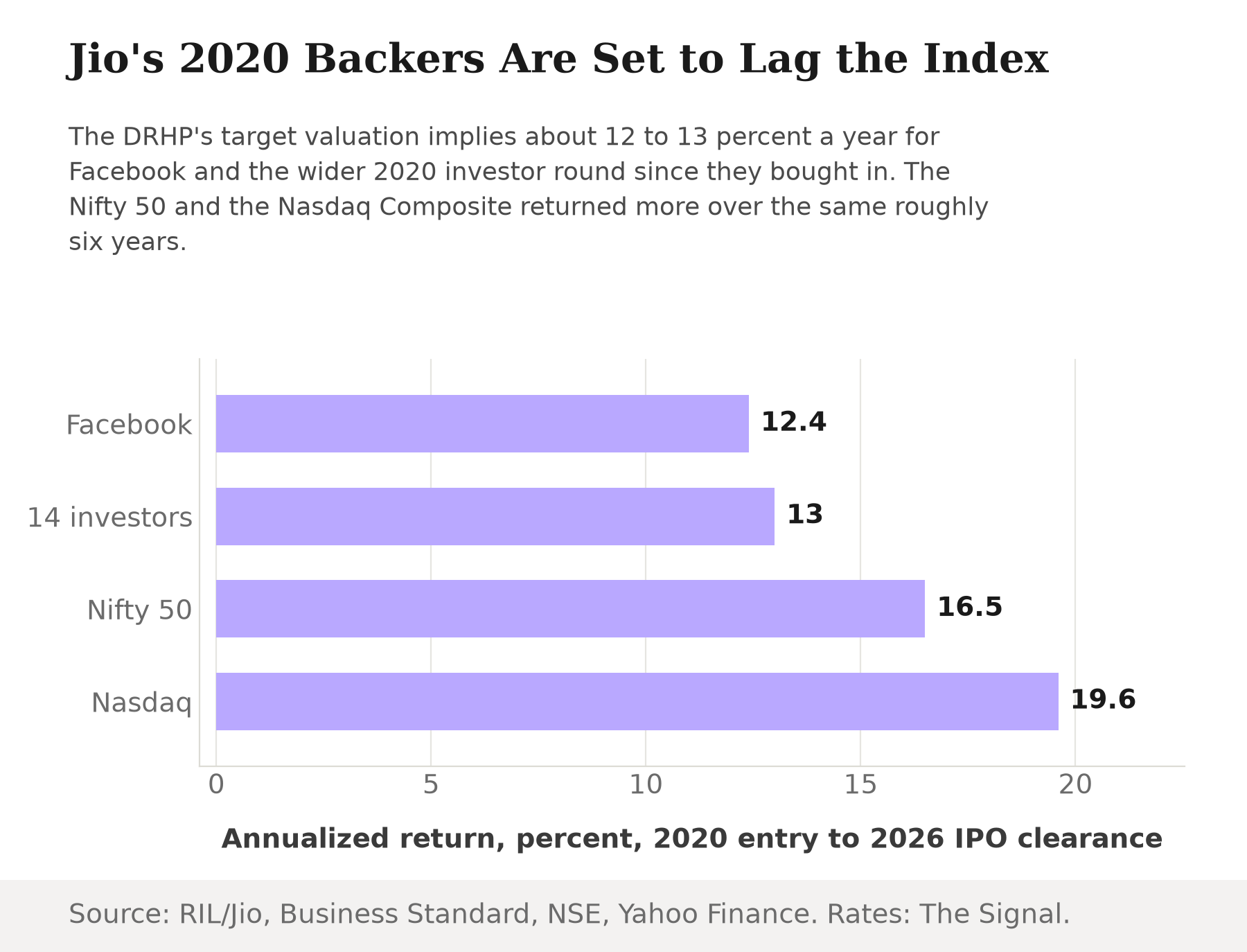
The number that carries the answer is this. At the draft prospectus's target valuation, Facebook's 2020 stake works out to an annualized return of about 12.4 percent, our calculation. The Nifty 50 returned about 16.5 percent a year over nearly the same stretch. The Nasdaq Composite returned about 19.6 percent. The world's most sophisticated strategic and financial investors, in the one Indian platform business every global tech giant wanted a piece of, are on track to trail a plain index by four to seven percentage points a year.
What the 2020 round actually paid
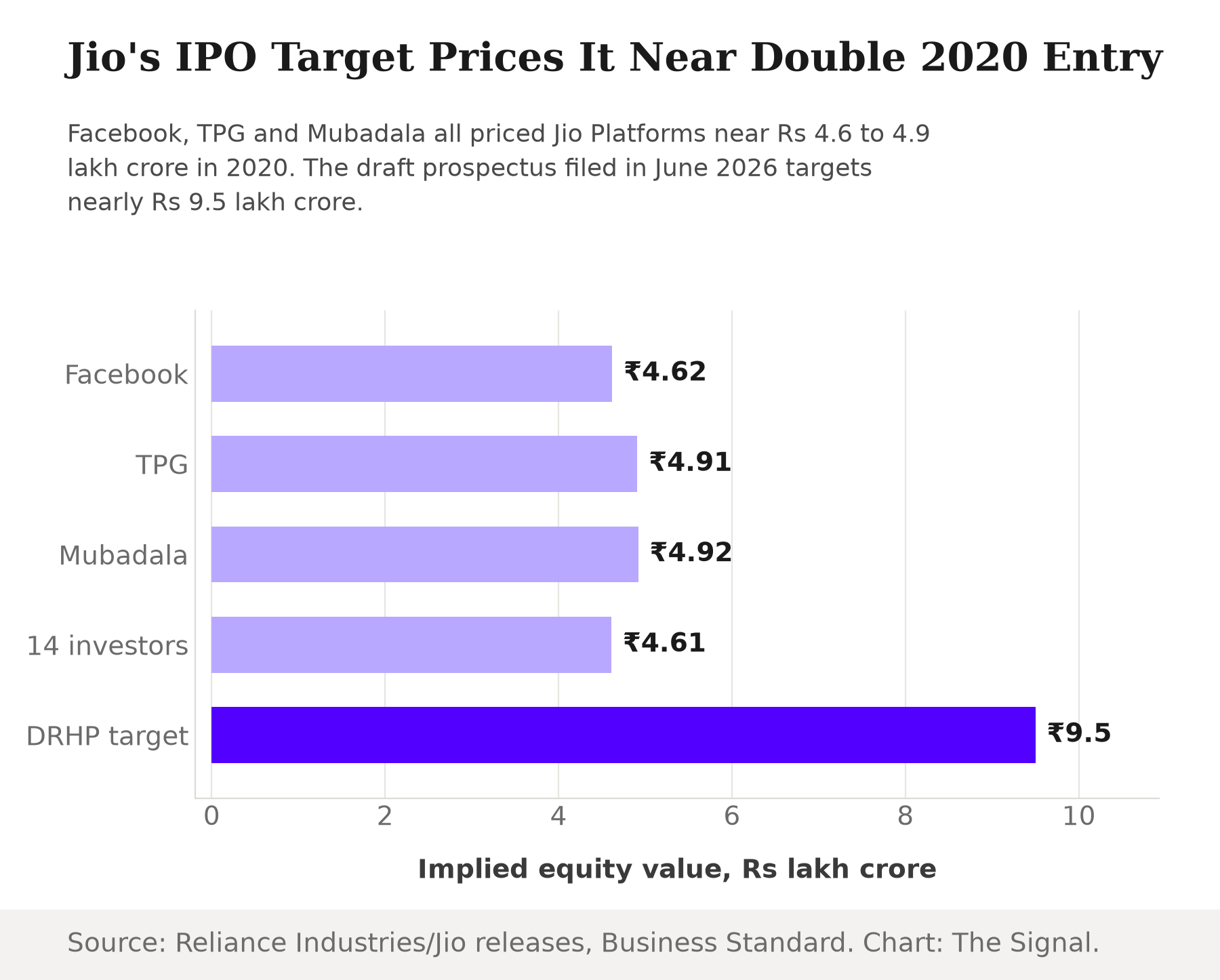
Facebook's Rs 43,574 crore investment for a 9.99 percent stake, announced April 22, 2020, valued Jio Platforms at Rs 4.62 lakh crore pre-money, or $65.95 billion at the exchange rate Reliance itself used that day. TPG followed on June 13, 2020, putting in Rs 4,546.80 crore for a 0.93 percent stake at an equity value of Rs 4.91 lakh crore, already a step up from Facebook's April price. Abu Dhabi's Mubadala invested Rs 9,093.6 crore for a 1.85 percent stake on June 5, 2020: dividing that investment by the stake implies an equity value of about Rs 4.92 lakh crore, within half a percent of what TPG paid the same month. By the time Google's Rs 33,737 crore, 7.73 percent investment was announced on July 15, 2020, the round's cumulative fundraising had reached Rs 1.52 lakh crore for a combined 32.97 percent stake sold to 14 investors: a blended entry price across the whole round of about Rs 4.61 lakh crore, almost exactly what Facebook paid three months earlier.
Facebook, TPG and Mubadala priced Jio Platforms within half a percent of each other in 2020.
| Investor | Date | Investment | Stake | Implied equity value |
|---|---|---|---|---|
| Apr 22, 2020 | Rs 43,574 crore | 9.99% | Rs 4.62 lakh crore | |
| TPG | Jun 13, 2020 | Rs 4,546.80 crore | 0.93% | Rs 4.91 lakh crore |
| Mubadala | Jun 5, 2020 | Rs 9,093.6 crore | 1.85% | Rs 4.92 lakh crore* |
| 14 investors, combined | by Jul 15, 2020 | Rs 1.52 lakh crore | 32.97% | Rs 4.61 lakh crore* |
Source: Reliance Industries and Jio Platforms media releases; Business Standard. Starred figures are The Signal's calculations from the investment and stake size.
Six years against the market
None of that group's stakes are actually for sale at this IPO. The draft prospectus is entirely a fresh issue of new shares, and not one existing shareholder, including the 2020 investors, is selling into it. What the offering does is put a number on paper next to what each of them still holds, and that number, an implied Rs 9.5 lakh crore equity value at the draft-prospectus stage, is where the comparison turns uncomfortable.
Take Facebook's Rs 4.62 lakh crore April 2020 entry against the Rs 9.5 lakh crore draft-prospectus target: a 2.06 times markup over roughly six years and two months, which compounds to about 12.4 percent a year. TPG and Mubadala, who priced in near Rs 4.91 to 4.92 lakh crore in June 2020, are sitting on a smaller multiple, near 1.94 times, or about 11.5 to 11.6 percent annualized. The blended entry price across the full 14-investor round implies roughly 13.0 percent a year.
Now set that against the market over the same window. The Nifty 50 closed at 9,187.30 on April 22, 2020, the day of the Facebook deal, and at 24,175.65 on August 28, 2026, the day SEBI cleared the IPO: a 2.63 times return, or about 16.5 percent a year, our calculation. The Nasdaq Composite moved from 8,495.38 on the same April 2020 day to 26,402.42 on the same August 2026 day: 3.11 times, about 19.6 percent a year. A rupee left untouched in either index for six years would have outgrown the rupee Facebook, TPG, Mubadala and the rest put into Jio Platforms.
That rupee-term math also hides a currency effect that cuts against the 2020 investors further. The RBI's own reference rate for the dollar was Rs 95.5614 on August 28, 2026, the day SEBI cleared the IPO, against the Rs 70-to-the-dollar rate Reliance itself used to value Facebook's April 2020 stake. Converting the draft prospectus's Rs 9.5 lakh crore target at that current rate puts Jio Platforms at about $99.4 billion, a 1.51 times multiple on Facebook's $65.95 billion entry price and just under 6.7 percent a year, half the rate its rupee-denominated return implies. The gap is the rupee itself: it has weakened by roughly a third against the dollar since April 2020, so a chunk of what looks like a markup in rupees simply is not one once measured in the currency Facebook actually reports its investment in, and puts Facebook's Jio stake even further behind the Nasdaq's dollar-denominated 19.6 percent a year.
The honest objection
The strongest case against this comparison is that Facebook, Google and the private-equity consortium were never buying a liquid, freely tradeable security the way a Nifty or Nasdaq investor is. They were buying access to a private, unlisted digital and retail platform with no public substitute in 2020. A pure financial-return comparison misses whatever strategic option value justified paying up for that access, and that logic likely explains why a diversified financial investor was willing to be so early at all.
But the case cuts against itself once the company actually lists. An IPO is precisely the moment private, strategic access converts into a plain financial security that can be benchmarked like any other. And since the draft prospectus carries no offer-for-sale component, none of the 2020 backers can sell into this listing at all: the Rs 9.5 lakh crore is a valuation on paper, not a cheque anyone is cashing in 2026. Until a post-listing lock-up lifts and shares actually change hands, the returns this piece computes are unrealized twice over, both subject to wherever the final price band lands and untouchable even after that.
The Signal
Every headline this week will call this India's biggest IPO, and on the rupee figure alone, it will be right. It is a less obvious win, on the numbers, for the marquee names who financed Jio Platforms' expansion when Reliance needed the capital most. The draft prospectus's own target values the business at nearly double what Facebook, TPG and Mubadala paid in 2020, and a rupee sitting in the Nifty or the Nasdaq over the identical stretch would have grown faster than that markup, with no lock-up and no bet on a private company's distribution deals ever paying off. Watch the final price band when it is set. If it prices meaningfully above the draft target, the 2020 round's math improves. If it prices at or below it, the investors everyone assumed made the smartest bet in Indian tech will have tied up six years of capital in the country's biggest listing and still trailed a fund anyone could have bought in an afternoon.
Reporting basis: the SEBI clearance date and language are per ANI's report of SEBI's own processing-status note. The DRHP's structure, filing date and target raise and valuation are per Business Standard, citing the draft red herring prospectus and people familiar with the matter. Facebook's and TPG's investment amounts, stakes and implied valuations are from Reliance Industries and Jio Platforms' own media releases. Mubadala's and Google's investment amounts and stakes are per Business Standard, the latter citing Reuters. Nifty 50 closing levels are from the National Stock Exchange's official index archive. Nasdaq Composite closing levels are from Yahoo Finance market data. The August 28, 2026 dollar reference rate is the RBI's own rate, archived by the Metropolitan Stock Exchange of India. Mubadala's implied valuation, the 14-investor round's blended entry valuation, the dollar conversion of the DRHP target, all annualized return figures, and the market-index comparisons are The Signal's calculations from those reported figures.