In January 2026, the Reserve Bank of India proposed that BRICS countries connect their central bank digital currencies, and asked the government to place the plan on the agenda of the 2026 BRICS summit that India is hosting, Business Today reported, citing two people familiar with the matter. The timing lines up: India holds the BRICS chairship for 2026, the platform from which it is already setting a renewed cooperation agenda for the bloc, a Press Information Bureau release states. That summit now has a date: the 18th BRICS Summit will convene on September 12-13, 2026, at Bharat Mandapam in New Delhi, News on Air reported, giving the CBDC-linkage pitch a concrete moment to clear or miss. A rupee-linked settlement rail across the group's central banks reads like a natural next step for a country that spent the last decade building one of the world's most-watched instant-payments networks.
It is worth slowing down on that framing. The RBI is pitching an infrastructure upgrade to BRICS partners that its own banking system has barely touched.
The pilot barely exists at home
Start with the number that should give any partner central bank pause: the wholesale digital rupee, the segment built for banks to settle large-value transactions among themselves, recorded circulation of exactly Nil, as on both March 31, 2026 and March 31, 2025, per the RBI's own Annual Report 2025-26, as reported by Business Standard. Two full years, and the wholesale rail a cross-border CBDC link would presumably run through has never carried a single rupee.
That is not for lack of participants. The RBI first launched the wholesale pilot on November 1, 2022, with nine banks (State Bank of India, Bank of Baroda, Union Bank of India, HDFC Bank, ICICI Bank, Kotak Mahindra Bank, Yes Bank, IDFC First Bank and HSBC) identified to take part, the RBI's launch announcement states. Nearly four years and nine of India's largest banks in, the pilot is structurally live and still carrying nothing.
The retail digital rupee is not zero, but it is shrinking. The value of retail e-rupee in circulation fell about 24 percent to Rs 771.7 crore as of March 31, 2026, down from Rs 1,016.5 crore a year earlier, Business Upturn reported, citing the same RBI annual report. The retail pilot launched a month after the wholesale one, on December 1, 2022, in four cities with four participating banks, the RBI's launch announcement states, which makes that 24 percent drop a decline in a program approaching its fourth birthday, not an early stumble.
Both segments of the digital rupee show no real growth: one stayed at zero, the other shrank.
| e-rupee segment | Mar 31, 2025 | Mar 31, 2026 | Change |
|---|---|---|---|
| Wholesale (e₹-W) | Nil | Nil | No change |
| Retail (e₹-R) | ₹1,016.5 crore | ₹771.7 crore | Down about 24% |
Source: Business Standard, citing RBI's Annual Report 2025-26 (wholesale); Business Upturn, citing the same report (retail).
The gap next to UPI
The pilot's overall reach is not much larger than its circulation numbers suggest. RBI Governor Sanjay Malhotra said in July 2026 that the digital rupee pilot has reached 12 million users and processed more than 175 million transactions worth close to Rs 400 billion cumulatively, speaking at the Financial Congress in St Petersburg on July 2, Angel One reported. That is the pilot's entire track record since it began: 175 million transactions, roughly Rs 400 billion moved.
Set that next to the payments network India already runs. UPI alone processed a record 23.66 billion transactions worth Rs 29.88 trillion in July 2026, its highest-ever monthly volume and value, Business Standard reported, citing NPCI data. UPI processed roughly 135 times as many transactions that month as the digital rupee has moved cumulatively across years of piloting, and settled about 75 times as much money. Both multiples are our calculation, converting the Governor's Rs 400 billion cumulative figure to the same Rs trillion scale UPI reports in.
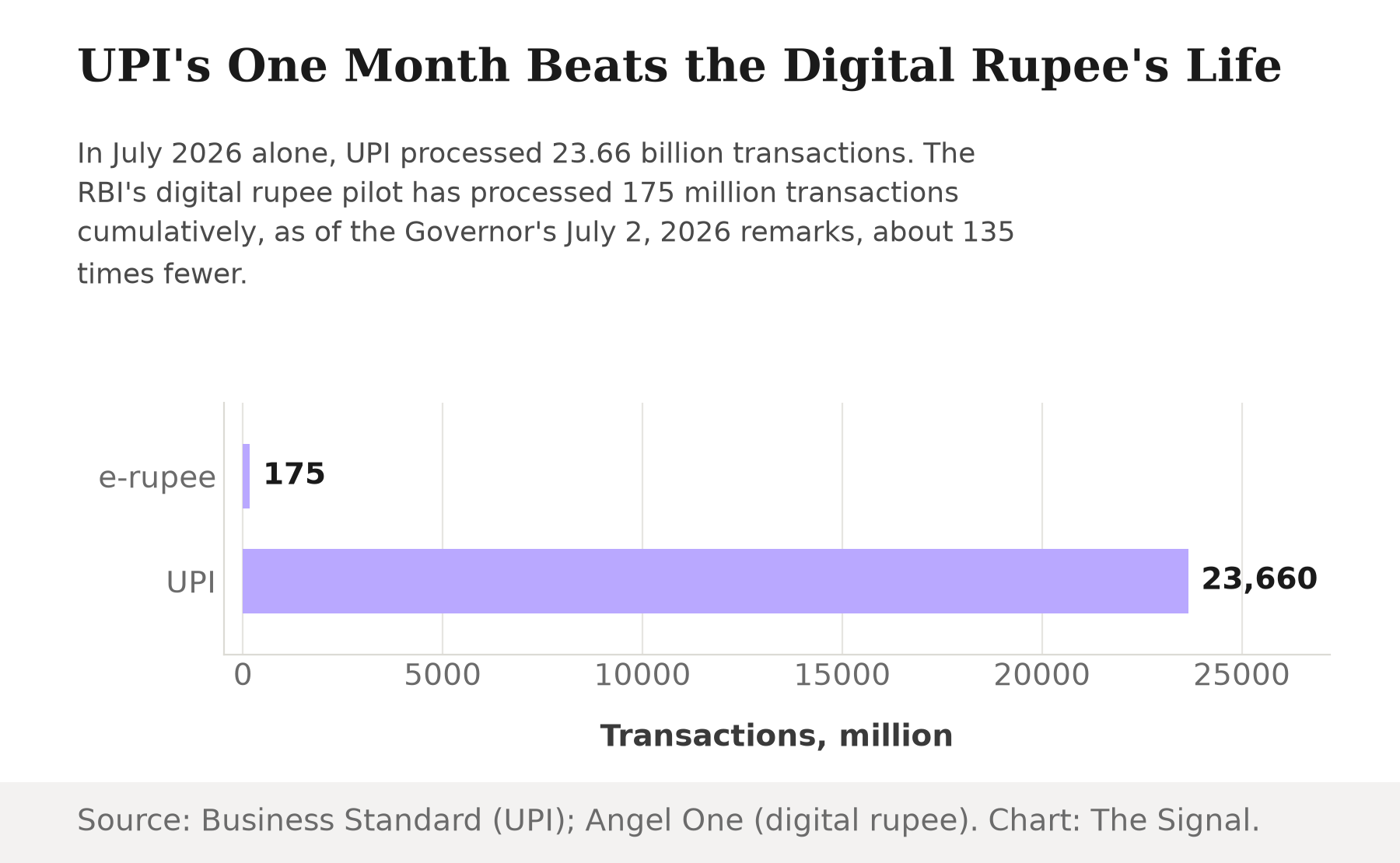
Source: Angel One; Business Standard, citing NPCI data. Chart: The Signal.
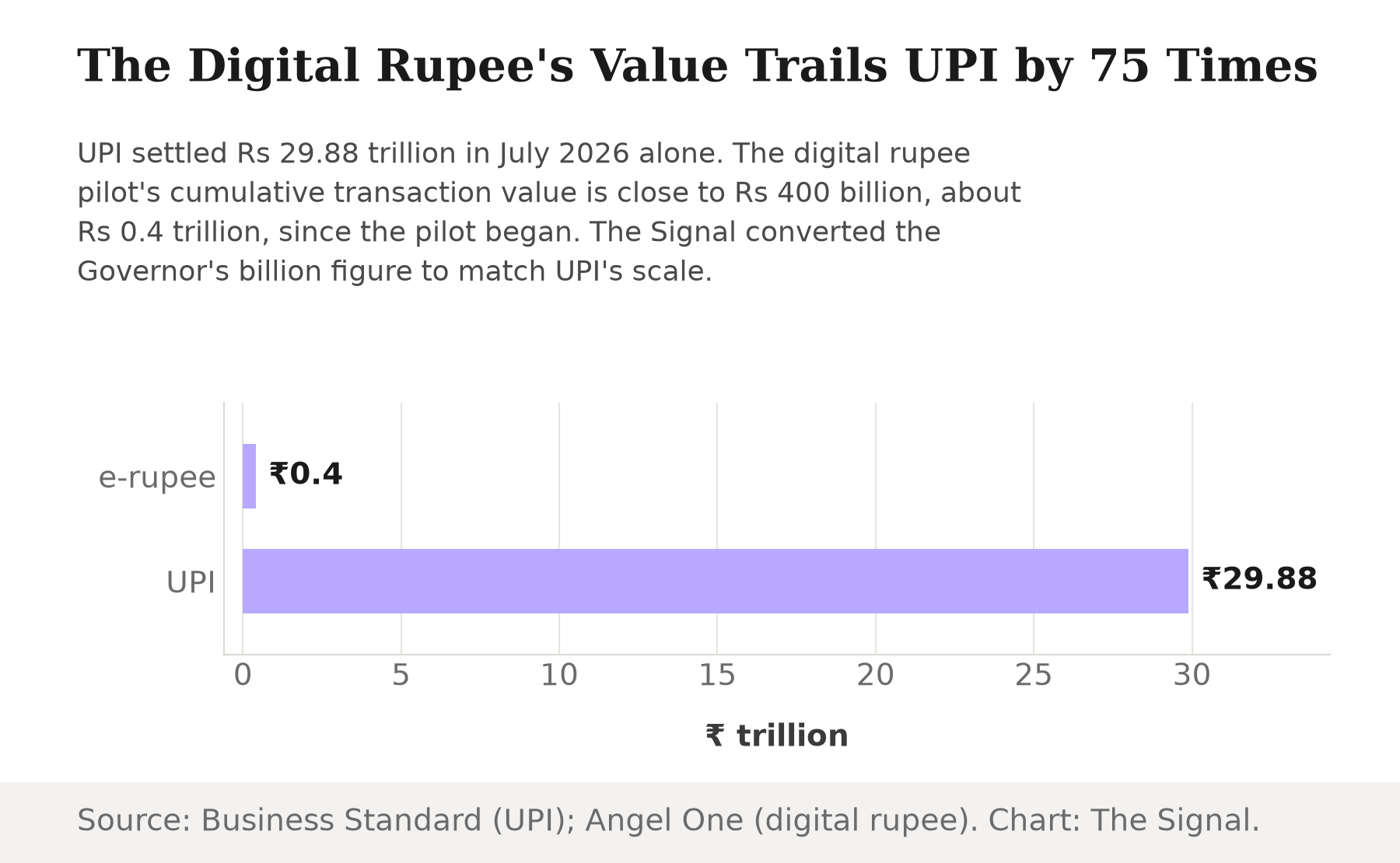
Source: Angel One; Business Standard, citing NPCI data. The e-rupee's cumulative value converted to trillion scale for comparison is The Signal's calculation. Chart: The Signal.
Where the pilot is actually growing
The RBI has not been idle on the retail e-rupee. In 2025-26 it expanded the pilot into welfare delivery, launching a CBDC-based digital food-subsidy pilot under the Public Distribution System in Gujarat, in partnership with the state government, across Ahmedabad, Anand, Valsad and Surat districts, a Press Information Bureau release states. That is a real, if narrow, use case: it proves the digital rupee can carry a targeted government transfer rather than just move money between willing early adopters. It is also a domestic welfare experiment aimed at last-mile delivery, not the cross-border settlement rail the BRICS proposal is actually about.
The honest objection
The strongest case for the BRICS pitch is that scale at home is not really the point yet. President Trump has repeatedly threatened BRICS nations with 100 percent tariffs on their exports if they move to replace the dollar in global trade, News on Air reported, a warning first issued in January 2025 and repeated since. Against that backdrop, a CBDC-linkage proposal is arguably a hedge and a statement of technical readiness rather than a plumbing upgrade meant to carry real volume soon: India can say it has the option on the table, even if its own banks are not using it yet, and even if using it at scale would be a stated act of de-dollarisation that Washington has promised to punish.
That case would be stronger if every prospective BRICS partner were in the same boat. They are not. China's e-CNY digital yuan had processed a cumulative 3.48 billion transactions worth 16.7 trillion yuan, about $2.3 trillion, since its 2019 pilot launch, as of November 2025, Caixin Global reported, citing PBOC deputy governor Lu Lei: roughly 20 times the digital rupee's cumulative transaction count, in the currency of the BRICS partner whose central bank India is asking to sit at the same CBDC-linkage table. Whatever the honest case for a hedge, it is not that CBDC scale is a bloc-wide blank slate India shares equally with its partners.
That case is real, but it cuts against the pitch as much as it explains it. If the wholesale rail India wants BRICS partners to connect to has processed nothing for two straight years, and the tariff risk of actually running volume through a rupee-linked settlement system is explicit and repeated, there is no obvious route from a summit agenda item to anyone actually using it. A hedge nobody can safely switch on is not much of a hedge.
The Signal
What India is offering BRICS is not working infrastructure. It is asking partner central banks to consider linking to a wholesale digital-currency rail that has recorded zero circulation for two straight years, and to a retail pilot that shrank by about a quarter over the same period, while its own instant-payments network settled far more money in a single month than the digital rupee pilot has moved since it began. The genuinely valuable thing the RBI has to offer BRICS is UPI's working payments culture, not a proven CBDC settlement system, and those are not the same export. Watch what the summit's agenda item actually commits partner central banks to. A study group or a technical working group means India is selling an idea. A request to route real transaction volume through the e-rupee-W means India is asking someone else to be the first serious user of a system its own banks have avoided for two years running.
Reporting basis: the RBI's BRICS CBDC-linkage proposal and its place on the 2026 summit agenda are per Business Today, citing two unnamed sources; India's 2026 BRICS chairship is per a Press Information Bureau release; the summit's confirmed September 12-13, 2026 dates and Bharat Mandapam venue are per News on Air (All India Radio). Wholesale and retail e-rupee circulation figures both trace to the RBI's Annual Report 2025-26, as reported respectively by Business Standard and Business Upturn; both pilots' 2022 launch dates, cities and participating banks are per the RBI's own launch announcements. RBI Governor Sanjay Malhotra's July 2026 pilot figures are per Angel One's report of his remarks at the Financial Congress in St Petersburg. UPI's July 2026 volume and value are per Business Standard, citing NPCI data. The Gujarat digital-rupee food-subsidy pilot is per a Press Information Bureau release. Donald Trump's tariff threat against BRICS de-dollarisation is per News on Air (All India Radio), reporting a warning first issued in January 2025. China's e-CNY cumulative transaction figures are per Caixin Global, citing PBOC deputy governor Lu Lei. The transaction-count and value multiples comparing UPI, China's e-CNY, and the digital rupee pilot are The Signal's calculations from those figures.