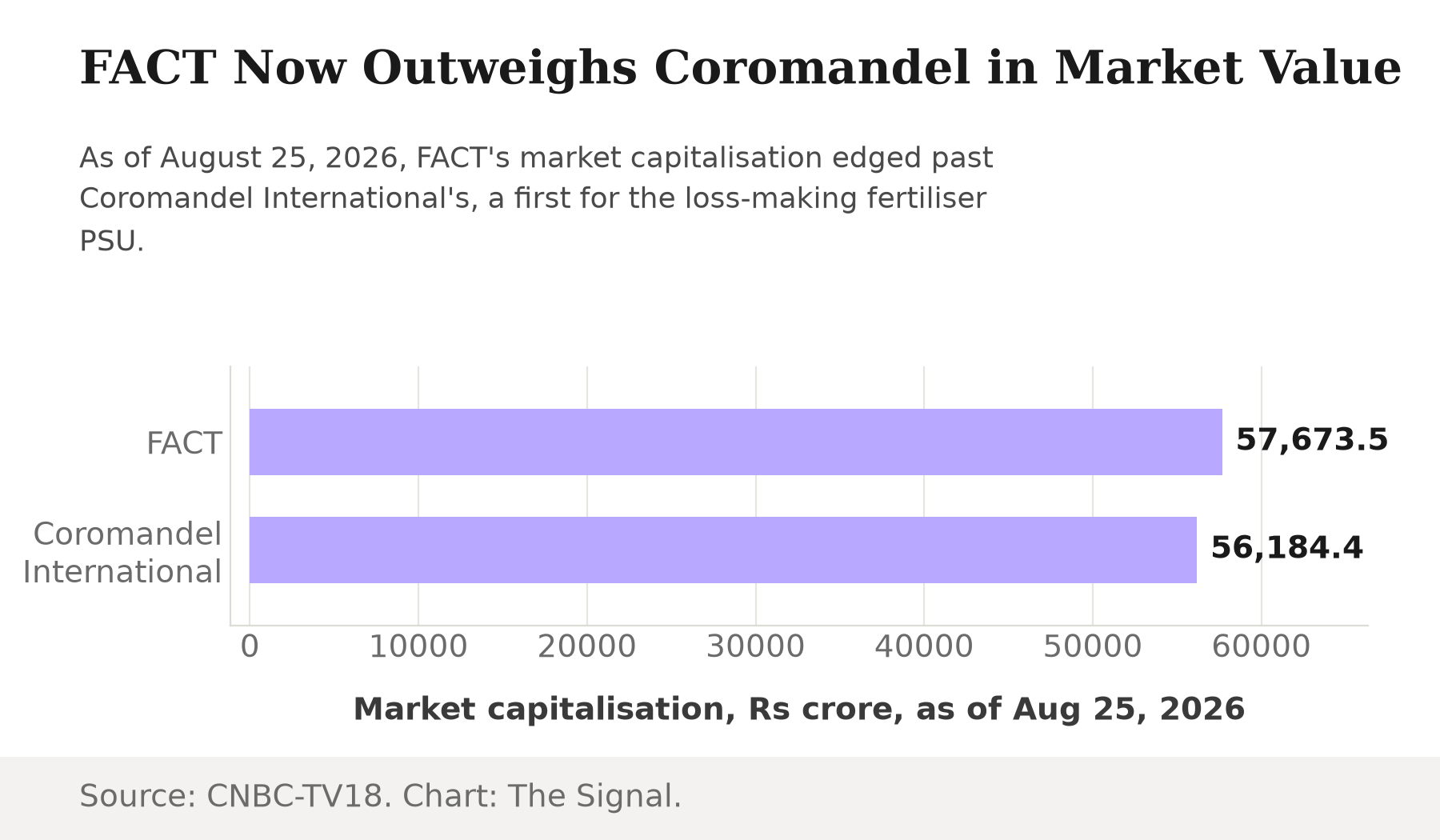
A state-owned fertiliser company that is currently losing money is now worth more on the stock market than a private-sector fertiliser company that is currently making money. On August 25, 2026, The Fertilisers and Chemicals Travancore Limited's market capitalisation reached ₹57,673.53 crore, overtaking Coromandel International's ₹56,184.41 crore. Read as a headline, it fits a familiar story: India's government-owned companies have been re-rated hard by investors since 2020, and FACT, a Kochi-based public sector unit, is simply the latest name catching that wave.
The gap between the two is thin, a little over ₹1,489 crore. But it is real, and it inverts what the two companies' own numbers say about their businesses.
The trigger for that specific day is not mysterious. FACT led a basket of fertiliser stocks that jumped after Russian President Vladimir Putin told India's external affairs minister S Jaishankar, in a meeting the day before, that Russia is willing to increase its fertiliser supplies to India; FACT shares rallied more than 14 percent intraday to a high of ₹894. That explains the day's spike. It does not, on its own, explain why a loss-making company's stock reacts to a foreign supply pledge harder than a profitable one's, or why that single day's move was enough to flip the market-cap ranking rather than just narrow the gap.
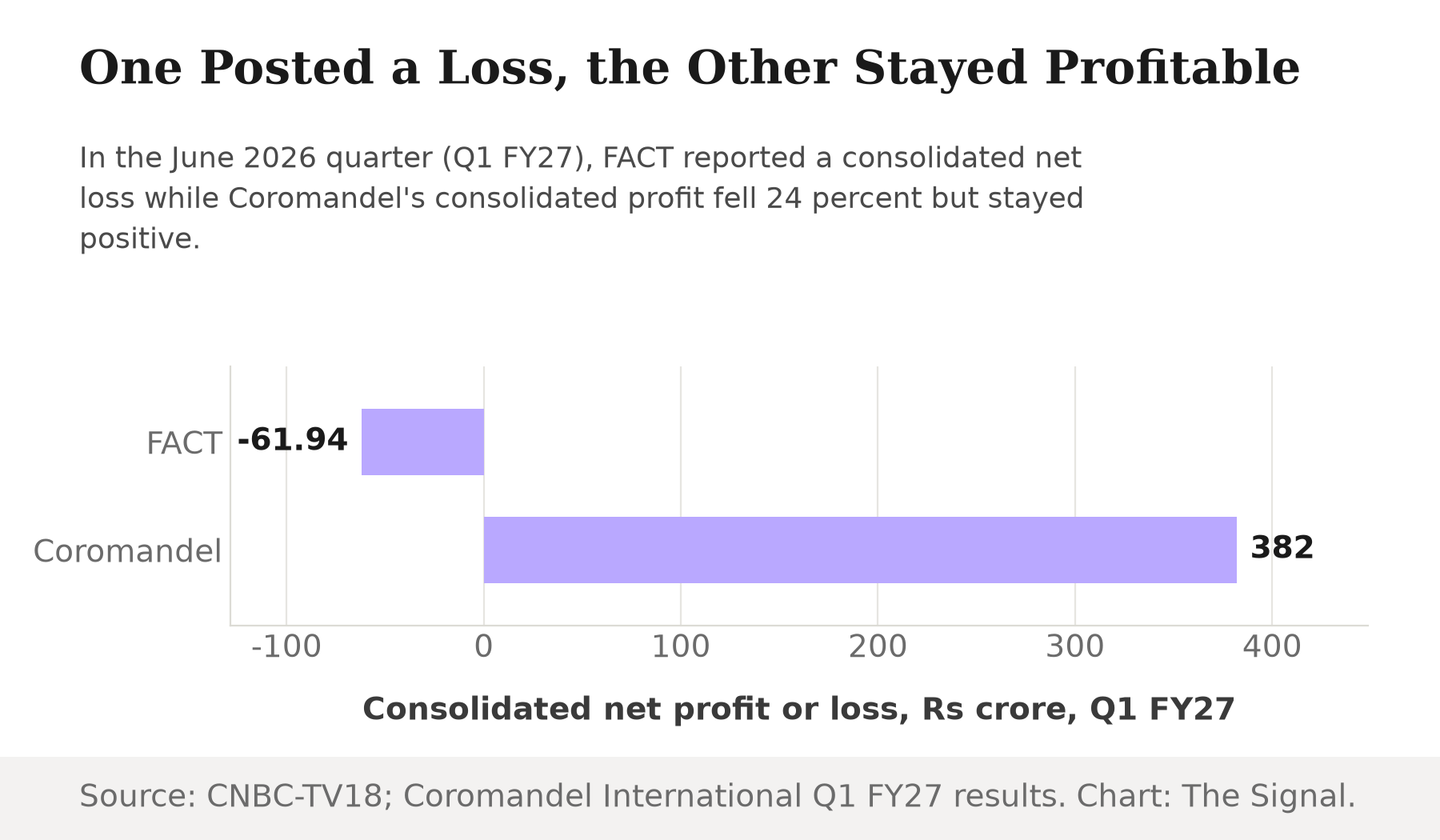
It is worth slowing down on that inversion. FACT reported a consolidated net loss of ₹61.94 crore in the June 2026 quarter (Q1 FY27), against a profit of ₹4.28 crore in the same quarter a year earlier: a swing of roughly ₹66 crore from profit into loss. Coromandel, over the same June 2026 quarter, did the opposite of collapse. Its standalone net profit fell 26 percent year-on-year to ₹377 crore, from ₹508 crore a year earlier, while consolidated profit after tax fell 24 percent to ₹382 crore from ₹502 crore. A weaker quarter, by Coromandel's own account. Still a profitable one, by several hundred crore.
What actually hit Coromandel's numbers
Coromandel's profit decline has a traceable cause. The company's own Q1 FY27 results release attributes the fall to elevated raw-material costs triggered by the ongoing Middle East crisis, which weighed on its fertiliser business even as revenue grew 10 percent. That is a company absorbing a global input-cost shock and still clearing a profit on the other side.
The same shock shows up, from a different angle, in the government's own books. India had already spent about ₹99,000 crore on fertiliser subsidies by August 19, 2026, exhausting roughly 58 percent of the full FY27 budgetary allocation in under five months, as global urea prices spiked after the West Asia conflict. The same conflict that squeezed Coromandel's raw-material bill is also blowing through the subsidy budget that fertiliser producers, private and public alike, depend on.
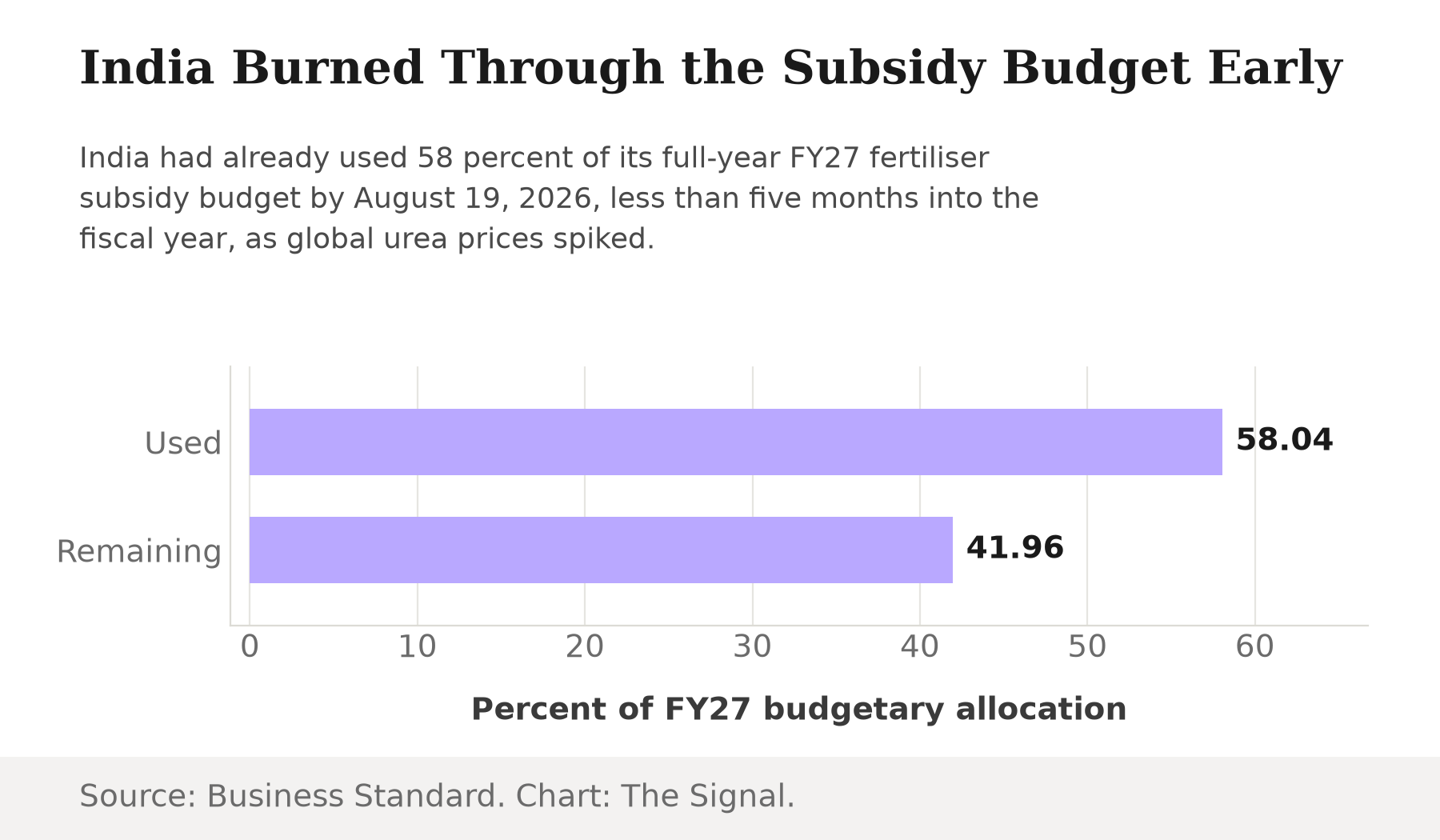
That is the honest, unglamorous backdrop: a cost shock hitting the whole sector, a subsidy pool being drawn down faster than the fiscal year is passing. None of it is specific to FACT. None of it explains why FACT, the company actually posting a loss, is the one the market chose to reward.
A small, old company with a large new price tag
FACT itself is not a large company by capital-market standards. Its issued and subscribed share capital is ₹647.07 crore, and it has been a Government of India-controlled public sector company since 1962. A modest, decades-old state manufacturer suddenly commands a market value ahead of a much larger, currently profitable private-sector peer.
What the market is pricing into that gap, whether it is optimism about a government-backed revival, land or asset value sitting on FACT's books, or simple disinvestment optionality, is not something the numbers on hand can answer. None of those explanations appears in FACT's own results or its investor disclosures, so this piece will not assert one. If anything, Parliament's own oversight of the sector points the other way: a Standing Committee on Chemicals and Fertilizers report made public on July 27, 2026 said the government had not resolved FACT's legacy debt, and pressed the Department of Fertilisers to examine restructuring options for FACT specifically, while separately flagging that fertiliser-PSU disinvestment decisions remain long-pending. A revival mechanism the market might be pricing has not, as of that report, been finalised in public. What can be said plainly is that the current price is not explained by current earnings, and the one government body that would know whether a revival plan exists says it does not yet.
The longer arc behind the rally
FACT's crossover did not happen in isolation. It is the latest data point in a multi-year re-rating of India's state-owned companies as a group. Business Standard reported, citing a Motilal Oswal analysis, that the S&P BSE PSU Index and the Nifty 50 delivered nearly identical returns over the decade to mid-2024, a convergence that closed a long-standing gap: the PSU index had fallen roughly 30 percent between FY14 and FY20 while the Nifty rose about 28 percent, before the PSU index rose five-fold from its March 2020 low. That figure is now more than two years old and this piece treats it as background, not as today's state of the rally, but it establishes that a broad re-rating of government-owned companies was already underway well before FACT's specific crossover on August 25, 2026.
The PSU index erased a six-year underperformance against the Nifty, then kept rising.
| Period | S&P BSE PSU Index | Nifty 50 |
|---|---|---|
| FY14 to FY20 | Fell about 30% | Rose about 28% |
| From March 2020 low to mid-2024 | Rose about 5x | Rose, decade returns converged with PSU index |
Figures as reported by Business Standard, June 2024, citing a Motilal Oswal report. Source: Business Standard.
FACT's move above Coromandel is what that multi-year re-rating looks like when it reaches an individual, currently loss-making name: the market is no longer pricing PSUs as cheap, low-growth utilities. It is pricing some of them ahead of profitable private-sector operators in the same industry.
The honest objection
The strongest case for FACT's price is that a market capitalisation is a bet on the future, not a receipt for what already happened. A single loss-making period, on its own, says little regarding a company's multi-year earnings path, especially for a state-backed manufacturer whose value could rest on land, plant capacity, or a policy tailwind that a profit-and-loss statement does not capture. On that view, Coromandel's steadier profit is backward-looking comfort, while FACT's price reflects information, real or speculative, that the market has already absorbed.
That case has real force, and it is exactly why this piece does not call FACT's price wrong. But it cuts both ways: a bet on an unreported future cannot be verified against another unreported future. What is verifiable is only the gap itself, between two companies in the same industry, hit by the same cost shock, one clearing several hundred crore in profit and the other posting a loss, now separated by roughly ₹1,489 crore of market value in FACT's favour. A market can hold that gap for a long time on the strength of a story alone, but a story is not a substitute for a results filing forever.
The Signal
Nothing here says FACT's price is a mistake. It says the price is currently unaccompanied by an earnings explanation, and that gap has to close one of two ways. Either FACT's next few quarters start producing the profit, asset sale, or government support that today's valuation is implicitly betting on, in which case the rest of India's loss-making PSUs just got a valuation template worth studying. Or the earnings never show up, Coromandel's quarter turns out to be the more ordinary kind of setback, and the market re-prices the gap back toward the two companies' actual profit-and-loss statements. Either way, the number to watch next is not FACT's market capitalisation. It is FACT's next quarterly result.
Reporting basis: the market-capitalisation crossover and FACT's Q1 FY27 loss figures are as reported by CNBC-TV18. Coromandel International's Q1 FY27 standalone and consolidated results, and its own attribution of the profit decline to Middle East-driven raw-material costs, are from the company's official results press release via the Murugappa Group. FACT's share capital and public sector ownership history are from FACT's own investor-information page. The FY27 fertiliser subsidy spending pace is per Business Standard, citing government sources. The decade-long PSU-versus-Nifty comparison is per a single Business Standard report from June 2024, citing a Motilal Oswal analysis, and is presented here as historical background rather than current data. The August 25 intraday surge and its link to Russian President Putin's remarks to India's external affairs minister are per Business Standard, citing Interfax. The status of FACT's legacy debt and fertiliser-PSU disinvestment decisions is per a Parliamentary Standing Committee on Chemicals and Fertilizers report carried by PTI via MillenniumPost. The ₹1,489 crore market-value gap and FACT's swing from profit to loss are The Signal's calculations from those figures.