SEBI has rejected settlement applications from 13 overseas portfolio investors linked to Adani Group companies, in a probe dating to 2020 over whether they were genuine public shareholders or entities acting for Adani Group founders. Business Standard reported this week, relaying a Bloomberg News account that cites the Economic Times' sourcing. Some of the funds were unwilling to provide information SEBI considered necessary to settle the case, while others resisted SEBI's demands to disgorge money, according to BusinessToday's own account of the same reporting. Read quickly, this is one more entry in a long-running standoff between the regulator and the conglomerate's overseas investors, the kind of procedural setback that happens all the time at a securities regulator.
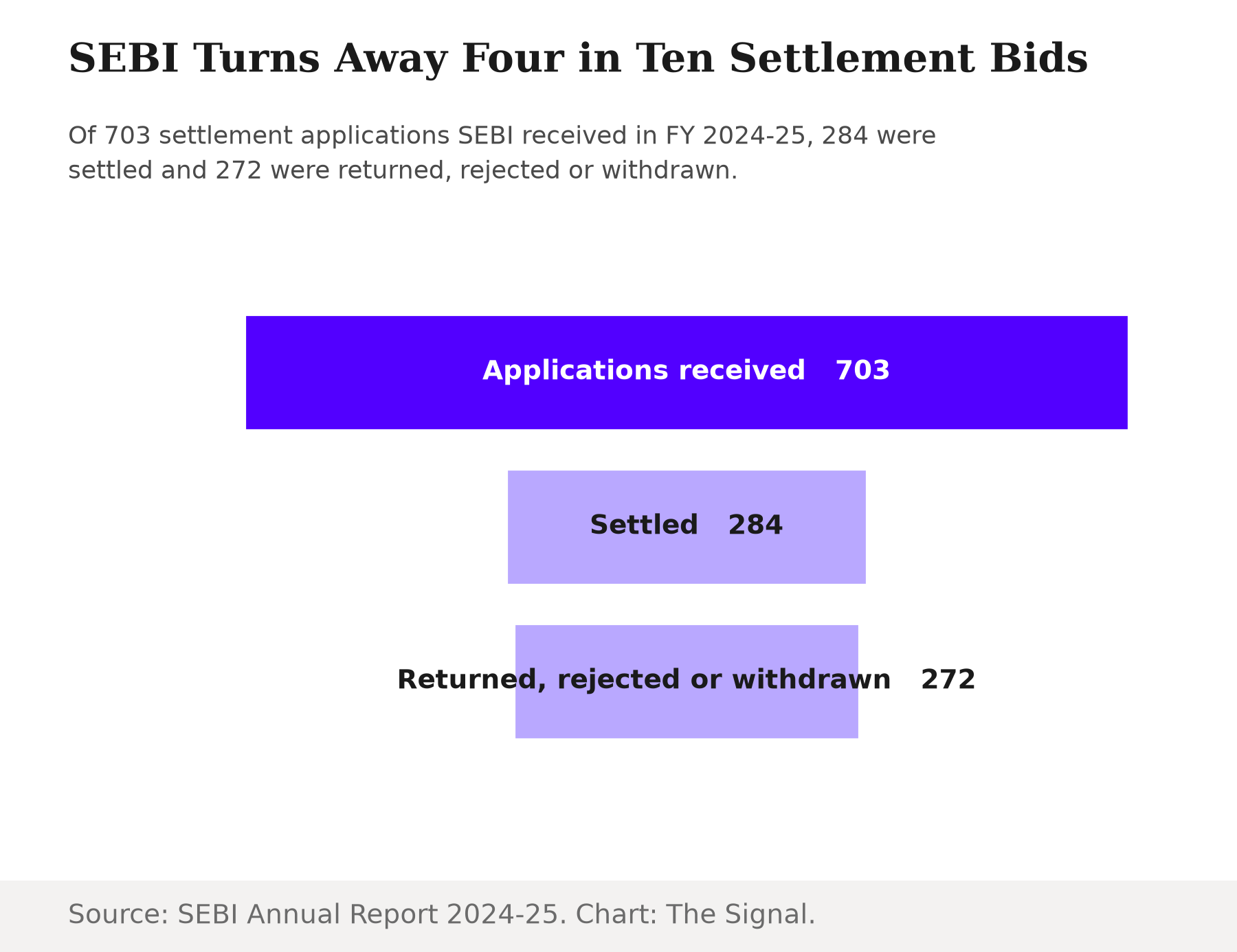
It is worth slowing down on that read. SEBI's settlement window is not a formality that nearly everyone clears. In the financial year 2024-25, SEBI received 703 applications for settlement and closed 284 of them with a settlement order, while 272 more were returned, rejected or withdrawn: a regulator that turns away roughly as many cases as it settles. Getting rejected at SEBI's settlement desk is common. What is worth asking is what gets waved through and what does not.
Source: SEBI Annual Report 2024-25. Chart: The Signal.
What the routine price looks like
Months before the Adani-linked rejections were reported, SEBI settled a case that looks, on paper, like the same kind of problem. In November 2025, SEBI accepted a settlement of Rs 39,97,500 from BNP Paribas over an FPI disclosure matter, without the firm admitting or denying the underlying findings. That is the going rate for a foreign portfolio investor caught on a disclosure violation at SEBI: a fee under Rs 40 lakh, no admission required, case closed.
The 13 Adani-linked funds had already tried that exact route. By April 2024, eight of the 13 funds under scrutiny, Albula Investment Fund, Cresta Fund, MGC Fund, Asia Investment Corporation (Mauritius), APMS Investment Fund, Elara India Opportunities Fund, Vespera Fund and LTS Investment Fund, had collectively filed 16 settlement applications with SEBI after being asked to defend against disclosure and investment-limit violations. That is more settlement paperwork, from more funds, than the single BNP Paribas case. And it did not work. All 13 funds have now had their settlement bids turned down.
BNP Paribas paid a fee and moved on. The Adani-linked funds could not.
| BNP Paribas | The 13 Adani-linked funds | |
|---|---|---|
| What is alleged | An FPI disclosure violation | Whether they are genuine public shareholders or entities acting for Adani Group founders, under probe since 2020 |
| Settlement attempt | A single proposed fee | 16 settlement applications from 8 of the 13 funds by April 2024 |
| Admission required | None | None reported |
| Outcome | Settled, November 2025 | Rejected, reported August 2026 |
Sources: SEBI's November 2025 settlement order; Business Standard, April 2024; Business Standard, August 2026.
The question a fee cannot close
A disclosure violation is a paperwork problem: you filed late, or filed wrong, and a fee closes the file. What SEBI has been investigating in the Adani-linked funds since 2020 is a different kind of question: not whether paperwork was filed correctly, but whether the funds' claimed identity as independent shareholders is accurate.
Hindenburg Research's January 2023 report alleged that the funds it identified are promoter, or insider, entities holding enough shares in Adani-listed companies to push four of them well over the 75 percent threshold that triggers delisting. That is not a generic allegation against offshore funds in the abstract: five of the funds under SEBI scrutiny, Albula Investment Fund, Cresta Fund, LTS Investment Fund, Asia Investment Corporation Mauritius and APMS Investment Fund, were among the specific entities Hindenburg's report named. Hindenburg is a short seller with a financial stake in the stocks it targets, so that is an allegation from an interested party, not a neutral finding, and SEBI has not confirmed it. But it names the exact mechanism a settlement fee cannot touch: India's listing rules require a minimum share of a company to sit with genuine public shareholders, not with the promoter group. One of SEBI's own prescribed routes for meeting that rule requires a promoter's on-market sale to continue until public holding reaches 25 percent. A 75 percent insider ceiling and a 25 percent public floor are the same line drawn from two directions.
If a fund counted toward the public float SEBI's minimum-shareholding rule requires actually belongs, in substance, to the promoter group, the company's public shareholding number is wrong, not just its disclosure paperwork. A settlement fee, paid without admitting anything, would not fix that number. It would just let SEBI collect money while leaving the classification question open. That looks like the difference between BNP Paribas's case and the 13 funds: one was a discrete violation with a clear price; the other sits on top of a live question about which shareholders count as genuinely public in an Adani-listed company at all.
Source: SEBI Annual Report 2024-25. Chart: The Signal.
Two funds asked a tribunal to force an answer
The funds have not simply waited on SEBI's timeline. Two of the 13, Elara India Opportunities Fund and Vespera Fund, took SEBI to the Securities Appellate Tribunal in March 2025 over delayed decisions on their FPI-regulation applications, which involved converting warrants and disposing of the resulting shares. SEBI committed before the tribunal to decide those applications by March 31, 2025. That is a separate track from the settlement bids, but it shows the same pattern: funds pushing for a resolution, and a regulator moving on its own schedule rather than a fee-driven one.
The honest objection
The strongest case against reading anything special into this is the base rate itself. SEBI returned, rejected or withdrew 272 of the 703 settlement applications it handled in FY 2024-25, so a rejection on its own proves nothing: incomplete filings, inadequate fee offers and procedural defects sink settlement bids at SEBI every year, for reasons that have nothing to do with any deeper classification fight.
That case is real, but it does not explain the pattern here. This is not one fund's paperwork rejected once. It is all 13 funds under the same, six-year-old probe, after 8 of them had already tried a collective, 16-application settlement push. A single misfiled form does not require that much persistence, from that many related entities, over that many years, only to be turned away as a group. The volume argument fits a scattered set of unrelated rejections. It fits less well when every rejected applicant traces back to the same unresolved question about which of them actually owns the shares outright.
The Signal
A settlement fee is priced for a violation SEBI can define and close. It is not priced for a question SEBI has not yet answered, and the identity of a public shareholder in a company with a legal minimum public float is exactly that kind of open question. BNP Paribas got a number attached to its violation because the violation was the whole problem. The 13 Adani-linked funds have not, because settling with them would not tell SEBI, or the market, whether Adani-listed companies actually meet the public shareholding rule their own circular sets out. Watch what SEBI does next with Elara and Vespera's separate tribunal-monitored applications, and watch whether SEBI ever formally rules on the promoter-or-public question at all. A fee can close a file. It cannot, on its own, settle the ownership question underneath it.
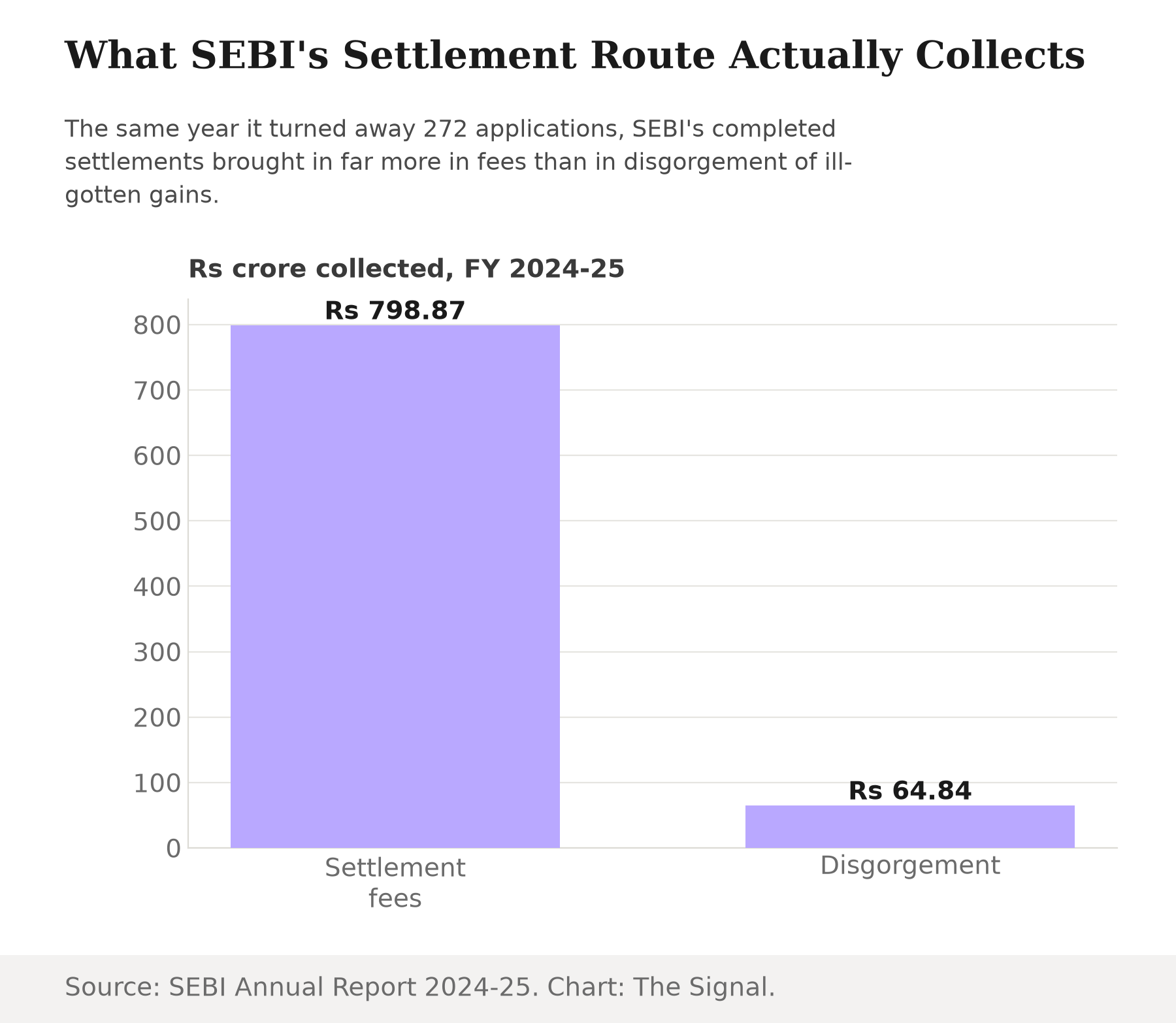
Reporting basis: the SEBI settlement rejection is per Business Standard's report this week, which relays a Bloomberg News account citing the Economic Times' sourcing; BusinessToday's account of the same underlying Economic Times reporting is the source for SEBI's stated reasons (funds withholding requested information, resisting disgorgement demands). The April 2024 filing of 16 settlement applications by 8 of the 13 funds is per a separate Business Standard report citing the Economic Times and Reuters. SEBI's FY 2024-25 application and collection figures are from SEBI's own Annual Report 2024-25. The BNP Paribas settlement amount is from SEBI's November 2025 settlement order. The Securities Appellate Tribunal's March 2025 order is the tribunal's own primary record. The promoter-classification and delisting-threshold allegation is Hindenburg Research's own January 2023 report, an interested short seller's claim rather than a neutral finding, and it is the only source for that allegation; Millennium Post's report on a related SAT filing is the source for which five of the scrutinized funds Hindenburg's report specifically named. The minimum public shareholding mechanism is from SEBI's own February 2023 circular. The reading of the 75 percent insider threshold and the 25 percent public-float floor as the same line is The Signal's own observation from those two sourced figures.