India's foreign exchange reserves are climbing back toward their record. In the week ended August 14, 2026, reserves rose to $716.907 billion, up $9.905 billion from the week before, led by a $7.225 billion increase in foreign currency assets, according to the Reserve Bank of India's Weekly Statistical Supplement. That is within striking distance of the all-time high: reserves touched $728.49 billion in the week ended February 27, 2026, before easing back as a West Asia-driven oil price spike put pressure on the rupee. Read only the headline number, and the story is simple: after a rough patch, India's currency buffer is nearly back to full strength, just $11.6 billion below its February peak.
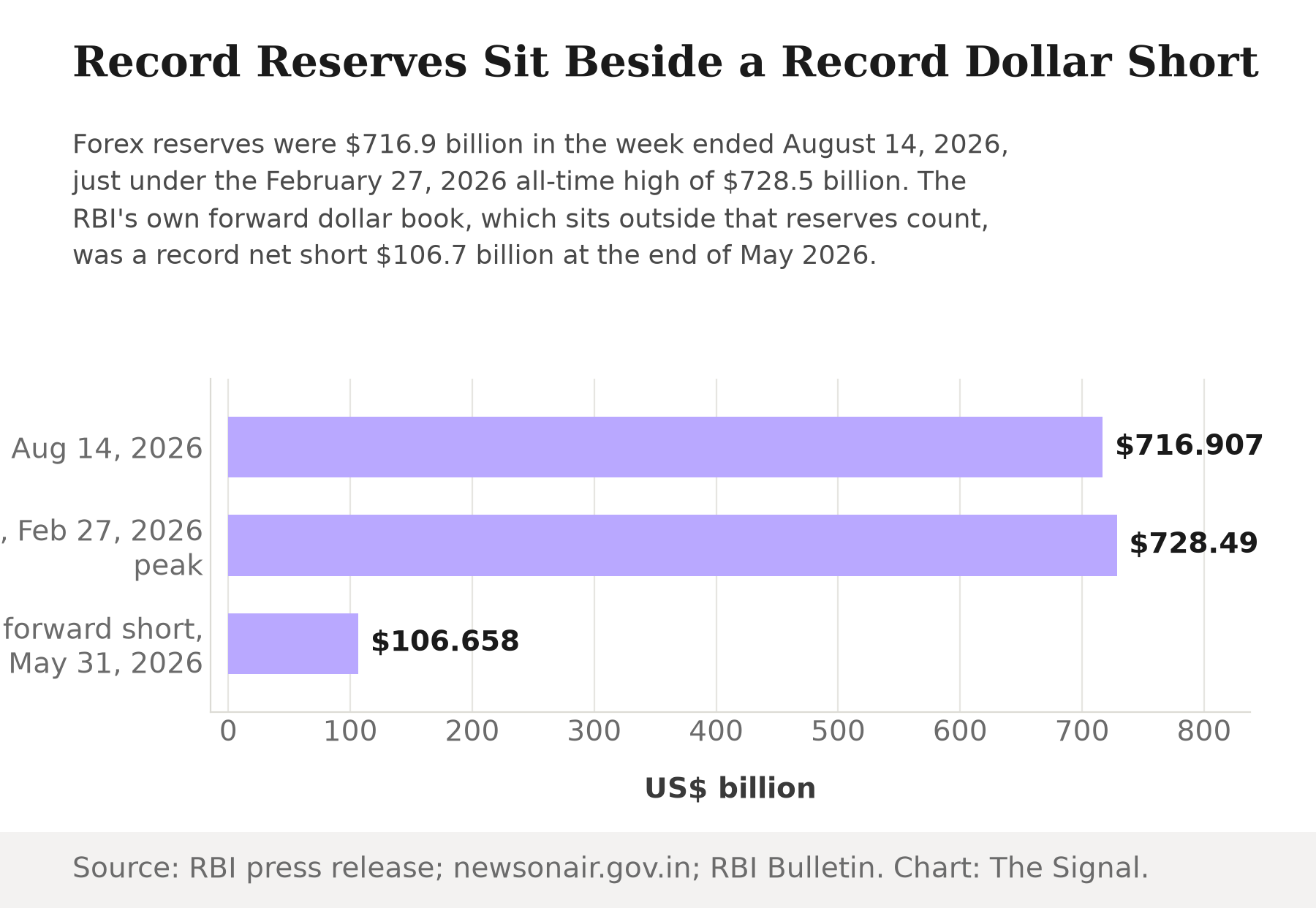
Source: Reserve Bank of India's Weekly Statistical Supplement; Akashvani/newsonair.gov.in, citing RBI data; RBI Bulletin. Chart: The Signal.
It is worth slowing down on that number. Reserves measure what the RBI owns outright today: dollars, gold and other assets sitting on its balance sheet. They say nothing about what the RBI has already contracted to hand over later, on a separate ledger the reserves count does not touch.
The book that sits outside the reserves count
The RBI's outstanding net forward position, dollars it has agreed over-the-counter to buy or sell on a future date, was a record net short $106.658 billion as of end-May 2026. That is equal to nearly 15 percent of the $716.907 billion headline reserves figure it sits outside of. Selling dollars forward lets the RBI commit today's supply without touching today's reserves count at all: the transaction only shows up on the balance sheet when it settles.
The RBI still deals directly in spot dollars too. In May 2026 alone it net-sold $6.104 billion, buying $22.229 billion and selling $28.333 billion in the onshore and offshore over-the-counter market. What it barely touches is the exchange-traded futures segment that traders sometimes point to when they debate whether the RBI is active on the exchange: the same RBI Bulletin table shows the RBI's own outstanding net position in currency futures was just $1.366 billion in May 2026, a fraction of its forward book. The defense is happening almost entirely off-exchange, in bilateral forward contracts that never touch a public order book.
Half the bet is not due for over a year
Of the $106.658 billion net short forward position, $56.072 billion, 52.6 percent, matures more than a year out, the largest single maturity band in the book, bigger than the up-to-one-month, one-to-three-month and three-month-to-one-year buckets added together. The RBI is not just short a record amount of dollars. It is pushing more than half of that commitment further into the future than ever before.
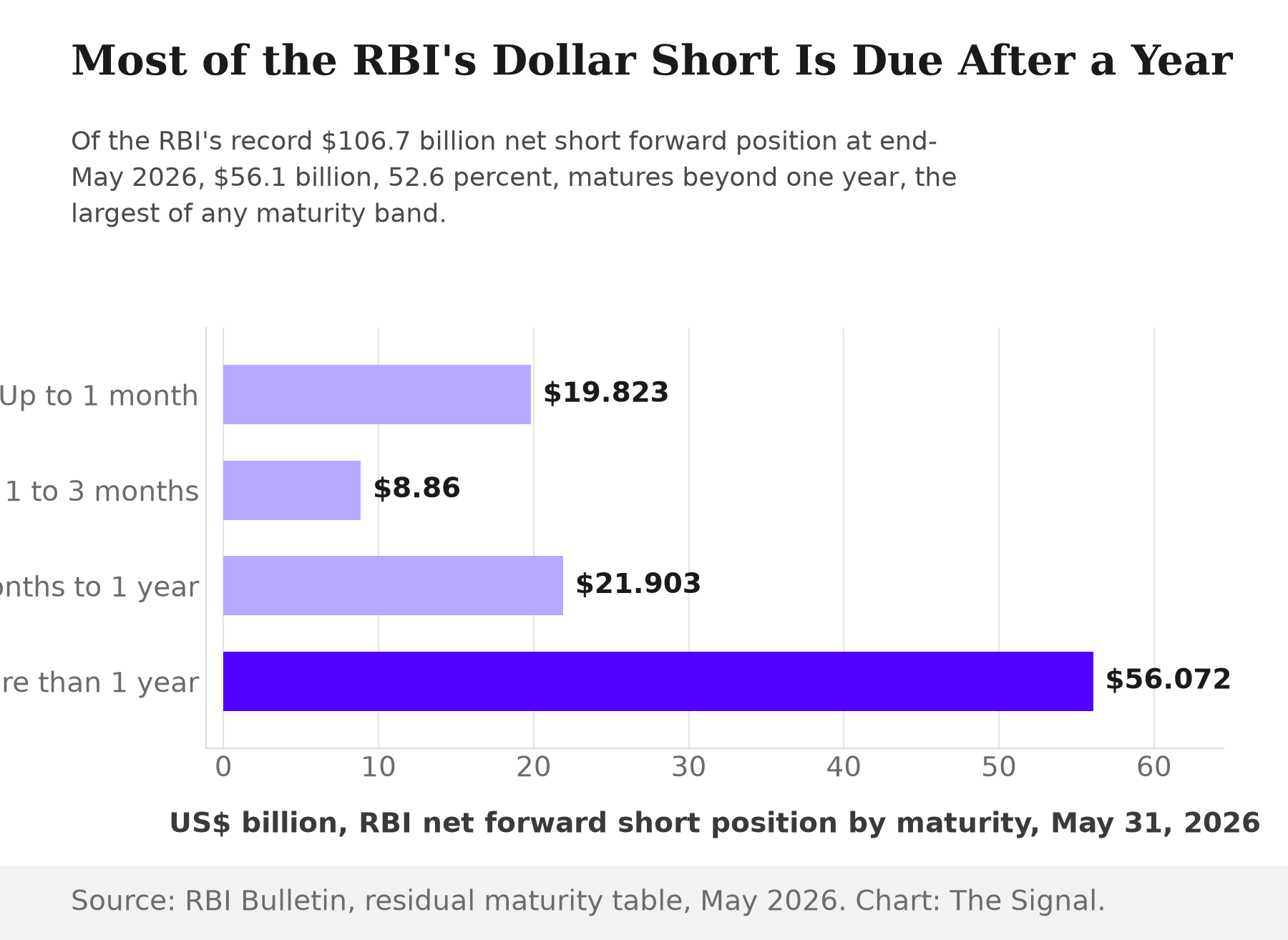
Source: RBI Bulletin, maturity breakdown of RBI's outstanding forwards, May 2026. Chart: The Signal.
The exchange-traded spike was not the RBI
NSE's exchange-traded USD-INR currency futures open interest climbed to a 2026 high of Rs 17,691.75 crore (1,862,644 contracts) at the end of May 2026, up from Rs 16,201.96 crore in April, then fell back to Rs 10,134.16 crore by the end of June, a drop of more than 40 percent in a single month. That peak landed in the exact month the RBI's own forward book peaked too.
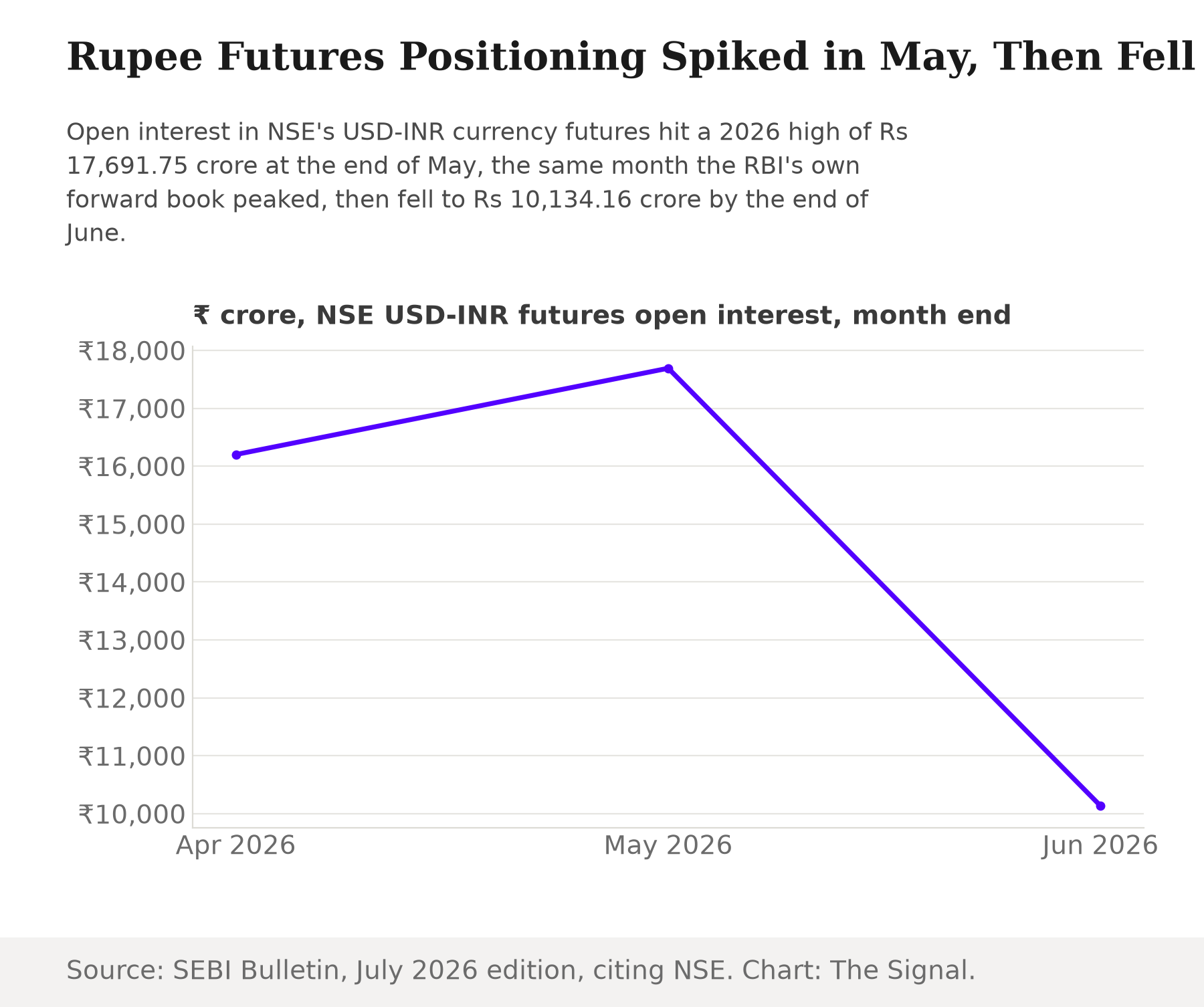
Source: SEBI monthly Bulletin, July 2026, Table 38, currency derivatives segment, NSE data. Chart: The Signal.
It would be easy to read that as the RBI's defense migrating onto the exchange. It has not. The RBI Bulletin shows the central bank's own currency-futures position stayed close to $1.4 billion throughout May, a rounding error next to its forward book. The May surge in open interest belongs to everyone else on the exchange, banks, corporates and traders positioning around the same currency stress that pushed the RBI deeper into forwards, not to the RBI itself.
A separate channel, running out
The RBI has also leaned on a channel that sits outside the weekly reserves print entirely. As of August 13, 2026, banks had mobilised $56.846 billion under the RBI's rupee-support inflow package: FCNR(B) deposits carry nearly all of it.
FCNR(B) deposits account for most of the RBI's inflow package.
| Channel | Amount mobilised (as of August 13, 2026) |
|---|---|
| FCNR(B) deposits | $52.300 billion |
| Overseas foreign-currency borrowings | $2.805 billion |
| External commercial borrowings | $1.741 billion |
| Total | $56.846 billion |
Source: Reserve Bank of India press release on forex inflows.
The swap facility attached to FCNR(B) deposits is available only for deposits mobilised through August 31, 2026, a date now just days away, though banks can still complete swaps with the RBI on deposits already mobilised until September 11, 2026. The parallel channels for overseas foreign-currency borrowings and external commercial borrowings stay open longer, through December 31, 2026. Once new FCNR(B) deposits stop qualifying, though, that channel stops adding to the pool, even as the forward book's longest-dated commitments keep stacking up.
The honest objection
The strongest case against reading any of this as a warning sign is that a large, long-dated forward book is exactly what an orderly, multi-year defense should look like. Selling dollars forward instead of dumping them in the spot market smooths volatility and avoids a single-day reserves shock. Pushing maturities out past a year looks like patient hedging that buys the RBI and the market more time to let flows normalise, rather than evasion. On that reading, a $106.658 billion forward book sitting beside $716.907 billion in reserves is a moderate, well-managed position, not a red flag.
The steelman has direct backing beyond the numbers, too. At the RBI's August 4, 2026 monetary policy press conference, Governor Sanjay Malhotra said the central bank's interventions "are limited to smoothing excessive and disruptive volatility in the foreign exchange market, without targeting any particular price band for the rupee," and that the RBI does not aim to defend any specific rupee level. By that logic, the size of the forward book is beside the point: the RBI is managing the pace of the rupee's move rather than its destination, and a bigger book simply reflects a bigger gap to smooth.
That case holds for the shape of the position. It says less about the scale and the timing. The book is not just large, it is a record, and the government's own parallel FCNR(B) inflow channel is closing to new deposits at the same time the longest-dated slice of that book keeps growing. Patient hedging does not usually coincide with the closure of a support facility it may need to lean on when those forward contracts eventually come due.
The Signal
None of this means the rupee defense is failing. It means the headline reserves number, the one that moves each Friday, is no longer the full picture of how hard the RBI is working to hold the currency. The real gauge is the forward book: its size, and how much of it keeps getting pushed past the one-year mark. Watch what happens once the FCNR(B) swap window shuts to new deposits after August 31, 2026, and watch the RBI Bulletin's maturity table each month after that. If the short position stabilises or shortens, the RBI is unwinding a hedge in an orderly way. If it keeps growing longer, the reserves headline will keep looking stronger even as the commitment sitting behind it gets harder to unwind quickly. A reserve you hold and a dollar you have already promised away are not the same number, even when they sit in the same central bank.
Reporting basis: the current and peak reserves figures are from the Reserve Bank of India's Weekly Statistical Supplement, with the February 2026 peak as reported by Akashvani/newsonair.gov.in citing RBI data. The RBI's outstanding forward position, its maturity breakdown, and its spot and currency-futures trading figures are all from the RBI Bulletin's monthly tables. NSE's currency-futures open interest is from SEBI's monthly Bulletin, which compiles NSE data. The FCNR(B), overseas-borrowing and external-commercial-borrowing inflow figures, and the channel-closure dates, are from an RBI press release on forex inflows. The RBI Governor's own account of the intervention rationale is from DD News's report on the August 4, 2026 monetary policy press conference. The share of headline reserves the forward book represents, the reserves-to-peak gap, the maturity-band comparison, and the open-interest percentage decline are The Signal's calculations from those figures.