
SEBI Chairman Tuhin Kanta Pandey said this week that the regulator's forthcoming AI and machine learning framework will require regulated entities to maintain kill switch mechanisms and "humans in the loop" controls, along with safeguards around data. He added that every SEBI-regulated entity remains fully responsible for any AI or machine learning tool it uses, whether built in house or bought from a vendor. SEBI's own filing shows the regulator first floated a public consultation paper proposing these AI/ML guidelines in June 2025, so today's remarks read as the obvious next step: a regulator getting ahead of a technology before it causes damage.
It is worth slowing down on that framing. A SEBI circular already requires brokers and exchanges to maintain an automated kill switch able to halt trading from a malfunctioning algorithm, effective August 1, 2025, about a year before Pandey's remarks. That rollout did not go cleanly. SEBI itself pushed the algo trading compliance deadline to October 2025 and then to a phased "glide path" into 2026, after brokers said they needed more time to update their systems. The kill switch is not a new invention. What changed today is who it is aimed at, and the timeline shows the base rule was still bedding in when the AI-specific layer was announced.
SEBI's kill switch did not start with this week's announcement.
| Date | Milestone |
|---|---|
| February 2025 | A SEBI circular requires an automated kill switch for algorithmic trading, effective August 1, 2025 |
| June 2025 | SEBI floats a public consultation paper proposing formal AI/ML usage guidelines |
| September 2025 | SEBI pushes the algo trading compliance deadline to a phased glide path into 2026, after brokers say they need more time |
| August 2026 | SEBI Chairman Tuhin Kanta Pandey says the forthcoming framework will add AI-specific kill switch and human-in-the-loop requirements |
Source: SEBI circulars (February, June and September 2025) and SEBI Chairman Tuhin Kanta Pandey's August 2026 remarks, as cited above.
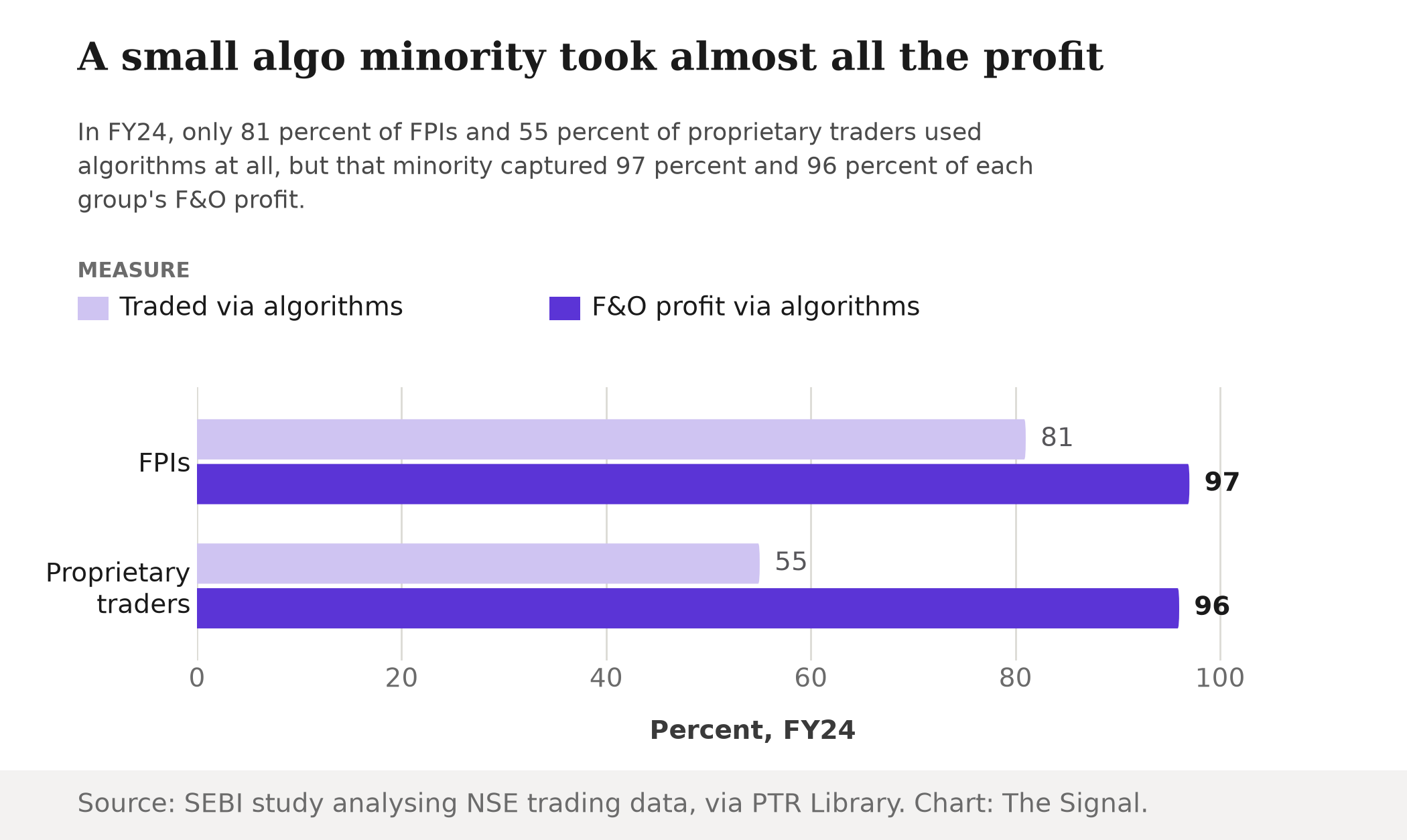
Algorithms are not a marginal presence in that market. They captured a record 53% of NSE cash market turnover in 2024, overtaking manual trading for the first time and up from just 14% in 2010. The reason for a second layer arrives in a different SEBI dataset entirely. In FY24, 97% of FPIs' and 96% of proprietary traders' gross F&O profits came from algorithmic trading, even though only 81% of FPIs and 55% of proprietary traders used an algorithm at all. Individual traders, by contrast, traded through algorithms in just 13% of cases. Whatever the stated rationale for the new AI rules, they are arriving in a market where the minority who already use algorithms collect almost all the money on the table.
A small algo-using minority already captured nearly all the institutional profit.
Who the new rules are actually built for
The AI framework layers a second obligation on top of the kill switch. SEBI's algo trading circular already requires providers of "black box" algorithms, those whose logic is not disclosed to the exchange, to register as a Research Analyst and maintain a detailed research report for every such algo, a compliance load smaller providers do not carry today. Add Pandey's accountability rule: a regulated entity now answers for an AI tool whether it built the tool or bought it. That extra weight falls hardest on smaller desks. A large FPI or a bank-owned broker can already spread a Research Analyst registration and a report-per-algo obligation across a compliance department; a smaller desk cannot.
That matters because the profit data above is not evenly spread within either group. FPIs and proprietary desks large enough to run in-house algorithmic strategies are also the ones with the compliance headcount to absorb a new registration regime. A smaller proprietary trading firm running a handful of black-box strategies faces the same paperwork with none of the scale to spread it across.
The profit the switch arrives after
The other side of that FY24 breakdown is retail. SEBI's own study found that 93% of individual traders in India's equity F&O segment lost money in the three fiscal years through FY24, with aggregate losses exceeding Rs 1.8 lakh crore. These are largely the same traders who barely touch algorithms at all.
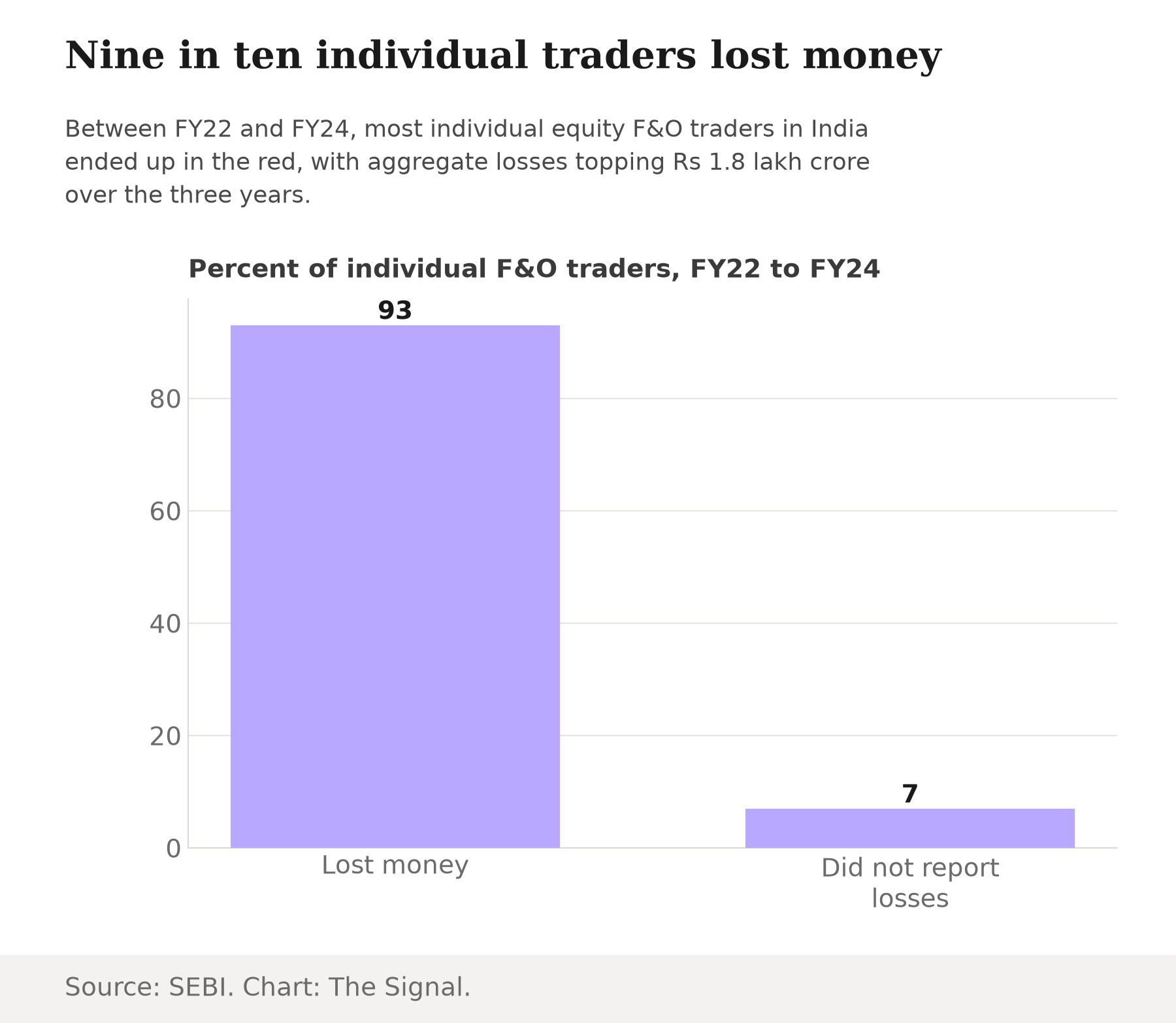
Put the two SEBI datasets side by side. Individual traders used algorithms in just 13% of cases and were the group least exposed to them; 93% of that same population lost money over the period. SEBI's new AI rules do not change that split. They regulate the machinery of the winning side.
The honest objection
The strongest case against reading the kill switch as a response to who profits is that it was never framed that way. SEBI's own circular describes the kill switch as an emergency function and the last level of defence against an algorithm malfunction, expected to automatically halt trading based on pre-defined conditions. That is a description of operational safety, not fairness. On this view, the profit gap between algo and non-algo traders more plausibly reflects capital, speed and sophistication advantages that predate any of these rules. A kill switch does nothing to touch that gap; it only stops a runaway program from doing more damage once something breaks.
That case holds for the switch itself. It does not hold for the accountability and registration rules layered on top of it. Every SEBI-regulated entity is now answerable for an AI tool it merely bought, and black-box algorithm providers must register as Research Analysts and maintain a report for every algo; that changes which desks can afford to operate in a market this concentrated, regardless of why the underlying safety rule exists. A kill switch is neutral machinery. The paperwork wrapped around it is not.
The Signal
The kill switch itself is not the news. It has been in force since August 2025, and the broader compliance timeline around it had already slipped once by the time Pandey spoke. What he added this week is an accountability layer that puts every AI tool, homegrown or bought, on the regulated entity's own book. It arrives at the exact moment a small algorithm-using minority already keeps almost everything the FPI and proprietary segments made in FY24, while the rest of the market, largely without algorithms, is mostly losing money. Watch whether the black-box registration rule changes which desks can afford to run an algorithmic strategy in India, or simply formalizes the position the largest ones already hold. A switch installed after the money has already moved does not choose the winner. It only decides who answers for the next malfunction.
Reporting basis: SEBI Chairman Tuhin Kanta Pandey's remarks on the forthcoming AI/ML framework are as reported by Moneylife and, separately, by the Free Press Journal. The June 2025 consultation paper, the February 2025 kill switch and algo-trading circular, the September 2025 deadline revision, and the September 2024 study of individual trader losses between FY22 and FY24 are all primary SEBI documents; the February 2025 circular text was independently cross-checked via NCDEX's and the Calcutta Stock Exchange's verbatim copies distributed to their members. The FY24 algorithmic trading profit and participation breakdown is from a SEBI study of NSE trading data, as reproduced by PTR Library. The FPI and proprietary trader algorithm participation rates, 81% and 55%, are The Signal's calculations from the raw trader counts in that same study. The market-wide algo-trading turnover figure for NSE's cash market is as reported by Investing.com, citing NSE's own Market Pulse data.