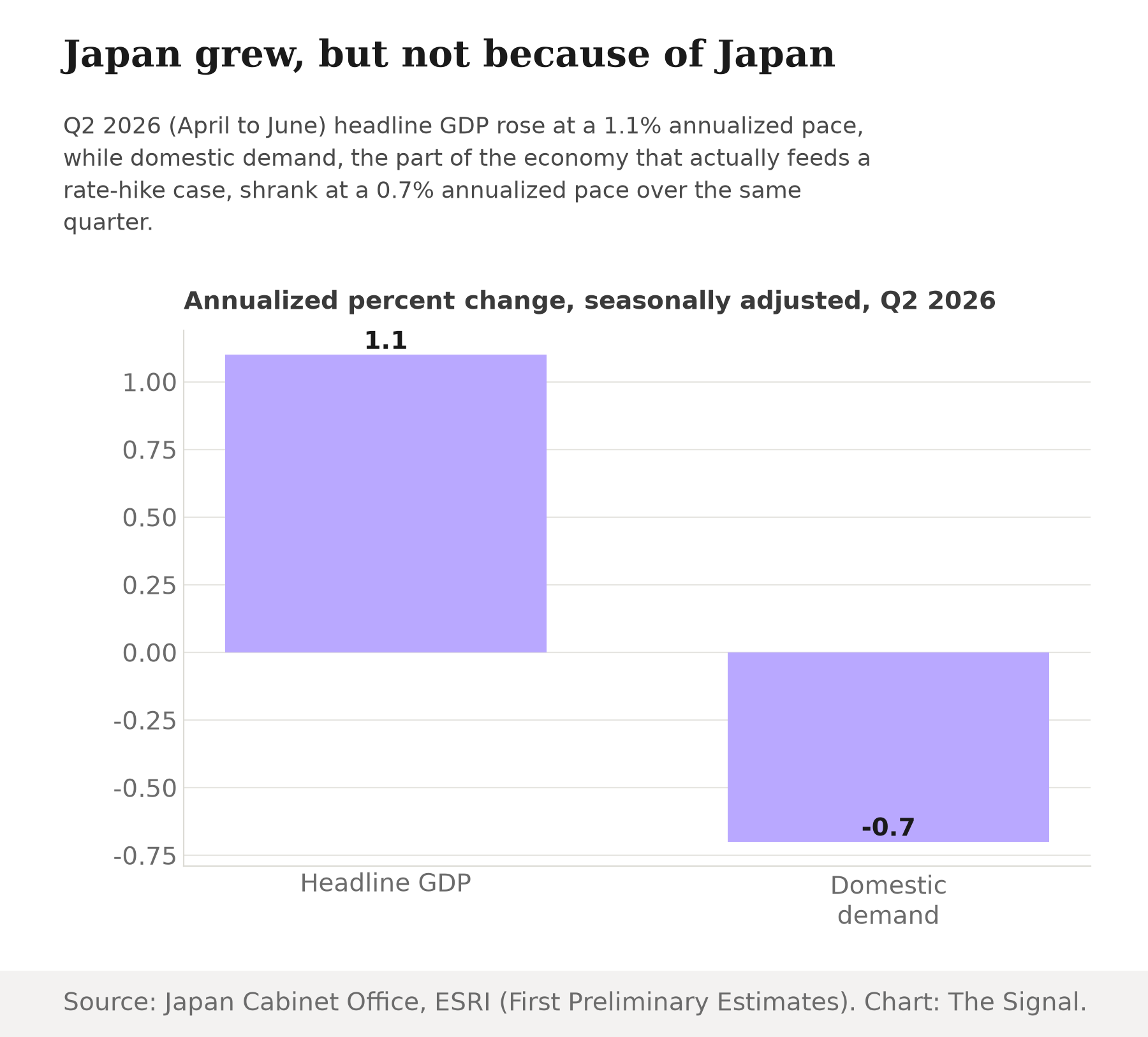
Japan's Cabinet Office released its first look at second-quarter growth on August 17, 2026, and the headline missed what economists had been penciling in. Real GDP grew a seasonally adjusted 0.3% quarter-on-quarter in the April-June period, an annualized 1.1%, while domestic demand, the spending and investment that actually happens inside Japan's own economy, contracted at an annualized 0.7% pace over the same quarter. That is not a marginal shortfall: the median economist forecast going into the release was for annualized growth of 2.0%, nearly double what Japan actually posted. Read as a stand-alone number, that is a weak print from an economy that needed a stronger one.
It is worth slowing down on why a soft number out of Tokyo is being read as a relief in Mumbai. The connection runs through a single institution's calendar, not through any Indian data at all: a Bank of Japan that looked closer to raising rates a month ago just got a data point that makes it easier to wait, and waiting is exactly what a fragile turn in Indian foreign flows needs right now.
Why one number moves a central bank
The Bank of Japan was not idle going into this GDP print. At its July 31, 2026 meeting, the board held its policy rate at around 1.0% by an 8-1 vote, and the lone dissenter proposed an immediate move to 1.25%, arguing the Bank needed a nimbler response to upside price risks. That is not a central bank in wait-and-see mode by default. It is a board with a real internal argument for moving sooner, held back for now by a majority that preferred patience.
A GDP report showing domestic demand shrinking on an annualized basis is exactly the kind of evidence that strengthens the patient majority's hand over the dissenting minority's. The next scheduled Monetary Policy Meeting, on September 17-18, 2026, is the first live test of whether the weak print actually delays the anticipated hike, or whether the board's hawks use the month between now and then to make their case instead.
What happened last time Tokyo hiked into this
India has already lived through what happens when this goes the other way. The Bank of Japan's July 31, 2024 rate hike, landing alongside a weak US jobs report, triggered a rapid unwind of an estimated ¥40 trillion, about $250 billion, in yen-funded carry trades. The stress peaked on August 5, 2024, when Japan's own TOPIX index lost 12% in a single day. The shock traveled: India's Sensex fell 2,222 points, 2.7%, to close at 78,759 that day, and the Nifty fell 662 points, 2.6%, to 24,055.
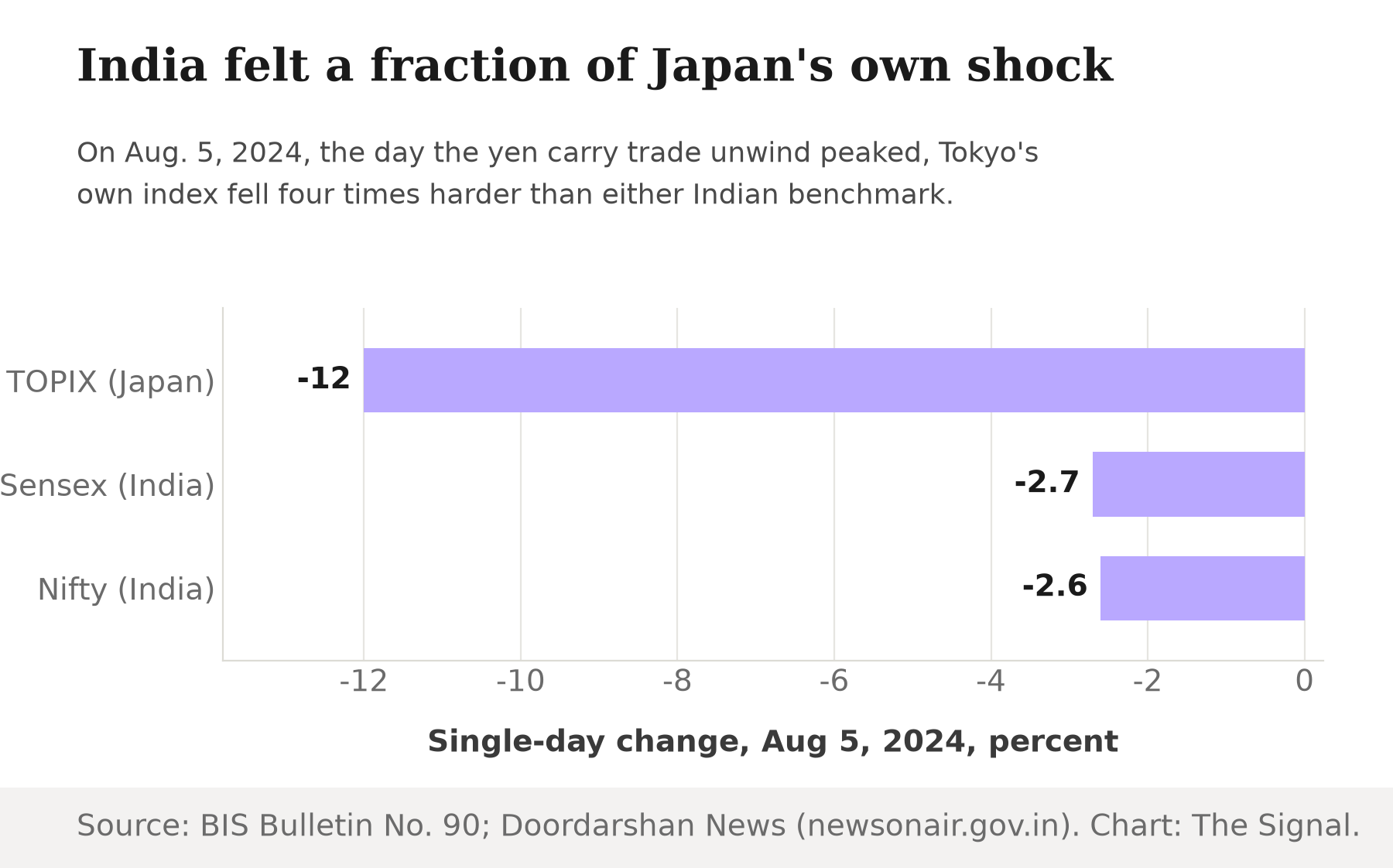
Even at the peak of a global unwind, Tokyo's own index fell more than four times as hard as either Indian benchmark that day, a gap wide enough to show the shock reached India mostly as sympathy selling, not as a direct hit. And the sympathy selling did not last: despite the single-day crash, foreign portfolio investors ended August 2024 as net buyers of Indian equities, investing a net ₹7,320 crore into the market that month. One violent day did not flip the month.
Why the timing is different this time
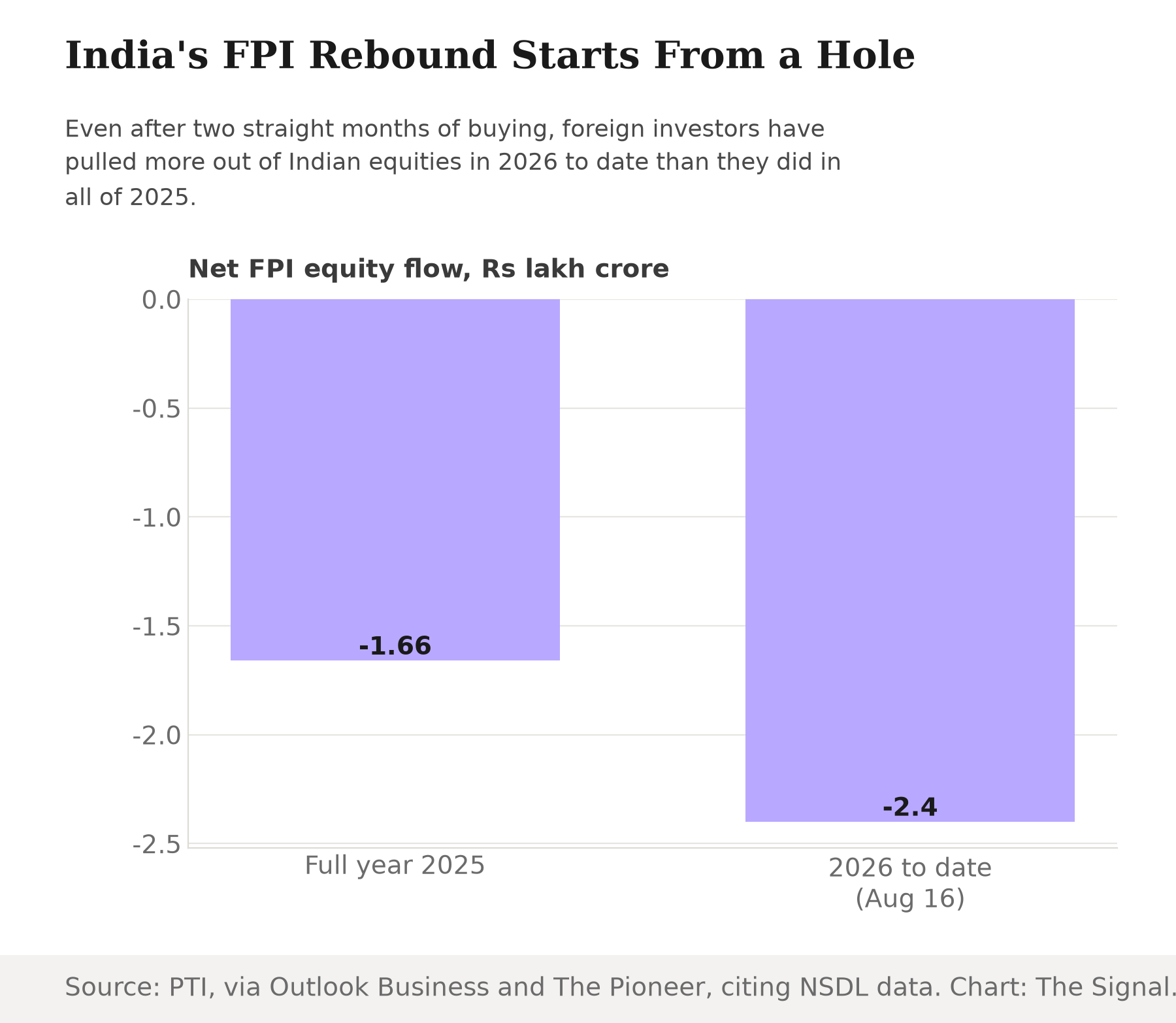
That resilience in 2024 rested on a base that was already buying. India's 2026 starting point is not. Foreign investors invested ₹16,621 crore into Indian equities in the first fortnight of August 2026, following a ₹20,200 crore investment in July 2026, reversing four straight months of selling. That is a genuine turn. But despite that July-August buying, foreign investors remained net sellers of Indian equities for 2026 overall, having withdrawn around ₹2.4 lakh crore year-to-date, a figure that already exceeds the ₹1.66 lakh crore outflow recorded in all of 2025. With more than four months of 2026 still to run, this year's outflow is already about ₹74,000 crore ahead of last year's full-year total.
The mechanics are the same as 2024. The starting conditions are not.
| Metric | August 2024 | August 2026 |
|---|---|---|
| Bank of Japan posture | Hiked rates, catalyzing the shock | Held near 1.0%, on an 8-1 vote |
| Single-day India equity move | Sensex down 2.7%, Nifty down 2.6% (Aug 5) | No equivalent shock; a GDP miss instead |
| Monthly FPI flow context | Net buyers for the month, +₹7,320 crore | Net sellers year-to-date, -₹2.4 lakh crore, despite July and August buying |
Source: Bank for International Settlements, Bulletin No. 90; Doordarshan News (newsonair.gov.in); the Bank of Japan; PTI, via Outlook Business and The Pioneer.
In 2024, a violent one-day shock landed on a market that was already buying for the month. A repeat now would land on a market still ₹2.4 lakh crore underwater for the year, only two months into a reversal that has not had time to compound. That is the mechanism connecting a soft Japanese GDP print to Indian market stability: it does not make foreign investors buy. It just removes, for six more weeks, a trigger that could otherwise interrupt them.
The honest objection
The strongest case against reading this as a reprieve is that the July 31, 2026 vote to hold was not unanimous. The dissenting board member explicitly pushed for a move to 1.25%, arguing Japan faced upside price risks that needed a nimble response, and a single soft quarter does not retire that argument. If inflation data between now and mid-September firms up, the September 17-18, 2026 meeting is exactly the forum where the hawkish minority could become the majority. Nothing about this GDP print guarantees the Bank of Japan stays on hold.
It is also fair to note that India's 2024 experience shows FPIs can absorb a real shock without turning net negative for the month, which cuts against any assumption that a repeat would be catastrophic. Both objections are real. But neither changes what is actually different this time: the flow base a fresh shock would hit is not the same one that absorbed August 2024's crash. It is one still recovering from a ₹2.4 lakh crore hole, where a two-month buying streak is fragile precisely because it is new.
The Signal
This piece traces a second-order effect doing work no domestic Indian catalyst is doing right now. A weak GDP print in Tokyo buys the Bank of Japan room to hold, and holding is what keeps the carry trade unwind risk that hit India in August 2024 off the table for another month. Watch the September 17-18, 2026 meeting: if the patient majority holds again, India's foreign-investor rebound gets more room to dig out of its ₹2.4 lakh crore hole. If the hawkish minority converts, the mechanism that hit Indian markets in August 2024 is back in play, this time against a shallower base of buying. Either way, the number worth watching next is not in Mumbai. It is in Tokyo.
Reporting basis: Japan's second-quarter 2026 GDP figures are from the Cabinet Office's Economic and Social Research Institute, First Preliminary Estimates, and the 2.0% median consensus forecast it missed is from TradingEconomics' economic calendar. The Bank of Japan's July 31, 2026 policy decision, vote count and dissenting proposal, along with its September 2026 meeting date, are from the Bank of Japan's own published statement and schedule. The mechanics and scale of the 2024 yen carry trade unwind, including the ¥40 trillion figure and the TOPIX decline, are from a Bank for International Settlements bulletin. India's August 5, 2024 Sensex and Nifty closes and August 2024's net FPI equity investment are from Doordarshan News (newsonair.gov.in), India's public broadcaster. The July and first-half-August 2026 FPI figures, and the 2026 year-to-date comparison against 2025's full-year outflow, are PTI wire figures, carried by Outlook Business and, separately, The Pioneer. The ratio of Japan's single-day index decline to India's, and the gap between 2026's year-to-date FPI outflow and 2025's full-year total, are The Signal's calculations from those figures.