India's initial public offering market just closed its biggest year on record. SEBI's Monthly Bulletin for April 2026 puts FY2025-26 at a record 366 IPOs raising roughly Rs 1.9 trillion, a 9.5 percent increase over FY2024-25, with the mainboard segment alone accounting for 109 listings and Rs 1.7 trillion of that total. Read only the top line and the story writes itself: Indian companies are tapping the public market for growth capital at a pace they never have before.
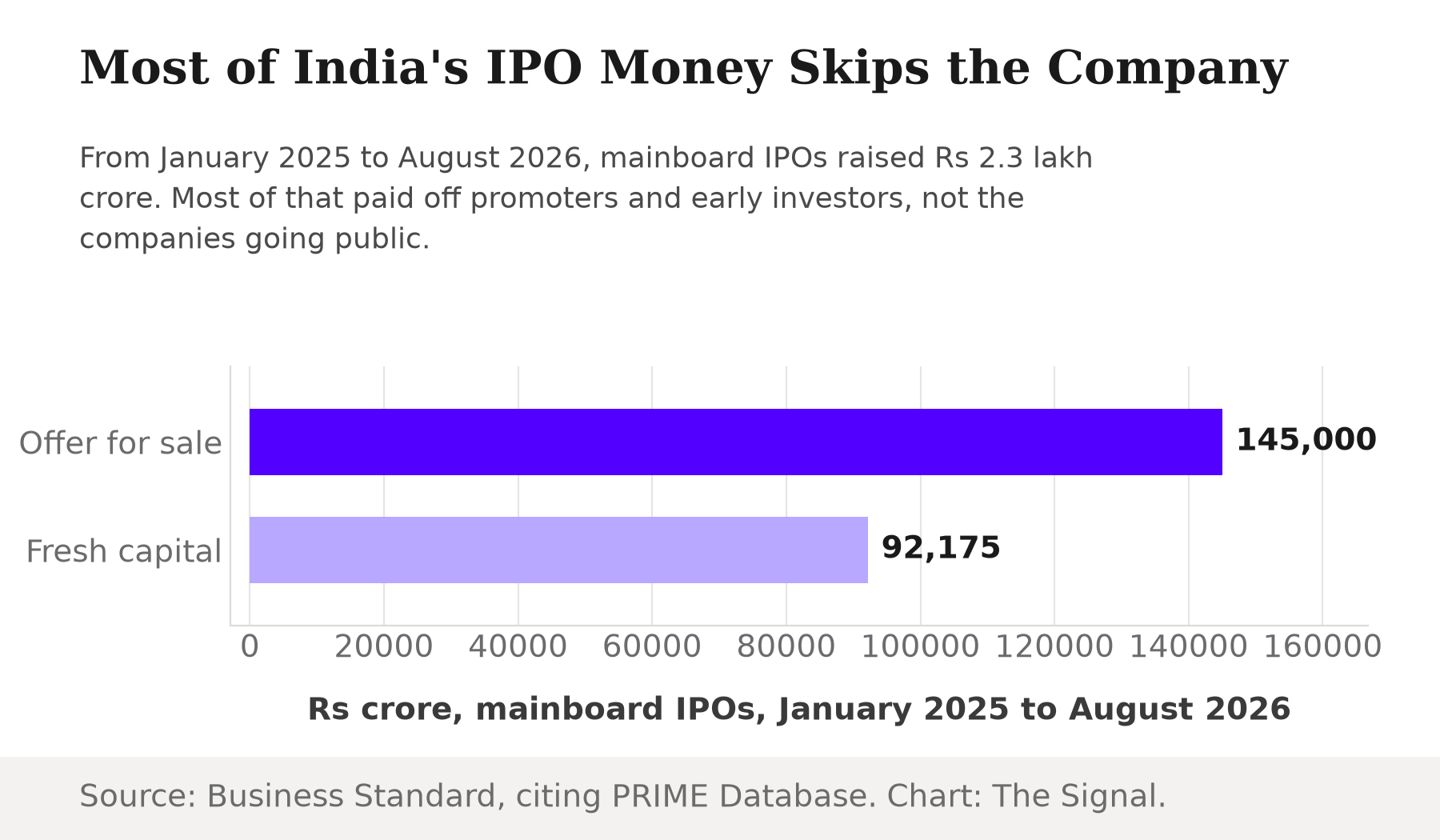
It is worth slowing down on that framing. SEBI's own annexure data show that of the Rs 1,77,029 crore mainboard IPOs raised in FY2025-26, Rs 1,07,706 crore, 60.8 percent, came through offer for sale, the mechanism by which existing shareholders sell stock they already hold, rather than new shares the company issues. Only Rs 69,323 crore, 39.2 percent, was fresh capital that actually reached the listing companies' balance sheets. And it is not a one-year quirk: from January 2025 through August 2026, mainboard IPOs raised a combined Rs 2.3 lakh crore, of which Rs 1.45 lakh crore, 61.2 percent, came via offer for sale and just Rs 92,175 crore, 38.8 percent, was fresh capital, according to PRIME Database data reported by Business Standard.
Six of every ten rupees raised through a mainboard IPO in India over the past year and a half went to someone selling shares, not to the company that listed.
The zero at the extreme end
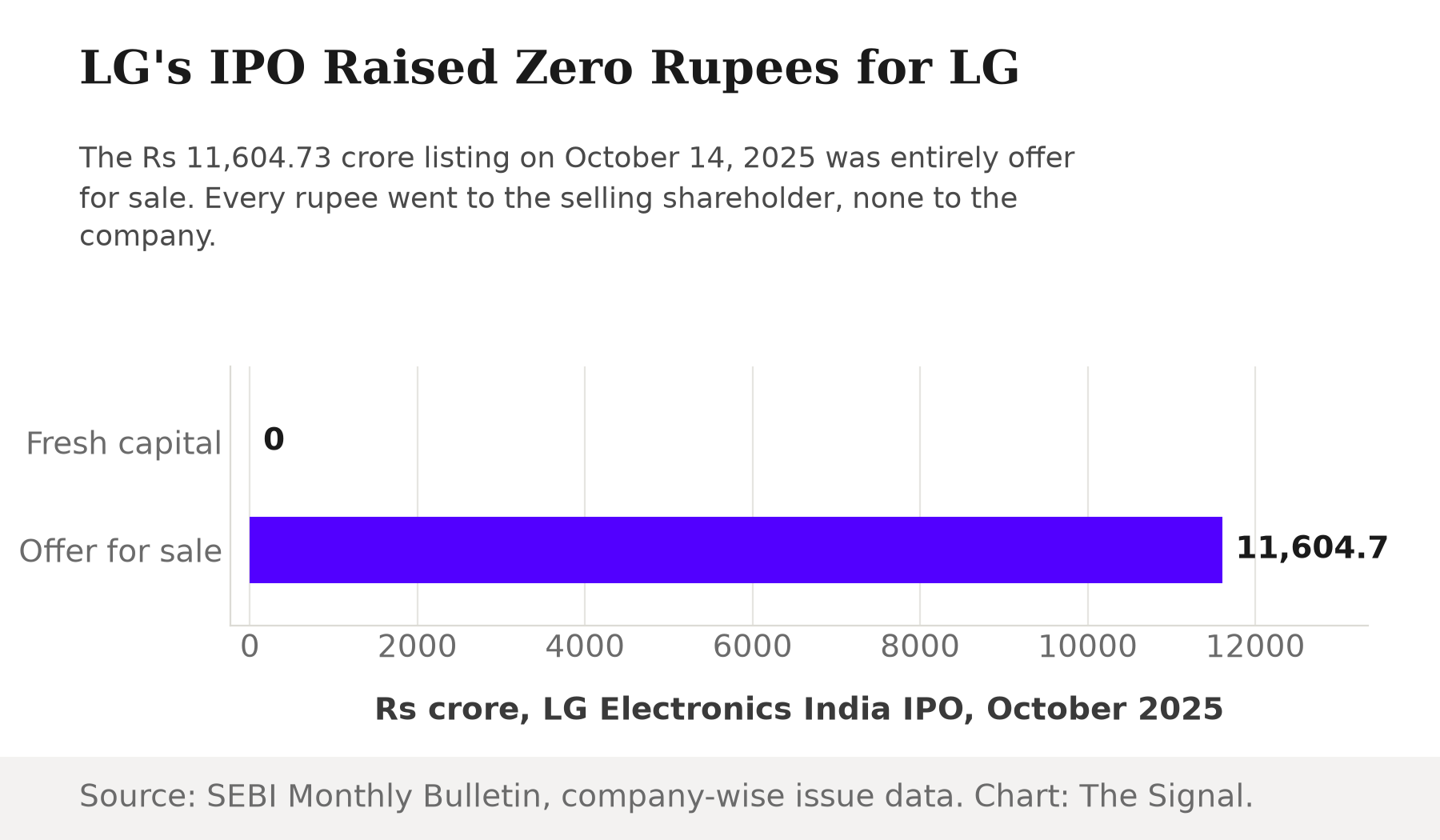
The clearest illustration sits in a single filing. LG Electronics India's Rs 11,604.73 crore listing on October 14, 2025 was entirely offer for sale: SEBI's company-wise issue data record its fresh-issue component as zero. Every rupee of that raise, one of the largest of FY2025-26, went to the selling shareholder, LG's Korean parent, not to LG Electronics India itself. The subsidiary got a stock listing and a public market price, and none of the proceeds.
What growth capital actually looks like
Compare that with India's SME platform, the exchange segment for smaller listed companies. SEBI's data for FY2025-26 show SME IPOs raised Rs 11,587 crore across 257 issues, but only Rs 2,008 crore, 17.3 percent, came via offer for sale; Rs 9,579 crore, 82.7 percent, was fresh capital, the reverse of the mainboard's split. The gap holds at monthly scale too, not just across the full year.
In June 2026 alone, mainboard IPOs stayed OFS-heavy while SME IPOs stayed fresh-capital-heavy.
| Segment | Raised, June 2026 | Issues | OFS share |
|---|---|---|---|
| Mainboard IPOs | Rs 1,652 crore | 3 | 60% |
| SME IPOs | Rs 845 crore | 19 | 5% |
Source: SEBI Monthly Bulletin, July 2026 issue.
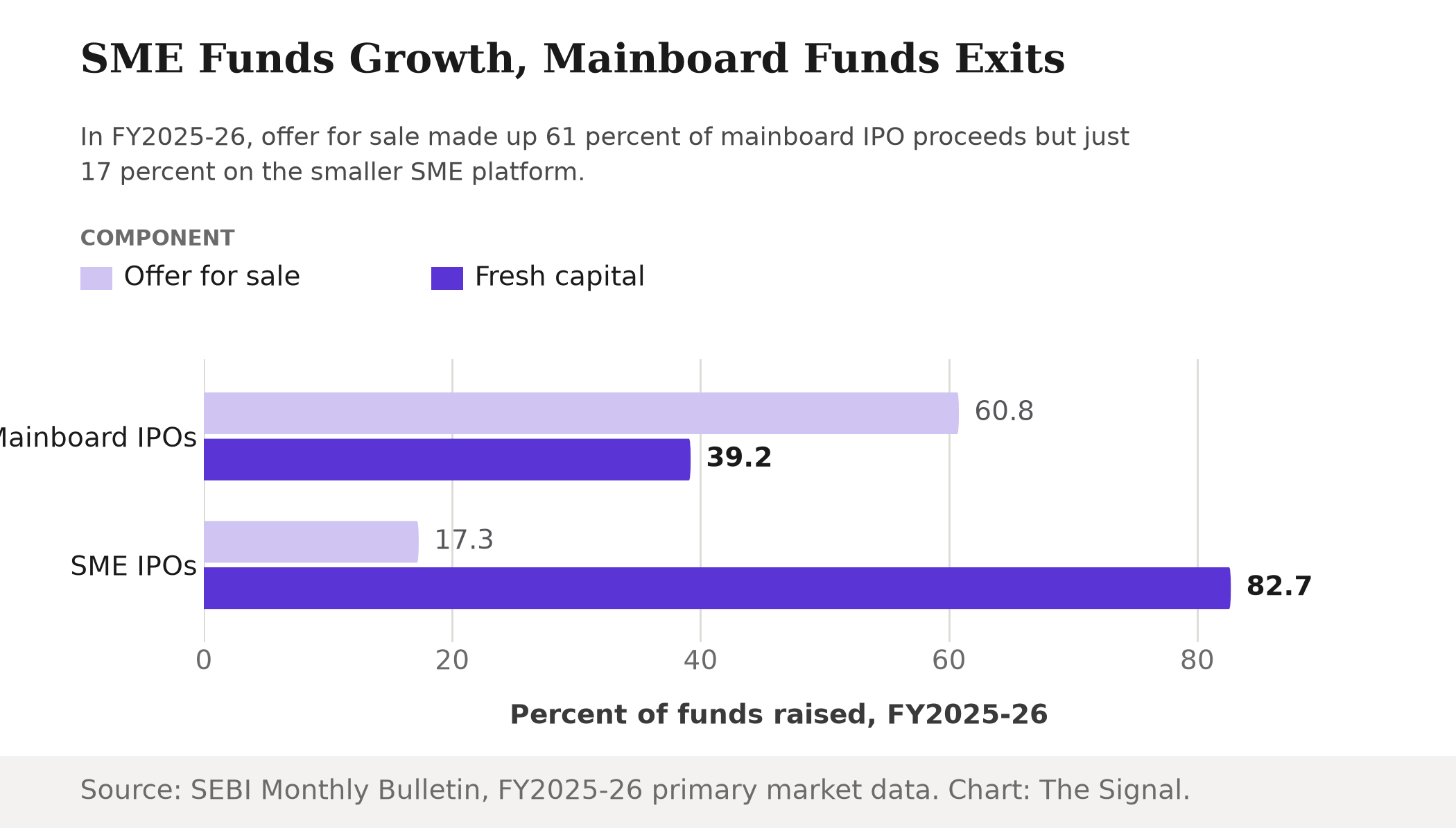
SME-listed companies are, by definition, smaller and younger, and more likely to actually need the money they raise. That they route four-fifths of their IPO proceeds into the company while the mainboard routes six-tenths of its proceeds out to sellers is not a coincidence of scale; it is what an IPO market weighted toward growth capital would look like, if the mainboard were built the same way.
Not a new pattern
None of this is a recent shift. Equirus Capital's analysis, reported by Business Standard, puts the OFS share of total Indian IPO funds raised at over 50 percent in 2025, up from under 10 percent in 2011 and almost nil in 2001: a rise that has run for roughly two and a half decades without reversing. PRIME Database figures, also reported by Business Standard, show that since 2015, nearly three-fourths of total Indian IPO fundraising, Rs 4.73 lakh crore, has been offer for sale, against just Rs 2.44 lakh crore raised as fresh capital. The record year that opened this piece is not a break from the pattern. It is the pattern, at a larger scale than before.
A regulatory push, not just a preference
Part of this is not just what promoters and sellers want; it is what SEBI's own rulebook requires. Under SEBI's Securities Contracts (Regulation) Rules, an issuer that lists with less than 25 percent of its shares in public hands must bring public shareholding up to at least 25 percent within five years, regardless of whether the company itself needs any more capital; SEBI's own August 2025 board memorandum on the rule acknowledges that this requirement is hardest to meet for issuers that are profitable, cash-rich, or past their high-growth phase and so have no need to raise capital at regular intervals. A company in that position still has to dilute equity to comply. Selling existing shares rather than issuing new ones lets it meet that obligation without forcing capital onto a balance sheet that does not need it. That mechanism does not explain every mainboard OFS, but it is a structural push SEBI's own rules create, not simply a pattern of promoters choosing to cash out.
The honest objection
The strongest case against reading this as a problem is that an exit is not automatically a loss for the company or the market. Promoters and private equity investors need a route to cash out so they can redeploy that capital into the next venture; a market that lets founders and funds sell down stakes after years of holding them is doing what a functioning secondary market is supposed to do. LG Electronics India did not need its IPO proceeds to fund operations. It is a mature, profitable consumer electronics business already backed by a well-capitalized global parent; the listing's purpose was a public valuation and a partial exit, not a capital raise, and judging that transaction by how much it raised for the company holds it to a standard it was never trying to meet.
That case holds for a single mature subsidiary, but it holds less well as a description of an entire market. The OFS share has climbed from almost nil in 2001 to over 50 percent in 2025 across companies of every size and sector, not just a handful of large, already-funded multinational arms, and SME IPOs, which by definition list younger and smaller companies still actually short of capital, raised 82.7 percent of their FY2025-26 proceeds as fresh capital, running in the opposite direction from the mainboard. If the mainboard split were purely a function of individual company maturity, it would vary company by company. Instead it holds steady across a Rs 2.3 lakh crore, nineteen-month sample of the largest, most closely watched Indian listings, which points to a market-structure pattern rather than a case-by-case judgment call.
The Signal
The headline number every year is how much money India's IPO market raised. The OFS share shows what that money actually does. Six of every ten rupees raised by mainboard IPOs from January 2025 to August 2026 went to somebody selling, not a company building; for LG Electronics India specifically, the company got none of it. That split is not a scandal. Promoters are entitled to sell what they own, and a deep secondary market is a sign of a maturing exchange, not a sick one. But it means a reader who treats a record IPO year as shorthand for a record year of capital formation is measuring the wrong thing. Watch the OFS share on the next large filing before the size of the raise. If it clears 60 percent again, the market is doing what it has done for years: pricing an exit, not funding growth.
Reporting basis: FY2025-26 IPO volumes and the mainboard-versus-SME offer-for-sale split are from SEBI's Monthly Bulletin, primary data SEBI compiles from BSE and NSE filings, drawn from three separate 2026 issues (April, early-July and late-July) plus LG Electronics India's company-wise listing record in the November 2025 issue. The January 2025 to August 2026 aggregate is as reported by Business Standard, citing PRIME Database; the multi-decade OFS trend since 2001 and the since-2015 fundraising split are also as reported by Business Standard, citing Equirus Capital's analysis and PRIME Database respectively. Those three figures rest on secondary reporting of data compiled by outside research firms, not on a primary release The Signal could independently pull. Every percentage and rupee figure in this piece is as stated by its source; none is a Signal-calculated derivation.