On August 3, 2026, India's stock exchanges switched on a new way of setting the closing price. SEBI's circular put the Closing Auction Session (CAS) into effect for F&O-eligible stocks in the cash segment. CAS is a 20-minute single-price auction, replacing the old 30-minute volume-weighted-average-price method. The regulator had built it over months of consultation. The pitch was simple: a shorter, cleaner auction window would make the single most-watched number in Indian markets, the daily close, harder to game.
It is worth slowing down on what CAS was actually replacing. A July 2025 SEBI interim order found that Jane Street Group entities had earned an estimated Rs 4,843.57 crore in unlawful gains from index manipulation on Nifty and Bank Nifty expiry days under the prior closing-price mechanism, and ordered the amount impounded. CAS is not a routine plumbing upgrade. It is the regulator's direct answer to the most expensive closing-price manipulation case in the history of India's derivatives market.
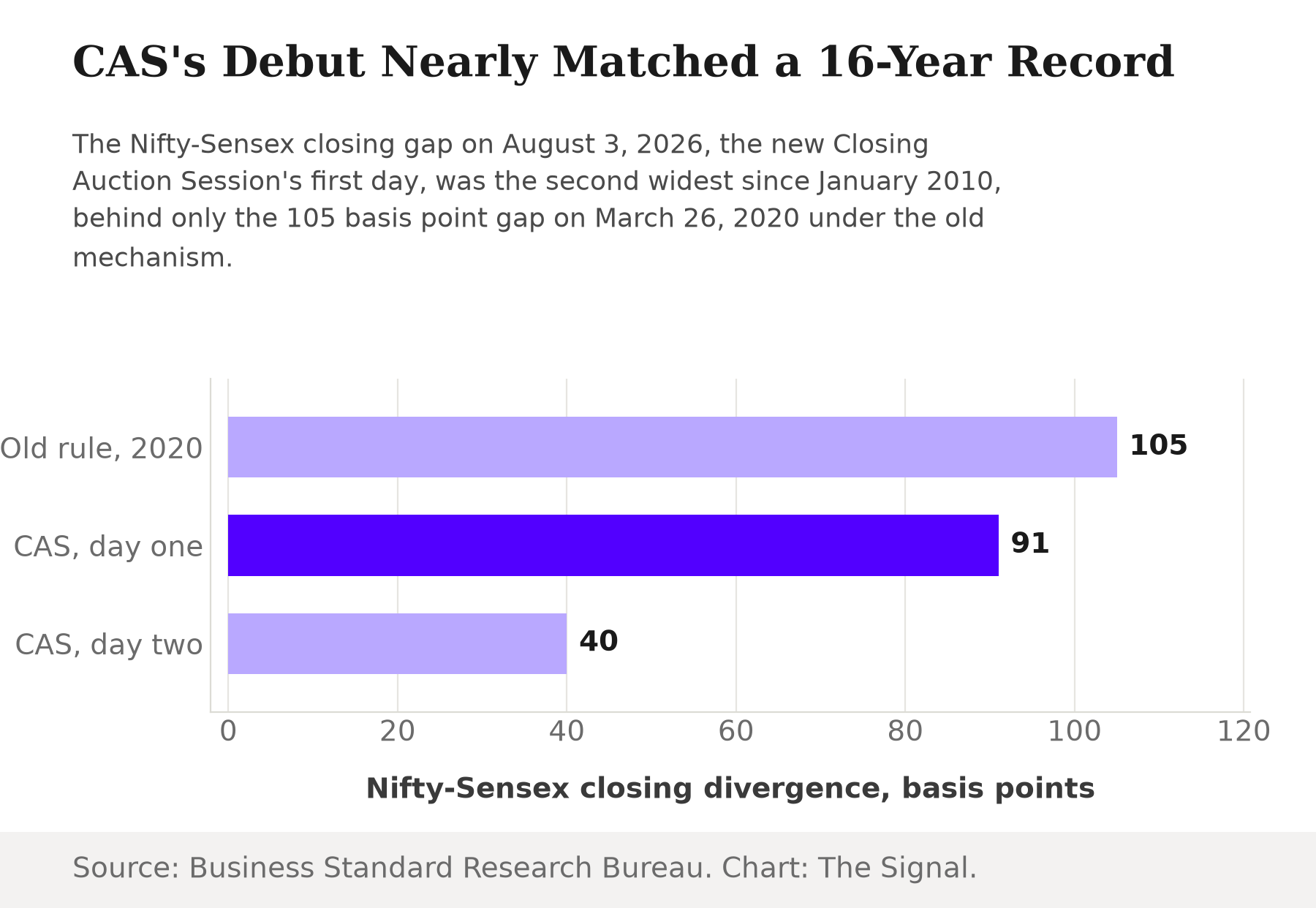
Now strip away the reform narrative and look at what the new rule actually did on its own debut. On CAS's first trading day, the Nifty closed 1.6% higher at 24,774 while the Sensex gained just 0.7% to 78,639, a 0.9 percentage point divergence between the two indices, the second-widest since January 2010, behind only a 105 basis point gap recorded on March 26, 2020. A mechanism built after a Rs 4,843 crore manipulation case produced, on day one, the second-largest closing anomaly since 2010.
CAS's debut nearly matched India's biggest closing-price anomaly since 2010.
What actually changed on August 3
SEBI's redesign touched two things: the length of the window and the way the price inside it is set.
| Feature | Old closing method | Closing Auction Session (CAS) |
|---|---|---|
| Window | 30 minutes | 20 minutes |
| Pricing method | Volume-weighted average price | Single-price call auction |
| Scope | All listed stocks | F&O-eligible stocks, cash segment |
Source: SEBI's circular.
CAS's 20-minute window is also long by the standards of the markets it was modeled on. The New York Stock Exchange runs a 10-minute pre-close window before its own single-price closing auction, with order-imbalance information starting to publish at 3:50 p.m. ET and the auction itself beginning at 4:00 p.m. ET. Cboe Europe goes tighter still: its pan-European order book, which trades London Stock Exchange-listed and other European stocks, allows just 5 minutes for the closing auction call, plus up to a 30-second random extension. CAS is two to four times longer than either.
The second day tested the new mechanism harder than the first. August 4, 2026 was a weekly derivatives expiry day, and the Nifty and Sensex diverged by 0.4 percentage points: the Sensex fell 0.3% to end at 78,429 while the Nifty fell 0.64% to 24,615, after moving up 0.6% during the closing auction window alone. A single 20-minute window was enough to swing the index six-tenths of a percentage point from where it had been trading moments before it opened.
The regulator is now checking its own fix
SEBI is examining trades executed during the Closing Auction Session on August 3 and 4, 2026, and has sought trading data from the exchanges to check whether the sharp gap between pre-CAS and post-CAS index levels reflected normal trading or manipulation. That is a striking position for a regulator to be in eight days into a reform. CAS exists because a prior closing mechanism was gamed for thousands of crores. Its own opening week produced a gap large enough that the same regulator now needs to rule out the same thing happening again, this time inside the tool built to prevent it.
The rule built to end expiry-day manipulation is now the subject of a manipulation check on its own first week.
Retail traders want out
The response outside SEBI's building has been louder than the one inside it. Retail day traders organized an online campaign urging a one-day boycott of trading on August 12, 2026, to protest CAS and press for its rollback. The complaint is less about manipulation than about who a 20-minute single-price auction favors: a trader who cannot react inside that window loses control of the price at which their position closes.
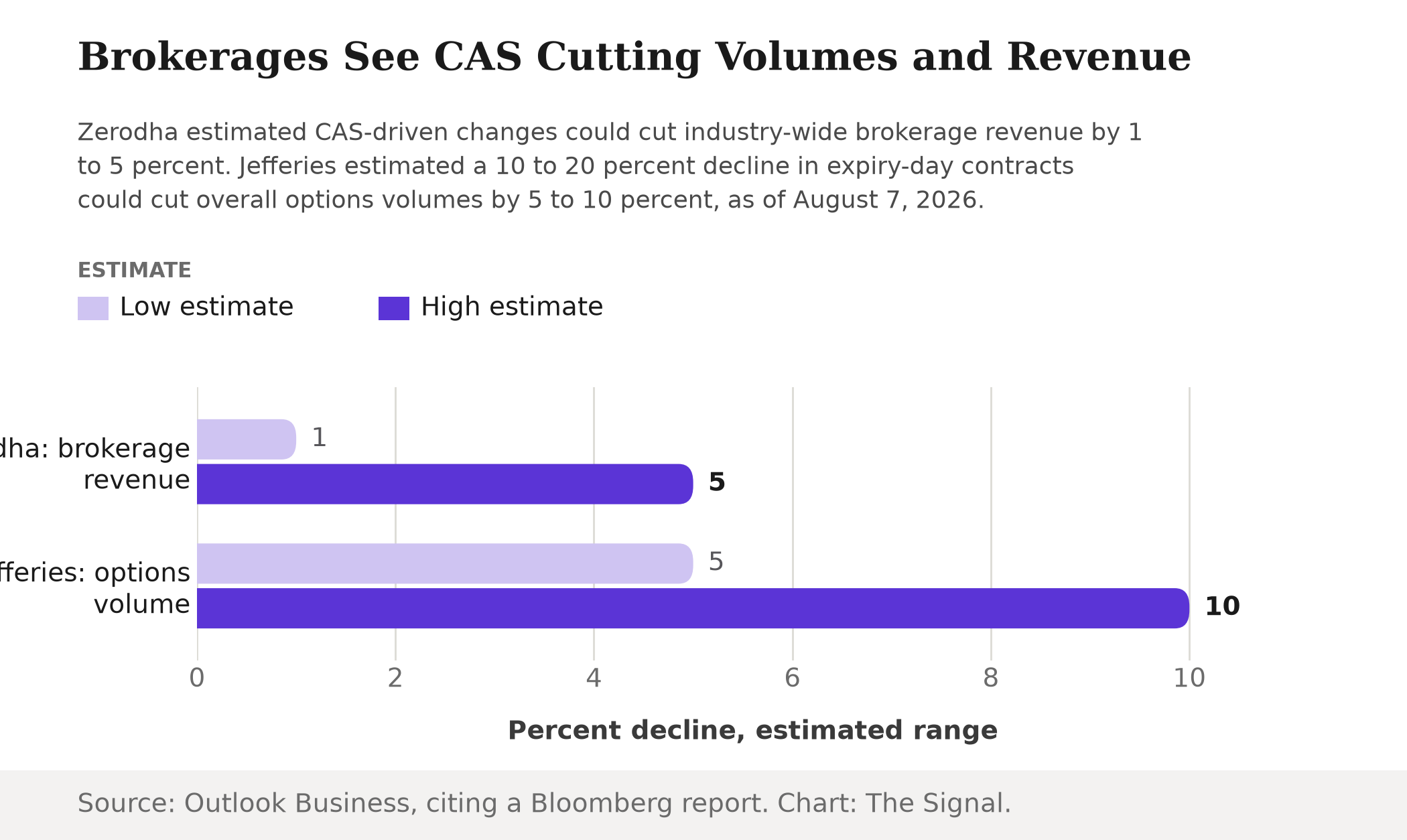
Brokerages are pricing in the same disruption from the other side of the ledger. In estimates reported August 7, 2026, Zerodha projected CAS-driven changes could reduce industry-wide brokerage revenue by 1 to 5%, while Jefferies estimated that a 10 to 20% decline in expiry-day contracts could translate into a 5 to 10% drop in overall options volumes. A reform aimed at cleaning up the close is, in its first week, read by two different constituencies as a threat to their volumes rather than a fix to their prices.
The honest objection
The strongest case for patience comes from SEBI itself. The regulator sees no flaws in the structure or design of the new closing auction and is unlikely to review it immediately, telling market participants it is too early to act while urging brokers to boost retail participation. On this reading, a two-day divergence and a retail boycott campaign are exactly the noise any new market structure produces in its first week: traders adjusting to an unfamiliar window, not evidence the window itself is broken.
That case is real, and it is not actually contradicted by the trade examination that followed it. SEBI's no-design-flaw position and its manipulation check are answers to two different questions: whether CAS's structure is sound, and whether specific trades placed inside that structure on two specific days were legitimate. A regulator can hold both at once without inconsistency. But the sequence still matters. SEBI's confidence in the design was stated on August 5, while the check into whether the design's opening days were exploited was still running as of August 10. A rule can be well designed and still get tested for abuse in its first week, and the second fact does not disappear because the first one is also true.
The Signal
CAS was built to close the exact gap Jane Street was fined for: a closing mechanism wide enough, in time or in method, for a well-resourced trader to move the number that decides who wins on expiry day. Within 48 hours of launch, the replacement had produced the second-widest Nifty-Sensex closing gap in over sixteen years, and the regulator that built it is now checking whether that gap was earned the same way the old one was. Watch two things from here: what SEBI's examination of the August 3 and 4 trades finds, and whether the August 12 boycott call actually dents volume enough to force a redesign before the data does. A closing auction built to make manipulation harder is not proven safe by its design. It is proven safe by what happens when someone tries it.
Reporting basis: the Closing Auction Session's design and effective date are from SEBI's own circular. The Jane Street Group's impounded gains under the prior closing mechanism are from SEBI's July 2025 interim order. The Nifty and Sensex closing figures for August 3 and August 4, 2026 are from Business Standard Research Bureau's analysis of NSE and BSE closing data, across two separate reports. SEBI's ongoing examination of CAS trades is per Outlook Business, citing a Moneycontrol report. The retail boycott campaign is per Business Today's reporting of the social-media campaign. SEBI's public position that the design needs no immediate review is per Reuters, as reported by Business Standard, citing a source with direct knowledge of the matter. The brokerage revenue and options-volume estimates are Zerodha's and Jefferies' own figures, as reported by Outlook Business citing Bloomberg. The percentage-point-to-basis-point conversions and the sixteen-year framing are The Signal's calculations from those figures. The NYSE's 10-minute pre-close window is per the NYSE's own guide to its closing auction. Cboe Europe's 5-minute closing auction call is per Cboe Europe's own auction-timing documentation.