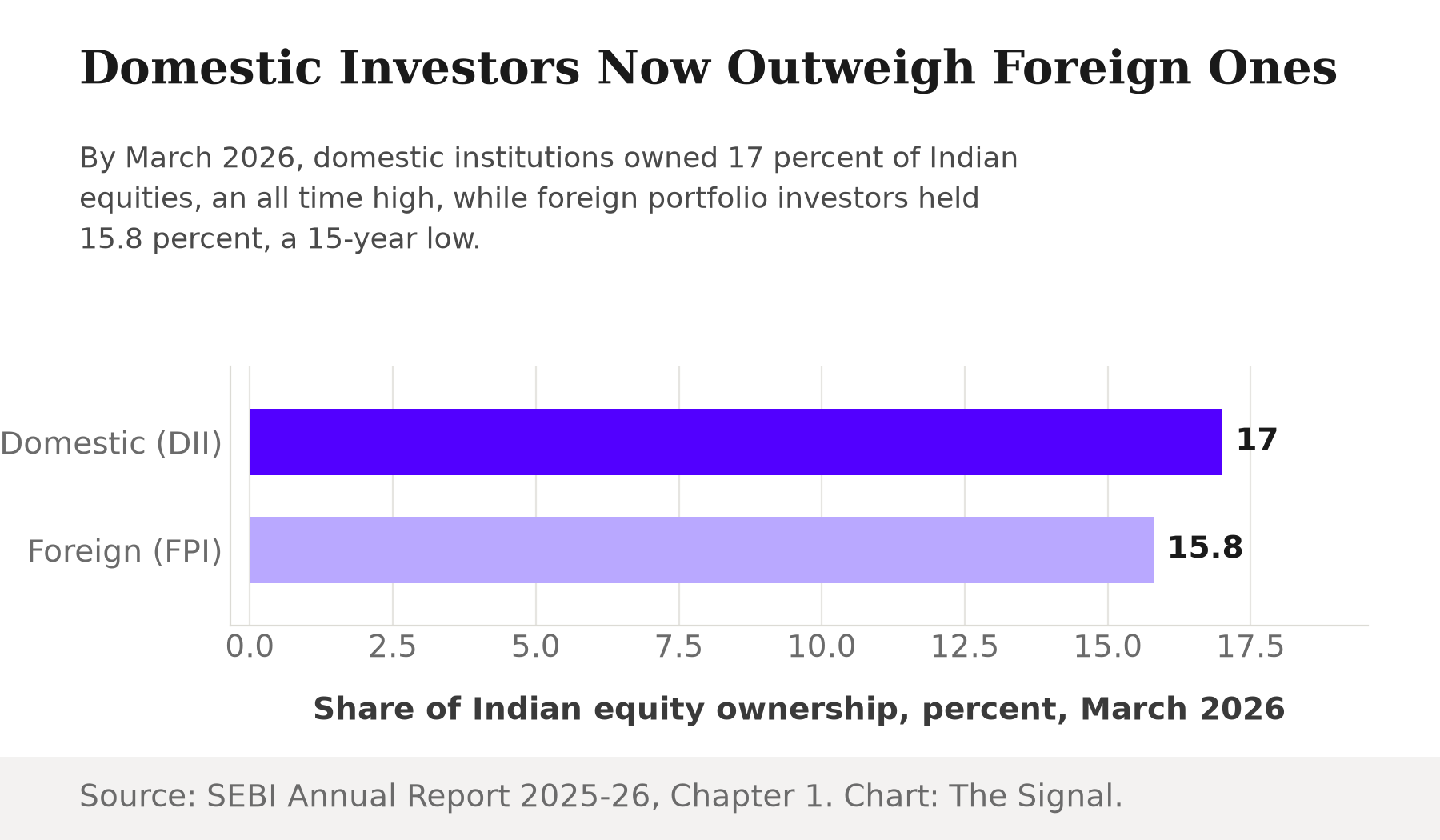
For the year ended March 2026, India's stock market quietly changed owners. DIIs, the banks, insurers, mutual funds, pension money and development financial institutions grouped together as domestic institutions, held an all-time high of 17 percent of Indian equities. Foreign portfolio investors held 15.8 percent, a 15-year low, according to SEBI's Annual Report 2025-26. The obvious read is that India has decoupled: domestic money is now bigger than foreign money in the market that matters most, and the foreign investor who once set the country's stock prices has been dethroned.
Domestic institutions now hold a bigger share of Indian equities than foreign investors do.
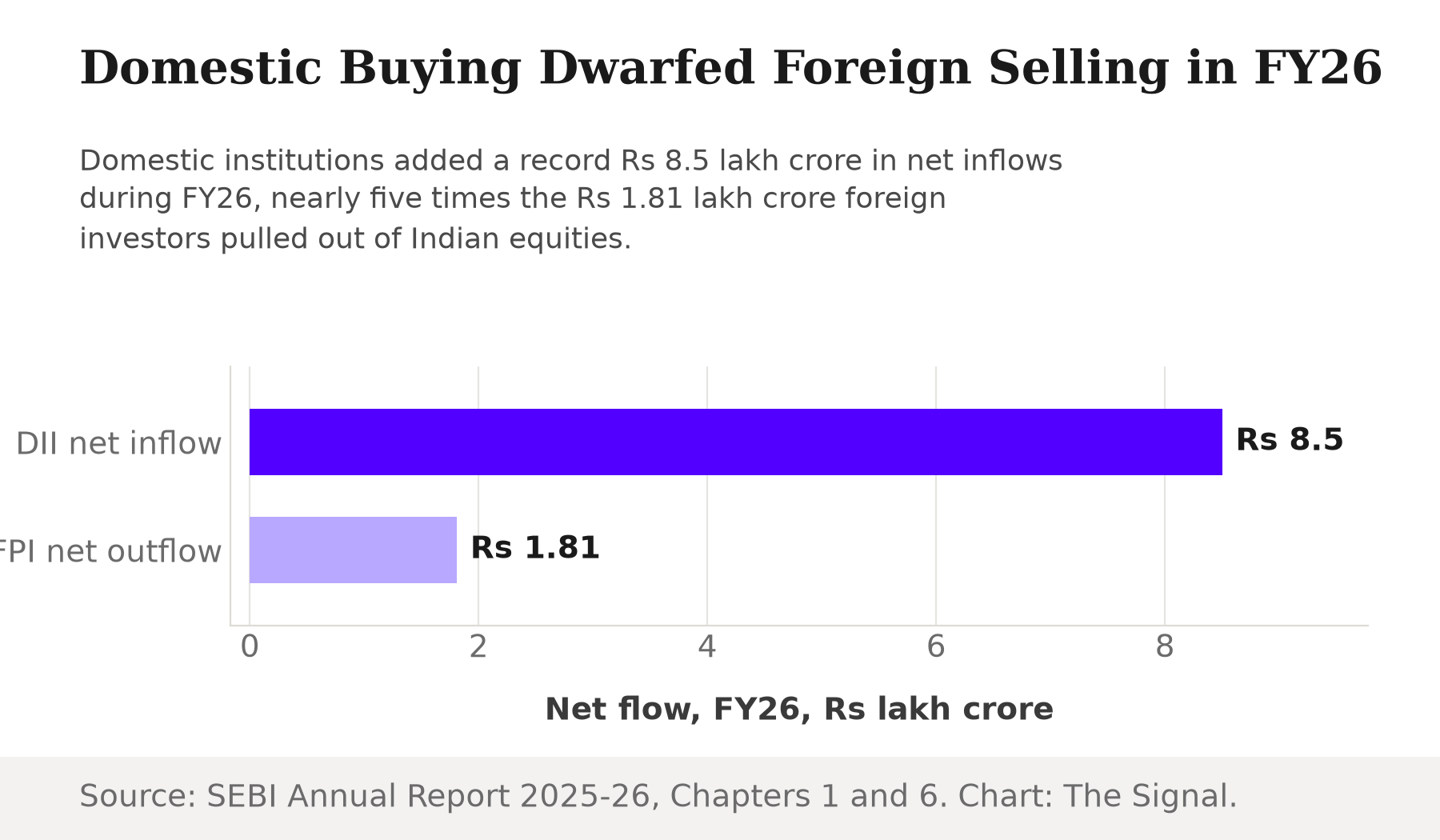
It is worth slowing down on that gap. Seventeen against 15.8 is a lead, not a landslide. What actually did the work this year was not a slow accumulation of ownership. It was the scale of one year's flow. SEBI's report says DIIs absorbed foreign divestments with a record cumulative net inflow of Rs 8.5 lakh crore in FY26, while foreign portfolio investors sold a net Rs 1,80,832 crore of Indian equities over the same year. That outflow was more than 40 percent higher than the year before, and domestic buying ran to nearly five times the foreign selling it was absorbing.
Domestic funds bought about five times what foreign investors sold.
That FPI figure is the equity number specifically. FPIs' total net outflow across all instruments in FY26 was Rs 1,52,692 crore, the highest annual outflow on record, smaller than the equity-only outflow above. The gap between the two, about Rs 28,140 crore, is our calculation from the same chapter. It implies foreign investors were still adding money to Indian debt even as they pulled it out of equities. That is a narrower retreat than "foreign investors are leaving India" suggests. What did leave, decisively, was the appetite for Indian stocks specifically.
The retail engine behind the wall
The money absorbing that selling did not arrive as a few large institutional decisions. It arrived as a habit, repeated by tens of millions of people every month. SIP accounts grew 3.9 percent to 10.45 crore in FY26, and the average net monthly SIP inflow rose 25.8 percent to Rs 16,413 crore. By the end of the year that pace had accelerated further: monthly SIP contributions crossed Rs 0.32 lakh crore for the first time ever in March 2026, at Rs 32,087 crore, while mutual fund industry assets under management rose 12.2 percent year on year to Rs 73.73 lakh crore, a figure AMFI compiles independently of SEBI and which lines up with SEBI's own chapter 5 numbers. March's actual contribution was nearly double the year's monthly average, evidence that the SIP wall was still building, not just holding steady, as FPIs sold into it.
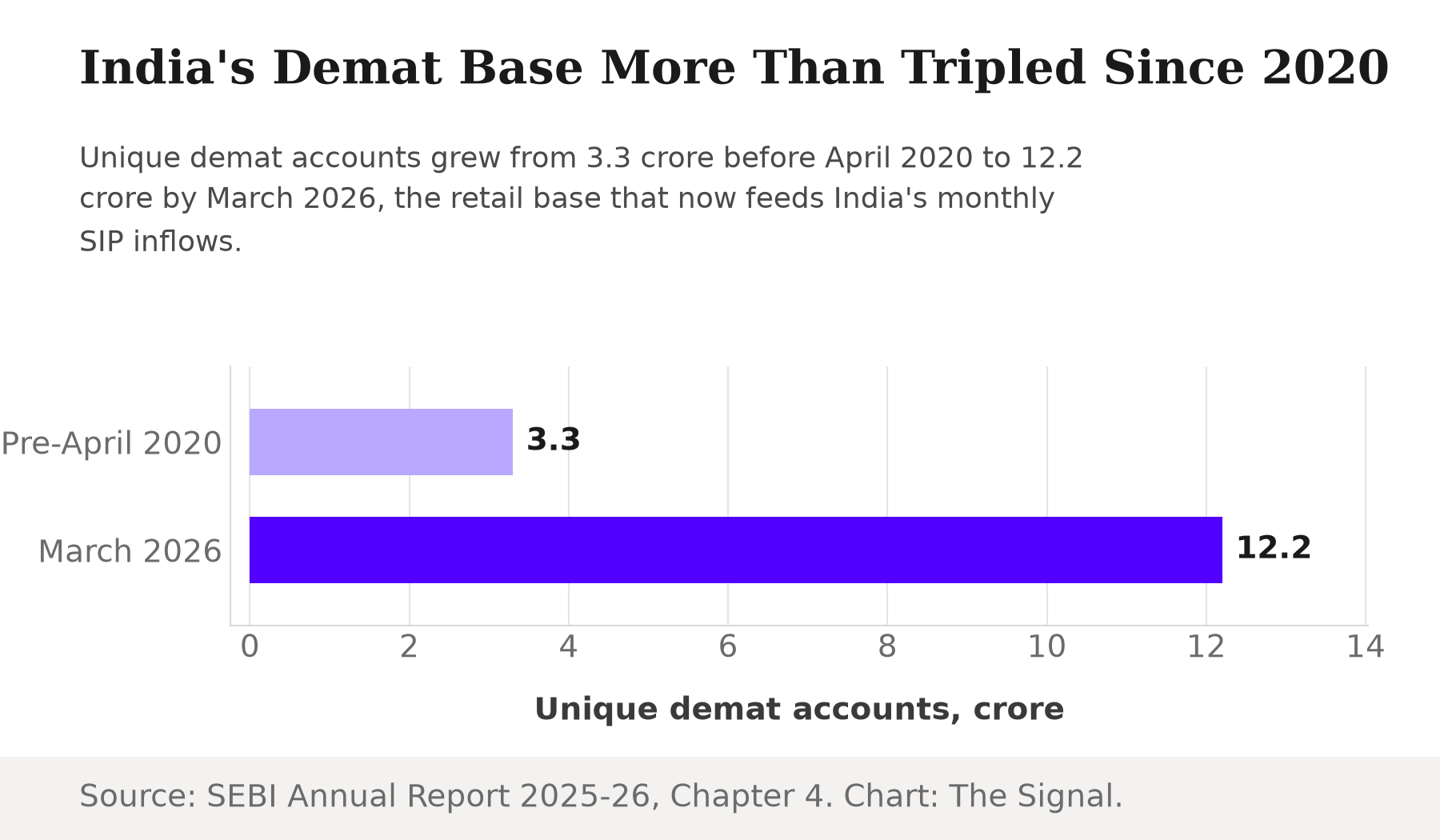
That base did not exist a few years ago. Unique demat accounts, individual investors rather than the accounts they hold, more than tripled to 12.2 crore from 3.3 crore in the period since April 2020, and 18.8 crore of the 22.5 crore total demat accounts open in India as of March 2026, about 84 percent, were opened in that same window. The DII wall that absorbed FY26's foreign selling is largely a post-2020 creation: a retail base that did not exist to buy the last time foreign investors sold this hard.
What record buying could not buy
Here is the part the ownership-crossover headline skips. Despite that wall of domestic buying, the Nifty 50 and broader Indian indices still fell about 14 percent in US dollar terms over FY26. SEBI attributes the decline to several things at once: sustained FPI selling pressure through much of the year, a weakening rupee that ate into dollar returns, valuation concerns, a slowdown in corporate earnings growth, and the shock from the Middle East conflict late in the year. Domestic money was the biggest buyer in the market for the first time on record by these measures, and the market fell anyway.
Currency did more of that work than the headline number suggests. The rupee itself slid roughly 9 percent over the year, the steepest fall among a tracked basket of currencies, weakening from about Rs 85 to Rs 94.8 per US dollar between April 2025 and March 2026. Combine that currency slide with the 14 percent dollar-terms decline and Indian shares were down closer to 6 percent in rupee terms: roughly half of what a dollar-based investor experienced was the rupee weakening, not Indian equity value actually disappearing.
That is the real shift to track, and it is a mechanical one. SIP money is contributed on a fixed date each month by habit, largely independent of that day's price. It is a stabilizing bid, not a valuation-setting one: it shows up whether the market is expensive or cheap, which is exactly why it could absorb five times its own weight in foreign selling without panicking. That same indifference to price means it can cushion volatility but cannot anchor where shares trade once a shock hits. Ownership and price discovery turned out to be two different things this year, and India's institutions now clearly lead the former without yet controlling the latter.
The ownership shift does carry one hard consequence beyond price: governance. Banks, insurers, mutual funds and pension money holding 17 percent of the market, ahead of foreign funds' 15.8 percent, means more of the votes on executive pay, related-party deals and buybacks at India's listed companies now sit with domestic institutions than with foreign ones. That leverage does not show up on a stock ticker, but it changes who a company's board has to listen to first.
The honest objection
The strongest case against reading too much into this is that FY26 was not a clean test. A market cannot demonstrate that domestic ownership insulates it from a shock when the shock in the year ended March 2026 was a bundle of things: a weakening rupee, an earnings slowdown, and a geopolitical event in the Middle East, on top of the FPI selling itself. Attributing the roughly 14 percent dollar-terms decline to "foreign investors still move the market" when three other forces were pulling in the same direction is not a clean read.
That is fair, and it is why this piece does not claim domestic dominance failed. But the objection cuts only so far. SEBI's own explanation names sustained FPI selling as one of the explicit drivers, not a bystander, in the very year DII ownership hit its record share. If domestic money's record buying had been enough to fully offset foreign flows at the margin, that driver would not appear in the official explanation at all. It does. The floor held. The price still moved.
The Signal
India's stock market now has a different owner and the same open question. Domestic institutions, powered by a SIP base that barely existed six years ago, became the market's largest buyers, taking their ownership share to an all-time high, absorbing nearly five times what foreign investors sold in a single year without flinching. That is a genuine structural change, and it hands mutual funds, insurers and pension money real say over how listed companies are run. What it has not yet done is make the market immune to a global risk-off year: Indian equities still fell about 14 percent in dollar terms, with FPI selling explicitly on the list of reasons why. The number to watch from here is not the ownership share. It is what happens to that SIP habit the first time a bad year makes it a hard month to keep the contribution running, because there is no comparably sized buyer left standing behind it if it does.
Reporting basis: the ownership shares, flow totals, SIP, demat, market-performance and rupee figures in this piece are all from SEBI's FY26 annual disclosures for 2025-26, drawn from its chapters on securities market overview, market performance, depository accounts and mutual funds, and its FPI chapter, which is itself sourced from NSDL data. The March 2026 SIP and mutual fund AUM figures are from AMFI's own monthly note, an independent compiler whose numbers corroborate SEBI's chapter 5 figures for the same period. The ratio of domestic inflow to foreign equity outflow, the implied debt-market inflow figure, the share of demat accounts opened since April 2020, and the rupee-terms equity figure (combining SEBI's dollar-terms figure with its rupee depreciation figure) are The Signal's calculations from those figures.