On 22 December 2025, InterGlobe Aviation, the parent of IndiGo, entered the BSE Sensex from the opening bell, taking the place of Tata Motors Passenger Vehicles. The official reason was procedural: TMPV's free-float market value and trading volumes had fallen below the eligibility bar the index applies twice a year, after the company's commercial-vehicle demerger left it too small to keep its seat. Read that way, it is routine index housekeeping: one eligible large-cap swapped for another.
It is worth checking what that swap actually closed out.
Only six of the Sensex's original 1991 constituents are still in the index today.
Twenty-five years after the reforms that opened India's economy, seven of the Sensex's original 30 constituents were still in the index in 2016: Tata Steel, Tata Motors, Reliance Industries, Mahindra & Mahindra, Larsen & Toubro, ITC and Hindustan Unilever, per Business Standard's retrospective marking the anniversary. That count is now out of date. The index's live constituent table for 31 July 2026 lists Reliance Industries, Larsen & Toubro, Hindustan Unilever, Mahindra & Mahindra, ITC and Tata Steel among the 30 names, with Tata Motors absent. Of the seven that made it to the 25-year mark in 2016, only six remained by 31 July 2026 (our calculation, comparing the two lists).
| Company | Sensex constituent, 2016 | Sensex constituent, 31 July 2026 |
|---|---|---|
| Reliance Industries | Yes | Yes |
| Larsen & Toubro | Yes | Yes |
| Hindustan Unilever | Yes | Yes |
| Mahindra & Mahindra | Yes | Yes |
| ITC | Yes | Yes |
| Tata Steel | Yes | Yes |
| Tata Motors | Yes | No |
Source: Business Standard, 2016; Smart-investing.in, 31 July 2026. Compilation: The Signal.
The churn was never a one-off
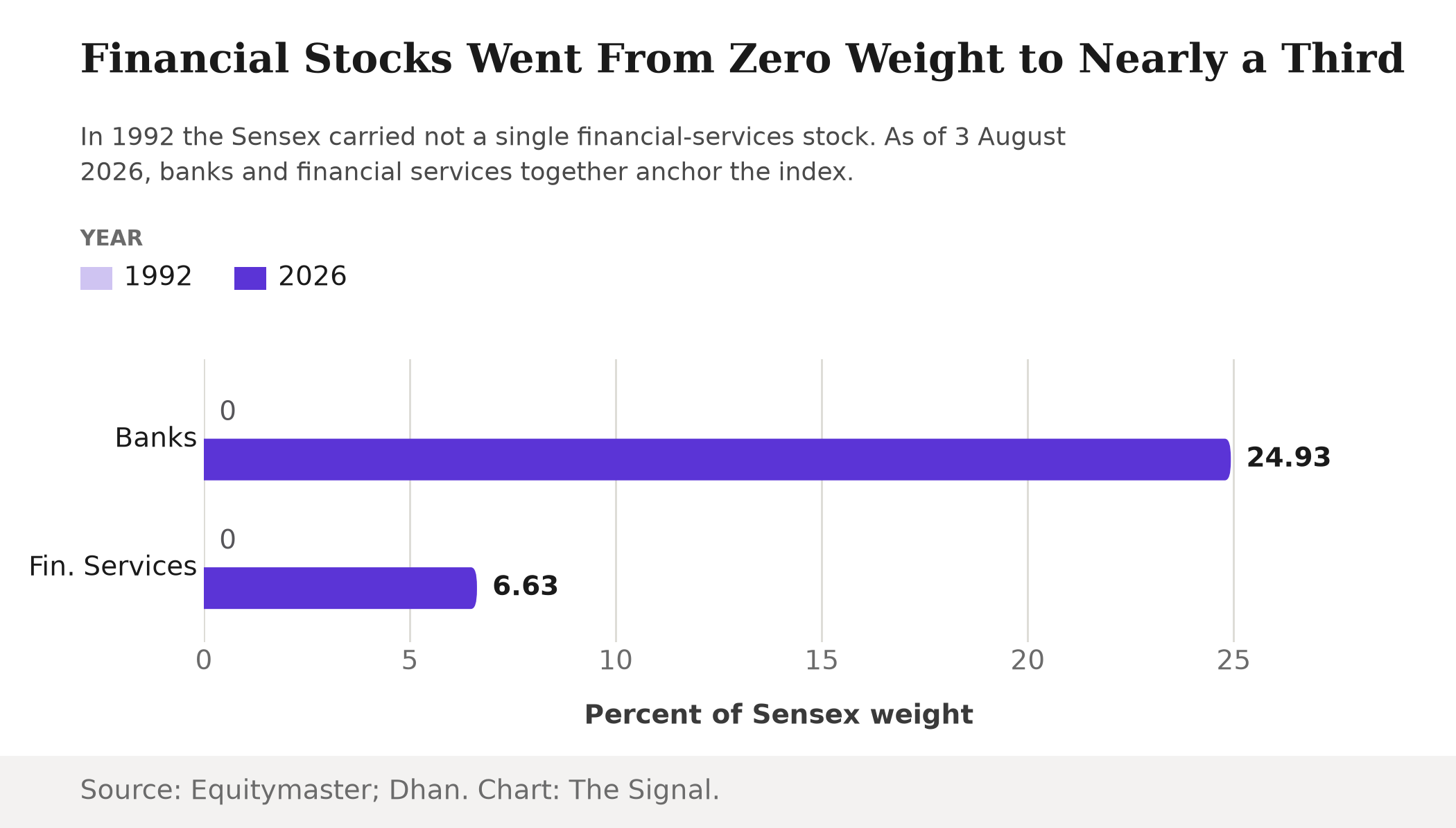
The Tata Motors exit is not an isolated correction. In 1992 the Sensex had not a single financial-services stock among its 30 members, and textiles alone carried the single highest sector weight, at 24%, per Equitymaster's history of the index. By 2016, foreign multinationals in the index had fallen from five to just one, Hindustan Unilever, and the largest constituent's share of the combined market cap of the 30 companies had nearly halved. That multinational count has barely recovered since: marking the index's 40th anniversary, Business Standard found multinationals' representation among the 30 constituents at just two by early 2026, still far below the five that held seats in 1985 and the six of 1990. The reshuffling has names attached to it, too: Power Grid Corporation of India, a state-run transmission utility, took Bharat Heavy Electricals' seat in the Sensex-30 from June 2016, one of many swaps in which an older capital-goods or PSU name gave way to a newer one, long before IndiGo's parent took Tata Motors'. The Sensex has been rewritten, sector by sector, for decades, never the static portrait of Indian industry its listing suggests.
Source: Equitymaster; Dhan. Chart: The Signal.
What has replaced the textile mills and the industrial conglomerates is now unmistakable. As of 3 August 2026, banks alone carry a 24.93% weight in the Sensex and information technology 11.85%, with financial services adding a further 6.63%, together well over a third of the index, per Dhan's live sector-weightage data. The index that once had no way to price a bank now prices little else as heavily.
The real economy moved the same direction
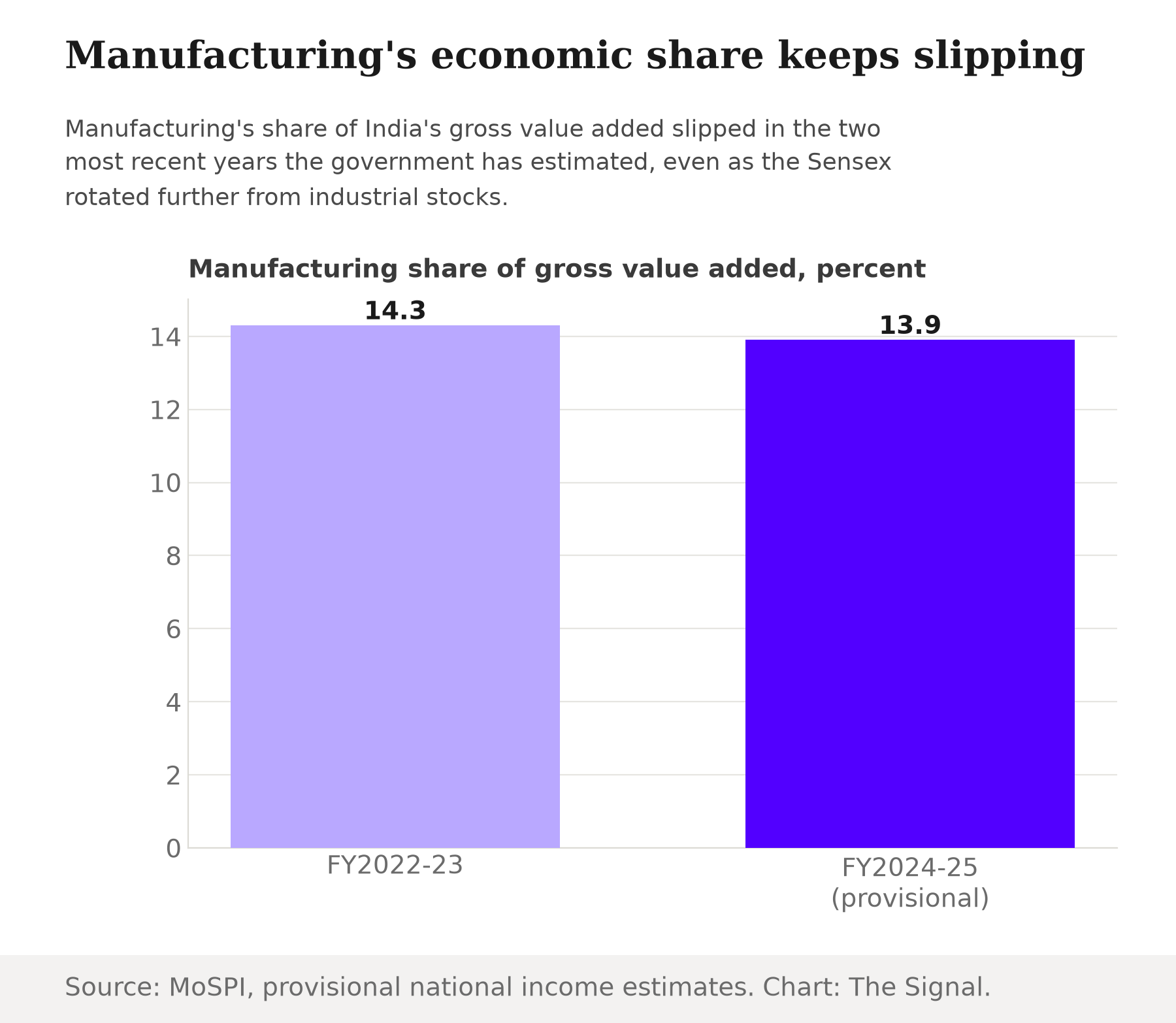
The obvious question is whether this is just an accident of who chooses to list, or whether it tracks something happening off the exchange too. The government's own data point the same way. Manufacturing's share of India's total gross value added slipped from 14.3% in FY2022-23 to 13.9% in FY2024-25 on the latest provisional estimates, per the Ministry of Statistics and Programme Implementation. That is not a large single-year move, but it lines up with a longer pattern. A 2020 peer-reviewed study in Economic and Political Weekly found that manufacturing's share of India's GDP has stagnated rather than risen since liberalisation, with the usual shift of output into industry that economies see as they develop stalled rather than merely delayed.
Source: MoSPI, provisional national income estimates. Chart: The Signal.
Services, meanwhile, kept adding weight on both sides of the ledger. India's software services exports rose 7.3% to $204.7 billion in FY2024-25, from $190.7 billion the year before, according to the Reserve Bank of India's annual survey. An index that carries no financial stocks in 1992 and 11.85% information technology by 2026 is not chasing a trend it invented. It is pricing a shift the national accounts and a central bank survey independently confirm.
The honest objection
The strongest case against reading the index as a mirror of the economy is that stock markets sample who chooses to list, not the full economy. Large parts of manufacturing sit in unlisted, family-owned, or state-run firms that never had a Sensex seat to lose, while banks and IT services floated shares early and grew straight into benchmark weight. On this view, the Sensex's sector mix says more about India's equity-market plumbing than about industrial policy, and the composition shift and the GVA numbers could simply be two separate stories that happen to point the same way.
That case would be stronger if the two data sets disagreed on direction even once. They do not. A single peer-reviewed study finding stagnation could be an outlier; a government statistics office and a central bank publishing consistent, independent numbers in the same direction is a harder coincidence to explain away. The listing-bias argument explains why the index moved further than the economy did, not why both moved the same way for three decades running.
The Signal
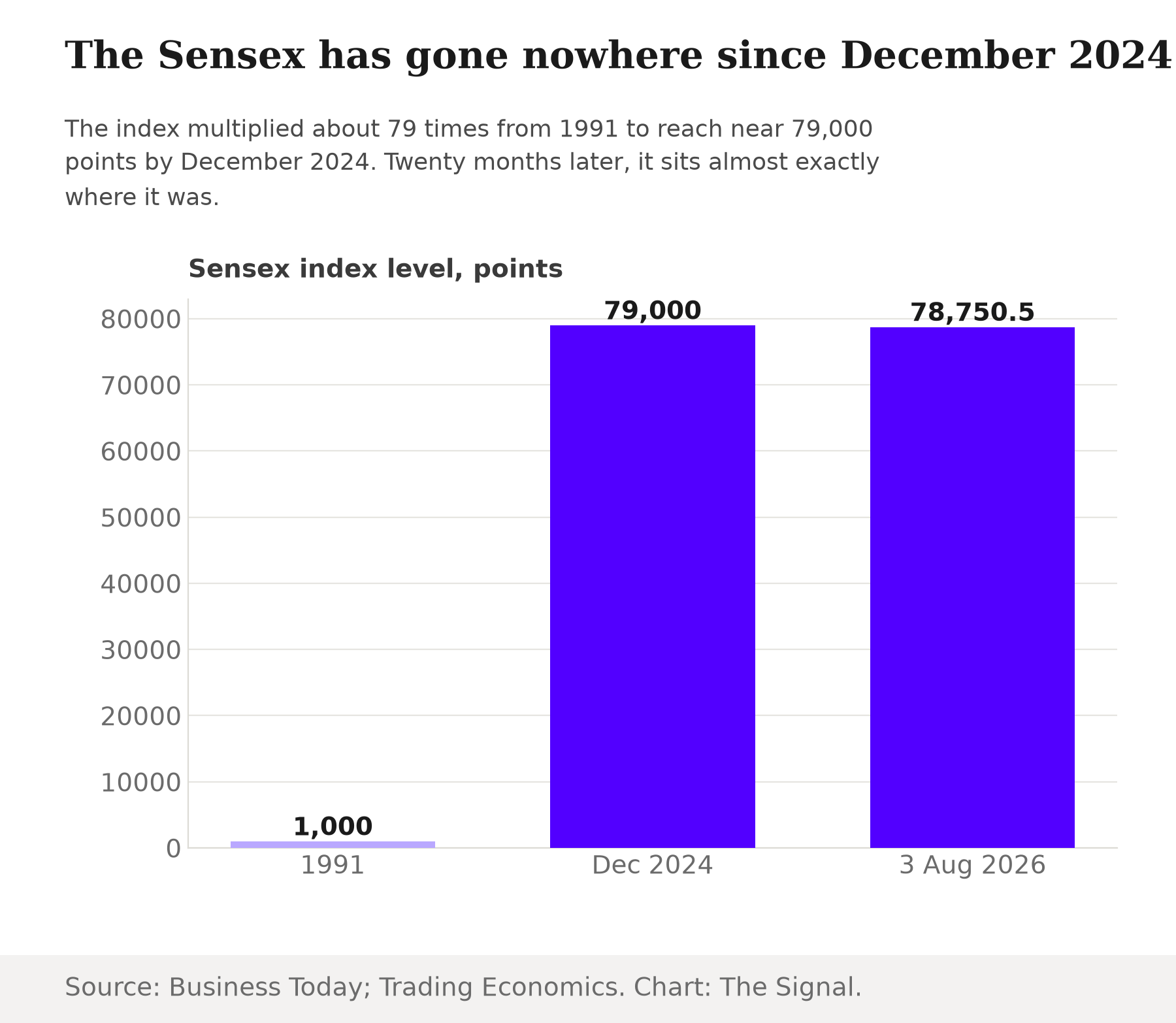
Twenty months after the Sensex first reached close to 79,000 points in December 2024, it stood at 78,750.50 on 3 August 2026, essentially unchanged, even though the index had already multiplied about 79 times from roughly 1,000 points in 1991 to get there. The churn under the surface never stopped. The level on top of it has. That is the split worth watching: a benchmark that keeps trading out its industrial heritage for banks and software, without the reward of a higher number to show for the latest round of it. The next reconstitution will not be news. What it keeps removing will be.
Source: Business Today; Trading Economics. Chart: The Signal.
Reporting basis: the 22 December 2025 IndiGo-for-Tata Motors reconstitution and its stated eligibility rationale are per Outlook Money. The current, 31 July 2026 Sensex constituent list and weights are from Smart-investing.in's live data table. The 2016 lineage of original constituents and the multinational and market-cap-concentration figures for that year are from a single Business Standard retrospective and rest on that one source. The 1992 sector composition is per Equitymaster's history of the BSE 30. Current sector weightings are from Dhan's live sector-weightage data. The 2026 multinational count is from Business Standard's separate Sensex-at-40 retrospective, a different piece from the 2016 one cited above. The Power Grid-for-BHEL swap and its June 2016 effective date are per a contemporaneous Business Standard news report. Manufacturing's share of gross value added is from MoSPI's provisional national income estimates; the finding that this stagnation predates the recent data is from a peer-reviewed 2020 Economic and Political Weekly study, an independent academic source. Software services export figures are from the Reserve Bank of India's annual survey. The index levels for 1991, December 2024 and 3 August 2026 are from Business Today and Trading Economics respectively. The count of six surviving original constituents and the "well over a third" combined financial-sector weight are The Signal's calculations from those figures.