On August 3, 2026, the day this piece is being filed, SEBI's new Closing Auction Session went live in the cash segment for stocks eligible for futures and options trading. SEBI's circular states that CAS runs as its own 20-minute session, from 3:15pm to 3:35pm, on every trading day, and that the framework took effect in the cash segment from August 3, 2026. It replaces a close that had been the volume-weighted average price of the last 30 minutes of ordinary trading. A call auction works differently: it gathers fresh buy and sell orders through its own window and clears the whole order book at one price, rather than averaging trades that already happened. Exchanges that have adopted a similar design elsewhere favor it for a simple reason. A single clearing price computed from a concentrated order book is harder to nudge than a running average built from ordinary trading.
The case for that redesign was made publicly, not just filed procedurally. Zerodha founder Nithin Kamath, explaining CAS's rationale, said concerns had built up that large last-minute orders were being used to push indices toward certain closing levels, and that pooling every order into a single auction makes influencing the close harder. That is the manipulation-resistance argument in one sentence: whatever CAS costs arbitrageurs and passive funds, it is a tradeoff the mechanism was built to make on purpose, not a side effect nobody anticipated.
On that first day, the Nifty 50 closed at 24,774.30, up 390.70 points or 1.60 percent, while the Sensex closed at 78,639, up 544 points but only 0.70 percent. Both indices are dominated by the same handful of large-cap names, and a spread of nearly a full percentage point between their daily moves is a striking way for a rebuilt closing mechanism to introduce itself.
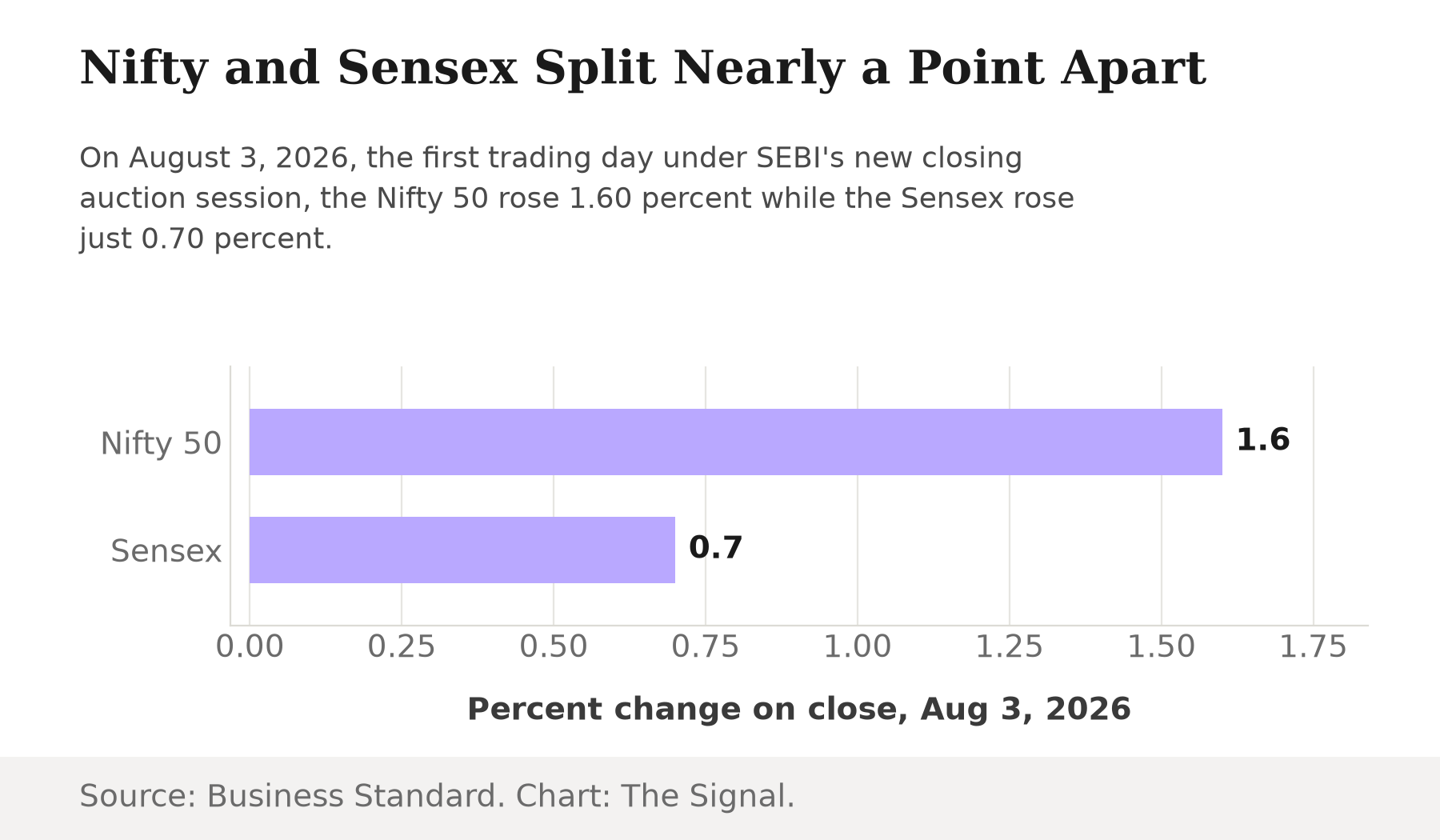
Source: Business Standard. Chart: The Signal.
It is worth pausing on what a single day actually proves. Nifty and Sensex draw on different, if overlapping, constituent lists and different weightings, so some daily gap between their percentage moves is unremarkable by itself. What makes August 3 worth a second look is that the gap showed up on the exact day the mechanism that computes both indices' final print changed, for every F&O-eligible constituent stock, all at once.
The trade the old close was built for
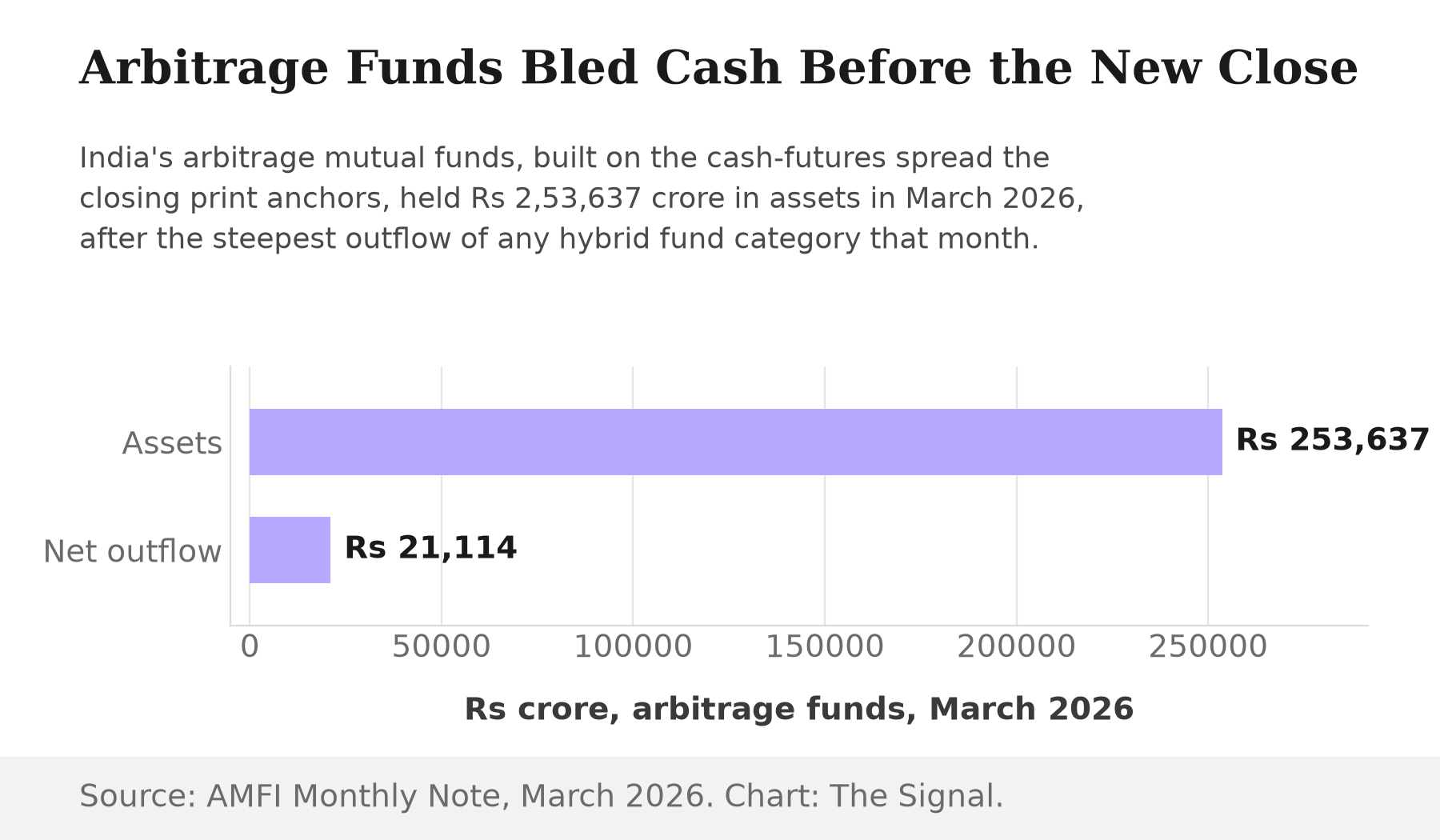
Cash-futures arbitrage is one of the oldest trades in Indian markets: buy a stock in the cash segment, sell the equivalent futures contract, and collect the difference as the futures price converges to the cash price by expiry. The trade's profit, and its unwind, is priced off one specific number, the stock's official closing price. The mutual funds built on exactly that spread, India's arbitrage funds, held Rs 2,53,637 crore in assets in March 2026, down 7.3 percent on the month, and recorded the steepest outflow of any hybrid-fund category that month, Rs 21,114 crore. That was five months before CAS existed. The trade was already shrinking on its own before the mechanism it depends on changed under it.
Source: AMFI Monthly Note, March 2026. Chart: The Signal.
A cash market a fraction of the size of what rides on it
The derivatives complex riding on that closing print trades at roughly 395 times the size of the cash market that sets it.
| Segment | FY25 average daily turnover | FY26 average daily turnover | Change |
|---|---|---|---|
| Cash (NSE + BSE combined) | Rs 1.21 trillion | Rs 1.13 trillion | down 6% year on year |
| Futures & options (combined) | not disclosed in this reporting | Rs 447 trillion | up 4.6% year on year |
Source: Business Standard. The turnover ratio is The Signal's calculation from these figures.
Average daily turnover in the cash segment across NSE and BSE fell 6 percent year on year to Rs 1.13 trillion in FY26, down from Rs 1.21 trillion in FY25, even as combined futures and options turnover rose 4.6 percent to Rs 447 trillion a day: the derivatives leg of the trade runs at roughly 395 times the size of the cash leg whose closing print CAS just rebuilt. That is the imbalance sitting underneath CAS's twenty minutes: a shrinking cash market sets a number that a vastly larger derivatives book has to converge to at every expiry.
The honest objection
The strongest case against reading August 3 as evidence of anything structural is timing. One session is not a trend. Nifty and Sensex have different constituents and different weights, so a gap this size on a single day could just as easily be an outsized move in one heavyweight stock as a mechanism problem, and new market plumbing often settles down once participants adjust to it.
That case would carry more weight if SEBI itself had not already flagged a version of this risk before CAS launched. In its August 2025 consultation paper on the CAS framework, SEBI warned that passive and index funds could end up with negative cash balances after CAS-driven trades on index-rebalancing days, and proposed letting those funds borrow overnight to cover the shortfall. A regulator that pre-builds an overnight-borrowing facility for a mechanism, a year before that mechanism goes live, is telling you it expects real side effects, not first-week noise.
The Signal
CAS was framed as plumbing: a cleaner way to compute one number at the end of the day. What August 3 showed is that the old number was carrying more than the plumbing metaphor suggests. SEBI's own pre-launch planning anticipated mechanical fallout serious enough to warrant an overnight-borrowing fix for passive funds, and on the mechanism's first live day, the two indices that are supposed to track the same market closed nearly a percentage point apart. Arbitrage funds, the trade most directly exposed to the closing print, were already shrinking before any of this began. Now the print they trade against has been rebuilt, underneath a derivatives book running at roughly 395 times the cash market's size. Watch whether the Nifty-Sensex gap narrows back toward its old range over the next several closes, or whether August 3 becomes the new baseline. A closing price is never neutral plumbing. Somebody's trade is priced off exactly where it lands.
Reporting basis: the mechanics and effective date of SEBI's Closing Auction Session are from SEBI's own circular. The stated case for the mechanism (that large last-minute orders were being used to push indices toward certain closing levels) is Zerodha founder Nithin Kamath's public explanation, as reported by Business Standard, not a direct quote from SEBI itself. The Nifty and Sensex closing figures for August 3, 2026, are as reported by Business Standard, and the FY26 cash and derivatives turnover comparison is from a separate Business Standard report. Arbitrage-fund assets and outflows for March 2026 are from AMFI's own Monthly Note, compiled with Crisil Intelligence. SEBI's August 2025 warning about negative cash balances for passive funds, and its overnight-borrowing proposal, are as reported by Business Standard on SEBI's consultation paper, which is the only source for that detail. The turnover ratio between the derivatives and cash segments is The Signal's calculation from those two Business Standard figures.