A decade-old legal overhang on India's largest stock exchange has a price now, and the market is reading it as good news. SEBI, in an email dated July 30, 2026, agreed in principle to accept NSE's settlement terms in the co-location and dark-fibre cases, demanding a further cash payment of Rs 714.74 crore on top of the Rs 776.47 crore NSE had already deposited. Add the two together and the settlement comes to Rs 1,491.21 crore. That is the number that has been hanging over NSE's initial public offering since the case first surfaced, and it is now, in principle, resolved.
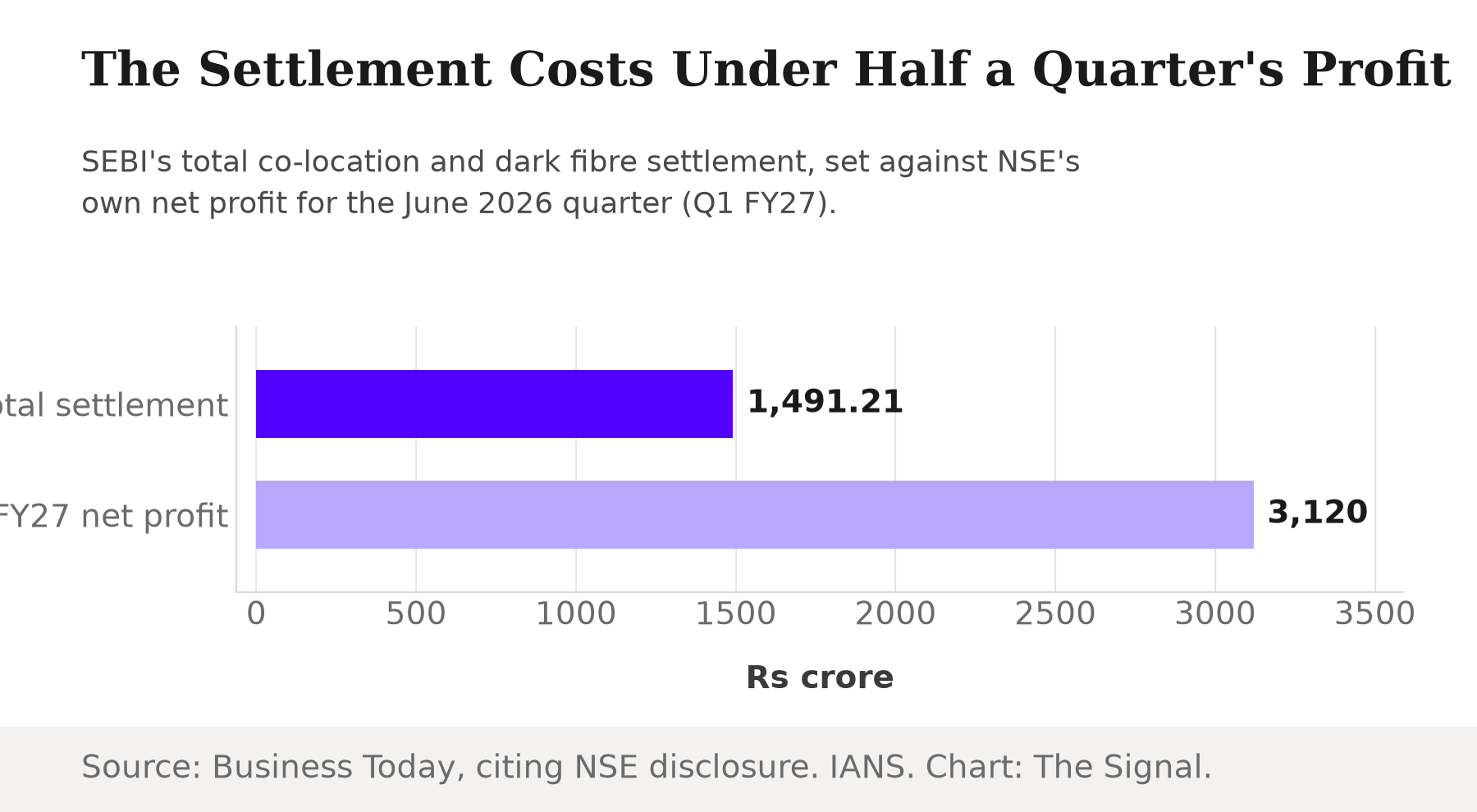
It is worth slowing down on that number before calling it resolved. NSE's consolidated net profit rose 8.7 percent quarter-on-quarter to Rs 3,120 crore in the June 2026 quarter, the same quarter this settlement was struck in. Set the two figures side by side and the entire decade-old case, co-location and dark fibre both, clears for Rs 1,491.21 crore against Rs 3,120 crore of profit: less than half of what the exchange earned in three months.
NSE's Q1 FY27 scorecard, the quarter the settlement landed in
| Metric | This period | Comparison period | Change |
|---|---|---|---|
| Consolidated net profit | Rs 3,120 crore (Q1 FY27) | prior quarter | up 8.7% quarter-on-quarter |
| Consolidated revenue | Rs 4,560 crore (Q1 FY27) | Rs 4,968 crore (Q4 FY26) | down 8.2% sequentially |
| Consolidated net profit | Rs 3,120 crore (Q1 FY27) | Rs 2,924 crore (Q1 FY26) | up 7% year-on-year |
| Consolidated total income | Rs 5,252 crore (Q1 FY27) | prior year | up 9% year-on-year |
Source: IANS; PTI, via HDFC Sky.
NSE's consolidated net profit for the quarter was also up 7 percent year-on-year, from Rs 2,924 crore in the same quarter of the prior year, on consolidated total income of Rs 5,252 crore, up 9 percent year-on-year. Revenue fell sequentially even as profit rose, which is its own story. But the more striking arithmetic sits between the settlement and the earnings line: an exchange that made Rs 3,120 crore in three months is closing out the single largest legal overhang in its history for less than half that sum.
What the settlement actually covers
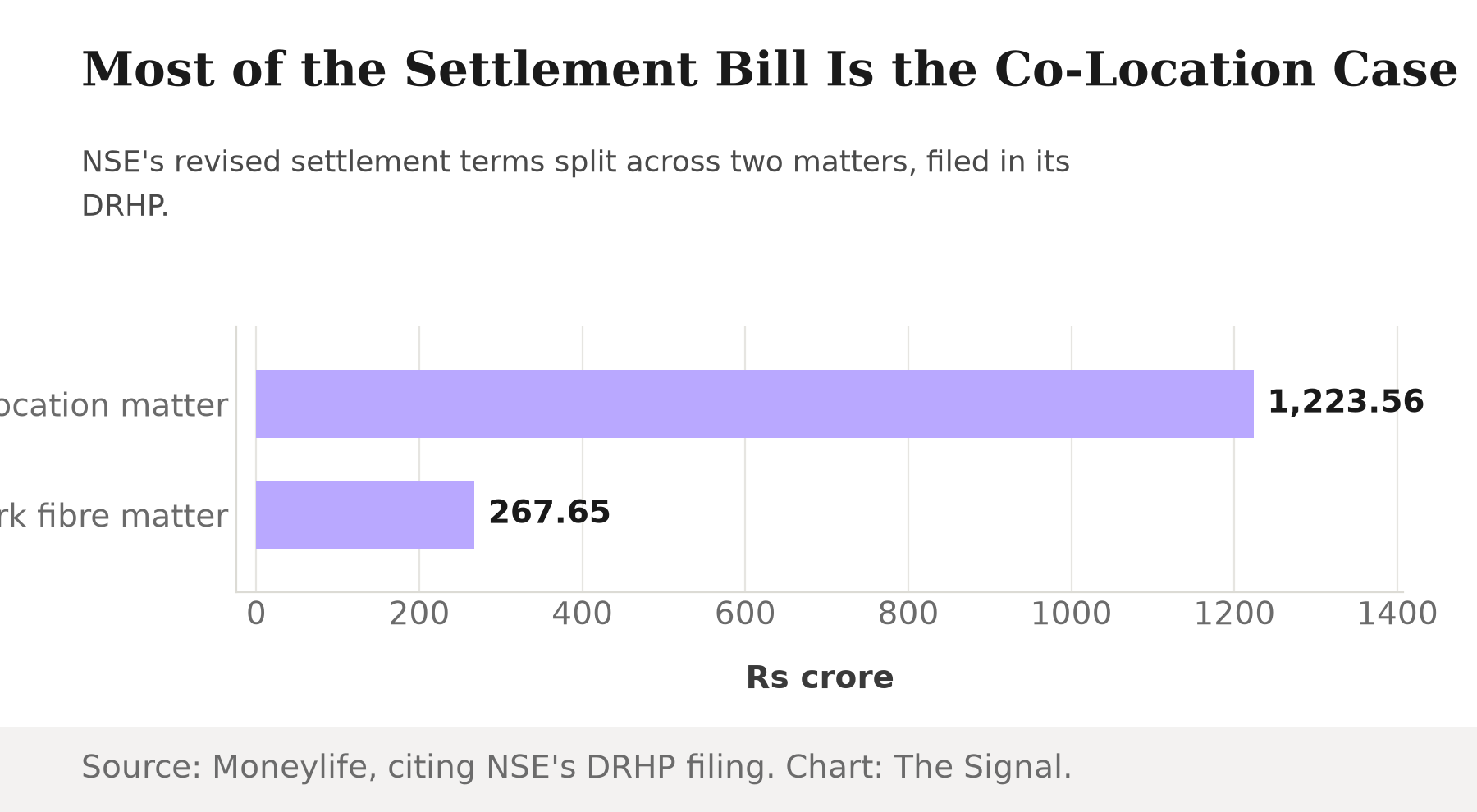
The case was never one dispute. NSE's revised terms allocate Rs 1,223.56 crore to the co-location matter and Rs 267.65 crore to the separate dark-fibre matter, together making up the Rs 1,491.21 crore total. The co-location case, which alleged that some brokers got preferential, faster access to NSE's trading systems for years before regulators intervened, accounts for 82 percent of the bill on its own. The case was first exposed in 2015, when a whistleblower using the pseudonym "Ken Fong" wrote to SEBI and to Moneylife, naming OPG Securities as the broker that profited from preferential, low-latency access to NSE's servers. It has taken more than a decade, and this settlement, to close the file that letter opened.
NSE has recognised a provision of only Rs 1,391.21 crore in its FY25-26 accounts, roughly Rs 100 crore short of the Rs 1,491.21 crore SEBI's July 30, 2026 email now asks for. That gap is small next to the exchange's quarterly earnings, but it is a reminder that even the accounting on this settlement has been catching up to the number, not the other way round.
The IPO the settlement clears the way for
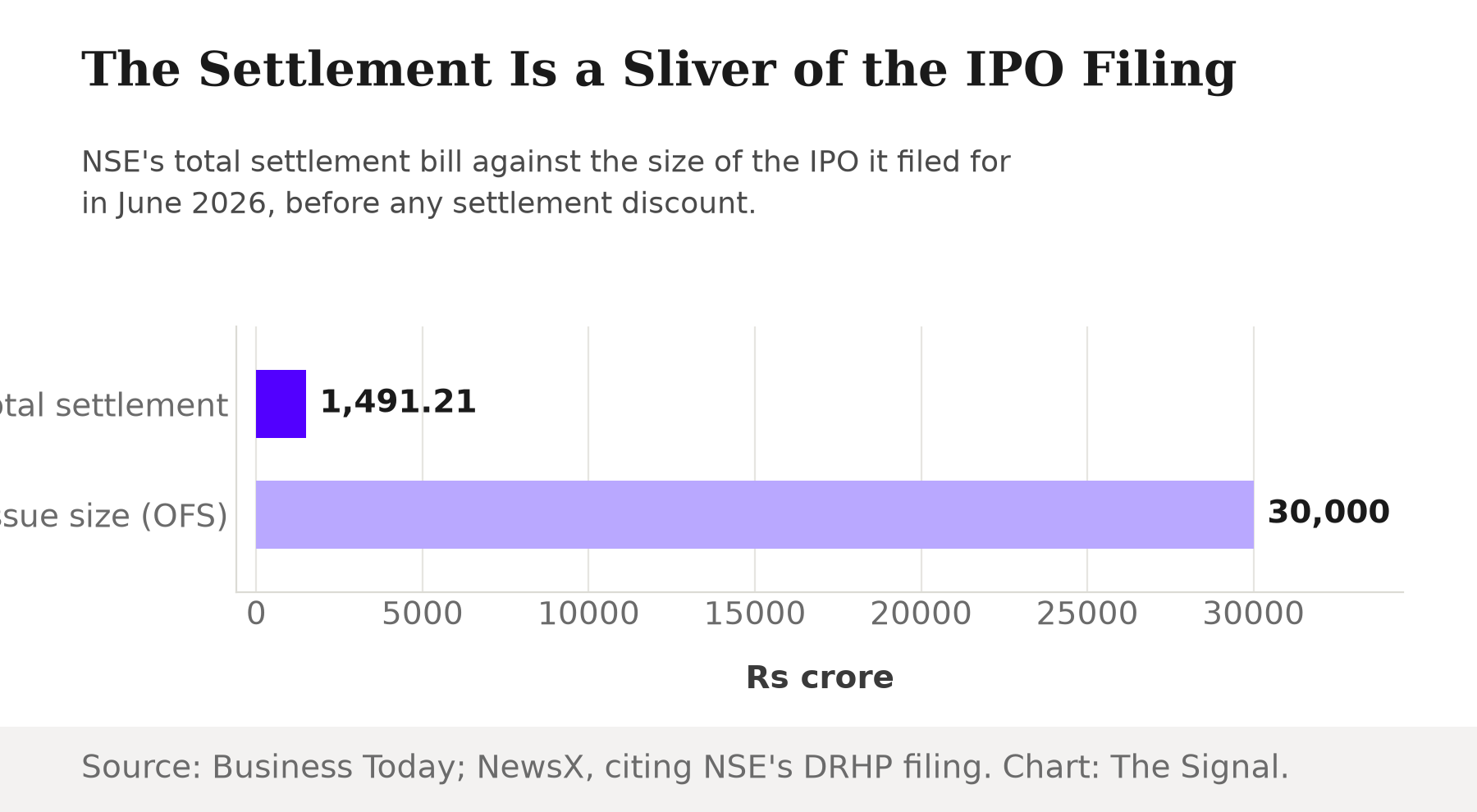
NSE has not been waiting for the settlement to finish its IPO paperwork. NSE filed its Draft Red Herring Prospectus with SEBI on June 17, 2026, structured entirely as an Offer for Sale, sized at roughly Rs 30,000 crore against an implied valuation of more than Rs 5 lakh crore. An Offer for Sale raises no fresh capital for the company; it lets existing shareholders, who have waited years through this exact legal cloud, sell shares to the public instead. Set the settlement against the filing it clears the way for, and the number shrinks further still: Rs 1,491.21 crore is under 5 percent of the Rs 30,000 crore the offer itself is sized at.
The scale of what is being priced explains why. India's total stock market capitalization of listed domestic companies stood at $5.13 trillion in 2024, the most recent year the World Bank has published. The total value of stocks traded in India equaled 89.0 percent of GDP that same year. Both numbers underscore how central exchange trading, dominated by NSE, is to the Indian economy. Those figures are two years old and NSE's own market has likely grown since, but they set the frame: NSE is not a peripheral utility clearing a fine. It is the venue for most of that trading, filing to sell a slice of itself into a market it has effectively defined for decades.
The honest objection
The strongest case against reading this as cheap is that removing legal uncertainty before an IPO is simply sound governance, not evidence the settlement route is a bargain. A pending co-location and dark-fibre case, unresolved, would have sat as a disclosed contingent liability in the DRHP, unsettled the valuation conversation with anchor investors, and given short-sellers a live story to point to on listing day. Paying to make that risk disappear, on this view, is what any well-run company preparing to go public would do, regardless of the size of the check relative to a single quarter's profit.
That case is real, and it likely describes NSE's own reasoning well. But it does not change what the settlement's price tag signals to everyone watching who is not NSE. A penalty smaller than NSE's Rs 3,120 crore quarterly profit is not calibrated to deter the underlying conduct; it is calibrated to make the conduct's legal tail disappear before a listing. Whether that was the regulator's intent or simply how the settlement math worked out here, sound governance for NSE and a light deterrent for the market are not mutually exclusive. Both can be true, and the second one is the part that outlasts this IPO.
The Signal
The co-location case was, at its core, about who got to be faster than everyone else on NSE's own exchange. So was the dark-fibre case, just through different infrastructure. NSE is now closing both out for a sum smaller than its own quarterly profit, on the way to selling shares through an Offer for Sale that raises it no new capital. It is selling to the very public that the alleged speed advantage was taken from. If the IPO prices anywhere near the more than Rs 5 lakh crore valuation in its DRHP, the settlement will look, in hindsight, like the cheapest step in the entire listing process. Watch what SEBI does with the next exchange or broker settlement that reaches this stage. If the arithmetic runs the same way again, that would be evidence of a pattern that had already started here.
Reporting basis: the SEBI settlement terms and NSE's July 30, 2026 disclosure are per Business Today's reporting on the company's own filing; the co-location and dark-fibre split, and NSE's provisioning, are per Moneylife's reporting on NSE's DRHP disclosure; the 2015 whistleblower origin and the broker named in it are per Moneylife's own contemporaneous reporting. Q1 FY27 quarter-on-quarter results are per IANS's reporting on NSE's quarterly filing; year-on-year results are per PTI's reporting, as carried by HDFC Sky. The DRHP filing date, Offer for Sale structure, issue size and implied valuation are per NewsX's reporting on the filing. India's market capitalization and traded-value figures are World Bank compilations for 2024, the most recent year published. The settlement's share of the quarter's profit and of the IPO issue size are The Signal's calculations from those figures.